시조 및 본관의 유래: 무송은 전라북도 고창군 무장면에 두었던 통일신라 때의 행정구역명으로, 본래 백제의 송미지현 인데, 통일신라의 경덕왕 때 무송현으로 개명하였으며, 1417 년(태종 17) 장사현과, 합하여 무장현이라고 일컫다가 몇 차례의 변천을 거쳐 고창군에 편입되었다. 무송윤씨의 선대는 계대가 실전되어 미상하다가 고려 예종 때 윤양비가 보승낭장에 올라 무장 현호장을 역임하게 되자 양비를 시조로 하고 무송을 관향으로 하여 계대하고 있다.
가문을 빛낸 대표적인 인물로는 양비의 증손인 문정공 택이 충숙왕때 문과에 급제한 후 정당문학과 첨의찬성사를 역임하였으며, 택의 손자 소종은 이 색의 문인으로 공민왕 때 문과에 장원한 뒤 조선에서 병조 전서를 지낼 때 「고려사」의 편찬에 참여하였으며 회군삼등공신에 올랐고 수문전 학사 동지춘추관사 등을 겸직했다. 또한 성리학과 경사에 밝고 문명이 있었다. 소종의 아들인 회는 태종 때 문과에 급제한 후 세종 때 맹사성 신 장과 함께 「팔도지리지』를 편찬하였으며 병조 판서와 대제학을 역임하였다. 특히 술을 좋아하여 주호로 이름이 났었다. 회의 손자 자운은 병조와 형조의 판서를 역임했으며, 우의정을 걸쳐 성종 때 영의정을 지내고 무송부원군에 봉해졌다. 또한 자운의 5 세손 형은 선조 때 종계변무의 공으로 광국이등공신에 책록되어 호조판서와 판중추부사에 이르렀고 임진왜란 때 왕을 호종한 공으로 보국숭록대부에 올랐다. 이외에도 근대에 와서 독립운동에 앞장선 세복 세주 호 등이 무송 윤씨의 가문을 빛냈다.
1985 년 경제기획원 인구조사 결과에 의하면 무송 윤씨는 남한에 총 2,470 가구, 10,320 명이 살고 있는 것으로 나타났다.
모계: 한양 조씨
한양조씨의 시조 조지수는 덕원부 용진현에 세거해온 사족의 후예로 고려조에 첨의중서사를 지냈다. 그 후 후손들은 조선이 개국하자 한성으로 이거하여 가세가 크게 번창하였고, 많은 명신과 훈신 유현을 배출하였으므로 본관을 한양으로 하여 세계를 이어 왔다. 그러나 한양 조씨는 지수의 후손에서 판도판서를 지낸 인재의 계통과 총관을 지낸 휘의 계통으로 대별되어, 서로 계대를 다르게 하며 보도 따로 만들고 있다. 가문을 빛낸 인물로는 휘의 아들 양기가 1281 년(충렬왕 기) 부원수가 되어 일본정벌에 참가했고 21 세 때 합단의 침입을 대파한 공으로 원나라 세조로부터 금포와 옥대를 하사받았다.
양기의 아들 돈은 1356 년(공민왕 5) 쌍성수복 작전 때 공을 세워 예빈경이 되고 이듬해 평양에 침입한 홍건적을 대파한 후 판사농시사 밀직부사에 오르고 1375 년(우왕 1) 삼중대광으로 용성군으로 봉해졌다. 돈은 아들 4 형제를 두었는데 모두 벼슬에 올라 가문을 빛냈다. 그 중 맏아들 인벽은 동북면 원수로 왜구를 토벌하였고 정화공주와 결혼하여 이성계의 매부가 되었으며 용원부원군에 봉해졌다. 또한 판도판서 인재의 증손이자 판서 세진의 아들인 영무는 조선조에 개국삼등공신으로 자헌대부에 올라 한산군에 봉해졌으며 1405 년(태종 5) 우의정에 오르고 이듬해 판이병조사를 겸임한 후 한산부원군에 진봉되어 태종의 극진한 총애를 받았다.
조선조에 와서 한양 조씨의 가문을 더욱 빛낸 사림파의 영수 광조는 개국공신 온의 현손으로 14 세 때 어천도 찰방으로 부임하는 아버지 원강을 따라가 희천에 유배중인 김공필에게 글을 배웠다. 그는 성리학 연구에 힘썼으며 유교로써 정치와 교화의 근본을 삼아 왕도정치를 실현해야 한다는 지치주의를 역설했다. 중종 때 대사헌에 있으면서 신진사류인 30 대의 소장학자들을 요직에 안배하는 한편, 훈구파를 외직으로 몰아내는 등 과격한 개혁을 단행하여 마침내 훈구파의 반발을 야기시켜 남 곤·심 정 등이 주동한 기묘사화에 피화되어 능주에 유배, 배소에서 죽음을 당했다. 율곡 이 이는 김광필 조광조·정여창 이언적을 가리켜 <동방사현>이라 칭송하며 평생토록 숭배하였다 한다. 그 밖의 인물로는 중종 때 대사간 형조 판서 등을 지내고 청백리에 녹선된 위한과 그의 동생으로 시문에 능한 찬한이 유명했다. 공근은 선조 때 무과에 급제하여 위성공신에 오르고 한흥군에 봉해졌으며, 인조 때 동지중추부사를 역임하였고, 대제학을 거쳐 이조판서를 지낸 경은 청백리에 녹선되어 기로소에 들어갔으며 글씨에도 뛰어나 당대에 명성을 떨쳤다. 장령 중여의 아들 종전는 사학·천문·산수 의학에까지 박통하여 문명을 날렸으며, 충정공 인옥의 아들 뇌는 예조 참판을 지내고 효행으로 이름을 날렸다. 또한 계유정난 때 안평대군 일파로 몰려 아들과 함께 죽음을 당한 순생과 그의 아들 명, 시인 수삼, 화가로 이름난 중묵 등이 유명했는데, 수삼은 현종 때 문장과 시로써 여섯 차례나 중국을 왕래하여 명성이 높았으며, 서예와 중국어에도 능통했다 그의 손자 중묵은 특히 초상화를 잘 그렸으며 희원 이한철과 더불어 조선 말기의 대표적인 화가로 알려졌다. 이렇게 조선조에서 세도를 떨친 한양 조씨는 근대에 와서도 많은 인물들이 배출되어 나라와 가문을 위해 공헌했다. 독립투사인 맹선은 을사보호조약이 체결되자 매국칠적을 죽이려는 뜻을 이루지 못하고 평양에서 의병을 일으켜 항전했고 독립단을 조직하여 군사훈련에 힘써 많은 독립투사를 배출했다. 인원의 아들인 병옥은 대학생으로 한인회 흥사단 등에 가입하여 독립운동에 참여했으며 해방이 되자 한국민주당을 창당하여 경무부장으로 치안유지에 힘썼다. 그 후 반독재 투쟁에 앞장섰으며, 1955 년 민주국민당이 민주당으로 개편될 때 최고위원이 되어 야당을 영도했으며, 대통령에 입후보하였으나 신병으로 미국 육군병원에서 영면하였다. 저서로「민주주의와 나」「나의 회고록」 등이 있으며 1962 년 대한민국 건국공로훈장 단장이 수여되었다. 청록파 시인으로 널리 알려진 지훈 도 해방 후부터 6•25 를 거쳐 현대에 이르기까지 한국문단의 선구자로 민족적 정서운동에 앞장섰으며, 종신토록 대학교단에서 문학을 피력하였고, 사회활동에 이바지함이 지대하여 후에 그를 기리는 시비가 세워졌다. 이 밖에도 많은 유명인사를 배출시킨 한양 조씨는 선현의 유지에 맥을 더하고 있다.
1985 년 경제기획원 인구조사 결과에 의하면 한양 조씨는 남한에 총 64,881 가구, 273,408 명이 살고 있는 것으로 나타났다.
Origin and history of the clan: Musong was the administrative district under the Unified Silla Dynasty, located in present-day Mujang-myeon, Gochang-gun, Jeollabuk-do. Originally, this area was called Songmijihyeon during Baekje. During the reign of King Gyeongdeok of Unified Silla, it was renamed Musong-hyeon, and in 1417 (the 17th year of King Taejong’s reign), it was merged with Jangsa-hyeon and renamed Mujang-hyeon, eventually becoming part of Gochang-gun after several administrative changes.
The early lineage of the Musong Yun clan is unknown due to missing records. However, during the reign of King Yejong of Goryeo, Yun Yang-bi attained the position of Boseung Nangjang and became the Hojang (local chief) of Mujang-hyeon. Hence, Yun Yang-bi became the clan’s founder, and Musong was adopted as the clan’s ancestral seat.
Prominent figures from the Musong Yun clan: Yun Yang-bi’s great-grandson, Munjeonggong Taek, passed the civil service examination during King Chungsuk’s reign and served as Jeongdang Munhak and Chameuichanseongsa. Taek’s grandson, Sojong, was a disciple of Yi Saek and topped the civil service examination during King Gongmin’s reign. He participated in the compilation of Goryeosa, was a third-rank meritorious retainer, and also served as a scholar of Sumunjeon and Dongji Chun-chugwan. Sojong’s son, Hoe, passed the civil service exam during King Taejong’s reign and co-authored Paldo Jiriji with Maeng Saseong and Shin Jang during King Sejong’s reign. He also served as Minister of War and Daejehak and was well-known for his love of alcohol. Hoe’s grandson, Ja-un, served as Minister of War and Justice and became Yeonguijeong under King Seongjong’s reign, receiving the title of Musong Buwon-gun. Additionally, Ja-un’s fifth-generation descendant, Hyeong, was honored as a second-rank meritorious subject (Gwangguk Ideung Gongsin) under King Seonjo for his role in resolving royal genealogy disputes, served as Minister of Finance and Chancellor, and was appointed Boguk Sungrok Daebu for his role in protecting the king during the Imjin War. In modern times, independence activists such as Sebok and Seju have also upheld the honor of the Musong Yun clan.
According to the 1985 Economic Planning Agency census, there were 2,470 Musong Yun clan households in South Korea, totaling 10,320 members.
Maternal lineage: Hanyang Jo clan
Founder: Jo Ji-su
Origin and history of the clan: Jo Ji-su, the founder of the Hanyang Jo clan, was a nobleman from Yongjin-hyeon in Deokwon-bu during the Goryeo Dynasty and served as Chameui Jungsa. After the founding of the Joseon Dynasty, his descendants moved to Hanseong (Seoul), where they flourished and produced many famous officials and scholars. Henceforth, they took Hanyang as their ancestral seat.
The Hanyang Jo clan branched into two main lineages: one descended from the lineage of Jo Ji-su, who held the office of Pandopanseo, and another descended from Hui, who held the position of Chong-gwan. Each branch created its own separate genealogy.
Prominent figures from the Hanyang Jo clan: Hui’s son, Yang-gi, became a vice commander in 1281 (during the reign of King Chungnyeol), fought against the Khitan invasions, and received gold cloth and a jade belt as gifts from Emperor Shizu of the Yuan dynasty. Yang-gi’s son, Don, contributed to reclaiming the Ssangsong region in 1356 under King Gongmin’s reign and, the following year, played a key role in defeating the Red Turbans who had invaded Pyeongyang. He served as Miljik Busa and was ennobled as Yongseong-gun in 1375 under King U. Don’s four sons all held office and upheld the family’s prominence. His eldest son, In-byeok, became a commander of the northeastern region, suppressing Japanese pirates, married Princess Jeonghwa, and was ennobled as Yongwon Buwon-gun as brother-in-law to Yi Seong-gye. Young-mu, a great-grandson of Pandopan-seo In-jae and son of Pandopan-seo Se-jin, was honored as a third-rank meritorious subject upon the founding of Joseon and appointed to Jaheon Daebu and Hanseong-gun. In 1405 (the 5th year of King Taejong), he became Uijeong, then concurrently served as Minister of War, and was ennobled as Hanseong Buwon-gun, earning the king’s close favor.
Prominent Confucian scholars and political figures: One of the most renowned figures was Jo Gwang-jo, a leader of the Sarim faction during King Jungjong’s reign and a fourth-generation descendant of On-ui, a meritorious subject at the founding of Joseon. Jo Gwang-jo studied under Kim Gong-pil in exile in Huichon and devoted himself to Confucian principles. He emphasized Confucian statecraft and led reforms to advance Confucian ideals and place capable young scholars in key offices. However, this triggered opposition from the entrenched Hungu faction, leading to the infamous Gi-myosa purge orchestrated by Nam Gon and Shim Jeong, during which Jo Gwang-jo was exiled to Neungju and subsequently died. Revered as one of the “Four Confucian Sages of the East,” Jo Gwang-jo was greatly respected by Yi I (Yulgok) and other Neo-Confucian scholars. Additionally, Jo Gwang-jo’s relatives included figures like Ui-han, a Daesagan and Minister of Justice who was revered as one of the “Cheongbaekri” (upright officials). Gyeong-eun, who excelled in calligraphy and served as Minister of Personnel, was also recognized as Cheongbaekri. Jong-jeon, son of Jangryeong, was well-versed in history, astronomy, mathematics, medicine, and literature. Nok, son of Chungjeonggong In-ok, became a vice-minister of Rites and was known for his filial piety. Su-sam, a renowned poet and envoy to Ming six times, also excelled at calligraphy and Chinese language, and his grandson Jung-muk was one of the most celebrated portraitists of the late Joseon period alongside Yi Han-cheol.
Modern contributions of the clan: During the modern period, Jo Maeng-seon attempted to assassinate the “five traitors” after the signing of the Eulsa Treaty. Failing in this mission, he led an army from Pyongyang and fought against Japanese forces, then founded the Independence Corps to train independence fighters. His son, Byung-ok, was a student-activist who joined the Korean Students’ Association and the Young Korean Academy. After Korea’s liberation, he founded the Korean Democratic Party and served as Chief of Police. Later, he became a leader of the opposition Democratic Party and ran for president, but passed away in a U.S. Army hospital. Among his works are Democracy and Me and My Memoirs, for which he was awarded the Order of Merit for National Foundation in 1962. Renowned poet Jo Ji-hun was a prominent member of the Cheongrok literary group and champion of Korean national sentiment in literature after liberation. Throughout his career as a professor, he greatly influenced Korean letters and public life, with a memorial stele later erected in his honor.
According to the 1985 Economic Planning Agency census, the Hanyang Jo clan numbered 64,881 households and 273,408 people in South Korea.
My wife’s Ancestral Seat and historical background of her clan :
The Jeonju Choi clan (전주 최씨) is a Korean clan with its ancestral seat (본관) in Jeonju, located in present-day Jeollabuk-do, South Korea.
Origin and History:
The Jeonju Choi clan traces its origins back to Choi Sun (최 순), who is considered the founding ancestor. Jeonju, historically an important center of the Baekje Kingdom and later a royal city during the Joseon Dynasty, became the clan’s ancestral seat.
The Jeonju Choi clan is one of the prominent Korean clans bearing the Choi surname. Over generations, its members have produced distinguished scholars, military officers, and public officials. Throughout the Goryeo and Joseon Dynasties, members of the Jeonju Choi clan played significant roles in national affairs, administration, and Confucian scholarship.
Legacy:
As a clan with a long lineage, the Jeonju Choi clan honors its ancestry through periodic gatherings, commemorative rituals, and the study of genealogy. Today, descendants of this clan can be found across South Korea and around the world.
Notable Figures from the Jeonju Choi Clan:
Choi Rip (최립, 崔岦, 1539–1612) – A prominent Confucian scholar, civil servant, and literary figure during the mid-Joseon Dynasty. Choi Rip passed the civil service examination and held various high-ranking government posts. Known for his skill in writing and poetry, he greatly influenced Korean literature.
Choi Mun-sik (최문식) – A distinguished civil official who served in the royal court, contributing to state administration and scholarship. Members of the Jeonju Choi clan often filled such roles during the Joseon Dynasty.
Historical Anecdotes and Legacy:
The Jeonju Choi clan is a part of the large Choi family group, which consists of various clans with different regional origins (bon-gwan). Among them, Jeonju Choi is respected for its emphasis on scholarship, Confucian ideals, and public service.
Jeonju itself holds historical significance as the birthplace of the Joseon Dynasty, so clans based there — like the Jeonju Choi — often benefited from royal favor and opportunities to serve in important government offices.
Even into modern times, descendants of the Jeonju Choi clan strive to preserve their ancestry by holding periodic memorial services at clan shrines and producing clan genealogical records (jokbo). Many clan members are proud of their scholarly and administrative traditions, viewing them as a legacy that shapes their family’s identity.
Notable Figures of the Jeonju Choi Clan
Choi Sun (최 순) – Recognized as the progenitor (founding ancestor) of the Jeonju Choi clan. He is believed to have lived during the early Goryeo Dynasty. He settled in Jeonju, and his descendants established Jeonju as their bon-gwan (ancestral seat).
Choi Jeong (최정) – A prominent official during the Goryeo period. He served in various high government positions and contributed to the administrative and cultural development of the kingdom.
Choi Hyeon (최현) – A respected Confucian scholar in the early Joseon Dynasty. He contributed to the promotion of Confucian ethics and education, and helped guide regional governance based on Confucian ideals.
Choi Yu-ha (최유하) – A military commander who defended Korea’s borders during times of foreign invasions. His loyalty and service to the court were praised in royal records.
Modern descendants – The Jeonju Choi clan has continued to produce figures involved in government, academia, culture, and business in modern Korea. Many of its members have contributed to Korean independence movements, education reforms, and cultural preservation.
Cultural and Historical Contributions
The Jeonju Choi clan, like other historic Korean clans, maintains detailed genealogical records (jokbo, 족보) that trace its lineage back to its founding ancestor.
The clan participates in ancestral rites (jesa, 제사) to honor their forebears, often gathering at ancestral shrines in or near Jeonju.
Over centuries, the Jeonju Choi clan contributed to the transmission of Confucian values and the establishment of scholarly traditions in Korea.
21세기를 향해 나아가는 한국 교회에는 새로운 영적 길 안내와 프로그램이 여전히 부족합니다. 교회 현장 목회자로서 가장 안타까운 점은, 성도들의 신앙생활에서 가장 심각하게 드러나는 문제가 “소외”라는 사실입니다.
이 소외 문제는 단순히 개인의 외로움 차원을 넘어, 교회가 소외 문제를 외면하거나 행사 위주의 프로그램에 몰두할 때 더욱 심화됩니다. 그 결과 교회가 양적 성장을 추구하더라도 성도들의 영적 갈급은 채워지지 않고, 오히려 다른 교회나 새로운 의미를 찾아 떠나도록 만드는 경우가 발생합니다.
2. 교회의 한계
현대 교회들은 여전히 물량적 성장, 전통적인 성령체험, 교회학교 교육정책 등에 집중하고 있습니다. 심지어 세속 사회의 방식까지 수용하여 성장을 도모하기도 합니다. 그러나 아무리 물량적 성장을 이룬다 하더라도 교회 안에 참된 영성의 중심이 없다면, 소외 문제를 해결할 수 없습니다. 결국 성도들은 교회가 아닌 새로운 조직과 새로운 방향을 찾아 떠나게 될 것입니다.
3. 교회가 놓치고 있는 본질적 문제
교회가 성도들의 영적 갈급을 채우지 못하고 새로운 영적 비전을 제시하지 못한다면, 교회의 미래 또한 긍정적일 수 없습니다. 이 문제의 핵심은 성도들의 “삶”과 “기도생활” 사이의 균형 상실에서 비롯된 것입니다. 현대 사회에서 수많은 성도들은 교회 안에서 예배를 드리더라도 정작 일상에서 평화와 온전함(Shalom)을 경험하지 못한 채 소외감을 느낍니다.
4. 한국 교회의 과제
이러한 소외 현상에 직면한 한국 교회에는 다음과 같은 과제가 놓여 있습니다.
예수를 믿고 중생 체험을 한 성도 가정의 소외 문제
세상 속에서 소외당하는 성도의 문제
21세기 교회가 반드시 해결해야 할 문제는 물량적 성장이나 웅장한 건축물이 아니라,
성도의 분열된 인격 회복,
교회와 사회의 괴리 해소,
하나님과 인간의 소외 문제 해결에 있습니다.
5. 영성 클리닉의 방향과 목적
이러한 상황에서 영성 클리닉은 살아 있는 하나님 체험과 전인적 영적 변화를 중심에 두고, 성도들의 온전한 삶과 기도의 균형을 회복하기 위한 새로운 대안적 훈련 프로그램입니다. 이 프로그램은 교회가 성도의 내적 분열 문제를 인식하고, 이를 회복하는 방향을 지향하는 데 목표를 두며, 교회를 새롭게 변형시키기 위한 “변형연습(Transforming Praxis for Ecclesiogenesis)”을 담고 있습니다.
6. 영성 클리닉의 단계별 훈련
영성 클리닉은 세 단계의 훈련 프로그램을 통해 교회의 근본적 회복을 도모합니다.
기초편 (개인변형, Personal Transformation) 개인이 하나님의 창조 목적을 발견하고 자신의 정체성을 회복하도록 돕습니다.
중급편 (교회변형, Ecclesiological Transformation) 인간관계 훈련을 통해 부부, 부모-자녀 관계를 새롭게 함으로써 가정 자체가 ‘작은 천국’이 되도록 이끌며, 교회 구조의 근본 단위를 새롭게 합니다.
생활편 (사회변형, Community Transformation) 성도로 하여금 사회 속에서 책임 있는 자아를 개발하고, 일터와 세상에서 하나님의 변형 손길이 되도록 돕습니다. 이를 통해 교회가 하나님 나라 확장을 위한 도구로 거듭납니다.
7. 결론
결국 “기도”와 “삶”의 균형을 되찾고 하나님과의 깊은 교제 속에서 온전함을 회복하는 것이 소외 문제를 해결하는 열쇠입니다. 성도의 삶이 성령 충만의 일시적 현상에 머물지 않고, 성격적 문제를 치유하고 평화로운 삶을 경험하는 것이 하나님께서 원하시는 축복된 삶입니다. 영성 클리닉은 바로 이러한 변화를 일으키기 위한 필수적이고 체계적인 프로그램입니다.
Experiencing the Living God and Pursuing Holistic Spiritual Transformation for a Whole and Complete Christian Life
By Rev. Yoon Tae-hun
As someone who pastors on the frontlines of ministry, I often feel a deep sense of regret that our churches still lack a new spiritual path and corresponding programs that truly guide people into deeper life with God. One of the most serious problems that we face today is human alienation.
People experience loneliness in many ways. But one thing is clear: if the church ignores this issue of alienation and focuses solely on events and numerical growth, then that growth is meaningless and will eventually decline. Burnt-out church members, spiritually parched and disconnected, will wander off to seek other churches—or even leave the faith entirely—in search of deeper nourishment.
In today’s society, which is already filled with alienation and isolation, traditional churches remain preoccupied with quantitative growth, personal spiritual experiences, and educational strategies that help Sunday schools grow. Even secular marketing and research methods have become the norm in church life. However, quantitative growth cannot address the deeper spiritual emptiness within. Without spiritual core values at the center, churches may repeat the same programs but fail to heal the alienation and guilt experienced by people. Eventually, these people will seek new organizations and new sources of meaning outside the church.
If the church cannot offer true spiritual nourishment and direction, especially for those who are already feeling a deep spiritual thirst, its future cannot be bright. This serious issue reveals the lack of balance between one’s everyday life and one’s prayer life. Many Christians live as people with “broken wings” or on the margins of society without finding ways to pursue the “wholeness of life” (Shalom) within church culture.
Several urgent challenges must be faced:
The alienation that Christian families face, even those who have experienced conversion.
The isolation Christians feel from society at large.
Thus, the most critical tasks for the 21st-century church lie not in quantitative growth or grand church buildings, but in healing these deeper wounds:
Healing the divided character of individual Christians.
Healing the rift between church and society.
Healing the alienation between God and humanity.
The Spirituality Clinic is an alternative path—one grounded in a real and ongoing encounter with the living God. It aims to restore holistic spiritual health by training Christians to live an integrated life of prayer and practice. Its foundation is built upon deep theology, drawing strength from psychological insight and nurturing prayer as the lifeblood that bears future fruit for the church.
Prayer and life both center on one thing: a genuine relationship with God. When this relationship is broken or out of balance, alienation sets in. Even someone who attends church regularly may feel spiritually thirsty and disconnected from God. Sometimes, one may experience fleeting religious emotions but continue to live in guilt and inner emptiness. This cannot be the life God intended for His people.
The Spirituality Clinic addresses this issue at its root—by acknowledging that our spiritual alienation is fundamentally tied to losing our sense of wholeness in life. It provides training for people to embrace transformative practices that help renew the church as a whole.
The program follows three progressive stages:
Foundational Training (Personal Transformation) This stage helps individuals recognize their unique identity as created by God and reconnect with their true selves.
Intermediate Training (Ecclesiological Transformation) This stage equips people to transform their relationships with one another—whether spouses, parents and children, or friends—so that their families and church community may grow into little “heavens on earth.”
Practical Training (Community Transformation) This stage prepares believers for responsible self-leadership in society. It aims to form Christians who will live as agents of Christ’s transforming touch in their communities, bringing healing and light into the world and furthering the Kingdom of God.
In this way, the Spirituality Clinic supports the church’s deeper mission of transforming its people, transforming its structures, and transforming its society through the holistic practice of prayer and life, fully grounded in the experience of the living God.
영성 클리닉은 나 스스로의 자습할 시간의 부족으로 인해 아직은 큰 효과를 기대 할 수 없는 것 같다. 그러나 생활의 바쁜 그날 그날의 쳇바퀴 생활에서 오로지 한 길로 만 가야 하는 것이 아니고, 옆에 또 다른 길이 보이고 또 다른 길이 마음의 평온을 주어, 더 여유와 행복을 느낄 수 있는 길이라고 느꼈을 때는, 이것이 영성 크리닉에서 얻은 내 마음 속의 열매라고 나름대로 생각이 든다. 다른 길이라는 형태는 영성크리닉을 시작하기 이전에도 느낄 수 있었으나, 영성크리닉을 통해 다시 한번 재확인 할 수 있어서 큰 강화되는 힘을 느꼈다.
매번 성심껏 강의를 해주시는 윤태현 목사님께 다시 한번 감사를 드리며, 우리 모임의 모든 분들의 솔직하고 겸손하고, 좀더 나은 것을 지향하며, 헌신적으로 남을 생각해주는 따뜻한 마음들- 언제나 흥미 있고 발전적으로 빛나는 시간을 만들었다. 이제 끝나는 과정에서 영성크리닉으로 인해 삶의 여유를 찾을 수 있는 길을 재확인 할 수 있어서 큰 보람을 느낀다.
양 연균
광고로만 보아왔던 윤목사님의 영성 클리닉을 우리교회에서 직접 목사님으로부터 매울 수 있는 기회주심을 진심으로 하나님께 감사한다. 마음을 모아(Focusing)와 말씀묵상을 통해서 주님의 음성을 짧은 시간에 효과적으로 들을 수 있는, 기도방법을 배운 아주 좋은 시간이았다. 나의 삶이 하나님이 주시는 평안과 기쁨으로 지날 수 있도록 도와주신다.
일주일에 한번씩 오전 9시부터 12사까지의 세시간이지만, 길다는 느낌은 전혀 없었다. 반장인 주미경 집사님의 리더쉽과 함께 10명의 친교시간도 매우 즐거웠다. 한 사람 한사람 개인의 성격검사로 서로의 개성을 존중하고 이해하며, 잘 협력해 나가는 사랑의 공동체가 만들어 질 수 있는 귀한 행함의 신앙생활이 될 수 있을 거라는 기대감도 크다. 우리교인 모두가 참석 할 수 있다면 참 좋을 것 같다.
주 미경
주님! 저에게 그리스도인의 참 자유의 삶”을 인도해 주신 주님의 사랑과 은혜에 감사 드립니다.
미국에 이민 온 후 매일 바쁘게 뛰어다녔다. 햇수가 더할 수록 삶의 기쁨보다는 몸과 마음이 피곤함을 자주 느끼며, 가끔 한적한 곳에 가서 쉬고 싶은 생각이 나기도 했다. 그러던 중에 주님의 손길의 인도하심으로 영성 클리닉에 나갈 수 있는 기회를 갖게되었다. 성격조사를 분석하여 나의 성경과 다른 사람의 성격, 그리고 내 성격에 맞는 주님의 말씀을 통해 상상치 못했던, (예수님과의 만남, 주고받은 대화, 주신 말씀) 여러 가지 일들이 일어났다. 예전에 주님께 다가서는 길이 멀고 어렵게 생각되었으나 이제는 즐겁고 사모하는 마음으로 주님을 향하여 기쁨으로 다가갈 수 있게되었다. 특히 성도들의 사랑, 이해, 위로를 통하여 “나눔의 삶”을 가지 는 매주 목요일을 기다리는 즐거운 기다림이 있었다. 옛날에 읽었던 똑같은 성경구절과, Focusing을 통해서 보는 말씀묵상은 전혀 다르며, 주안에서 이뤄지는 거룩한 상상력은 일일이 말로 표현하기가 부족하다.
영성크리닉을 통해 마음의 평안과 걱정근심을 제거 할 수 있게 되었고, 쉽고도 간단한 “신비의 진리”를 깨닫게 해주심을 주님께 감사드린다. 또한 이러한 기회를 만드시고 준비해 주신 윤태헌 목사님께 감사드린다. 마지막으로 영성 클리닉에 모든 성도들이 참여하기를 기도한다.
백 지연
진정한 자유인이 되고파서…
2001년 9월 중순, 삼십대 중반의 주부답지 않게 콩콩 뛰는 설레는 가슴을 안정시키며, 남편과 함께 들어선 영성 클리닉 첫 수업시간. 화려하지도, 그렇다고 초라하지도 않은 교실에서 남편과 나란히 앉아있는 나는 기쁨과 감사에 젖어있었다. 결혼생활이 벌써 10년이 되었고, 세 자녀를 둔 엄마가 되어 있는 내 자신은, 항상 바쁜 생활 속에서도 내게 마땅한 교회를 주시라고 일년이 넘게 기도해왔었고, 하나님은 응답을 해 주셨다.
결혼하고 처음으로 장만한 나의 집, 이사한지 겨우 이 개월도 안된 상태였다. 짐을 풀면서도 힘든지 몰랐고, 마음이 즐거워서인지 토닥거리던 남편과의 사랑싸움도 휴전(?) 상태였다. 함께 사시는 친정부모님은 말할 필요도 없었고 아이들도 새집을 무척 좋아하고 있었다. 지금 생각해 보니, 그 당시엔 전혀 문제점 없었던 것 같았던 나를 사랑하셔서 영성 클리닉에 참가토록 하신 것이었다.
나의 기대만큼이나, 윤목사님은 꼼꼼한 준비를 해 오셨다. 목사님이 틀어주신 음악소리, 바다의 시원한 파도소리, 갈매기 소리는 마치도 휴가를 온 듯 문득문득 착각케 하였다. 그런데, 성격검사를 위한 시험을 치르게 되었다. 갑자기 웬 시험? 쉽던 어렵던 시험에는 발발 떠는 나는 성격조사인지도 모르고 긴 시간에 시험을 치렀다. 옆에서 남편도 열심히 시험을 치렀다. 시험결과 나는 ESFJ라는 성품조사 결과가 나왔다. 나는 몹시 궁금하여 목사님의 해설에 귀기울였다. 그런데, 나는 목사님의 해설을 들으면서 족집게 같네! 라는 탄성을 지를 수밖에 없었다. 어쩌면 평소 내가 느끼고 있던, 내 자신은 이런 사람이야 라는 것을 그대로 맞춤복처럼 딱 맞지 않는가! 그래, 시험이란 정직하게 치러야 되는 거야…. 하면서 나는 정말 놀라지 않을 수 없었다. 그러나 더 놀라운 사실은 남편의 성품을 알고 나서 달라지기 시작한 나의 태도였다.
물론 성격조사의 내용처럼 남편을 어느 정도는 파악하고 있었지만, 목사님께서 그 사람의 성품 과 그 모습 그대로 받아들일 때, 내가 진정한 자유를 얻을 수 있다는 지혜를 얻게 되었다. 나는 비로소 남편 백운태 성도님은 예수님 다음으로 멋있는 남자로 내게 비쳐왔다. 어느 잘생긴 배우보다, 말 잘하는 성우보다, 노래 잘하는 성악가보다도 비교 할 수 없는 가장 매력 있는 남편이 되어있었다. 사실 남편은 성격자체가 그리 달라진 것은 없다. 그러나 내가 배운 것은 남편 뿐만 아니라, 곧잘 만나는 사람들을 내 표준으로 판단하던 교만한 나의 태도가 바뀌게 되었다는 것이다. 정말 그것이 진정한 그리스도인의 태도가 아닐까? 무엇보다도 아는 내 자신을 더 사랑하게 되었다. 나는 과거에는 종종 내 자신을 용납하지 못했고 질책 만 하였었다. 하지만, 주님은 내가 어떤 모습이든지 사랑하신다는 사실이다. 주님이 나를 사랑하시므로 나는 나를 사 랑해야 한다는 것도 배웠다. 이것은 절대 교만과는 먼 시작이었다. 나를 사랑하므로 장점은 키워나가 주님께 영광 돌리는데 쓰이고, 버려야 할 점은 버리고, 또 고쳐야 할 점들은 반드시 시정하는 노력 속에, 그리스도 안에서 올바른 그리스도인으로 성장한다는 목적이 생겼다.
예수님을 내 구주로 영접한지 17년이란 긴 세월이 지났다. 10년이면 강산도 변한다는 데, 나는 아직도 베이비 크리스천으로 아장아장 걸음마만 하고 있지 않는가! 다행히 영성 크리닉을 통해 예수님을 자주 만날 수 있게 된 사실은, 이 바쁜 생활 속에서의 영적인 쉼이며, 수확이다. 내 마음을 비우고 내 문제를 찾아 그 문제를 예수님을 만난 후 그 분께 드리는 과정, 그리고 주님이 가져가신 후의 자유스러운 내 마음은, 경험을 안해 본 성도들은 꼭 한번 해야되는 즐거움이다. 내게 더 이상 예수님은 멀리계신 분이 아니시다!
주일날, 대 예배에 참석하고 임원으로, 일반성도로 봉사 활동함으로써 진정한 그리스도 인이 되는 것 같진 않다. 적어도 지금의 나는 진정한 자유를 누리고, 심신으로 쉴 수 있는 행복한 그리스도인이 되고자 노력하는 중이다. 그래서 그 예수님을 모르는 이웃이 내게 다가와 “당신은 참으로 기쁜 것 같소. 비결이 무엇입니까?” 라는 질문을 고대하며 기도한다. 아니, 내 스스로가 그들을 찾아가기를 원한다. 왜냐면 예수님께서 명령하셨다. “주안에서 항상 기뻐하라, 내가 다시 말하노니 기뻐하라” (빌립보서 4:4절)
백 운태
매주 목요일, 모든 다른 성격을 가진 분들과 같은 Subject을 가지고, 서로 다른 생각을 하는 것을 보면서, 하나님이 우리를 향하신 사랑을 느껴질 정도로 개개인의 독특하고 개성이 주어진 것을 보면서, 서로 받아들이고 Respect하라는 뜻인 것 같다. 평소에는 느끼지 못한 나의 성격도 자료를 통해 알고 나니까, 나의 성격의 좋은 점은 내가 생각해도 Respect가 가고, 또 내 성격의 결함은 내가 생각해도 정말 밉다.
말씀묵상은 정말 우리가 매일 삶을 살 때에 쌓일 수 있는 걱정, 스트레스, 영적문제를 시간과 장소를 초월해 시도할 수 있는 Too로써, 현대를 살아가는 나약한 우리에겐 정말 필요한 것 같다. 물론 개인적으로는 잘 Focus가 되진 않지만, 주어진 시간에 간절히 구하면 될 것 같다.
성격 Test는 서로를 이해하고 용납하고, 나가서는 하나님의 사랑으로 교제할 수 있는 좋은 결과다. 이번 영성 클리닉은 모두가 모든 것을 내놓고 토론하고 간증할 수 있었던 것은 성격 Test를 통해 이루어진 것 같다. 왜냐하면 서로의 다른 성격이나 행동을 이해받지 못하면 서로 가 깊은 얘기나 생각을 하기에는 매우 한정될 것 같다. 어느 모임이나 단체를 통해 영성 클리 닉처럼 깊은 얘기를 서로가 나눈 적은 없었던 것 같다. 교회나 가정에서나 나가서는 직장, 사업 에서 서로를 이해하고 Respect가 이루어지면 “하나님 보시기에 아주 좋았더란” 말을 듣지 않을까 싶다. 마지막으로 누가 읽어주기엔 너무나 부족한 글이고 두서가 없으나, 목사님께 이런 기회를 주신 걸 감사드립니다.
Spirituality Clinic has not been as effective as I hoped, mostly due to my lack of time for personal practice. However, amid the busy, repetitive routine of daily life, I have come to realize that we don’t have to follow just one path. When I noticed another path alongside my usual one—a path that brings peace to my heart and allows me to experience greater ease and happiness—that, I believe, is one of the fruits the Spirituality Clinic has nurtured in me.
Of course, I had sensed the existence of this “other path” even before attending the clinic, but going through the Spirituality Clinic helped me recognize and reaffirm it once again. That, to me, has been very empowering.
I want to express my heartfelt thanks once again to Pastor Yoon Tae-hun for his sincere and dedicated teaching. I also appreciate all the members of our group—your honesty, humility, commitment to pursuing better things, and warm concern for one another—which created a time together that was both inspiring and growth-filled.
As we come to the close of this course, I feel deeply gratified that the Spirituality Clinic has helped me rediscover the path that brings more spaciousness and ease into my life.
Yang Yeon-gyun.
I sincerely thank God for giving us the opportunity to experience Pastor Yoon’s Spirituality Clinic in our own church—a clinic we had only seen advertised before. It was a wonderful time of learning how to listen to the Lord’s voice in a short yet effective way through focusing and meditating on Scripture. It really helped me live my daily life with the peace and joy that God provides.
Although we met once a week for three hours, from 9 a.m. to 12 p.m., it never felt long at all. The fellowship with the other ten members was also very enjoyable under the leadership of our class president, Deaconess Joo Mi-kyung. Getting to appreciate and respect each other’s personalities through individual personality tests was so meaningful. I have high hopes that this will grow into a loving community of faith, where we put our beliefs into practice and work together in harmony. It would be wonderful if everyone in our congregation could participate.
Joo Mi-kyung
Lord! Thank You for Your love and grace that have guided me into the life of true Christian freedom.
After immigrating to America, I spent my days rushing around busily. As the years went by, I often felt tired in both body and soul rather than joyful, and sometimes longed for a quiet place to rest. In the midst of this, by Your leading hands, I was given the opportunity to attend the Spirituality Clinic. Through personality assessments, I was able to reflect on my character alongside others’ personalities and discover the words of God that fit me. In this process, unexpected things happened — encounters with Jesus, heartfelt conversations with Him, and words received from Him. In the past, I thought approaching the Lord was distant and difficult, but now I find myself coming to Him with joy and a heart full of longing.
Especially through the love, understanding, and encouragement of my fellow believers, I began to look forward every week to Thursdays — the joyful anticipation of living a “life of sharing.” Even familiar Bible passages I had read before felt completely new as I meditated on them through Focusing. The holy imagination that God stirred up within me is beyond what I can fully describe in words.
Through the Spirituality Clinic, I was able to find peace in my heart and let go of my worries and anxieties. I thank the Lord for helping me realize the simple yet profound “mystery of truth.” I also want to thank Pastor Yun Tae-hyun for making this opportunity possible and preparing it so thoughtfully. Finally, I pray that all the members of our congregation will have a chance to participate in the Spirituality Clinic as well.
Baek Ji-yeon.
In mid-September of 2001, as a housewife in my mid-thirties, my heart was pounding with excitement as I settled into my seat alongside my husband for our very first Spirituality Clinic session. Sitting together in a classroom that was neither too fancy nor too plain, I felt filled with joy and deep gratitude. It had already been ten years since we were married, and as a mother of three, I had been praying for more than a year, even in the midst of my busy daily life, that God would lead me to the right church. Finally, my prayers had been answered.
We had just moved into our new home — the first house we had ever owned as a married couple — less than two months before. Even the work of unpacking boxes didn’t feel tiring. Perhaps my heart was too light, too happy, and my husband and I had even called a temporary ceasefire on our usual little bickering. My parents, who were living with us, had no complaints either, and the children loved the new house. Looking back, everything felt perfect at that time, and I truly believe it was God’s love for me that led me to join the Spirituality Clinic.
As I had hoped, Pastor Yun had prepared thoroughly for the sessions. The sound of the ocean waves, seagulls crying, and the music he played created such a restful atmosphere that I almost felt as if I were on vacation. But then came the surprise — we had to take a personality test. A test? Suddenly my nerves kicked in. Whether a test is easy or hard, I always feel nervous, and so I worked my way through it carefully, without realizing at first that it was a personality survey. My husband, seated next to me, was also focused intently on his own.
When the results came back, I learned that I was an ESFJ. Curious, I listened carefully to the pastor’s explanation. And as I did, I couldn’t help but exclaim to myself, “Wow, this is spot on!” It felt like someone had tailored this just for me. How could this test describe me so accurately? Right then, I realized the test really had to be taken honestly — and I was genuinely amazed. Even more surprising was the shift that began to happen in my attitude after I learned about my husband’s personality.
Of course, I already knew my husband fairly well, but hearing the pastor encourage us to accept each other as we truly are — including our personalities — gave me new wisdom and deeper insight into true freedom. Suddenly my husband, Baek Woon-tae, looked to me like the most wonderful man in the world after Jesus Himself. Compared to any handsome actor, eloquent speaker, or talented singer, my husband was incomparably the most charming. In truth, my husband himself hadn’t changed at all. What had changed was my own proud habit of sizing up everyone around me according to my own standards. That was my real lesson — I was letting go of my pride and opening my heart to others as they truly are. Isn’t that what it really means to live like a Christian? Above all, I learned to appreciate myself more too. In the past, I was often harsh and unforgiving toward myself. But I learned that the Lord loves me just as I am — and that I must also love myself because of that love. This was not a matter of arrogance; rather, by cherishing myself, I could grow my strengths to glorify God, let go of my weaknesses, and strive to correct my shortcomings. My goal was to grow into the kind of Christian who reflects Christ’s character.
Seventeen long years had already passed since I first accepted Jesus as my Savior. They say a landscape can change entirely in ten years, yet hadn’t I remained a baby Christian, still stumbling along? Thankfully, my experience at the Spirituality Clinic gave me the gift of meeting Jesus more often, even amid my busy life — this was a true spiritual harvest and restful oasis for my soul. Emptying my heart, identifying my troubles, bringing them to Jesus, and receiving His gentle removal of my burdens left me feeling lighter and freer. Anyone who hasn’t experienced this should really give it a try — it’s a joy like no other. Jesus is no longer someone distant to me!
Of course, attending Sunday worship and serving as a church officer are important, but that’s not what truly makes one a Christian. At this point, my deepest desire is to embrace the true freedom of Christ, to live as a joyful Christian in both body and soul. I pray for the day when someone will come up to me and say, “You seem truly joyful. What’s your secret?” In fact, I hope to reach out to them first. Why? Because Jesus commands us: “Rejoice in the Lord always. I will say it again: Rejoice!” (Philippians 4:4).
Baek Woon-tae.
Every Thursday, seeing people with all kinds of different personalities come together around the same topic—and listening to one another’s different thoughts—makes me feel that God’s love is reflected in the way He created each of us to be so unique and special. It feels like God is telling us to accept and respect one another. Even things about my own personality that I never really thought much about before became clearer through the materials we studied. Some of my good qualities make me appreciate myself more, and some of my flaws, honestly, I really don’t like.
Meditating on God’s Word is such a wonderful tool—it can help us manage the worries, stress, and spiritual struggles that accumulate in our daily lives, reaching beyond time and place. It feels truly necessary for us as fragile people living in these modern times. Even though I don’t always focus perfectly on my own, I realize that if I simply use the time I’m given and sincerely seek God, it will help me.
The personality test was a valuable part of the clinic as well. It enabled us to understand one another better, accept one another, and ultimately have fellowship together with God’s love at the center. I believe that everyone could speak so openly and give their testimony during the Spirituality Clinic because we had learned about each other’s different personalities through this process. Without this kind of mutual understanding, it would have been very difficult to share deeper thoughts and feelings. In all my experience with church or other groups—whether at home, work, or business—I don’t think I have ever been part of such deep, meaningful sharing as we had at this clinic. When we truly respect one another like this, I believe we’ll hear God say, “And it was very good.”
Lastly, I’m aware that my writing may feel a bit unpolished and scattered if someone else were to read it. Still, I am very grateful to you, Pastor, for giving us this opportunity.
“영성클리닉”의 목적 중에 하나는 목회자의 상담목회를 돕고, 궁극적으로는 미국 땅에 이주해 살고 있는 모든 이민자(이중문화인)의 정신적인 문제를 영적인 것에 근거를 두고 있다는 전제 아래, 참 행복의 자유인으로 기쁨을 그리스도 안에서 누리도록 하는데 그 목적을 두고 있다.
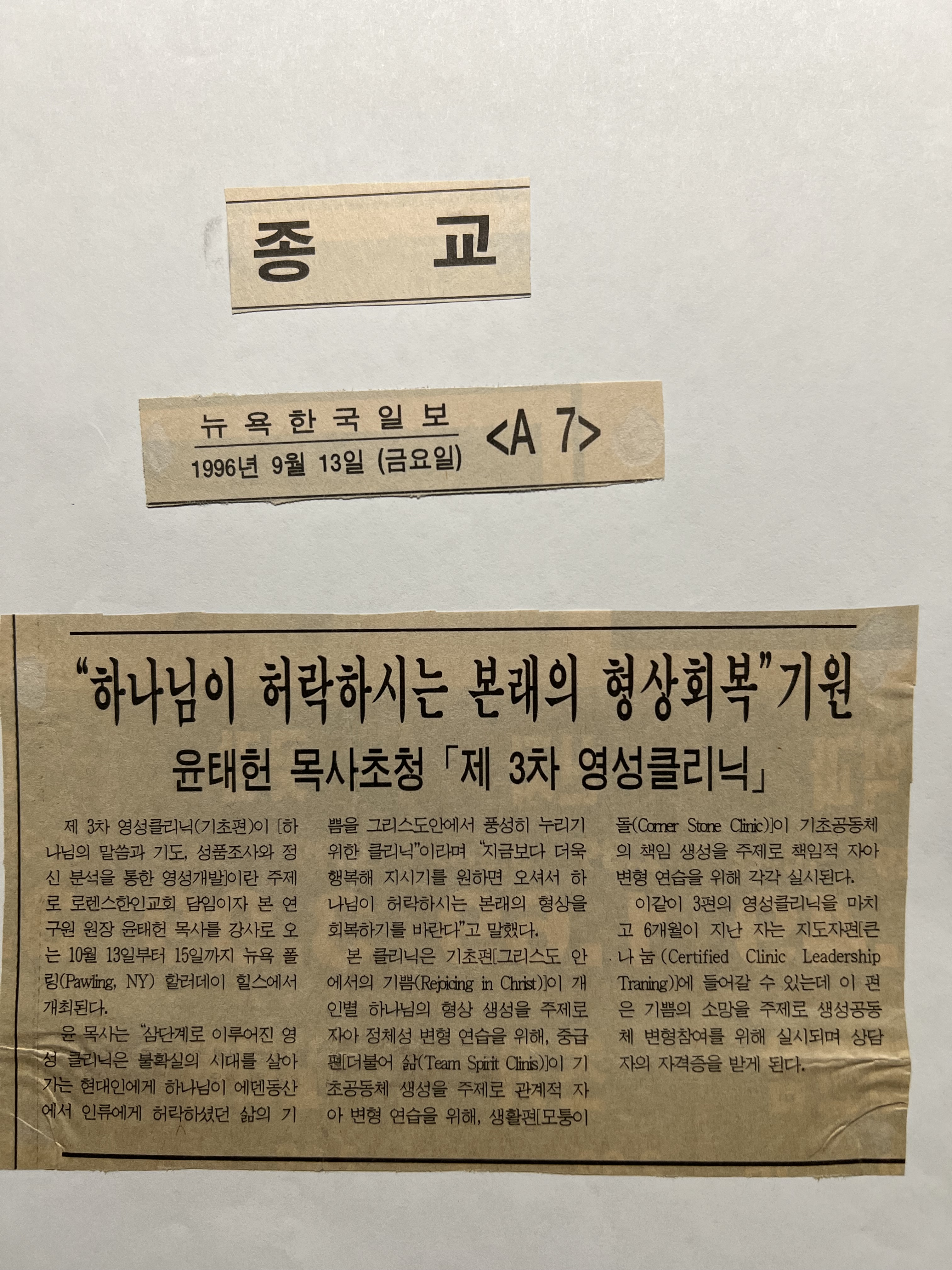
삼단계로 이루어진 영성 클리닉”은 불확실의 시대를 살아가는 현대인에게 하나님이 에덴 동산에서 인류에게 허락하셨던 ‘삶의 기쁨’을 그리스도 안에서 풍성히 누리기 위한 클리닉이다. 삶은 하나님이 창조하시고 보시기에 좋았다고 하신대로, 건강하고, 아름답고, 존귀하게 살아가야 하는 것이 하나님의 뜻이라 하겠다.
삶의 조건과 환경의 억눌림에서 매일 시달리는 상처가 있는가? 삶의 의미를 잃고 무기력해졌는가? 자신이 없는가? 혹은 모든 것이 편한 것 같고 잘되는 것 같은데 무엇인가 변화가 있어야 한다고 생각하는가? 오랜동안 믿음 생활 하면서, 은혜체험도 했는데 아직도 성격문제로 고민하는가? 은혜를 자주_ 쏟는가? 영적체험에 자신이 없는가? 그래도 불안한가? 교회에 다녀도 기쁨이 없는가? 부부 및 자녀사이나 타인과의 관계에서 자주 부딪치거나 고립이 되는가? 그리고 지금보다 더욱 행복해지기를 원하는가? 은혜받은 것이 쉽사리 쏟아져 버리는가?
하나님이 우리 속에 성령과 교통하시려 주신 그리스도의 심령을 통해서 하나님이 주시는 기쁨의 샘물을 터트리고자 기다리는 당신의 진실한 자신을 발견하게 된다. 그리고 모든 문제는 평온을 찾는다.
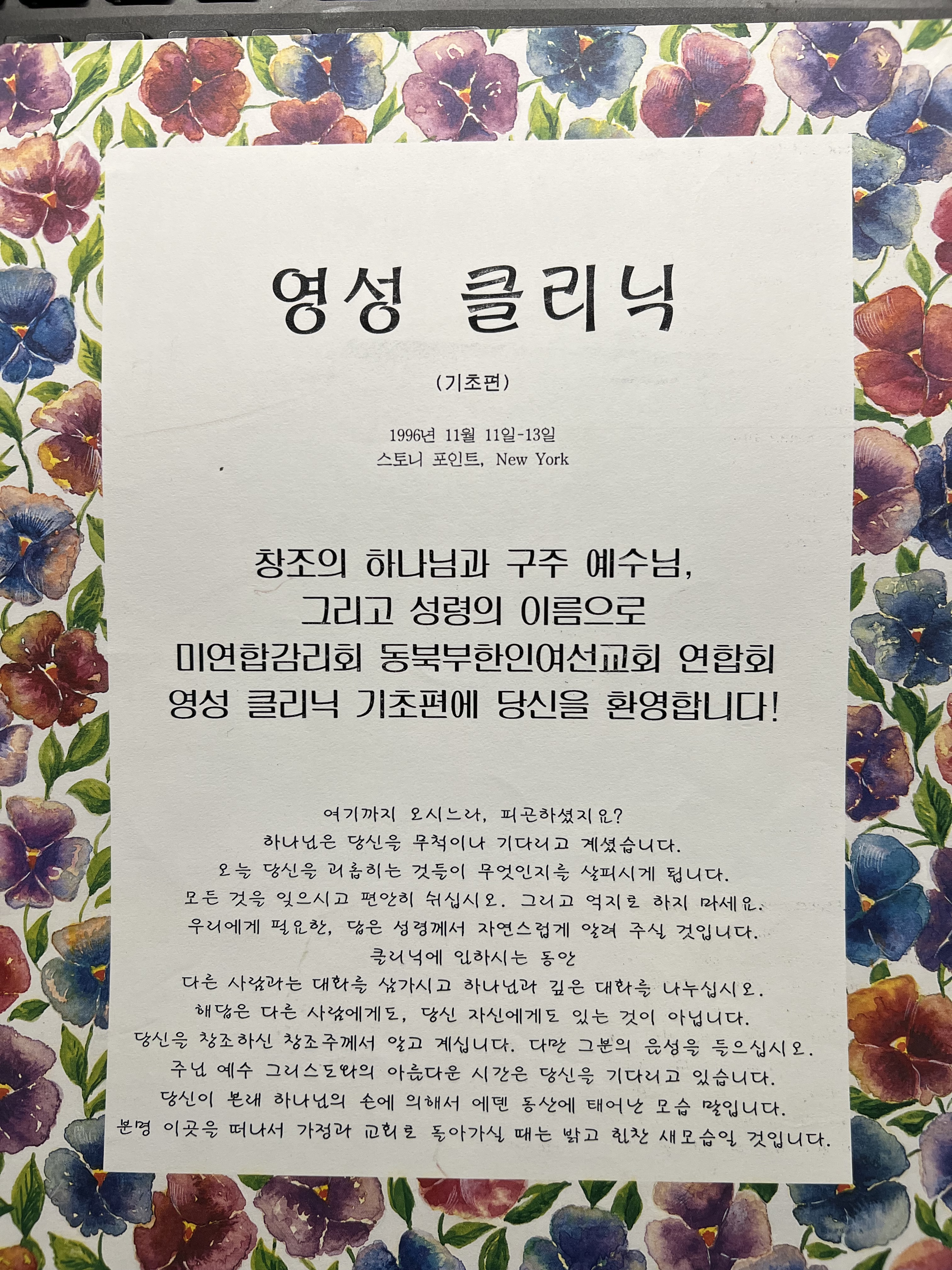
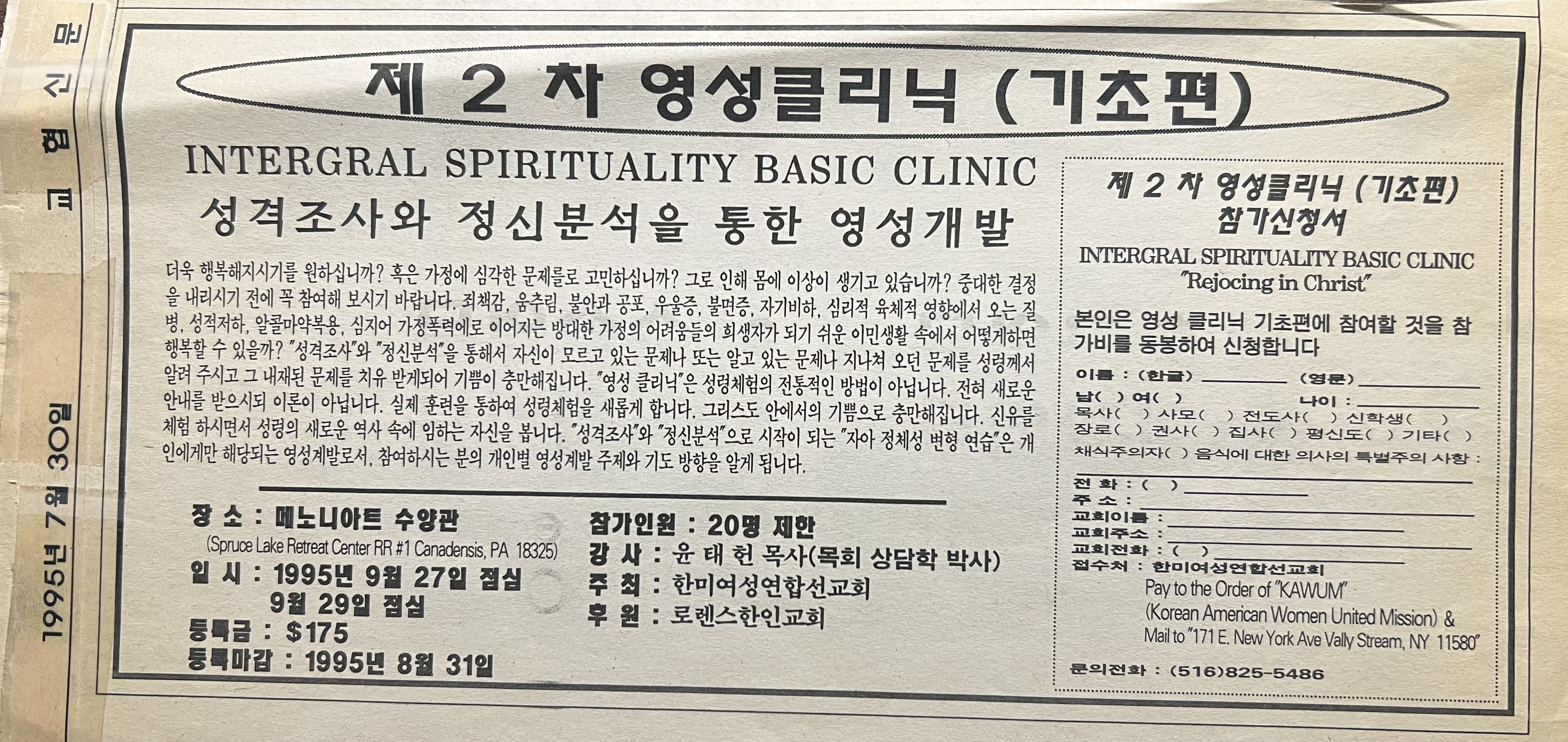
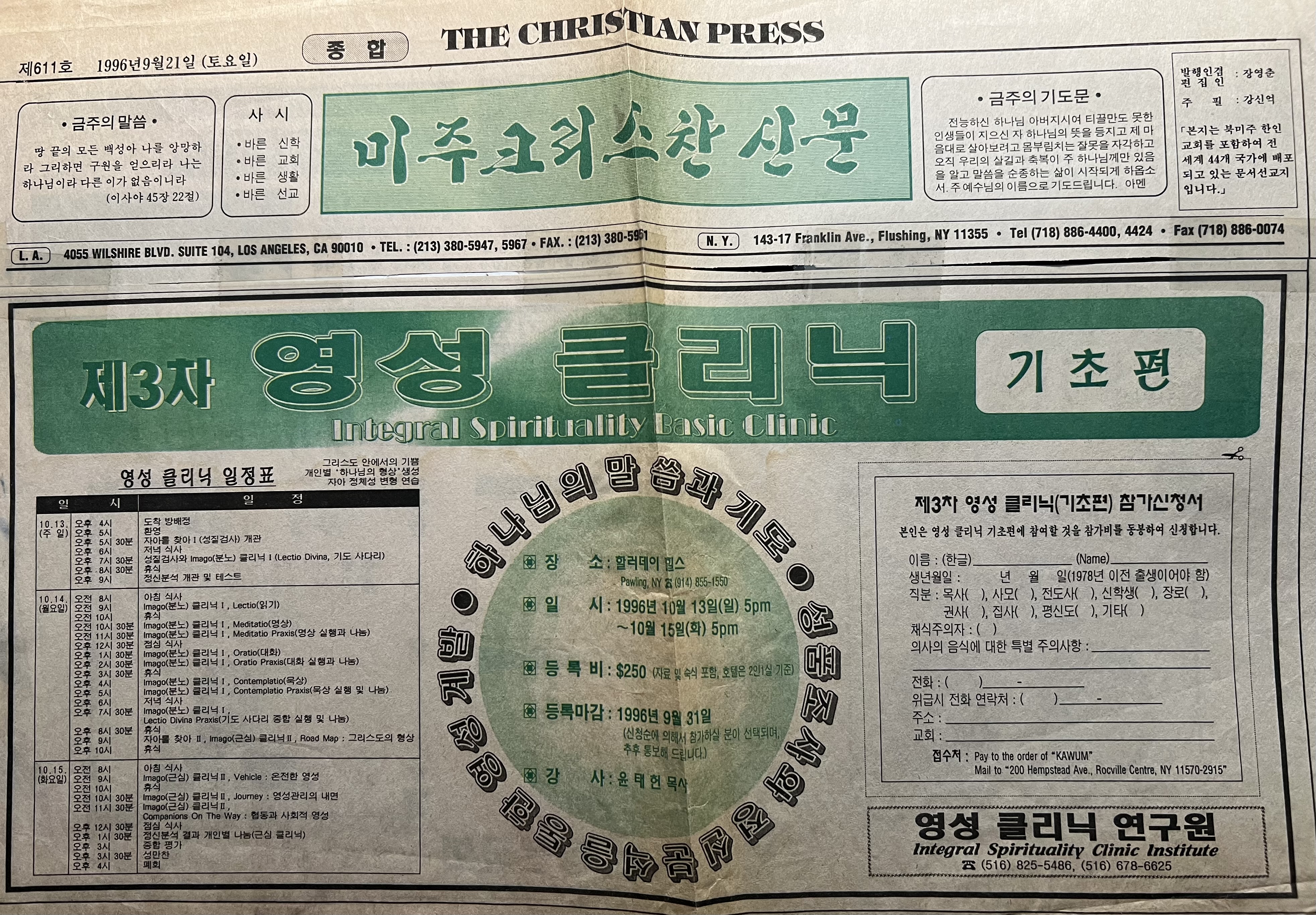
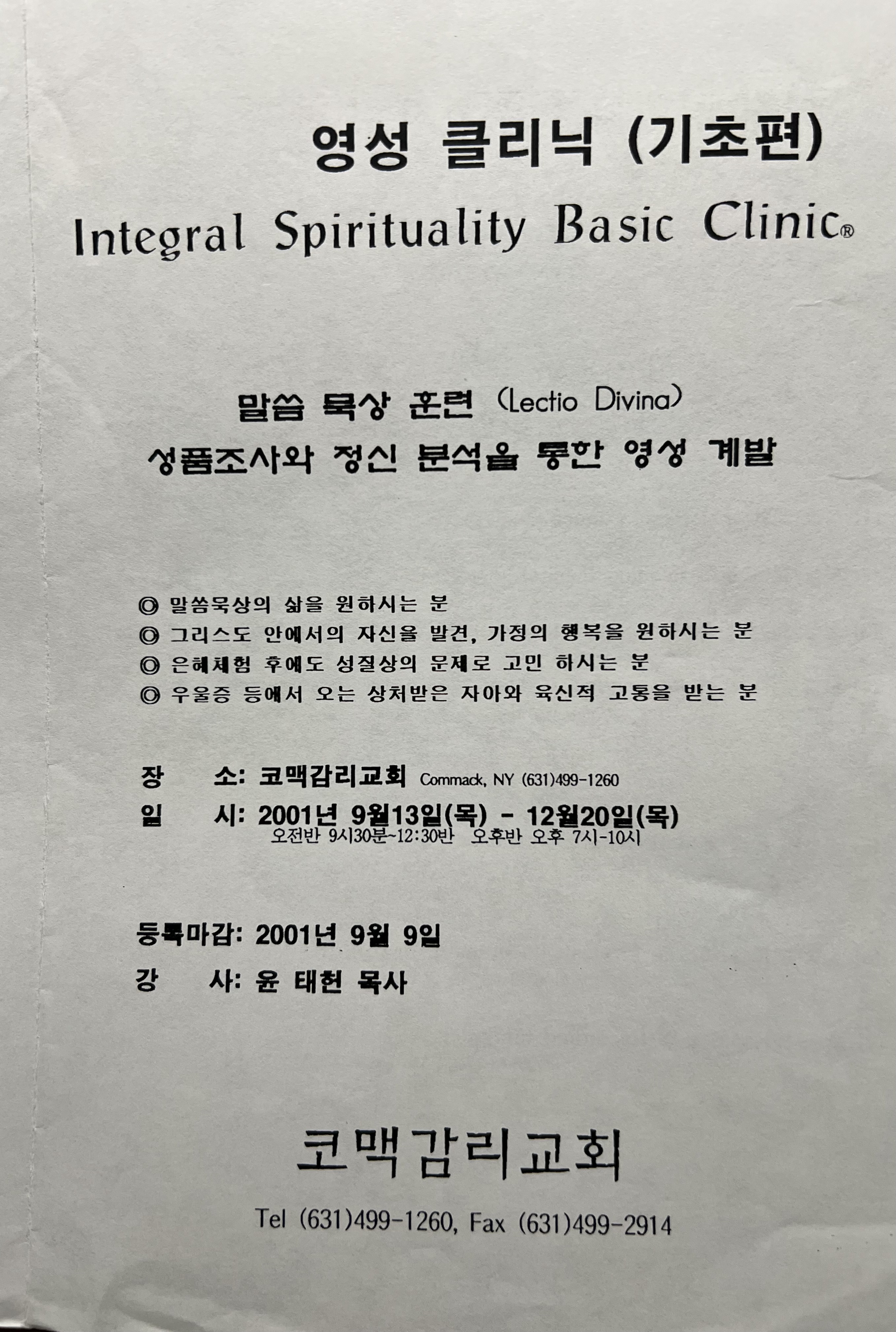
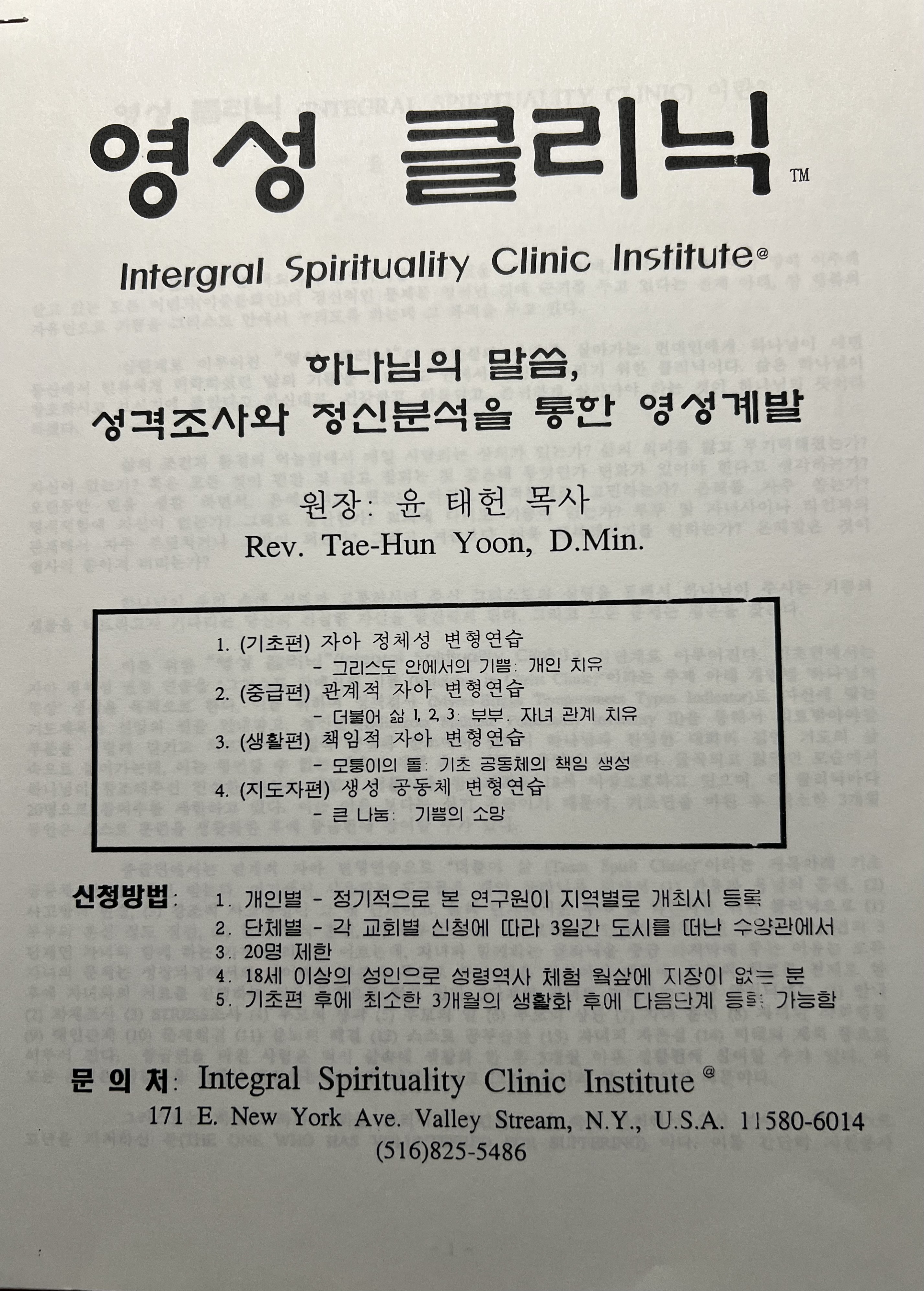
이를 위한 영성 클리닉”(Integral Spirituality Clinic)은 삼단계로 이루어진다. 기초편에서는 자아 정체성 변형 연습을 “그리스도 안에서의 기쁨 (Rejoicing in Christ Clinic)”이라는 주제 아래 개인별 하나님의 형상, 생성을 목적으로 한다. 이를 위하여 성격검사 (Myers-Briggs Temperament Types Indicator)로 자신에 맞는 기도제목과 신앙의 길을 안내받고, 정신분석(Minesota Multiple Personality Inventory DI을 통해서 치료받아야할 부분을 성령께 맏기고 치료받는다. 결국 근심과 분노에서 벗어서 하나님과 진정한 대화의 길인 기도의 삶 속으로 들어가는데, 이는 형언할 수 없는 자유의 체험 속에 기쁨을 충만케 하여준다. 굴곡되고 잃었던 모습에서 하나님이 창조해주신 진실한 자신을 찾았기 때문이다. 참가자격은 18세 이상으로하고 있으며, 매 클리닉마다 20명으로 참여수를 제한하고 있다. 이는 이론 보다는 실기 훈련이기 때문에, 기초편을 마친 후 최소한 3개월 동안은 스스로 훈련을 생활화한 후에 중급편에 참여할 수가 있다.
중급편에서는 관계적 자아 변형연습으로 “더불어 삶 (Team Spirit Clinic)”이라는 제목아래 기초 공동체 생성을 훈련 받는다. 여기에서 사용되는 도구들은 개인 클리닉을 위해서 (1) 관용과 용납의 훈련, (2) 사고방식 변형, (3) 창조적 사고생성이 그 첫 단계이고, 둘째 단계에서는 부부 및 약혼자를 위한 클리닉으로 (1) 부부의 혼선 정도 점검, (2) 협력 방식 훈련, (3) 부부의 관계 치료로서 이 단계가 이루어진 부부는 중급편의 3 단계인 자녀와 함께 하는 가정 클리닉에 이르는데, 자녀와 함께하는 클리닉을 중급 마지막에 두는 이유는 모든 자녀의 문제는 성장과정에서의 잃어버린 부분과 부모로 부터 받은 상처이기 때문에, 부모의 치료를 전제로 한 후에 자녀와의 치료를 진행하는 것을 원칙으로 하고 있다. 3단계의 자녀와 함께하는 가정 클리닉에는 (1) 안내 (2) 자체조사 (3) STRESS조사 (4) 부모의 생각 (5) 부모의 일 6 부모의 상관(7) 자녀 훈련 (8) 자녀의 사회행동 (9) 대인관계 (10) 문제해결 (11) 분노의 해결 (12) 스스로 공부습관 (13) 자녀의 자존심 (14) 미래의 계획 등으로 이루어 진다. 중급편을 마친 사람은 역시 삶속에 생활화 한 후 3개월 이후 생활편에 참여할 수가 있다. 이 모든 훈련은 생활편을 위해서 훈련하는 것이다. 이것이 바로 그리스도인의 참 모습이기 때문이다.
그리스도는 하늘 보좌와 영화를 버리시고 인간의 고난 속에 자처해서 오신 분이다. 즉 스스로 고난을 자처하신 분(THE ONE WHO HAS VOLUNTEERED FOR SUFFERING) 이다. 이를 간단히 자원봉사(自願俸事,Voluntery Suffering)라고 이른다면, 기독정신에 세운 미국은 바로 이 자원정신에 의해서 오늘도 유지된다고 해도 과언이 아닐 것이다, 경찰 자원대, 소방자원대, 구급 자원대, 병원 자원봉사자 등, 참지어 단체의 이사회나 임원들도 자원 봉사자들이 대부분이다. 따라서 “생활편의 클리닉은 책임적 자아 변형 연습을 위해서 모퉁이 돌 (CORNER STONE CLINIC)이라는 제목아래 기초 공동체의 책임생성을 위해서 훈련 받는다. 사용도구로는 (1), 자원 봉사자, 그리스도의 기쁨 (2) 창조적 형상의 기쁨 (3) 더불어 삶의 기쁨, 등 훈련을 마치고 나면, 교회와 사회 가정 그리고 개인이 일체감있게 되며, 삶의 풍족함과 보람으로 자신이 이 사회에서 하나님이 자신에게만 특별히 맡겨주신 사명을 깨닫고 기쁨의 생물이 더져 나오는 삶으로 살아가게 된다 이전에 고민과 무의미 그리고, 병색은 사라진다. 그리스도의 참 제자로 그 빛을 세상에 널리 그리고 참으로 후손에 이르기까지 길게 던지며 산다.
생활편을 마친 분 가운데 “영성 클리닉”의 지도자가 되시고 싶은 분은 생성 공동체 변형 참여를 위해서 큰 나눔 (CERTIFIED CLINIC LEADERSHIP TRANINING)® 훈련을 받고 지도자 자격을 취할 수가 있다. 훈련 도구로는 (1) 더불어 삶의 훈련 (2) 경험과 표현 (3) 잃은 자들 더불어 삶에로 초청 (4) 이웃을 향한 기쁨등이다. 이는 기쁨의 소명을 받은 분들로, “영성 클리닉”과정에 상담자의 자격을 받는다.
교회를 담임하고 계신 목사님들의 성도들을 위한 상담에 “영성 클리닉”을 권한다. 감정이 상당 수준으로 올라있는 경우에는 정상적인 사고 능력과 판단이 어려운 상태에서는 말씀과 기도를 통한 치유의 역사를 볼 수가 없다. 따라서 말씀과 기도로 완전한 치료를 이루기 위해서는, 먼저 준비해야만되는 필수적인 단계는, 문제의 핵심을 찾아내는 일이다. 문제를 찾아내는 일이 담임 목사님에게는 교인과의 관계에서 어려움을 준다. 즉 평신도 제직과 담임자 간의 관계로 개인의 신상에 대한 것을 구체적으로 내어 놓기가 어려운 경우를 염두에 둔다면, 교회내에 전문인을 둘 수 있는 부서를 만들던지, 아니면 기독교 전문인에게 의뢰하고 자문을 얻어 목회자가 계속 신앙 상담으로 마무리해 나가야 할 것이라고 본다. 이를 집단적이며 집중적으로 돕는 것이 바로 “영성 클리닉”이라 하겠다.
전체적으로 살펴 볼 때, 한인사회의 심각한 문제는 대부분의 한국인은 이러한 심각한 문제를 (1) 정신건강에 익숙치 않은 이유와, (2) 혼자서 혹은 집안에서 해결 시도, 그리고 (3) 체면문제로 이목이 두려워 하다 보니, 치료받아야 할 때를 놓쳐버리는 경우가 많다. 교회의 이에 대한 입장이, 이러한 현상에 대하여 예민해야 할 것이라고 본다. 교인이나, 일반인이 집안에서 문제를 갖고 씨름 하거나 남을 향한 체면을 보다가 시기를 놓치기보다는 자. 교회의 목회자에게 상담을 의뢰하는 것이 중요하다고 본다. 건강하고 행복한 공동체와 개인의 삶이 되기를 간절히 기도한다.
Spiritual Clinic to Support the Counseling Ministry of Pastors
One of the goals of the “Spiritual Clinic” is to help pastors with their counseling ministry, and ultimately to support all immigrants (bicultural individuals) living in the United States, under the premise that many mental and emotional struggles have spiritual roots. Its aim is for people to enjoy true, joyful freedom in Christ.
The Spiritual Clinic, which consists of three stages, is designed to help modern people in uncertain times fully enjoy the “joy of life” that God granted humanity in the Garden of Eden, through Christ. God created life good, healthy, beautiful, and honorable. That is His will.
Do you feel burdened by the stress and wounds of daily life? Have you lost meaning and feel powerless? Do you lack confidence? Or do you feel comfortable on the outside, yet sense that something deeper must change? Do you struggle with personal issues despite years of church life and past spiritual experiences? Do you often lose the grace you receive? Do you lack joy? Do your relationships with your spouse, children, or others often experience conflict or isolation? Do you wish to become even happier and more at peace?
Through your communion with the Holy Spirit and the heart of Christ given to you, you will discover your true self, and all these struggles will gradually find rest.
The “Integral Spirituality Clinic” is conducted in three stages:
Foundational Stage – “Rejoicing in Christ Clinic,” focusing on recovering the “image of God” within oneself.
Intermediate Stage – “Team Spirit Clinic,” focusing on the restoration of relationships, including those of spouses and children.
Living Stage – “Cornerstone Clinic,” focusing on cultivating responsibility and sharing joy in community.
In the foundational stage, participants explore their God-given nature and practice self-transformation under the theme of personal joy in Christ. Tools like the MBTI (Myers-Briggs Temperament Indicator) help participants identify their unique personality type and discover their own prayer style and path of faith. The Minnesota Multiphasic Personality Inventory (MMPI) is also administered so that participants can entrust any unhealthy areas of their lives to the Holy Spirit for healing. Eventually, they will break free from anxiety and anger, entering into the life of prayer—a true dialogue with God—and thereby taste indescribable freedom and joy.
This stage is open to anyone aged 18 or over, and each clinic is limited to 20 participants, as the emphasis is on practice rather than theory. After completing the foundational stage, participants are encouraged to live out their training for at least 3 to 6 months before moving on to the intermediate stage.
The intermediate stage—“Team Spirit Clinic”—aims at creating the basic sense of community. It is divided into three parts: (1) Individual Clinic, training in tolerance, mindset transformation, and creative thinking; (2) Couple and Fiancée Clinic, diagnosing spousal miscommunication, learning cooperative styles, and healing relationships; and (3) Family Clinic, where parents and children receive healing together. Children come last because most childhood wounds come from unresolved parental issues, so parents must experience healing first. This stage looks at family systems including stress, parental thoughts, parenting styles, communication, children’s social behavior, self-study habits, self-esteem, future goals, and more.
Graduates of the intermediate stage will live their training for another 3-6 months before moving on to the final “Living Stage,” the Cornerstone Clinic. The Living Stage is meant to train participants to be responsible, joyful members of the larger community under Christ. Its purpose is to highlight the attitude of voluntary suffering for others’ sake, as Jesus left His throne and glory to embrace suffering. The Christian spirit of volunteerism is what underpins American society itself: volunteer firefighters, paramedics, hospital volunteers, school boards, and church service are all examples of selfless service. The training in this final stage will lead people to become servants of Christ in their daily lives, and to recognize the true calling God has placed on each individual. Freed from worry, meaninglessness, and depression, they will discover a profound sense of calling, receiving joy like a spring bubbling up from within.
Upon completing the final stage, a sense of harmony will emerge across one’s personal life, home, church, and society. Participants will live with deep happiness, knowing they are fulfilling the special mission God has entrusted to them. Freed from fear, they will shine like true disciples of Christ and live a legacy that influences future generations.
Those who wish to become leaders of the Spiritual Clinic may participate in the Certified Clinic Leadership Training for leadership formation. This program includes training in collaborative life, deep listening, sharing one’s experiences and expressions, inviting the lost into a life together in Christ, and offering joy to one’s neighbors. Graduates receive credentials to become counseling leaders who can help others grow in this same spiritual path.
Finally, pastors seeking help with counseling ministries can also look to the Spiritual Clinic. Often, a person’s emotional intensity can prevent them from receiving healing through mere Bible study or prayer alone. To reach true healing, the root issue must first be uncovered. However, congregants may hesitate to reveal their personal struggles to their own pastor due to role dynamics or shame. Creating a professional counseling team or making use of outside Christian counseling professionals is advisable so pastors can eventually resume and conclude the counseling ministry with spiritual guidance.
When viewed holistically, one serious issue facing the Korean immigrant community is that most Koreans do not seek help early enough due to unfamiliarity with mental health treatment, attempting to resolve problems privately at home, or fear of losing face. The church must take this reality seriously. Instead of allowing people to delay treatment until problems worsen, the pastor and church must encourage people to seek help without shame. This proactive attitude will lead to a healthy and joyful spiritual community for all.
Written by Rev. Dr. Tae Hun Yoon, (Retired in 2014 from the Holston annual Conference of the United Methodist Church)
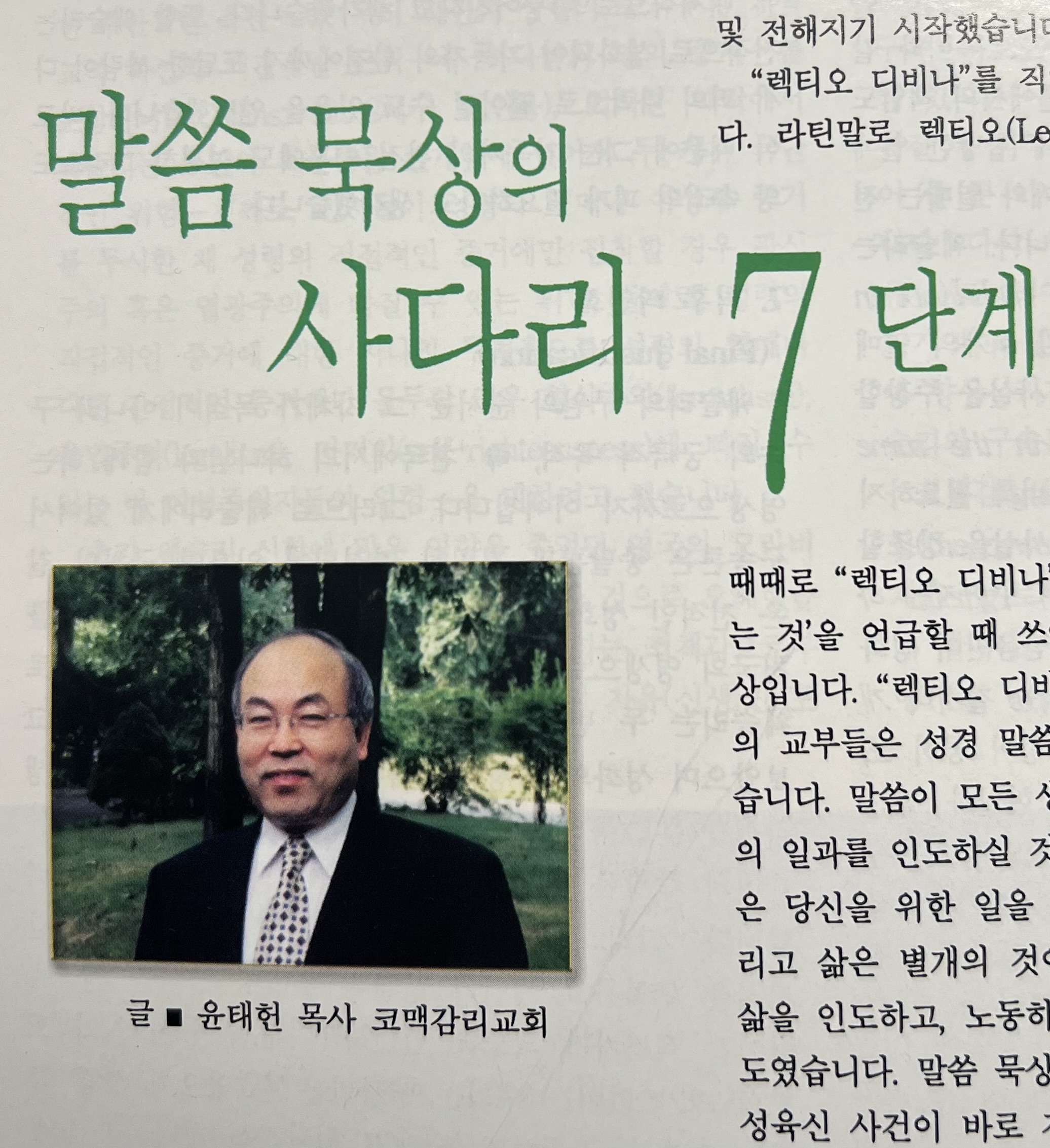
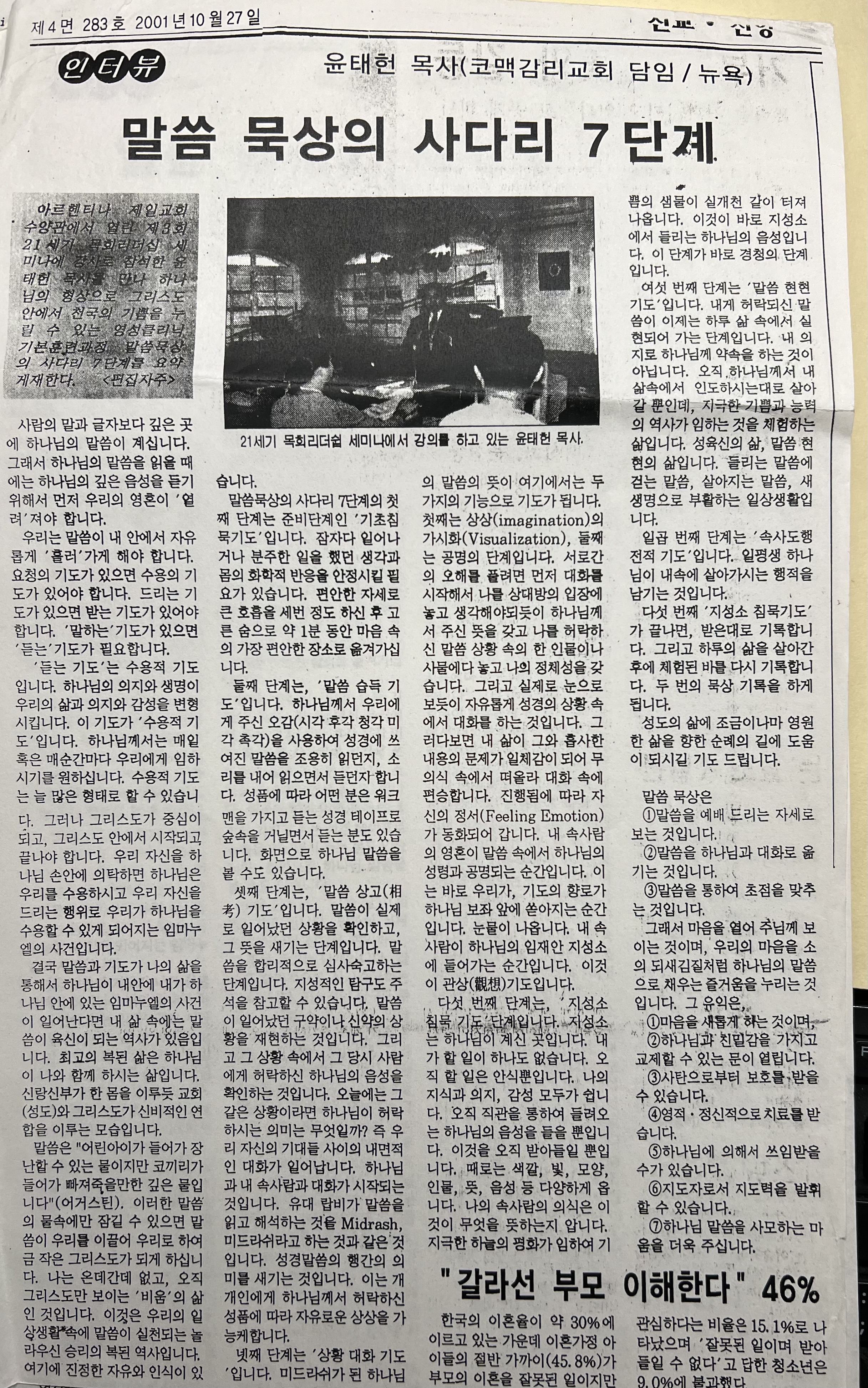
“말씀묵상의 사다리 7단계”는 수도원의 수도사들이 해 오던 말씀 묵상 방법인 “렉티오 디비나”(Lectio Divina) 4 단계를 이민 교회 현실에 맞게 변형시킨 것입니다. 수도원에 갇혀 있는 말씀 묵상의 길을, 평범한 신앙인이 매일 하나님께 더욱 가까이 나아가 하나님과 말씀 가운데 영적으로 교통할 수 있도록, 우리의 일상 생 활에 알맞도록 보완한 것입니다.
“렉티오 디비나”라는 명칭은 사막의 교부들이 쓰던 말씀 묵상의 방법을 일컫는데 먼저 쓰여졌습니다. 이 방법은 알렉산드리아의 아다나 시우스에 의해서 4단계로(Lectio, Meditatio, Oratio, and Contemplatio) 정립된 후, 성베네딕트(St Benedict) 수도원의 수도사들에 의해 발전 및 전해지기 시작했습니다.
“레티오 디비나”를 직역하면 ‘Divine Reading (거룩한 독서)가 됩니 다. 라틴말로 레티오(Lectio)는 ‘가르침’ 혹은 ‘교훈’이라는 뜻이기에, 때때로 “렉티오 디비나”가 ‘성경 본문’을 가리키기도 하고, 단순히 ‘읽는 것’을 언급할 때 쓰이기도 합니다. 그렇지만, 본래의 의미는 그 이상입니다. “렉티오 디비나”는 “단순한 영적 독서”와는 다릅니다. 사막 의 교부들은 성경 말씀 자체가 ‘삶의 학교’요, ‘기도의 학교’로 이해했습니다. 말씀이 모든 생명 규칙 위에 있다고 믿었습니다. 말씀이 그날 의 일과를 인도하실 것으로 믿었습니다. ‘말씀을 들었습니까? 그 말씀은 당신을 위한 일을 아주 잘 할 것입니다.” 그들에게 묵상, 기도, 그리고 삶은 별개의 것이 아니라 하나였습니다. 묵상과 기도가 하루의 삶을 인도하고, 노동하면서 사는 하루의 삶 자체가 말씀 묵상이며 기도였습니다. 말씀 묵상을 통해 삶이 진행되는 것을, 말씀이 육신이 된 성육신 사건이 바로 지금 그들의 삶 안에서 벌어지고 있는 것이라고 믿었습니다. 이런 삶의 시작과 과정 모두를 렉티오 디비나”라고 고백 한 것입니다.
이런 고백과 삶을 이민교회 현실에 적용 및 발전 시키고, 이민자 삶 속에서도 성육신의 사건이 일어나기를 원하는 마음에서 시작한 프로그램이 바로 “말씀 묵상의 사다리 7단계”입니다.
기본 전제: 수용적 기도
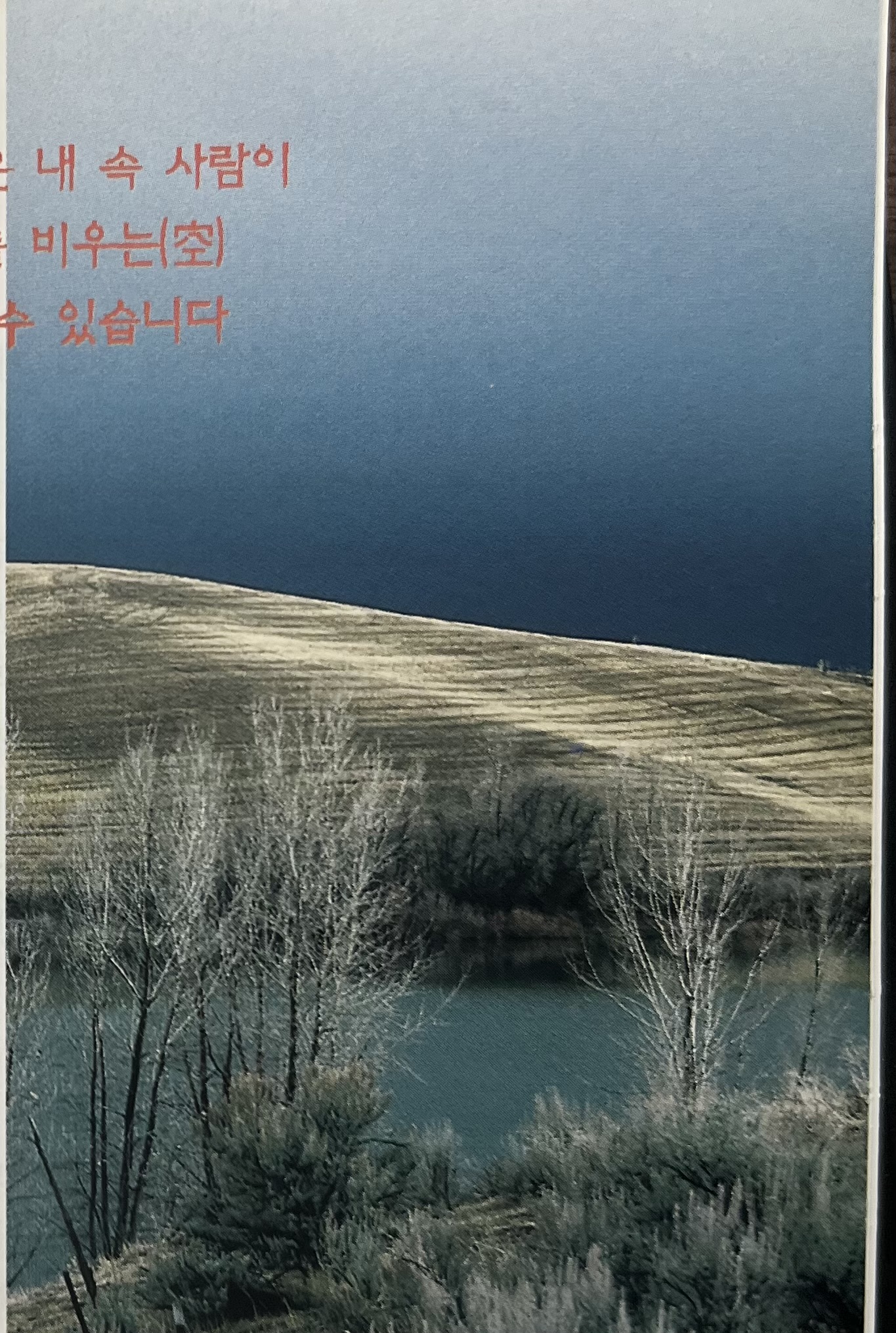
말과 글자보다 더 깊은 곳에 하나님의 말씀이 계십니 다. 그 깊은 하나님의 음성을 듣기 위해 먼저 우리 영혼 이 하나님께 예배 드리는 모습으로 굳은 내 속 사람이 하나님을 향하여 “열려(배)”져 있어야 합니다. 하나님을 송축하며, 하나님만 바라는 경외가 있어야 합니다. 또한 나를 비우는(4) 영혼의 맑음이 있어야 하나님의 말씀이 들어 올 수 있습니다. 겸손의 단계입니다. 그리고 나면, 비로소 하나님과 영적 말씀의 대화가 내 안에서 자유롭 게 흘러 유통(3t)하게 됩니다. 성령 충만의 모습입니다. 이 세배, 또, Mt 가지 조건을 충족시키는 것이 바로 “수용적 기도”입니다. 수용적 기도는 혼자만의 독백이 아 아닌, 말씀에 기초한 영적 교통의 기도입니다. 요청의 기 도가 있으면 수용의 기도가 있어야 합니다. 드리는 기도 가 있으면 받는 기도가 있어야 합니다. “말하는(드리는)” 기도가 있으면 “듣는(받는)” 기도가 필요합니다. “듣는 기도”는 수용적 기도입니다. 매일 혹은 매순간마다 우리 에게 임하시기를 원하시는 하나님을 인정하고 적극적으 로 수용하는 것입니다. 하나님의 의지와 생명이 우리의 성품 구성(외향과 내향, 감각과 직관, 감정과 사고, 및 전 통과 수용)의 채널을 통해서 효과적으로 교통하면, 우리 의 삶을 통해 말씀이 성육신되는 것을 체험하게 됩니다. 이 기도의 과정을 “수용적 기도”라 볼 수 있습니다. 수용적 기도는 많은 형태로 나타날 수 있지만, 그리스 도가 중심이 되고, 그리스도 안에서 시작되고 끝나야 합 니다. 우리 자신을 하나님 손안에 의탁하면 하나님은 우 리를 수용하시고 우리 자신을 드리는 행위로 우리가 하 나님을 수용할 수 있게 됩니다. 임마누엘 사건이 우리 안 에서 벌어지는 것입니다. 내가 삶 속에서 늘 말씀과 기도 를 나눔으로 하나님이 내 안에 내가 하나님 안에 있는 임마누엘의 사건이 일어난다면, 그것은 또한 내 삶 속에 는 말씀이 육신이 되는 역사가 일어나는 것과 마찬가지 입니다. 하나님이 나와 함께 하시는 삶, 그것이 최고로 복된 삶입니다. 교회(성도)와 그리스도가 신비적인 연합 을 이루는 모습, 그것이야말로 최고로 복된 모습입니다.
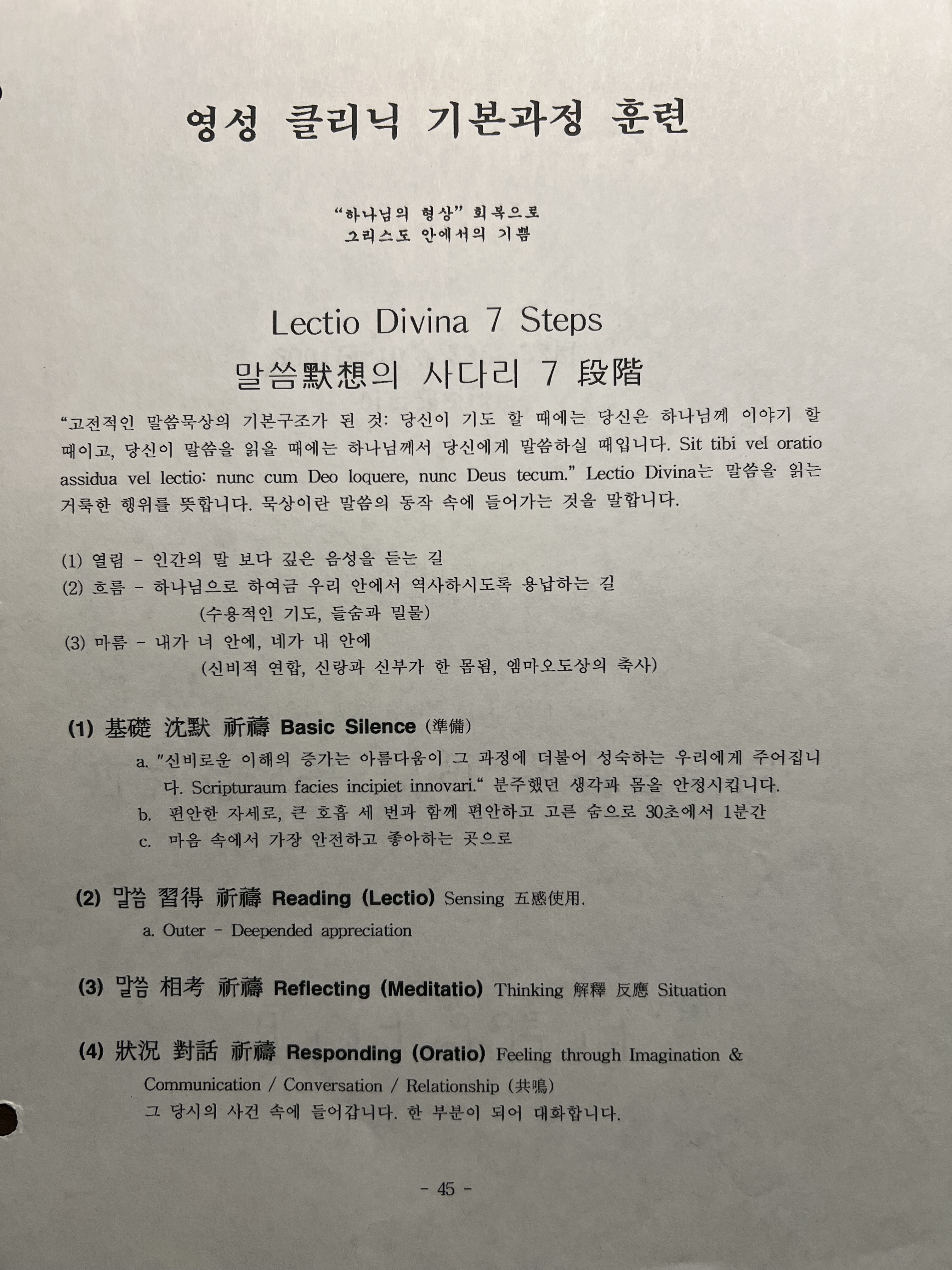
7단계 소개:
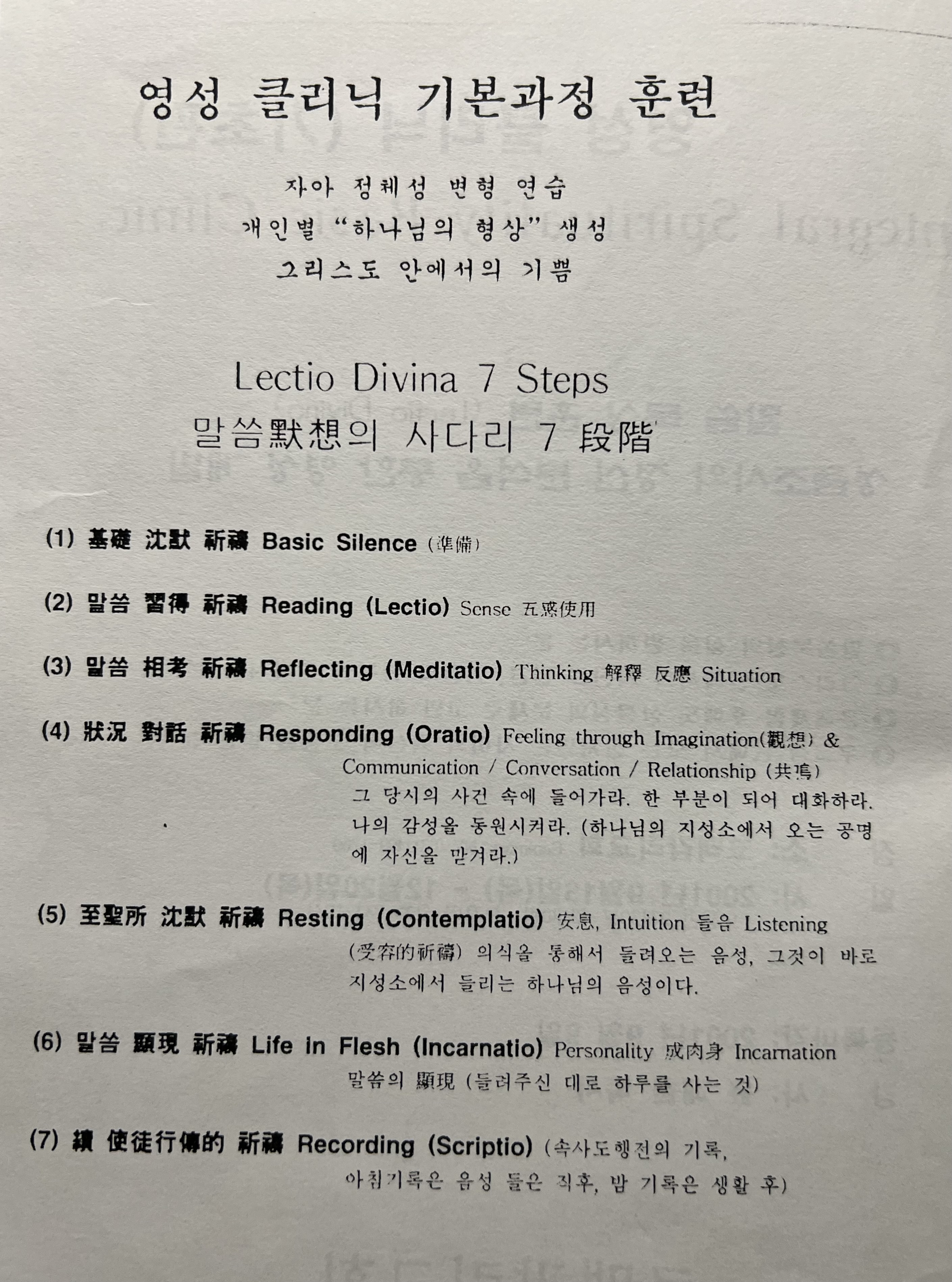
“말씀 묵상의 사다리 7단계”의 첫 단계는 준비 단계인 “기초 침묵 기도”입니다. 잠자 다 일어나거나 분주한 일로 허틀어졌던 생각과 몸의 화학적 반응을 먼저 안정시킬 필요가 있습니다, 편안한 자세로 큰 호흡을 세번 정도 한 후 고른 숨을 쉬면서 1-2분 동안 마음 속의 가장 편안한 장소로 옮겨갑니다. 그 자리는 하나님께서 나의 성격과 습관을 통해서 이미 마련해두신 곳입니다. 따라서 아무도 그곳에는 흥미도 없고 접근도 없어서, 나만의 안전하고 정말 편안한 곳입니다. 가장 편안한 자세로 쉽니다.
둘째 단계는, “말씀 습득 기도”(Scripture Internalization Prayer)입니다. 오감(시각, 후각, 청각, 미각, 그리고 촉각)을 사용하여 성경 말씀을 조용히 읽던지, 소리 내어 읽으며 듣던지 합니다. 성품 에 따라 어떤 분은 워크맨(Wallkman)에 성경 테이프를 담아 숲 속을 거닐며 듣는 분도 있습니다. Wireless 전화기로 하나님 말씀을 볼 수도 있습니다. 약 3분 정도
셋째 단계는, “말씀 상고 기도”(Scripture Reflection Prayer)입니다. 말씀이 실제로 일어났던 상황을 확인하고, 그 뜻을 해석하고 새기 는 단계입니다. 말씀을 심사숙고하는 단계입니다. 지성적인 탐구로 주석을 참고할 수 있습니다. 말씀이 일어났던 구약이나 신약의 상황을 재현하는 것입니다. 그리고 그 상황 속에서 그 당시 사람에게 허락하신 하나님의 뜻을 확인하는 것입니다. 오늘날 그 같은 상황이라면 하나님이 허락하시는 의도는 무엇일까? 즉 우리 속에 내면적인 대화가 일어납니다. 성경 말씀의 행간의 의미 (Midrash)를 새기는 것입니다. 이로써 개개인이 하나님께서 허락하신 성품에 따라 상상(내면 의식)을 하게 됩니다. 약 3분 정도
넷째 단계는 “상황 대화 기도”(Situational Conversational Prayer)입니다. 상고된 하나님 말씀의 뜻을 여기에서는 두 가지 기능으로 다시 기 도하면서 묵상하게 됩니다. 첫째는 상상(Imagination)의 가시화(Visualization)이고, 둘째는 공명의 단계입니 다. 마치도 서로 간의 오해를 풀려면 먼저 대화를 시작해서 나를 상대방의 입장에 놓고 생각해야 되듯이, 하나님 께서 주신 뜻을 갖고 나를 허락하신 말씀 상황 속의 한 인물이나 사물에다 놓고 나의 정체성을 갖습니다.
그리고 실제로 눈으로 보듯이 자유롭게 성경의 상황 속에서 대화를 하는 것입니다. 그러다 보면 내 삶 속에 있었던 흡사한 문제가 무의식 속에서 떠올라 대화 속에 편승합니다. 진행됨에 따라 자신의 정서(Feeling Emotion)가 동화되어 갑니다. 내 속 사람의 영혼이 말씀 속에서 하나님의 성령과 공명되는 순간입니다. 이는 바로 우리가, 기도의 향로가 하나님 보좌 앞에 쏟아지는 순간입니다. 눈물이 나옵니다. 내 속 사람이 하나님의 임재가 있는 지성소에 들어가는 순간입니다. 이것이 관상 기도(Contemplative Prayer)입니다. 약 2분 정도.
다섯 번째 단계는, “지성소 침묵 기도”(Holy of Holies Silent Prayer)단계입니 다. 지성소는 하나님이 계신 곳입니다. 가장 강조되어야 할 부분입니다. 내가 할 일이 하나도 없습니다. 오직 할 일은 안식뿐입니다. 나의 지식과 의지, 감성 모두가 쉽니 다. 오직 직관을 통하여 들려 오는 하나님의 미세한 음성을 들을 뿐입니다. 이것을 오직 받아들일 뿐입니다. 때로는 색깔, 빛, 모양, 인물, 뜻, 음성 등이 다양하게 옵니다. 나의 속 사람의 의식은 이것이 무엇을 뜻하는지 입니다. 지극한 하늘의 평화가 임하여 기쁨의 샘물이 실개천 같이 터져 나옵니다. 이것이 바로 지성소에서 들리는 하나님의 음성입니다. 이 단계가 바로 경청의 단계입니다. 이 순간이 바로 주님의 영과 신비로운 연합(Mystical Marriage with the Lord, Communion Sactorum)이 우로어지는 때입니다. 약 3분 정도.
여섯 번째 단계는 “말씀 현현의 기도”(Prayer of the Manifestation of the Word) 입니다. 내게 허락되신 말씀이 이제는 하루 삶 속에서 실현되어 가는 단계입니다. 내 의지로 하나님께 약속을 하는 것이 아닙니다. 오직 하나님께서 내 삶 속에서 인도하시는 대로 살아 갈 뿐인데, 지극한 기쁨과 능력의 역사가 임하는 것을 체험합니다. 성육신의 삶, 혹은 말씀 현현의 삶입니다. 들리는 말씀이 살아지는 말씀 그리고 새 생명으로 부활 하여 일상 생활을 이끌어 갑니다. 온 종일.
일곱 번째 단계는 “속 사도행전적 기도”(Inner Acts-style Prayer)입니다. 일평생 하나님이 내 속에 살아가시는 행적을 남기는 것입니다. 다섯 번째의 “지성소 침묵 기도”가 끝나는 순간, 하나님 이 주신대로 받은 것을 단순히 기록합니다. 그리고 하루의 삶을 정리하는 시간에, 하루 동안 하나님께서 허락하신 삶이 어떠했는가를(체험된 바를) 다시 기록합니다. 하루에 두 번의 기록을 남기는 것을 권합니다. 훗날 이것은 본인에게는 귀중한 개인 영적 순례의 기록으로 남을 것이며, 다른 사람에게와 후손에게는 귀한 속 사도행전적 말씀 역사의 기록으로 영원히 남을 것입니다. 약 2분 정도
(하루가 말씀 묵상의 시간의 연속이나, 한 자리에서 이루어지는 말씀묵상은 약 15분간이면 족합니다. 만일 시간이 30분 이상 초과하면, 다시 진행 과정을 점검할 필요가 있습니다. 너무나 많은 양의 성경 말씀이나, 말씀에 한 가지 이상의 사건이 복합 되여 있는 경우는 피해야 할 것입니다. 한 구절의 말씀도 바다보다 깊습니다.)
나가는 말:
말씀은 “어린아이가 들어가 장난 할 수 있는 물이지만 코끼리가 들어가 빠져 죽을 만한 깊은 물입니다”(성 어 거스틴). 이러한 말씀의 물 속에만 잠길 수 있으면 말씀이 우리를 이끌어, 우리로 하여금 작은 그리스도가 되게 하십니다. 나는 온데간데 없고, 오직 그리스도만 보이는 “비움”의 삶이 됩니다.
이것은 우리의 일상 생활 속에 말씀이 실천되는 놀라우신 승리의 복된 역사입니다. 여기에 진정한 자유와 안식이 있습니다. 그래서 사탄으로부터 보 호받을 수가 있습니다. 특히 만병의 근원인 분노와 두려움으로부터 “영육혼”이 자유 함을 받아, 육적 정신적 영적으로 치료를 받을 수가 있습니다. 또한 하나님에 의해 쓰임 받을 수가 있습니다. 지도자로서의 지도력을 발휘할 수 있습니다.
한 발 더 나아가, 전에 맛보지 못한 말씀 안에서의 즐거움으로 하나님 말씀을 더욱 사모하는 마음이 생깁니다. 그래서 온 종일 한 구절의 말씀을 먹고, 그에 초점을 두고, 소의 되삭임질처럼 하나님과 대화의 즐 거움을 누리며 살게됩니다. 이런 은혜와 축복이 성도의 삶에 나타나기를 기도합니다.
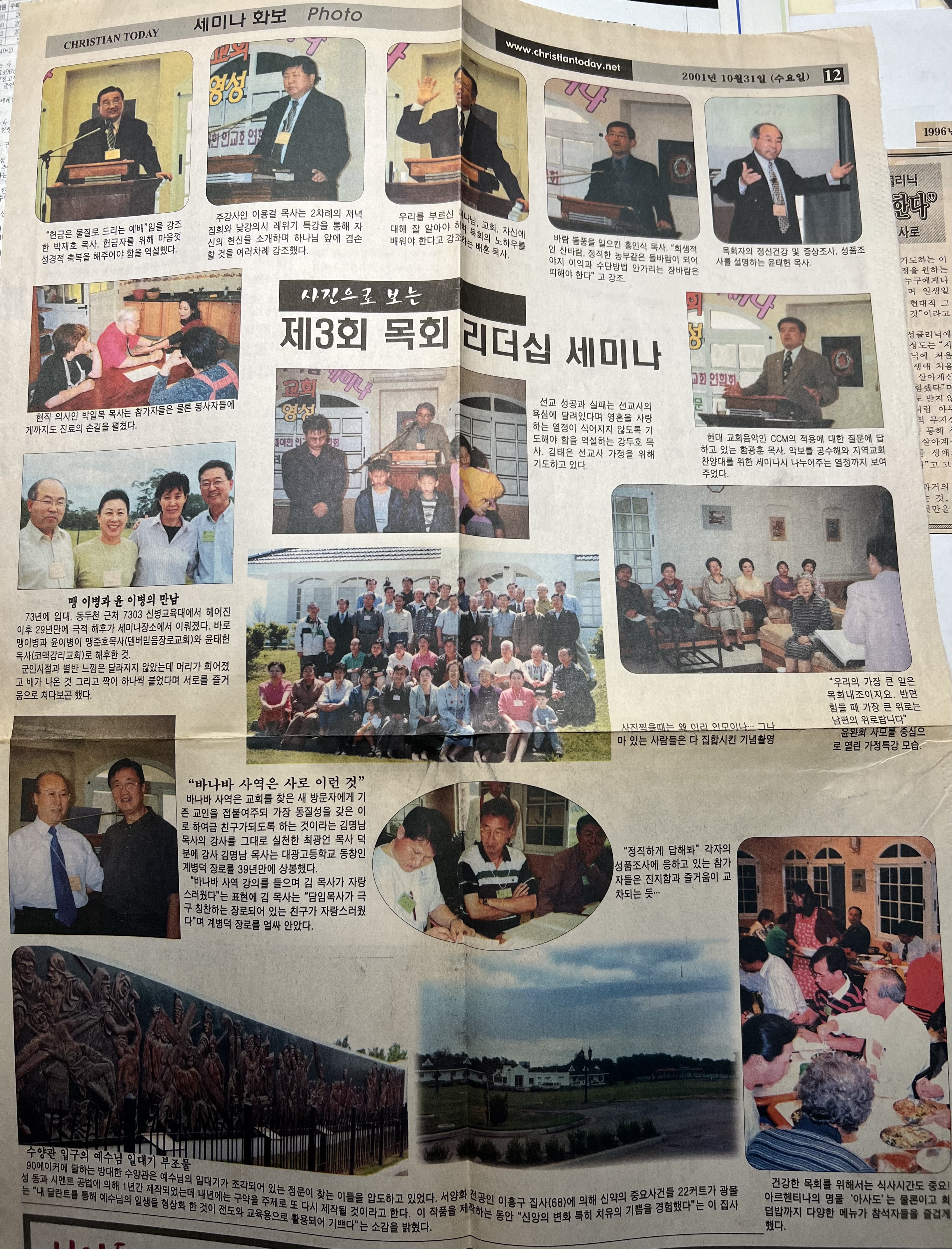
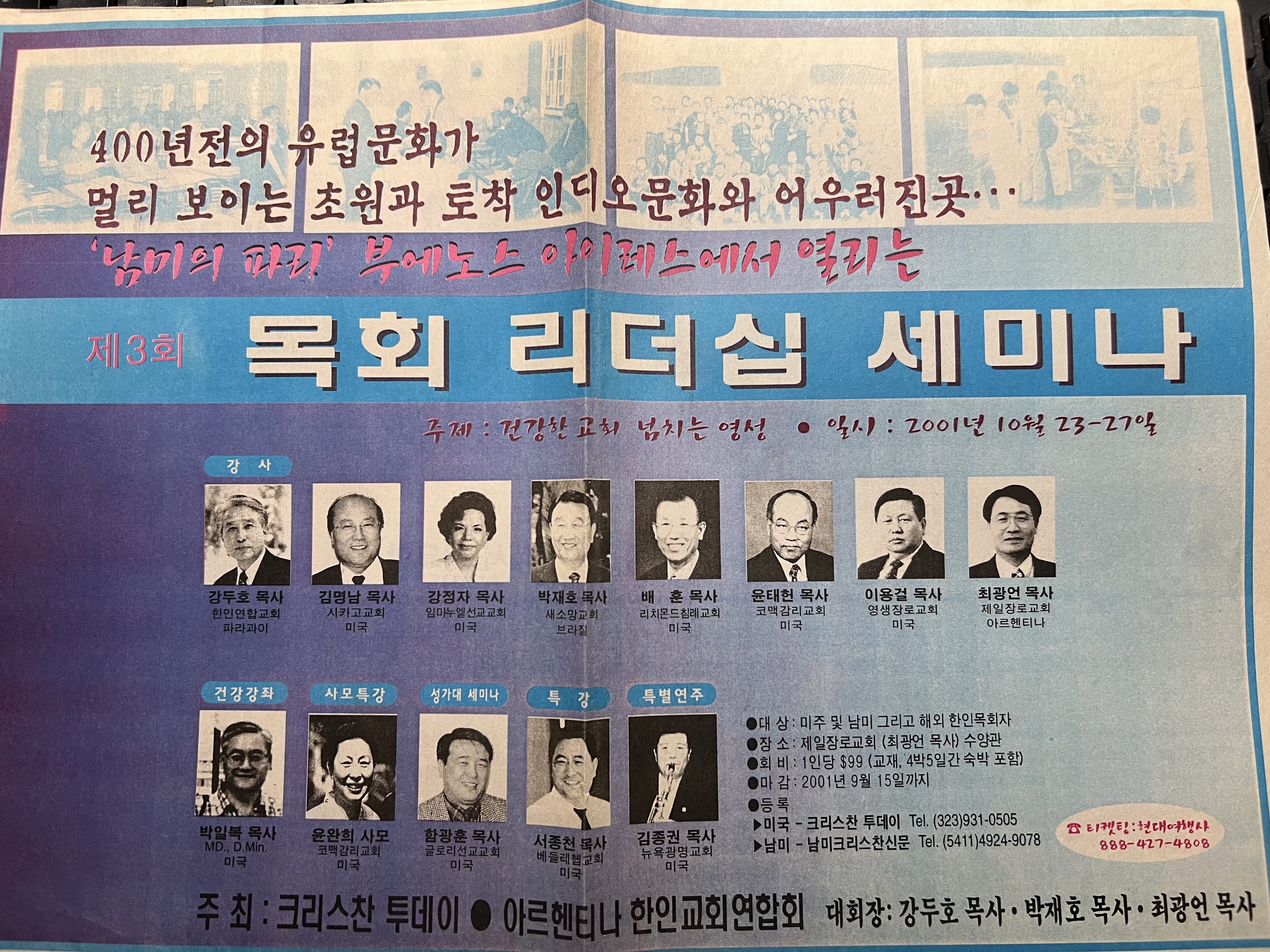
[이 글은 2001년 10월 “아르헨티나 제일교회” 수양관에서 미주 크리스천 투데이 주최로 열렸던 “제3회 21세기 목회 리더십 세미나”에서 발표한 것입니다. 삼기는 사람들 다음 호(Sep/Oct, 2002)에 실릴 “건강한 교회 넘치는 영성을 위한 ‘영성 클리닉'”과 연관이 있는 글입니다.]
By Rev. TaeHun Yoon, Long Island Korean United Methodist Church, Commack, NY (Retired in 2014 from the Holston Annual Conference, Southeastern Jurisdiction) (United Methodists in Service, July/August 2002, Volume 5, Number 4, pp. 16–18)
The “Seven Steps of the Ladder of Scripture Meditation” is an adaptation of the traditional monastic method of Lectio Divina into the context of immigrant churches. This method, long practiced by monks in monasteries, has been reshaped to suit the everyday spiritual life of ordinary believers—enabling them to draw closer to God and engage in deeper spiritual communion through the Word in the midst of their daily lives.
The term Lectio Divina originally referred to the way the Desert Fathers meditated on Scripture. It was later systematized into four stages (Lectio, Meditatio, Oratio, and Contemplatio) by Athanasius of Alexandria, and further developed and passed down by the monks of the Benedictine tradition.
Literally translated, Lectio Divina means “Divine Reading.” In Latin, Lectio means “teaching” or “instruction,” so the term has sometimes referred simply to the biblical text itself or to the act of reading. However, the original meaning goes much deeper. Lectio Divina is not merely a spiritual reading practice. For the Desert Fathers, Scripture was understood to be a “school of life” and a “school of prayer.” They believed the Word governed all rules of life and guided their daily activities. “Have you heard the Word? That Word will surely do its work in you.” For them, meditation, prayer, and life were not separate—they were one. Meditation and prayer shaped their day, and the very act of living and laboring was itself a form of Scripture meditation and prayer. They believed their lives were the unfolding of the Incarnation—the Word becoming flesh—right in their midst.
With this same conviction, the program of the “Seven Steps of the Ladder of Scripture Meditation” was born—designed to apply and develop this spiritual tradition in the reality of immigrant church life. It seeks to make the Incarnation alive again in the daily lives of immigrants through the transformative power of Scripture meditation.
Basic Premise: Receptive Prayer
Beyond spoken words and written letters lies the deeper presence of God’s Word. To hear this profound voice of God, our inner being must first be open and lifted toward God in worshipful posture. There must be a reverent awe that blesses God and waits only for Him. In addition, our souls must be emptied and clear, creating the space necessary for God’s Word to enter. This is the stage of humility.
Only then can the spiritual dialogue with God and His Word flow freely and circulate within us—this is the state of being filled with the Holy Spirit. These three—or perhaps more—conditions must be met to enter into what we call “Receptive Prayer.”
Receptive prayer is not a monologue, but a spiritual communion based on the Word. If there is a prayer of request, there must also be a prayer of reception. If there is a prayer of offering, there must also be a prayer of receiving. If there is a “speaking” prayer, there must also be a “listening” prayer. Listening prayer is receptive prayer. It is to actively welcome and acknowledge God, who desires to come to us daily—even moment by moment.
When the will and life of God effectively communicate through the channels of our personality (such as extroversion and introversion, sensing and intuition, feeling and thinking, tradition and receptivity), we experience the Word becoming flesh through our lives. This entire prayer process is what we call “Receptive Prayer.”
Receptive prayer may take many forms, but it must be centered on Christ, beginning and ending in Him. When we entrust ourselves into God’s hands, God receives us, and through the act of offering ourselves, we too become able to receive God. This is the event of Immanuel happening within us.
If in our daily lives we continually engage in Word and prayer, and God is in us and we in Him, then the event of Immanuel is occurring. It is nothing less than the incarnation of the Word in our lives. A life where God is with us—that is the most blessed life. The mystical union between the Church (believers) and Christ—this is the most blessed state.
Introduction to the 7-Step Ladder of Scripture Meditation
Step 1: Foundational Silent Prayer Begin with quiet prayer—this preparatory stage calms the mind and body after sleep or a hectic day. Sit comfortably, breathe deeply three times, then breathe evenly for 1–2 minutes. Imagine yourself in your most peaceful inner place—a sanctuary crafted from your personality and habits—safe, secluded, and deeply restful.
Step 2: Scripture Internalization Prayer Engage your five senses—sight, hearing, smell, taste, touch—to absorb Scripture. Read or listen silently or aloud. Some may walk outdoors listening to audio Scripture. Use whatever medium connects you with the Word for about 3 minutes.
Step 3: Scripture Reflection Prayer Delve into the context and meaning of the passage. Reflect intellectually with tools like commentaries. Reconstruct the biblical setting and consider God’s intent both then and now. Allow Midrash-like internal dialogue for about 3 minutes.
Step 4: Situational Conversational Prayer Immerse yourself imaginatively into the Scripture scene. Visualize and resonate emotionally by identifying with a character or aspect of the passage. Let your feelings and spiritual being harmonize with the Holy Spirit. This contemplative encounter may bring tears as you enter the inner sanctuary of God’s presence—for about 2 minutes.
Step 5: Holy of Holies Silent Prayer Now enter complete silence. In this stillness—where intellect, will, and emotions rest—you listen intuitively for God’s subtle voice. You receive whatever emerges: color, light, image, presence. Here the soul rests in divine peace. This is a moment of mystical union—about 3 minutes of listening.
Step 6: Prayer of the Manifestation of the Word Allow the Scripture to come alive in your day. Without forcing it, let God’s guidance unfold naturally, accompanied by joy and spiritual power. This is living the Word, day-long.
Step 7: Inner-Acts Style Recording Prayer Track your spiritual journey. After the silent prayer, write down what came to you. Then, at day’s end, journal how Scripture unfolded in your life. Twice-daily entries become a precious personal narrative—your own inner Book of Acts—for about 2 minutes each time.
A daily session of around 15 minutes is ideal; if it exceeds 30 minutes, simplify by focusing on one verse without multiple layers of interpretation.
Closing Reflection As St. Augustine said, scripture is water shallow enough for a child to splash but deep enough to drown an elephant. When we immerse ourselves, the Word shapes us into Christ-like vessels. In this “emptying,” Christ shines through. The practice brings true freedom, rest, emotional and spiritual healing, and empowerment for leadership in God’s mission. It fosters a lifelong delight in one verse of Scripture—repeatedly meditating on it like a cow chewing cud—and joyfully conversing with God throughout the day.
This presentation was delivered at the 3rd 21st-Century Pastoral Leadership Seminar (October 2001, Argentina First Church Retreat). It ties into the upcoming article “Spiritual Clinic for a Healthy Church, Abounding Spirituality” in the Sept/Oct 2002 issue of United Methodists in Service.








 Daily Sauntering
You must be logged in to post a comment.