Parsonage Letter (Four O’Clock Flower Story, Part Six)
© WanHee Yoon, 2001
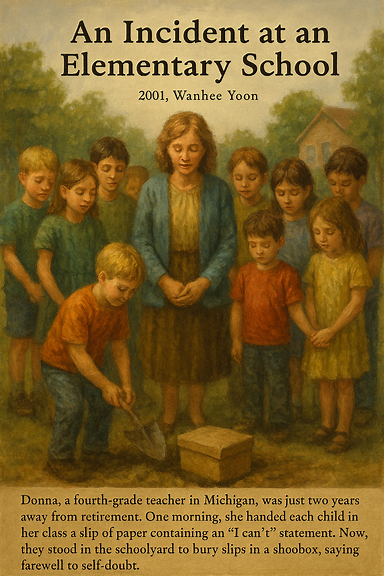
Donna, a fourth-grade teacher in Michigan, was just two years away from retirement. One morning, she handed each child in her class a blank sheet of white paper.
“Now, I want you to write down all the things you believe you cannot do,” she said. “For example: I can never make the football team because I’m too weak. Or, I can’t sing. Or, I could never be the goalkeeper on the soccer team. Go ahead—write down anything you’ve ever thought you couldn’t do.”
The children quickly filled their papers:
- “I can’t kick the ball over the school fence.”
- “I can’t eat more than one cookie.”
- “I can’t do more than ten push-ups.”
- “I can’t play the violin.”
Donna also joined in, writing her own “I can’ts”:
- “I can’t get John’s mother to come to a parent meeting.”
- “My daughter can’t put gas in the car.”
Before long, every sheet of paper was filled.
“Now,” Donna said, holding up an empty shoebox, “everyone put your papers in this box. Today we are going to bury our ‘I can’ts.’”
She led the puzzled children out to the schoolyard, where she had already prepared a small hole in the ground. The box full of “I can’ts” was placed in the hole. Donna dropped in the first shovelful of dirt, and then each child, one by one, did the same.
When the box was buried, the children stood hand in hand around the little grave. Donna spoke with a gentle, serious voice:
“Bow your heads. Today we gather to remember the life of ‘I can’t.’ He lived with us for many years. He influenced every public office, every school, even the White House. He was a close friend to everyone and was loved by all. But today, his life has ended. From now on, his stronger brothers, ‘I can’ and ‘I will,’ will influence our lives. A new world has opened for us, because today ‘I can’t’ has been laid to rest. Let us be grateful, for now we can move forward with confidence. Amen.”
Afterwards, the children returned to the classroom. Donna held a small “funeral party” with cookies and fruit punch. She then wrote an epitaph on heavy paper and posted it on the classroom wall:
“Here lies ‘I can’t.’ May he rest in peace.”
From that day on, whenever a student faced a difficult exam or problem and said, “I can’t do this,” Donna would quietly point to the epitaph. The children never forgot that day, and many carried its lesson into adulthood.
The Bible’s Parable of the Talents (Matthew 25:14–30) teaches us something similar. The master entrusted his servants with talents according to their ability. Two servants invested what they were given and doubled their talents. But one servant, out of fear, buried his one talent in the ground. The master called him a “wicked and lazy servant” and cast him out.
Here we see the contrast between “I can” and “I can’t.” Only those who act in faith, unafraid of failure, experience the miracle of growth. Fear and passivity, on the other hand, bring only loss.
I myself have often lived under the influence of “I can’t,” making excuses before I even began. But one day, my greatest Teacher—our Lord—showed me the truth: I no longer had time to waste with “I can’t.” In Christ who strengthens me, nothing is impossible. Fear disappeared when I realized He was with me.
The fragrance of Donna’s faith has left an unforgettable mark on her students’ lives. And what about us—our families, our churches, our society? Are we still trapped by “I can’t” or “We can’t”?
Remember the epitaph in Donna’s classroom. Write one for your own life. Then say with faith:
“I can do all things through Him who strengthens me.”
When you believe it, miracles will happen. You will no longer be a spectator of life—you will be a true participant, even a small Christ, bringing light and hope to this weary and broken generation.

 Daily Sauntering
You must be logged in to post a comment.