Morning came over the Jabbok. Jacob lifted his eyes, and there was Esau, with four hundred men raising dust behind him.
The night of wrestling was over, but another night still lived in him. Fear remembers everything, the way a scar remembers the knife.
He divided his family and his flocks, and hid the ones he loved most at the back. Then he went forward alone, limping, and bowed seven times into the dust.
But Esau ran. He did not bring a sword. He opened his arms, fell on his brother’s neck, and kissed him, and both of them wept.
Twenty years of ice broke in one embrace. Reconciliation needs no speech at first, only two wounded people standing face to face at last.
“Who are these?” Esau asked. “The children God has graciously given,” Jacob said, and what he once grasped with his fist now lay in his open hand.
“I have enough, my brother.” The robbed one says enough, and the old theft dissolves like salt in the river.
“Please accept my gift, for to see your face is like seeing the face of God.” Last night he saw God at Peniel and lived. This morning the same face looked at him through his brother’s eyes.
The mirror of the heart, once wiped clean, shows the Beloved everywhere, even in the one we ran from and in the face we feared most.
We do not find God by escaping the one who wounded us. Sometimes the veil is thinnest where the old wound is deepest.
“Go on ahead,” Jacob said. “I will walk slowly, at the pace of the children and the nursing lambs.” Peace does not have to walk the same road. It is love without control, forgiveness that remembers the past honestly.
Esau turned toward Seir, and Jacob toward Succoth. They did not become what they had been, but the hatred no longer ruled the road.
He built shelters for the flocks, then an altar at Shechem, and called it El-Elohe-Israel, God, the God of Israel. The name was new, the man was new, and the limp remained.
The wound is where the light enters. Blessing does not take our wounds away. It pours through them, like lamplight through the crack in a clay jar.
He had died at the river before he died, and the grasping self lay buried in the Jabbok’s stones. Now, emptied, he could receive what he had spent his life trying to seize.
The night changed him, and the morning showed it. A drop that had fought the ocean all night let go at dawn and found it was already home.
Note: This is what coming home means. We do not go back to who we were. We walk forward with our wounds, until the face we feared becomes the face through which God teaches us to see.
God who wrestles with us in the dark and meets us in the morning, empty our clenched hands so we can receive Your grace. Wipe the mirror of our hearts until Your face shines in the brother and sister we have feared. Teach us to say enough, and to walk at the pace of the smallest among us. Let light enter through our wounds, until every road between us is free.
You can hear Bach drifting from a young mother’s earbuds, her baby asleep in the cart at Walmart, a quiet cathedral in the middle of ordinary aisles.
You can hear a lullaby rising from an underground band in an empty building, after their loudest scream set, tenderness blooming after thunder.
Ah, there are singers beyond the lines of soldiers, voices crossing borders no army can close, giving a comfort deeper than the simple shape of their song.
Beauty is born every moment we step past ourselves into the still pond of the eternal.
Music, painting, dancing, writing, all flow toward that one pond, a language everyone knows, each an echo of the Creator’s beauty.
Ah, so much of heart and soul is woven together this fall, joy spilling over into the dark caves of war and ruin.
Can you see it? Can you listen long enough to taste the peace hidden in this season full of surprises?
It lies beyond the reach of human words, spoken only by nature’s instruments, painted only by nature’s hand.
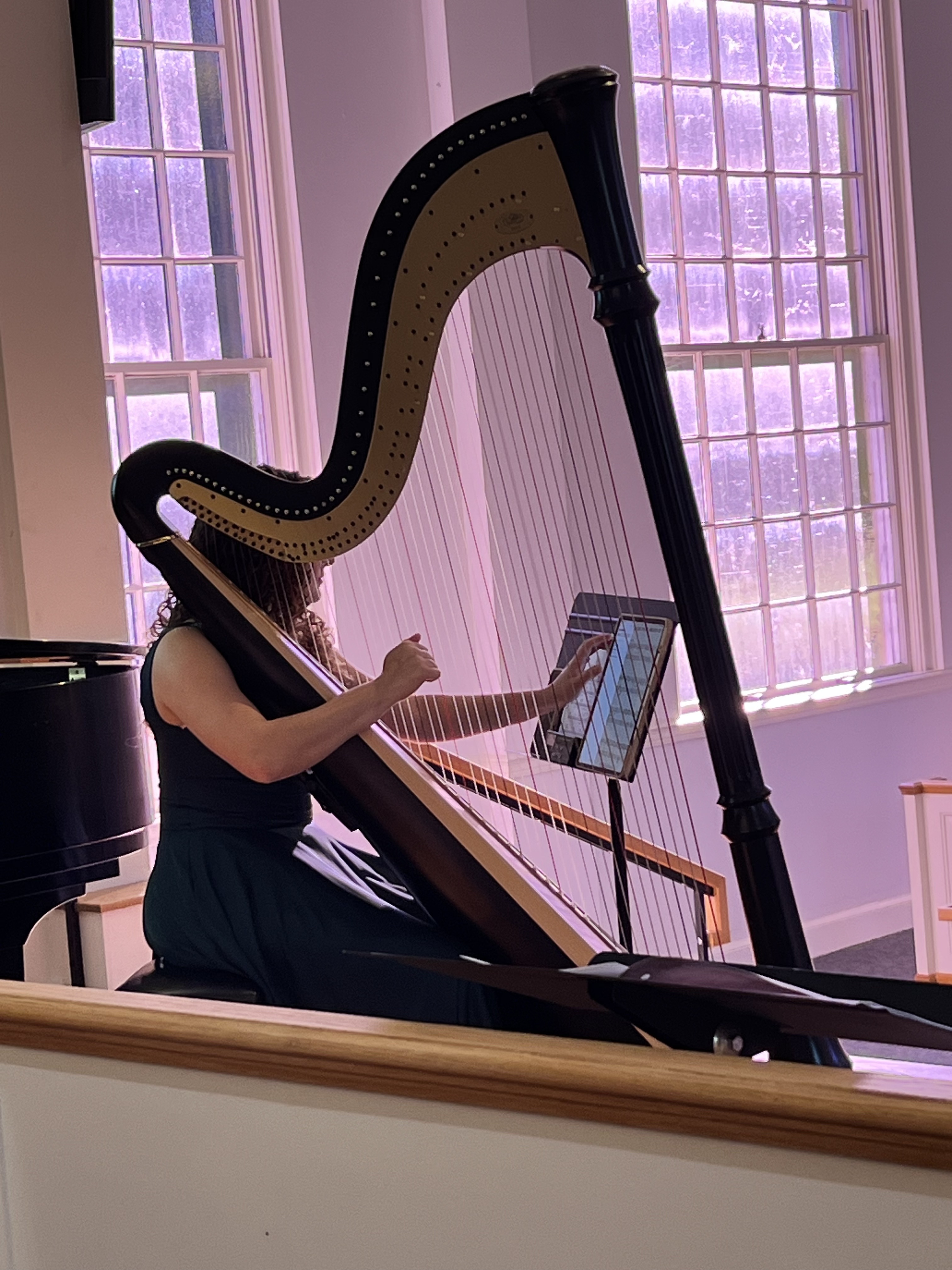
There is a moment before the harp is played, when the harpist leans in close and touches one string, then another, listening, turning a small key, listening again, until each note stands clear and distinct, and only then does she lift both hands and let the music come.
Last Sunday at St. Mark, Korenna Hodge sat at her harp and played “Breathe on Me, Breath of God,” and “In the Garden,” and at the end we sang “All Are Welcome,” and every note was distinct, every word of the hymn something I could carry home.
1 Corinthians 14 has a harp in it. It has a bugle too, and a stranger at the door.
Pursue love and strive for the spiritual gifts, and especially that you may prophesy. For those who speak in a tongue do not speak to other people but to God; for nobody understands them, since they are speaking mysteries in the Spirit. On the other hand, those who prophesy speak to other people for their upbuilding and encouragement and consolation.
Pursue love. The chapter begins where the last one ended. Love first. Then the gifts. Every gift measured by whether it builds up the other.
Upbuilding, encouragement, consolation. Three things a sermon is for. I wish I had written them on a card taped to the pulpit, these forty years. Not to impress. Not to win the argument. To build up. To encourage. To console.
Those who speak in a tongue build up themselves, but those who prophesy build up the church. Now I would like all of you to speak in tongues, but even more to prophesy.
Here it must be said plainly: Paul does not despise the gift of tongues. He speaks in tongues himself. I have Pentecostal friends, and brothers and sisters from the holiness churches, whose prayer rises in sounds I do not understand, and I have felt the Spirit in the room when they prayed. Paul’s concern is not the gift. It is the gathering. Who is built up when the church comes together?
Now, brothers and sisters, if I come to you speaking in tongues, how will I benefit you unless I speak to you in some revelation or knowledge or prophecy or teaching? It is the same way with lifeless instruments that produce sound, such as the flute or the harp. If they do not give distinct notes, how will anyone know what is being played? And if the bugle gives an indistinct sound, who will get ready for battle? So with yourselves; if in a tongue you utter speech that is not intelligible, how will anyone know what is being said? For you will be speaking into the air.
The flute or the harp. A harp with every string loose, plucked and plucked, a blur of sound, no melody anyone could sing. And a bugle in the dawn camp, blowing something no soldier recognizes, so no one rises.
Speaking into the air. I remember, by way of reflection, the sermons I preached into the air, long words from seminary, Barth and Tillich and Moltmann, to farmers and nurses and schoolteachers who had come on a Sunday morning needing bread. I gave them a bugle with no clear call. They were patient with me. They were kinder than my sermons.
There are doubtless many different kinds of sounds in the world, and nothing is without sound. If then I do not know the meaning of a sound, I will be a foreigner to the speaker and the speaker a foreigner to me.
A foreigner to the speaker. These are the words I take from 1 Corinthians 14.
I know what it is to be the foreigner. I crossed the sea long ago and stood in rooms where the words went past me like birds I could not name. And I know what it is to be the speaker who is foreign, preaching in a second language, my accent in every vowel, watching faces strain to follow me. Every Sunday for years I prayed, Lord, let them understand me. Let the gospel get through the strangeness of my tongue.
On Saturday the seventeenth, in Rome, Georgia, Deaf Christians gathered at a Baptist church for a day of worship and training, and a woman named Tarter, who is Deafblind, said, access is key, if you don’t have access to the information, it doesn’t matter what information you’re trying to share, you’re missing it. And a young Deaf worship leader taught how to interpret songs not only with the hands but with the face, the body, the rhythm, for those who cannot hear the music and know it by lyrics, beats, and vibration.
Access is key. Paul would have said it the same way. If they cannot receive it, it is speaking into the air.
And far away, this year, twenty-eight complete Bibles were launched, the whole Scripture now in more than eight hundred languages, among them the Marakwet people of Kenya. I think of an old woman in a Kenyan village hearing the psalms for the first time in the language her mother sang to her, no longer a foreigner to the Word.
So with yourselves; since you are eager for spiritual gifts, strive to excel in them for building up the church. Therefore, one who speaks in a tongue should pray for the power to interpret. For if I pray in a tongue, my spirit prays but my mind is unproductive. What should I do then? I will pray with the spirit, but I will pray with the mind also; I will sing praise with the spirit, but I will sing praise with the mind also. Otherwise, if you say a blessing with the spirit, how can anyone in the position of an outsider add their yes to your thanksgiving, since the outsider does not know what you are saying?
With the spirit and with the mind also. I remember, by way of reflection, the Methodist way I was taught, the warmed heart and the trained mind, John Wesley at Aldersgate, his heart strangely warmed, and the same Wesley reading Greek on horseback. Not one or the other. Both. The spirit that sings and the mind that understands what it sings.
The outsider. Paul keeps the stranger in view, the one at the back, the one who wandered in, who does not know when to stand, who cannot find the hymn number. Can they say yes to our thanksgiving? Can they follow the prayer? Worship is not a private room for those who already know the words.
I thank God that I speak in tongues more than all of you; nevertheless, in church I would rather speak five words with my mind, in order to instruct others also, than ten thousand words in a tongue.
Five words with my mind. This is the verse I keep turning over.
Five words. God is with you. You are not alone. Your sins are forgiven. Come, eat, there is room. I could have preached forty years on five words, and perhaps I did, under the ten thousand.
At seventy-seven my sentences grow longer, I lose the long word somewhere on its way to my mouth. And I find I do not mind. Five words, understood, are worth more than a library of brilliance. These poems I write now, short lines, plain words, are my five words offered at the end.
Brothers and sisters, do not be children in your thinking; rather, be infants in evil, but in thinking be adults. In the law it is written, By people of strange tongues and by the lips of foreigners I will speak to this people; yet even then they will not listen to me, says the Lord.
In the law it is written. Paul turns again to Israel’s Scripture, to Isaiah, the prophet who knew that God speaks even through foreign lips. Here it must be said plainly: Paul does not turn this word against his people. He turns it toward the Corinthians, toward the church, toward me. The danger of not listening belongs to all of us.
Tongues, then, are a sign not for believers but for unbelievers, while prophecy is not for unbelievers but for believers. If, therefore, the whole church comes together and all speak in tongues, and outsiders or unbelievers enter, will they not say that you are out of your mind? But if all prophesy, an unbeliever or outsider who enters is reproved by all and called to account by all. After the secrets of the unbeliever’s heart are disclosed, that person will bow down before God and worship him, declaring, God is really among you.
God is really among you. I remember, by way of reflection, the prophet’s vision of nations coming to Israel, saying, God is with you alone. And the stranger in Corinth saying the same about a little house church of slaves and merchants. The highest praise a church can receive is not, what fine music, or, what a fine building, but, God is really among you.
The secrets of the heart disclosed. Not exposed for shame. Disclosed for healing. I have seen it, a visitor weeping in the back pew because a plain word touched the place no one had touched, and afterward saying at the door, how did you know? I did not know. The Spirit knew.
What should be done then, my friends? When you come together, each one has a hymn, a lesson, a revelation, a tongue, or an interpretation. Let all things be done for building up. If anyone speaks in a tongue, let there be only two or at most three, and each in turn; and let one interpret. But if there is no one to interpret, let them be silent in church and speak to themselves and to God. Let two or three prophets speak, and let the others weigh what is said. If a revelation is made to someone else sitting nearby, let the first person be silent. For you can all prophesy one by one, so that all may learn and all be encouraged. And the spirits of prophets are subject to the prophets, for God is a God not of disorder but of peace.
Each one has a hymn. Each one. Not only the pastor. Not only the choir. A church where every person brings something, a hymn, a lesson, a word, and the others weigh it, and wait their turn, and let another speak. I think of all the Sunday mornings when I did most of the talking. Each one has a hymn. I should have listened more.
Let the first person be silent. A holy courtesy. When someone else has a word, sit down. Even the prophet stops talking when another rises. I am learning this too, at the church supper, at the family table, in old age. Let the first person be silent.
God is a God not of disorder but of peace. Shalom. Not the peace of a quiet room where no one dares to speak. The peace of a harp in tune, every string distinct, every voice heard, each in turn, making one music.
As in all the churches of the saints, women should be silent in the churches. For they are not permitted to speak, but should be subordinate, as the law also says. If there is anything they desire to know, let them ask their husbands at home. For it is shameful for a woman to speak in church. Or did the word of God originate with you? Or are you the only ones it has reached?
Here it must be said plainly: these lines have silenced women for nearly two thousand years. They have kept gifted women from pulpits, kept their voices out of councils, kept their wisdom at home. And these lines sit uneasily beside the same letter, where Paul assumes that women pray and prophesy aloud in the gathered church. Some ancient manuscripts place these verses in a different spot, and many faithful scholars wonder whether they were added later, or whether Paul was quoting the Corinthians’ own words in order to answer them. I do not know. I know only in part.
But I know this. I have heard the word of God from women in the pulpit, clear as a harp, building up, encouraging, consoling. My own church, long ago, opened its pulpits to women, and the Spirit did not leave the room. Did the word of God originate with you? No. It has reached the daughters too. It always has. Miriam with her tambourine. Deborah under the palm. Huldah reading the scroll for the king. Mary Magdalene in the garden, saying, I have seen the Lord.
Anyone who claims to be a prophet, or to have spiritual powers, must acknowledge that what I am writing to you is a command of the Lord. Anyone who does not recognize this is not to be recognized. So, my friends, be eager to prophesy, and do not forbid speaking in tongues; but all things should be done decently and in order.
Decently and in order. In my first years in this country I thought those words meant neat bulletins, straight rows, everyone seated by eleven o’clock. Now I think they mean something gentler. Order for the sake of love. Order so that the slow one can follow, so that the stranger can say yes, so that the Deaf worshiper can see the hands, so that the shy voice gets its turn. The order of a harp, tuned so the music can be heard.
And God whispered: Begin.
Not once, but every morning. Every time I choose five clear words over ten thousand clever ones. Every time I pray with the spirit and with the mind also. Every time I keep the stranger in view. Every time I sit down and let another speak. Every time I hear the word of God in a woman’s voice and give thanks. Every heart that rises after saying, I cannot, and then, after one long breath, Perhaps I can.
This is Corinthians in the language of my soul: love first, then every gift for building up, clear notes on a tuned harp, each one with a hymn, and a stranger at the door who says, God is really among you.
To pursue love. To speak five words with my mind. To keep the stranger in view. To let another speak. To make peace, not disorder.
The window is filling with light. In the next room my wife is humming a hymn, not loudly, just enough to carry, “Breathe on Me, Breath of God,” the one the harp played last Sunday. I know the tune before I know the words, and then I know the words, and I hum along, off-key, an old man’s voice, and the two of us, in separate rooms, make one plain music in the morning house.
God of peace and not disorder, thank You for every clear word that reached me, in my mother tongue and in the language I learned across the sea. Teach me to speak five words that build up rather than ten thousand that only sound wise, and to keep the stranger and the Deaf and the slow always in view. Forgive the church for silencing the daughters You have called, and let every voice You give be heard. Tune us like a harp, each string distinct, so that whoever enters may say, God is really among you.
Two old people on a porch swing, moving slowly, her hand on his, neither of them speaking, the chains creaking, the yard going gold.
If the rib could speak, I think it would say:
I was taken from his side.
Not from his head, the old preachers said, to rule over him.
Not from his feet, to be walked on.
From his side, near his heart, to walk beside him.
God built a woman from me while he slept, and when he woke, he sang: at last, bone of my bone, flesh of my flesh.
I don’t belong to him.
We belong to each other.
I take pleasure in three things, and they are beautiful in the sight of the Lord and of mortals: agreement among brothers and sisters, friendship among neighbors, and a wife and a husband who live in harmony.
A wife and a husband who live in harmony.
I stop here.
Fifty years.
Not always harmony.
My rough words.
Her patience.
And still, the swing, moving.
If you gathered nothing in youth, how can you find anything in old age?
How attractive is wisdom in the aged.
Rich experience is the crown of the aged, and their boast is the fear of the Lord.
The crown of the aged.
Not gold.
Gathered.
Then the chapter turns.
Any wickedness, but not the wickedness of a woman. No anger worse than a woman’s wrath. I would rather live with a lion and a dragon. A garrulous wife. Do not be ensnared by a woman’s beauty.
From a woman sin had its beginning, and because of her we all die.
If she does not go as you direct, separate her from yourself.
I can’t read this quickly.
I won’t read past it.
I want to say clearly: this is not permission to blame, shame, harm, or silence any woman.
Not Eve. Not any wife.
Sin did not begin with a woman.
Paul himself said, in Adam all die.
Garrulous. Venom. Dragon.
These are insults.
I won’t repeat them as Scripture’s truth.
I grieve for every woman who heard these lines read over her in a church, in a kitchen, in a court, and believed them.
And for every wife sent away because she would not go as she was directed.
The old poet of the reed says: woman is a ray of God; she is not only the earthly beloved; she is creative, not created.
A ray of God.
Husband, fifty years, not always in harmony. Pastor, reading chapters like this and not saying enough. Old man, on the swing, her hand on mine, gathering.
I am a rib. I was taken from his side. Not from his head to rule him, not from his feet to be walked on. From his side, near his heart, to walk beside him. I don’t belong to him. We belong to each other.
And I, a tenelach, when the heart is a porch at the close of a long day, sit beside the one God built from my side, and put my hand on hers, and say nothing, and let the swing move, and the chains creak, and see, in her quiet face, not the woman the book blamed, but a ray of God,
shining.
Note: God who built woman from the side of man, not to rule or to be ruled but to walk beside, thank you for fifty years of a wife who stayed in harmony with me when I did not deserve it, forgive every tongue, the book’s and the church’s and mine, that said sin began with a woman, or called a wife a dragon or venom or garrulous, or sent her away for not going as she was directed, grieve with every woman who heard these words read over her and believed them, and heal what they broke, and let me see in every woman a ray of you, creative and not only created, and give me in my old age the crown of rich experience gathered, and her hand on mine.
Five years a stranger, in my own retirement, drifting outside the common world, a cup poured out, not yet knowing what wine it was being emptied for.
*
The caravan of hours moved on without me. The mornings rose on the far side of the dunes. And sleep, that shy bird, would come near my hand and never land.
*
Ten years retired, I listened for the old drum, the pulse that once kept time for me, the hidden heartbeat that carried me through my days the way a mother carries a child who does not know he is moving.
The drum was gone. Only silence answered, and in the silence, a door.
*
Now I go down into the quiet rooms of the heart, where time forgets its hurry, where night is a cocoon spun from slow light, and the old self sleeps like a silkworm dreaming of wings.
Die before you die, the night whispers, and I am not afraid.
*
Now I rise, at three, at the lamp, with a new rhythm in me, not found, not borrowed, but grown from within, the way a rose does not search for its color.
The cup is empty now. The Cupbearer has begun to pour.
*
This is my adjustment: a turning, a returning, a re-turning, the moth back to the flame, the drop back to the sea, each step carrying me closer to myself, and in myself, to the One who was closer to me than my own breath all along.
A knock comes at midnight, and a lamp comes on inside. Outside, this October, the whole world is knocking.
He was praying in a certain place, and after he had finished, one of his disciples said, “Lord, teach us to pray.”
Teach us to pray. After forty years of public prayers, of pastoral prayers and benedictions and graves, I still sit at three in the morning with the news open beside the Bible, and I do not know how to pray this week. Teach me.
“Father, hallowed be your name. Your kingdom come.”
Your kingdom come. Not Caesar’s kingdom, not the empire of the strongest missile. I pray for a kingdom that comes the way dawn comes to my window, quietly, from below the hills.
Hours after a U.S. envoy sat with Putin in St. Petersburg, ballistic missiles struck Kyiv’s transport and medical buildings in waves through the night. UN monitors say the first two weeks of October were among the deadliest for Ukraine’s civilians in years. Days earlier in St. Petersburg, Ukrainian drones set an oil terminal burning, and one person was killed. The workers on both sides of that smoke have mothers too.
Here it must be said plainly: I pray for the kingdom while empires burn each other’s cities, and I will not say peace, peace, when there is no peace.
“Give us each day our daily bread.”
Daily bread. In Afghanistan the food is in the markets, but people cannot afford it. Nearly one in three face crisis-level hunger, and winter will push millions “one step away from famine.” In Tawila, a Darfur camp of about 700,000 displaced people, rations have been halved, and the rains in North Darfur were the lowest since 1984. In Taiz, under siege, the wheat may run out in less than three weeks.
Give us, not give me. The bread prayer has no private table. I have broken bread at a thousand altars and kitchen tables, and every loaf was meant to have room at its edges for a stranger’s hands.
“And forgive us our sins, for we ourselves forgive everyone indebted to us.”
Everyone indebted to us. Luke says debt. I remember, by way of reflection, the scroll at Nazareth, the year of the Lord’s favor, the Jubilee, when debts were released and land went back to the families who had lost it.
The poor nations owe the rich ones. The working poor owe the payday lender. The student owes the bank for the right to learn. When I pray this line, I pray for a Jubilee I may not live to see, the way an old man plants a tree whose shade he will never sit in.
“And do not bring us to the time of trial.”
“Suppose one of you has a friend, and you go to him at midnight and say, ‘Friend, lend me three loaves of bread, for a friend of mine has arrived, and I have nothing to set before him.'”
I have nothing to set before him. This month the World Food Programme cut food aid and in Gaza by about a third, leaving some half a million without monthly support. Two million still need shelter, and the winter rains have begun. Families fill old flour sacks with sand and pile them around their tents to hold back the water.
Flour sacks, emptied of bread, holding back the flood. “These are flour sacks that we used to retrieve from the jaws of death, so that we could eat,” a young man said. I grieve for Gaza’s children, and I grieve for the Israeli families still mourning the October morning three years ago. Grief has no border, and the rain falls on every tent.
“Do not bother me; the door has already been locked, and my children are with me in bed.”
The door is locked. How often the rich world answers from behind a locked door: not now, our children are asleep, the budget is closed. And how often I have answered that way myself, from behind the warm door of a busy week.
“At least because of his persistence he will get up and give him whatever he needs.”
His persistence. The old word means shamelessness. Teach me to knock without shame for those who cannot reach the door, to keep knocking the way rain keeps falling on a tin roof, until even a sleeping house wakes.
“Ask, and it will be given you; search, and you will find; knock, and the door will be opened for you. How much more will the heavenly Father give the Holy Spirit to those who ask!”
The Holy Spirit. Not only what I ask for, but the Giver. The wind enters the emptied heart the way breath enters a flute, and what was hollow in me begins, at last, to sing.
“Every kingdom divided against itself becomes a desert, and house falls on house.”
House falls on house. This is the verse I keep turning over this week. In India, 130 million names have been struck from the voter rolls, and some declared dead are still proving they are alive. In France, after the worst rioting in years over the cost of living, curfews fell on Paris and Lyon.
In my own country, red houses and blue houses are falling on one another. My own church, and the global church I have loved, are divided too, house on house. I have sat in conference rooms where brothers and sisters stopped looking at one another, and I felt the desert spreading under our chairs.
“But if it is by the finger of God that I cast out the demons, then the kingdom of God has come to you.”
The finger of God. I remember, by way of reflection, the magicians of Egypt, unable to copy the gnats, saying to Pharaoh, “This is the finger of God.” One finger, and Pharaoh’s power began to crack, like river ice under the first March sun.
A woman in the crowd cried out, “Blessed is the womb that bore you!” But he said, “Blessed rather are those who hear the word of God and obey it.”
Blessed rather. He widened the blessing. Her worth was more than her womb, and every listening heart may carry the Word.
“Your eye is the lamp of your body. Therefore consider whether the light in you is not darkness.”
Consider whether the light in you is not darkness. This country has called darkness light before. Slavery was blessed from pulpits with chapter and verse. The Cherokee were marched west out of these Tennessee hills in 1838, while church people called it progress. I drive past those hills, and the leaves this October are the color of embers.
In my strong years, I was sure of my own light. Some of it was only my shadow, cast very large against the sanctuary wall. The mirror of the heart must be wiped clean again and again, and at seventy-seven I am still wiping.
“You Pharisees clean the outside of the cup and of the dish, but inside you are full of greed. So give for alms those things that are within.”
The outside of the cup. In California, Meta made a deal so Mark Zuckerberg would not leave the state over a proposed billionaire tax. Great fortunes polish the outside of the cup, and the poor wash the dishes.
Give as alms what is within. Generosity washes the heart from the inside out, like spring water rising through an old well until it runs clear.
“Woe to you, for you tithe mint and rue and herbs of all kinds, and neglect justice and the love of God.”
Justice and the love of God. Luke sets them side by side, like two hands folded in prayer. Love of God without justice is a cup washed only on the outside. Justice without the love of God is a lamp without oil. I have tried to hold both all my life, and most days one hand slips.
Here it must be said plainly: these woes were spoken by a Jew to his own teachers, in the long family quarrel of the prophets. The church turned “Pharisee” into a curse against the Jewish people, and that was our sin. The Pharisee in this chapter lives most easily in my own heart and my own pew.
“Woe to you, for you are like unmarked graves, and people walk over them without realizing it.”
Unmarked graves. Here it must be said plainly: Native children buried behind boarding schools, the ones who died on the Trail of Tears, the enslaved, buried in fields now paved for parking lots. This nation walks over them every day without knowing, and the earth remembers what we forget.
“Woe also to you lawyers, for you load people with burdens hard to bear, and you yourselves do not lift a finger to ease them.”
Not lift a finger. The finger of God casts out demons, and the powerful will not lift one finger. I have laid burdens from the pulpit and not lifted a finger to help carry them. Forgive me.
“I will send them prophets and apostles, some of whom they will kill, from the blood of Abel to the blood of Zechariah, who perished between the altar and the sanctuary.”
Between the altar and the sanctuary. Birmingham, 1963, Sixteenth Street Baptist Church: four girls dressed for Sunday. Charleston, 2015, Emanuel AME: a Wednesday night Bible study that welcomed a stranger to pray with them, and nine died.
They were learning to pray. Teach us to pray, the disciples said, and those nine had already learned. Holy Wisdom grieves her children, from Abel to Zechariah, through Auschwitz, Hiroshima, and Rwanda, to Kyiv, Gaza, Darfur, and Taiz.
“Woe to you lawyers, for you have taken away the key of knowledge; you did not enter yourselves, and you hindered those who were entering.”
The key of knowledge. This country once made it a crime to teach the enslaved to read. Then came literacy tests at the courthouse door, the poll tax, the bridge at Selma. Today girls in Afghanistan are kept from the classroom, and in India names are struck from the rolls.
I was given a key. A young man who crossed the sea, and the doors that opened for him: Drew, Bernard’s long love-song of the soul, a pulpit for forty years. Woe to me if I keep that key in my pocket. A key is only holy when it turns in someone else’s lock.
When he went outside, the scribes and Pharisees began to press him hard, lying in wait to catch him in something he might say.
The knock comes again at midnight. I put down the news. I put down the pen. I rise slowly from the chair. The lamp is still burning, the bread is on the shelf, and somewhere in the dark the old whisper says,
Begin.
The door is not locked.
Note: God who taught us to ask for bread for all of us, one day at a time, hear the knocking from Kabul, Darfur, Gaza, Taiz, and Kyiv, and do not let the rich world answer from behind a locked door. Release the debts that crush the poor, and straighten the bent scales of nations and of my own heart. Show me where my light is darkness, and remember every name in every unmarked grave. Put the key of knowledge back into the hands of those kept outside, and teach me, still, to pray.
Listen. Every reed in the field is singing, the old song of the reed cut from its riverbank, longing to go home, and the whole hillside joins in until the chorus forgets it was ever many voices.
*
Above, the cobalt spreads wide and deep, the open robe of the Friend, and nothing hides.
*
Below, the pond lies still, a mirror wiped clean, and the light that falls into it looks back at itself and smiles.
*
On the horizon, trees stand like crystal, a line as thin as breath, the veil between this world and the next worn almost through.
*
Then the Beloved breathes into the reed. The air fills with a longing that needs no translation. Every creature knows this tongue. It is the first language, spoken before we were born.
*
The finch and the grasses whisper together the way lovers whisper when they think no one is near, and their secret rises like incense to the One who already knows it.
*
All creation is taking leave, and gladly, the way the moth goes to the flame, not losing itself but finding itself in the light.
Each leaf lets go the way a drop lets go into the sea.
It’s the season of saying goodbye.
*
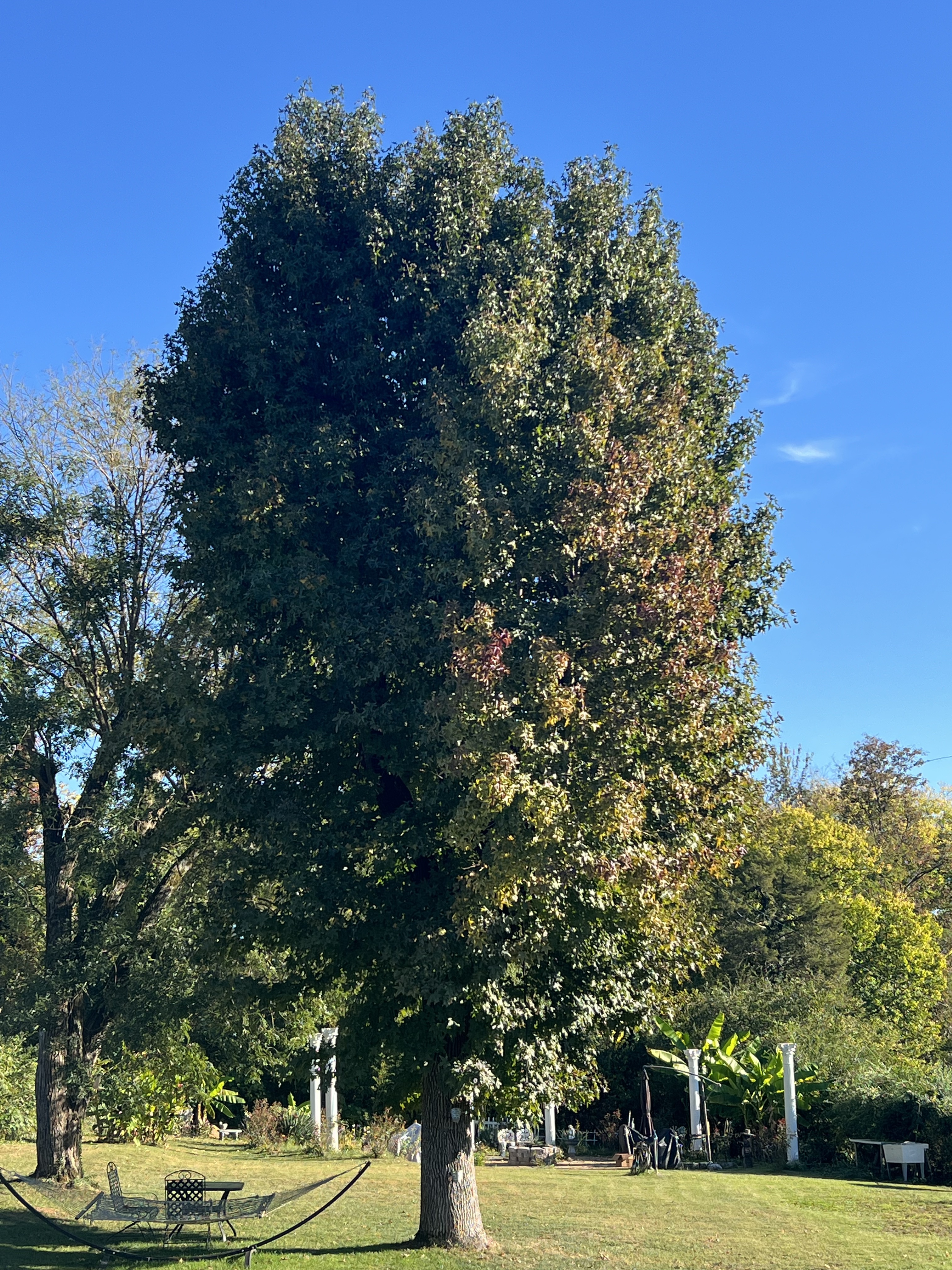
And hearts become guest houses, even an old heart like mine, seventy-seven autumns in it. Sorrow comes in, joy comes in, and I welcome them both, because each one was sent from beyond.
*
Don’t you taste it? The wine of love, poured in the falling of the leaves, sweet and a little sharp, the thin edge of eternity hidden in the pleasure of letting go.
The Fall is the promise of returning in the eternal realm.
*
From You we came. To You we return. Each goodbye is a door.
Behind him, the stones of the past. Ahead of him, the road home.
And on the way, the angels of God met him.
*
“This is God’s camp,” he said, and named the place Mahanaim, two camps.
Perhaps heaven was walking beside him. Perhaps the lonely road was never lonely.
The Beloved travels with the traveler, a second shadow the sun cannot cast.
*
Then another name came into his heart.
Esau.
The brother he deceived. The brother whose blessing he stole. The brother who once swore to kill him.
*
Jacob sent messengers ahead: Tell my lord Esau, your servant Jacob has lived with Laban until now. I have cattle, donkeys, sheep, servants, and families. I send this to find favor in your sight.
*
Today he might have typed it into a phone, read it over twenty times, pressed send, and watched the screen.
Three small dots. Then nothing. Then the dots again.
*
The messengers returned.
Your brother is coming to meet you, and four hundred men are with him.
*
Jacob was terrified.
His heart became a small room with no door.
*
He split his people and his flocks into two camps. If Esau attacks one, the other may escape.
Fear is always a careful planner.
*
Then Jacob prayed.
O God of my father Abraham, God of my father Isaac, You told me, return to your country, and I will do you good.
I am not worthy of the least of Your steadfast love.
I crossed this Jordan with nothing but my staff, and now I have become two camps.
Save me from the hand of my brother. I am afraid.
*
With nothing but my staff.
I crossed a sea once, from the East, with little more than a suitcase and a call I could not fully explain.
Now I look around this house in Knoxville: a wife of fifty years, two married daughters, a son, grandchildren, forty years of churches behind me.
I have become two camps. I am not worthy of the least of it.
*
Jacob remembered the promise, but fear was still breathing inside him.
Faith does not always silence fear.
Sometimes faith is only the prayer we say while fear sits in the room with us.
*
He sent gifts ahead, goats and sheep, camels, cows, donkeys, one drove after another.
Tell him these are from your servant Jacob, and Jacob is coming behind.
*
I will cover his face with gifts, Jacob thought. Perhaps then he will lift up my face.
*
How much of my life was spent like this, sending gifts ahead, good works, good sermons, hoping to soften a face I was afraid to meet.
*
That night he sent his wives, his children, and everything he had across the river Jabbok.
And Jacob was left alone.
*
Alone.
The word stood like a stone.
*
His family across the water. His wealth across the water. His future unknown. His past coming with four hundred men.
*
It looks like a modern night: a man in a parked car under an interstate bridge, trucks roaring overhead, the river black below, the phone face down on the passenger seat.
Or an old man at three in the morning, awake in a dark kitchen, the house asleep, nothing to do but face himself.
*
And there, in the darkness, someone wrestled with him until daybreak.
*
A man? An angel? God?
Jacob did not know.
He knew only that he could not let go.
*
He had wrestled with his brother in the womb. With his father-in-law for twenty years. With life itself.
Now he wrestled with God.
*
The stranger touched his hip, and it was thrown out of joint.
Still Jacob held on.
*
Let me go, for the day is breaking.
I will not let you go unless you bless me.
*
A wounded man asking for blessing.
The one who once stole a blessing in his brother’s clothes now begs for one in his own torn body.
Not by trick. Not by force. By holding on through the night.
*
What is your name?
Jacob.
*
The heel-grabber. The one who supplants.
To say his name was to confess his whole life.
*
I have had to say my name like that.
Not the title. Not Reverend. The real name underneath: the one who performed, the one who prayed less in his strong years, the one with rough words and bent scales.
God does not bless the costume. God asks for the name.
*
Your name shall no longer be Jacob, but Israel, for you have striven with God and with humans, and have prevailed.
*
A new name.
Not because his past had disappeared. Not because his hip had healed.
Because he had gone through the night, and was no longer the same man.
*
Please tell me your name.
Why is it that you ask my name?
And there the stranger blessed him.
*
Some names are not given to hold.
They are given as a blessing, and the hand stays open.
*
Jacob called the place Peniel, the face of God.
For I have seen God face to face, and yet my life is spared.
*
The sun rose on him as he passed Peniel, limping because of his hip.
*
The blessing had left a wound.
And the wound had become part of the blessing.
*
We do not always leave our meeting with God stronger, the way the world measures strength.
Sometimes we leave limping.
But we limp with a new name. We limp with deeper humility. We limp knowing we survived the night, knowing we were held while we were holding on.
*
My knees are slow now. I used to think grace would make me stronger. I am learning it can also make me humbler, and lean on Someone with every step.
*
Jacob had spent his life grasping.
The heel. The birthright. The blessing. Whatever he feared belonged to someone else.
*
At Peniel his hands learned another kind of grasping.
Not taking, but holding on. Not owning, but surrendering. Not winning, but being changed.
*
I think of the brothers and sisters in my own life I have not spoken to often.
A church that split. Colleagues who walked away. Old friends lost in a quarrel neither of us can remember well.
And I think of the world, where nations are brothers with four hundred men on each side, and borders where families stand on two banks of one river.
Every reconciliation has its own Jabbok, a night no one can skip.
*
Morning came.
The river moved quietly. The camps waited. Esau was coming.
*
Jacob could not know what would happen next.
But he knew who he had become.
Israel. A wounded pilgrim. A man who found that the face of God can be met in the very darkness we most want to escape.
*
He walked toward Esau. He walked toward his past. He walked toward reconciliation.
With every uneven step, the new day opened.
*
The night was over. The wound remained. The blessing remained.
And the God who met him at Bethel, followed him to Haran, watched over him twenty years, was still walking beside him.
*
Jacob came home with a limp.
But perhaps for the first time he was truly on his way home.
*
Note: God who wrestles with us in the dark until the day breaks, I will not let You go; bless me, wounded as I am. Take my old grasping name and give me the one You choose, let the limp You leave in me remind me who I lean on, and walk with me toward every sister/brother I have still not met.
Twenty years in another man’s house, under Laban’s watchful eyes, through heat by day and frost by night.
His wages changed like the moon, ten times. His life was weighed on another man’s scale.
But the Friend had not forgotten him.
*
Jacob heard Laban’s sons: He has taken everything our father had.
And he saw Laban’s face turned away from him, like a sunflower that has found another sun.
Then God spoke: Return to the land of your fathers, and I will be with you.
The road he had feared was the reed bed calling the reed home.
*
He called Rachel and Leah out to the field, away from their father’s walls, where the wind could carry the truth.
Your father’s face is no longer toward me. But the God of my father has been with me.
He cheated me. He changed my wages. Yet God has seen the work of my hands.
*
The sisters listened. They remembered too.
Their father’s house had been a cage painted like a home. He had sold them like sheep in the market, and spent what was theirs.
So they said, Do whatever God has told you.
*
Jacob rose. Wives, children, flocks, servants, everything God had given, a caravan slipping out at dawn without a word to Laban.
The door of the old house closed behind him like a book.
*
But Rachel carried something hidden. Her father’s household gods, wrapped and tucked away.
No one knew. Not Jacob. Not Leah. Not Laban.
*
We leave the old house and think our hands are empty. But the heart is a deep saddlebag. It carries old fears, old loyalties, old wounds, small gods we never meant to bring.
*
Three days passed before Laban knew. Seven days he rode after them.
Then, in the night, God came to Laban in a dream: Be careful. Say nothing to Jacob, good or bad.
The Friend had stepped between the hunter and the hunted.
*
At last Laban caught up, anger in the air like dust before a storm.
Why did you steal away? Why carry off my daughters like captives of the sword? And why did you steal my gods?
*
Jacob did not know. Search everything, he said. Whoever has your gods shall not live.
A careless word, an arrow shot into the dark, falling closer to Rachel than he knew.
*
Laban searched tent by tent, bundle by bundle.
Rachel sat on the camel saddle, the gods hidden beneath her. Do not be angry, my lord. I cannot rise. The way of women is upon me.
And the gods stayed hidden.
*
What strange gods, small enough to hide, small enough to carry, small enough to sit on. And still people trusted them with tomorrow.
We do the same. Money. Control. Reputation. The approval of others. Little clay gods, smooth from our worried hands.
But the God of Jacob cannot be hidden under a saddle. The Beloved does not fit in our tent.
The ocean does not live in the cup. The cup lives in the ocean.
*
Then Jacob’s anger rose, twenty years of it, pouring out like water over a broken dam.
Twenty years your ewes did not miscarry. Twenty years I paid for every torn lamb. Heat consumed me by day, frost by night, and sleep fled my eyes.
You changed my wages ten times.
If the God of my father, the God of Abraham, the Fear of Isaac, had not been with me, you would have sent me away empty-handed.
But God has seen my affliction and the labor of my hands.
*
God has seen. The whole road fits in those words.
The God who saw Hagar by the desert spring. The God who saw Leah in her lonely tent. The God who saw Jacob asleep on a stone.
The Beloved sees the labor no one praises, the tears no one notices, the years no one remembers.
Sometimes that is enough to keep a tired soul walking.
*
Laban answered: The daughters are mine. The children are mine. The flocks are mine. All you see is mine.
Mine, mine, mine, the old song of the fist.
But Jacob was learning a new tongue. Blessing cannot be owned. It is wind through an open hand, received, tended, passed on.
*
So they made a covenant.
Jacob set up a stone as a pillar. His kin gathered stones into a heap, and they ate bread beside it.
Laban called it Jegar-sahadutha. Jacob called it Galeed.
A heap of witness, two names for one memory, a line drawn in stone between yesterday and the morning.
*
The stones said: Remember the wounds. Remember the years. Remember the anger. But do not carry the old war into the new day.
*
Laban said, May the Lord watch between you and me when we are out of each other’s sight.
Not a spy’s eye. A prayer. May the Holy One stand in the space between us, a quiet flame keeping both tents from burning.
*
They broke bread. In the morning Laban kissed his daughters and his grandchildren, blessed them, and went home.
And Jacob turned his face toward the hills.
*
Ahead, Esau was waiting. Fear was waiting. The unknown was waiting.
But Jacob was not the man who had fled Canaan.
He had learned to labor, to wait, to love, to be deceived, to carry the weight of others.
And deepest of all, he had learned that the Friend does not leave when life turns unjust.
*
The God of Bethel had walked beside him twenty years, through another man’s house, through changing wages, through family wounds, through the long night, on the long road home.
Home is not only the place we return to. Home is the moment we see the Guest has been walking with us all along.
*
The stones remained. The covenant remained. The wounds were not erased. But the war was over.
Peace is not forgetting. Peace is remembering without letting the memory hold the reins of tomorrow.
*
Jacob walked on. Beyond the next hill waited the brother he had wronged.
The past was riding out to meet the future. But this time, Jacob did not walk alone.




You must be logged in to post a comment.