(Parsonage Letter: Story of the Four O’Clock Flower, Ninth)
© Wanhee Yoon, 1995
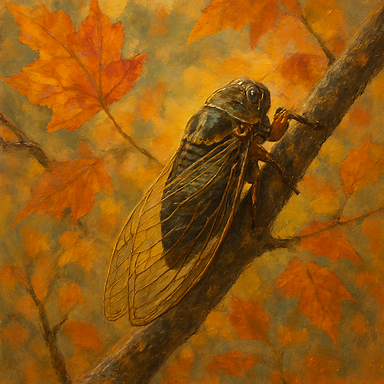
A few days ago, while eating breakfast, I found myself gazing out the window at the thick summer greenery. Then suddenly, from outside, came the loud chorus of cicadas rising all at once.
“Why is it so noisy? It’s not just one—hundreds of them are crying together!”
I murmured almost in complaint, startled by the sudden racket.
The pastor, who was reading his newspaper while eating beside me, looked puzzled.
“You mean you only hear that sound now? I’ve been hearing it for several days already.”
“Really? But why do I only hear it suddenly, just now? A moment ago, there was nothing…”
It was as if I had fallen under a spell. My ears opened wide, and the cicadas’ voices poured in all at once—astonishing.
The pastor folded his paper and said,
“That sound is the sound of time’s waves. Of course, it’s the desperate cry for a mate, but it’s also the sound of preparing for the next year. As each season passes, nature sings its many voices: in winter, the wind and the hush of falling snow; in spring, the bursting of new shoots, the thawing of frozen earth; in summer, the passionate thunder and lightning storms. And this cicada’s cry—surely it tells us autumn is on its way.”
The sound of time’s waves. Ah, indeed! Hearing so many cicadas crying at once—yes, autumn must be drawing near.
The pastor nodded.
“It is not a sound you hear all year round, but only in this brief season. It reminds us, who are busy just surviving each day, to look to the heavens, to search our inner selves, to train our ears to the breath of God.”
I agreed, and felt ashamed for neglecting the sounds of nature. The cicada lives only one season, pours out its whole being in that shrill “meeeeh-m,” and then is gone. Yet I, with my heart’s window closed, had been so stingy in listening.
The world is filled with countless sounds, yet how many we fail to hear! Nature speaks faithfully through all four seasons, but too often we, with our eyes fixed on the ground, live deaf to its voice.
Just as nature has its appointed sounds, so history has its sounds as well. Some are joyful, others suffocating, some stir our anger, some remain as silence—silence itself becoming an eternal sound that shakes the soul more than words.
As we marked the 50th anniversary of our nation’s (Korea) liberation, countless voices resounded at history’s crossroads. They broke our hearts, shocked us, saddened us. They reminded us of the trials and suffering our people endured in the noise of oppression. Without realizing it, we have become entangled in a complicated consciousness. Even foreign scholars confess that it is nearly impossible to grasp our people’s inner world: we cannot laugh freely when happy, nor weep openly when sorrowful—we hesitate to express ourselves honestly.
Beloved homeland! Even across the ocean, sounds reach us here. The sighs of apartment dwellers, the cracking of walls, the groans of corruption embracing power, the collapse of Sampoong, the collapse of Christians, the cries of Gwangju, the endless declarations of new political parties. And yet, somewhere, again and again, comes the song of unification—so close to bursting forth that our hearts tremble and sway.
Fifty years after liberation, our nation is still bound by division, by han, by regional strife, by the barbed wire of narrow human relationships. We bear the tremendous burden of unification. Faces stained with blood and tears still stand far off, struggling in the distance, as though if we only called “Father! Mother!” they would run toward us smiling—but they do not. Children born in the blessing of freedom have grown old carrying pain on their backs, walking into the sunset.
Today, still sick with the disease of division, unable to taste the full joy of liberation—I repent before God. I confess the mistrust and hostility I hold toward others. I confess that I put myself before my neighbor. I confess that I tried to earn what was freely given by grace. Standing at this fiftieth milestone of liberation, I pray that reconciliation may begin not from others, but from me.
This summer in New York was unbearably hot. Now, as the worst of the heat has passed, I look at the scattered cicada shells in the parsonage yard—hollow husks, remnants of a time already gone. I pick them up, turning them in my hand, pondering again the shells of dead time.
And I long—to become a cicada myself, to lift my voice all day long, crying out until hoarse beneath someone’s window.

 Daily Sauntering
You must be logged in to post a comment.