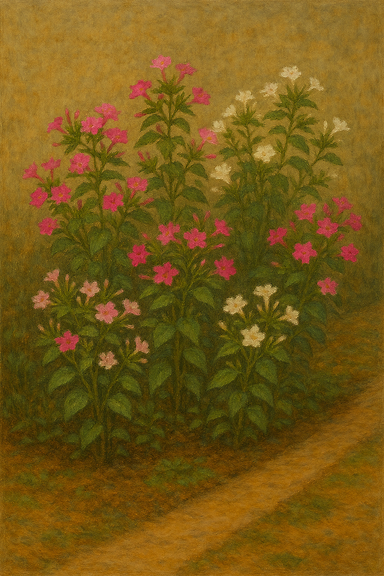
In our garden, the deep pink four o’clock flowers are now in full bloom, freely displaying their graceful beauty. From just a few seeds my mother planted last spring, the branches spread wide, and countless blossoms competed to bloom and fall throughout the summer.
These flowers seem bashful under the noonday sun, keeping their petals tightly closed, yet as the sun sinks beyond the western hills, they begin to open shyly. And when the white moon rises into the evening sky, they burst forth in full bloom—serene, pure, and at the height of elegance.
As I gaze upon their radiant petals, blossoming so abundantly, I feel as though sparks of life itself leap forth, a passion burning within. Whose life could be this vibrant, this diligent? Whose life could flower with such purity and beauty?
Long ago, four o’clock flowers often filled a corner of country yards, serving as the women’s “flower clock.” Grandmothers would watch for the moment when the petals began to open, and then tell their young daughters-in-law it was time to set the barley into the cauldron. For the men returning from long days in the fields, a good supper required the barley to be thoroughly boiled before the rice was cooked, so that fragrant barley rice would be ready on time.
These flowers were also an essential part of children’s play. Girls would pluck colorful blossoms to tuck into their long hair for make-believe weddings; crushed red petals, mixed in bits of broken pottery, would become food for play meals; and the white powder hidden inside the black seeds was brushed onto tender cheeks like a gentle face powder.
Carried with us in our immigrant bundle, the four o’clock flower knows how to turn even loneliness and sorrow into blossoms. Even without its old companions—the portulaca and balsam—it quietly fulfills its calling wherever it is planted by the hands of its master, pouring out the fullness of beauty, patience, joy, and restraint until its very life is spent. With arms forever raised toward the sky, it welcomes wind, sun, moon, rain, and thunder alike, and it holds the wisdom to know its time to bloom and its time to fall. Should a passing butterfly alight for a moment, the flowers, grateful, tremble with delight and join in the dance. They adore the gentle moonlight of evening, and to the nightlong serenade of field crickets pouring out their longing, their faces blush deeper red by morning.
Last month, when heavy downpours lashed for days, the four o’clock flowers all collapsed forward. Their fragile leaves and petals, beaten down by the rain, nearly uprooted them from the soil. With clumsy hands I tied their stalks upright and heaped soil around their roots for support. Soon, as if they had never fallen, they regained strength, lifted their faces, and breathed deeply toward the sky once more. Even in such small bodies there seemed to dwell a divine allotment of life, unwilling to return to earth before its appointed time.
The nature of the four o’clock flower is ever cheerful and pure. They resemble the innocent smile of elder sisters, the bright laughter of children, or the tender grace of a young bride next door. Not dazzling or extravagant, but warm, affectionate, and endearing. And yet, their small bodies cannot hide the mark of passing years—dark seeds rolling to the ground, petals falling without regret. But each seed carries a steadfast promise: the firm, unshakable covenant of resurrection, that tomorrow they shall rise again with the same life.
Who first taught these flowers the measure of time and season?
Who whispered to them the promise of tomorrow?

 Daily Sauntering
You must be logged in to post a comment.