(Letter from the Parsonage, Those Who Remained in the City, Fourteenth Story, 1994)
© Yoon Wan-Hee
“Did you know she had tuberculosis?”
The social worker’s voice buzzed from the phone, startled and anxious.
“As you know, I told you clearly yesterday that it was the first time I had met her myself!”
A slightly calmer tone came back through the receiver.
“Well, if what she said yesterday was true, she left her belongings at some Korean restaurant and asked me to pick them up for her. I’ll try to make time and go there soon.”
The social worker asked several times, almost pleading, for me to check quickly, and only then hung up, sounding somewhat relieved.
The call from the 105th police station had come about two weeks earlier. A homeless Korean woman had been wandering around the police station without leaving, and for three nights she had been sleeping in a chair inside the station. After interviewing her, my husband realized she needed both a health checkup and psychiatric care, and he sent her to a municipal hospital. Later the hospital transferred her to a psychiatric hospital and asked for our cooperation in finding her relatives.
In the north wing of the psychiatric ward, Black and white women with messy clothes and hair, their eyes unfocused, were bustling back and forth or sitting muttering intensely to themselves. The more seriously ill women were locked in rooms with keys, begging passersby to open the doors.
She looked about forty-five, with clear, clean skin, double-lidded eyes, and long permed hair flowing neatly down. During about fifteen minutes in the visiting room, she sat upright, composed, without a trace of disorder. At times she was almost overly polite, then suddenly glanced around and sighed deeply, saying she had reported to the police because bad people in the ward were trying to harm her. She also begged me to retrieve her two suitcases from a Korean restaurant and keep them safe.
What she said turned out to be true. With a skeptical heart—how could one trust the words of a psychiatric patient?—I called the restaurant she had named. They confirmed that they indeed had her bags.
The large travel bag was heavy. Carrying it out, hoping it might reveal her background, I felt the car rattling more than usual and thought there must be many torn-up roads.
Someday, when New York City’s finances improve, the smooth roadways will be paved again! Or, someday, when the han (deep sorrow) in our immigrant hearts disappears, when wounds are healed and dreams fulfilled, then everyone will speak with laughter of the time when we ran down the potholed immigrant road patched with longing and tears…
As I opened the woman’s bag, my heart began to tremble. Each item, carrying the scent of her life, stirred countless thoughts as if I were touching sacred objects. What were her dreams?
Inside, everything was clean and orderly. Underwear neatly washed and folded, winter and summer clothes separately packed and wrapped in white plastic. Between the clothes lay a bundle of papers—an English-Korean dictionary, GRE test prep books, envelopes from several U.S. universities, admission documents stamped February 5, 1985. An expired passport held her radiant smiling photo. There were a few blank airmail postcards, a well-kept black-and-white photo of a handsome man, and a carefully preserved, though years-old, Mother’s Day card. Between its pages lay a photograph wrapped lovingly in white paper—a photograph that struck me deeply.
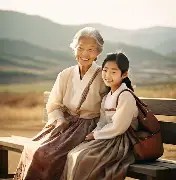
It showed an elderly woman in a pale hanbok standing on a bridge before a rural Korean reservoir, her hair pulled back into a bun, her smile fading as the picture was taken. Mother! It could only be her mother. Suddenly a wave of longing for my own mother crashed over me.
How many hours of sorrow had her mother endured after sending her young daughter to a foreign land? How many moments had the daughter, in her loneliness and struggle abroad, drawn courage and strength from that smiling photograph of her mother to nurture her dreams? How many nights, holding shattered dreams before that brilliant name “Mother,” had she wept bitterly? Just as a mother’s name is one, so is the heart of all mothers one. I thought of poet Kim Namjo’s confession that all her life’s burning and offering were shared between herself and her mother, known only to God. Like gathering broken pieces, I carefully repacked the scattered things of this woman. And I began to write a letter to her mother, who might still be alive:
“Mother! At last I take up the pen. Forgive me for loving you yet never properly saying, ‘I love you, Mother!’ It has been over ten years since I thought that when a new life began, I would run back to your side. Mother! These letters that never reached you, I let them fly in this spring wind. My unfinished dreams I will humbly bury in this land. My hungry desires I will lay aside. Mother! And I will return to your arms, smelling of the earth, where the buds of my life first began to bloom. Mother! Even if you say, ‘Is this the final stop you’ve arrived at?’ I trust you will not blame me. You will be my upright witness, my welcoming host, greeting me barefoot on my homecoming road. I pack my broken dreams back into the bag. Receive me. Forgive me.
—Your unfilial daughter.”

 Daily Sauntering
You must be logged in to post a comment.