© TaeHun Yoon, 1979 in Korean, Trans. by Copilot.
– A dream for peace beneath the storm –
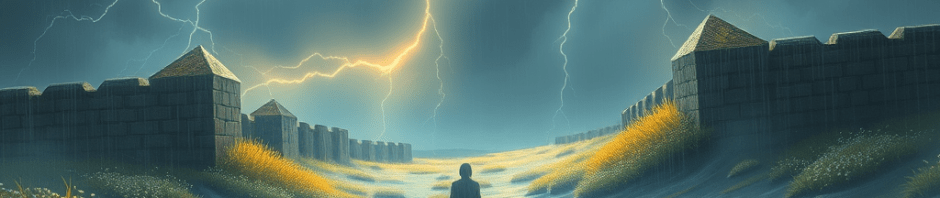
Lightning split the sky— and the earth, pale blue and yellow, wore the face of a weary child.
Rain walked with sky and soil, sloshing through the mire. White houses burned in the flash, but the fire longed to breathe with us— to share joy, to eat bread, to drink wine, to speak, to touch a human hand.
The stone walls, wet with rain, gleamed. They smiled.
“If the door is open, just come in.”
I am cold. I am hungry. And I am glad. I came from the edge of the earth. Silence is a good thing.
“If you enter our humble home, we will receive you as our master, and we shall become your servants.”
That was the first voice he heard.
I sell nothing. My face turned the color of soil. My cheeks, like sunken gourds. My eyes, faded green, glimmered like a wild cat’s in firelight.
The voices vanished. Has the world become an orphan?
At dawn, they say, some open their gates and step past the bodies of the poor who starved on the porch— lifting silk hems high to walk toward the temple.
You are the sign. Time is closing in.
Each second, plague and madness and flame step closer. Their wings already brush my hair.
The earth and man— freshly shaped by hand— still made of wet clay, lie in a field of blooming grass to dry in the sun.
Bones harden. Skin begins to color. Seventy-two joints knit together so he may rise and walk.
Birds circle overhead, watching this new creation with curious eyes.
And just as the sun begins to rise, he wakes— carrying the song of the black bird.
Author’s Note
“Earth Toward the Temple” was written in 1979, during a time of both personal and societal unrest. This poem was not born as a declaration, but as a dream—a journey through the subconscious in search of peace amid chaos and suffering.
The image of lightning splitting the sky, and a human figure made of wet clay lying under the sun, reminds us that we are still in the process of becoming. The earth, like a weary mother, rests in quiet strength, awaiting rebirth. The figures in the poem—whether starving or clothed in silk—are not symbols of division, but of choice. Each step toward the temple is a step toward transformation and restoration.
This poem is not a warning, but an invitation. If the door is open, come in. In silence, in dreams, we may be born again. Like the moment we awaken with the black bird’s song, peace has already begun within the depths of our being.
Work Commentary: “Earth Toward the Temple”
“Earth Toward the Temple” is a prophetic poem written in the language of dreams and the subconscious. It weaves together the chaos of the outer world and the longing of the inner self, creating a poetic space where destruction and restoration, silence and outcry, suffering and hope coexist.
The poem opens with a dramatic image: lightning splitting the sky. This is more than a natural event—it symbolizes a rupture in the age and an awakening of human consciousness. The earth, described as “pale blue and yellow,” appears like a newborn—fragile yet sacred. Rain walks with the sky and soil, dissolving the boundaries between nature and humanity and suggesting that all beings are bound in a shared destiny.
The central figure, “he,” is both human and creation—vulnerable, yet alive. Though he is cold and hungry, he declares himself joyful. This paradox reveals the resilience of the human spirit, its capacity to find meaning even in suffering. The invitation—“If the door is open, just come in”—becomes a symbol of radical hospitality, a call to restore sacred relationships through humility and mutual service.
As the poem progresses, its tone shifts toward the apocalyptic. “You are the sign,” the speaker says, turning to the reader. The urgency of time, the approach of plague, madness, and fire—all reflect the anxieties of a world on the brink. Yet even in this foreboding atmosphere, the poet does not abandon the possibility of renewal.
In the final stanzas, the image of a clay figure lying in a field of blooming grass, drying in the sun, becomes a powerful metaphor for humanity in formation. The body is not yet hardened; the joints are still knitting together. Birds circle overhead, watching this new creation with curiosity. And just as the sun rises, the figure awakens—carrying the song of the black bird.
This poem is not merely a description, but a meditation on the essence of being and the fate of the world. Through dreamlike imagery and spiritual symbolism, Yoon offers a poetic path toward awakening, asking each reader: Are you ready to open the door?

 Daily Sauntering
You must be logged in to post a comment.