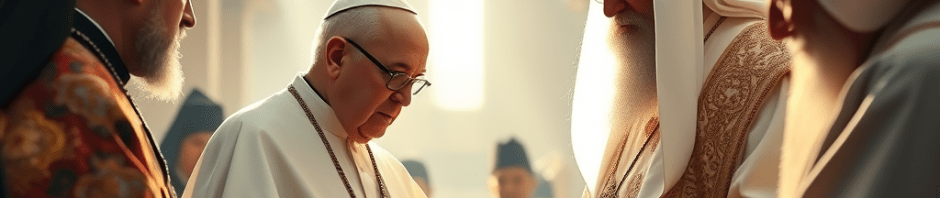
(I want to keep this most divine historical event in my library.)
Pope Leo and Ecumenical Patriarch Bartholomew signed a historic and symbolic joint declaration on Saturday, marking a renewed commitment to the unity of the Catholic and Orthodox Churches.
The two Church leaders met at the Ecumenical Patriarchate in Phanar, Istanbul, where they reaffirmed their dedication to full communion and emphasized the importance of continuing efforts to establish a common date for Easter for all Christians. The meeting highlighted both the spiritual and symbolic significance of fostering greater unity between the two traditions.
In their declaration, the Pope and the Ecumenical Patriarch unequivocally rejected the use of religion as a justification for violence. They stressed that the pursuit of Christian unity is inseparable from a broader commitment to peace. “The goal of Christian unity,” the declaration states, “includes the goal of making a fundamental and life-giving contribution to peace among all peoples. Together we fervently raise our voices, invoking God’s gift of peace in our world.” This language underscores the moral responsibility of religious leaders to advocate for harmony and reconciliation in a world still scarred by conflict.
The text of the declaration also acknowledges the ongoing human suffering caused by war and violence across numerous regions. It calls on those in political and social authority to exert every effort to bring an immediate end to these tragedies, highlighting the Church’s insistence on the ethical imperative to protect human life and dignity.
In reflecting on these responsibilities, both Patriarch Bartholomew and Pope Leo emphasized that the search for full communion is rooted not in human diplomacy but in fidelity to the Lord’s prayer in the Gospel of John: “That they may all be one, as you, Father, are in me and I in you, that they may be one in us, that the world may believe.” This invocation reinforces the spiritual foundation of their commitment and frames ecclesiastical unity as a testimony to the wider world.
Walk together “in love and truth,” say Pope Leo and Patriarch Bartholomew
Pope Leo and Ecumenical Patriarch Bartholomew reaffirmed their determination to continue walking together “in love and truth,” urging all the faithful—clergy, religious, and laity alike—to join in prayer and action for the fulfillment of this divine calling. They emphasized that the journey toward unity is not only a spiritual obligation but also a shared mission, inviting all Christians to cultivate mutual understanding, compassion, and commitment to the Gospel in their daily lives.
The Church leaders also highlighted the unifying power of the faith professed in the Nicene Creed, formulated 1,700 years ago. This ancient confession affirms that Jesus Christ is “true God from true God,” “of one substance with the Father,” who became incarnate for humanity’s salvation, suffered and rose from the dead, ascended into heaven, and will come in glory to judge the living and the dead. According to Pope Leo and Patriarch Bartholomew, this shared acceptance of the Creed provides a foundation for addressing contemporary challenges with mutual respect and a spirit of genuine hope, reinforcing the enduring bond between the Catholic and Orthodox traditions.
Expressing gratitude that Christians this year celebrated Easter on the same day, the leaders described it as a gift of Divine Providence and emphasized their shared desire to continue efforts toward finding a permanent solution that allows the “Feast of Feasts” to be celebrated together annually. They called upon all Christians to pray that this goal may be guided by wisdom and spiritual insight, fostering greater unity and solidarity among believers worldwide.
Sixtieth anniversary of declaration of the two leaders
Pope Leo and Ecumenical Patriarch Bartholomew also highlighted that this year marks the 60th anniversary of the 1965 Joint Declaration by Pope Paul VI and Ecumenical Patriarch Athenagoras, which led to the historic lifting of the excommunications of 1054. They expressed gratitude for this prophetic gesture, noting that it opened the way for dialogue grounded in “trust, esteem, and mutual love.” The leaders encouraged those who remain hesitant to engage in dialogue to listen attentively to the Holy Spirit, who calls Christians to offer the world a renewed witness of reconciliation and unity.
Reaffirming their support for the Joint International Commission for Theological Dialogue between the Roman Catholic Church and the Orthodox Church, the Pope and Patriarch emphasized that, in its current phase, the commission is examining issues that have historically been considered divisive. They underscored the importance of continued theological reflection and collaborative engagement in overcoming longstanding differences and deepening mutual understanding between the two traditions.
The historic Joint Declaration was signed on Saturday in the Throne Room of the Patriarchal House, immediately following the Doxology in the Patriarchal Church of Saint George. On the same day, the Pope presided over a Mass for Catholics at the Volkswagen Arena, an indoor event venue in Istanbul, reinforcing the spirit of ecumenical fellowship and shared devotion that the visit symbolizes.
The Pope and the Patriarch will bless the faithful together
On Sunday, the feast day of Saint Andrew the First-Called, founder of the Church of Constantinople, a patriarchal and synodal divine service will be celebrated, presided over by Ecumenical Patriarch Bartholomew and concelebrated by His Holiness Theodore of Alexandria. The service will mark the throne feast of the Ecumenical Patriarchate and is expected to be a significant occasion of ecumenical and spiritual reflection.
The ceremony will be attended by Pope Leo, hierarchs from both churches, representatives of other Christian denominations, diplomats, and officials. The Greek government will be represented by Deputy Minister of Foreign Affairs Yiannis Loverdos. At the conclusion of the service, both Church leaders will bless the faithful from the balcony of the Patriarchal House, offering a shared gesture of unity and spiritual guidance to all present. (PBS, by Phillip Chrysopoulos, 11/30/2025)
If you’ve ever attended a Christian church, that experience was likely influenced by the Nicene Creed.
1,700 years ago, Emperor Constantine gathered bishops together in Nicaea—today, the northern coast of Turkey—to form one of the most important councils in Christian history. There, they established doctrines, finalized religious dates, and worked out how to address schisms—decisions that have impacted the lives of Christians ever since.
Learn more about how the Nicene Creed came to exist. (National Geographic)
In the long centuries that followed, history – wounded by political, cultural, and theological complexities – brought about painful separations among Christians. Yet in recent times, we thank God that the walls which once divided us have begun to crumble.
The Roman Catholic Church and the Syriac Orthodox Church have cultivated a relationship built upon respect, honesty, and sincere desire for reconciliation. From the meeting of Pope Paul VI and Patriarch Mor Ignatius Jacob III in 1971, to the Christological agreements of the 1980s and 1990s, our predecessors have laid strong foundations for mutual understanding upon which we continue to work through dialogue and common pastoral ministry to further the unity between our churches through joint agreements, mutual visits, and our collaboration to protect persecuted Christian communities and their presence across the world.
I believe our Lord calls us to strengthen our theological dialogue, that our churches may more clearly express the communion already present among us. We are called to work together for peace and justice, especially in the Middle East, where the Christian presence is endangered, and to defend human dignity, freedom of conscience, the sanctity of life, and the family.
I wish to conclude by reciting a prayer by St. Aphrem the Syrian, praying for the unity of Christ’s Church:
“Mingle and unite, Lord, the schismatic factions.
Reconcile and shepherd, too, the quarreling parties.
From all the churches, may there come one Church of truth.
May her righteous children be gathered within her womb,
Giving thanks for your grace. Praises to your reconciliation!”
(St. Aphrem the Syrian, Hymns on Faith, Hymn 52)
at the Ecumenical Service in Nicaea:
”The Nicene Creed acts like a seed for the whole of our Christian existence. It is a symbol not of a bare minimum; it is a symbol of the whole. Having the fervor of the faith of Nicaea burning in our hearts, ‘let us run the course’ of Christian unity ‘that is set before us’ (cf. Hebrews 12:1); let us ‘hope to the end for the grace’ that is promised ‘at the revelation of Jesus Christ’ (cf. 1 Peter 1:13); and, finally, ‘let us love one another, that with one mind we may confess: Father, Son, and Holy Spirit, Trinity consubstantial and undivided’’.
“We live in a world where religion is too often used to justify wars and atrocities.”
Pope Leo XIV condemned the use of God’s name to justify violence, as he celebrated Mass in Istanbul, Türkiye. (Vatican News)
JOINT DECLARATION BETWEEN POPE LEO XIV AND ECUMENICAL PATRIARCH BARTHOLOMEW
Patriarchal Palace (Istanbul)
“O give thanks to the Lord, for he is good,
for his steadfast love endures for ever”
Psalm 106 (105): 1
On the eve of the feast of Saint Andrew the First-called Apostle, brother of the Apostle Peter and patron of the Ecumenical Patriarchate, we, Pope Leo XIV and Ecumenical Patriarch Bartholomew, give heartfelt thanks to God, our merciful Father, for the gift of this fraternal meeting. Following the example of our venerable predecessors, and heeding the will of our Lord Jesus Christ, we continue to walk with firm determination on the path of dialogue, in love and truth (cf. Eph 4:15), towards the hoped-for restoration of full communion between our sister Churches. Aware that Christian unity is not merely the result of human efforts, but a gift that comes from on high, we invite all the members of our Churches – clergy, monastics, consecrated persons, and the lay faithful – earnestly to seek the fulfilment of the prayer that Jesus Christ addressed to the Father: “that they may all be one, even as you, Father, are in me, and I in you… so that the world may believe” (Jn 17:21).
The commemoration of the 1700th anniversary of the First Ecumenical Council of Nicaea, celebrated on the eve of our meeting, was an extraordinary moment of grace. The Council of Nicaea held in 325 AD was a providential event of unity. The purpose for commemorating this event, however, is not simply to call to mind the historical importance of the Council, but to spur us on to be continuously open to the same Holy Spirit who spoke through Nicaea, as we wrestle with the many challenges of our time. We are deeply grateful to all the leaders and delegates of other Churches and ecclesial communities who were willing to participate in this event. In addition to acknowledging the obstacles that prevent the restoration of full communion among all Christians – obstacles which we seek to address through the path of theological dialogue – we must also recognize that what binds us together is the faith expressed in the creed of Nicaea. This is the saving faith in the person of the Son of God, true God from true God, homoousios with the Father, who for us and our salvation was incarnate and dwelt among us, was crucified, died and was buried, arose on the third day, ascended into heaven, and will come again to judge the living and the dead. Through the coming of the Son of God, we are initiated into the mystery of the Holy Trinity – Father, Son, and Holy Spirit – and are invited to become, in and through the person of Christ, children of the Father and co-heirs with Christ by the grace of the Holy Spirit. Endowed with this common confession, we can face our shared challenges in bearing witness to the faith expressed at Nicaea with mutual respect, and work together towards concrete solutions with genuine hope.
We are convinced that the commemoration of this significant anniversary can inspire new and courageous steps on the path towards unity. Among its decisions, the First Council of Nicaea also provided the criteria for determining the date of Easter, common for all Christians. We are grateful to divine providence that this year the whole Christian world celebrated Easter on the same day. It is our shared desire to continue the process of exploring a possible solution for celebrating together the Feast of Feasts every year. We hope and pray that all Christians will, “in all wisdom and spiritual understanding” (Col 1:9), commit themselves to the process of arriving at a common celebration of the glorious resurrection of our Lord Jesus Christ.
This year we also commemorate the 60th anniversary of the historic Joint Declaration of our venerable predecessors, Pope Paul VI and Ecumenical Patriarch Athenagoras, which extinguished the exchange of excommunications of 1054. We give thanks to God that this prophetic gesture prompted our Churches to pursue “in a spirit of trust, esteem and mutual charity the dialogue which, with God’s help, will lead to living together again, for the greater good of souls and the coming of the kingdom of God, in that full communion of faith, fraternal accord and sacramental life which existed among them during the first thousand years of the life of the Church” (Joint Declaration of Pope Paul VI and Ecumenical Patriarch Athenagoras, 7 December 1965). At the same time, we exhort those who are still hesitant to any form of dialogue, to listen to what the Spirit says to the Churches (cf. Rev 2:29), who in the current circumstances of history urges us to present to the world a renewed witness of peace, reconciliation and unity.
Convinced of the importance of dialogue, we express our continued support for the work of the Joint International Commission for the Theological Dialogue between the Roman Catholic Church and the Orthodox Church, which in its current phase is examining issues that have historically been considered divisive. Together with the irreplaceable role that theological dialogue plays in the process of rapprochement between our Churches, we also commend the other necessary elements of this process, including fraternal contacts, prayer, and joint work in all those areas where cooperation is already possible. We strongly urge all the faithful of our Churches, and especially the clergy and theologians, to embrace joyously the fruits that have been achieved thus far, and to labor for their continued increase.
The goal of Christian unity includes the objective of contributing in a fundamental and life-giving manner to peace among all peoples. Together we fervently raise our voices in invoking God’s gift of peace upon our world. Tragically, in many regions of our world, conflict and violence continue to destroy the lives of so many. We appeal to those who have civil and political responsibilities to do everything possible to ensure that the tragedy of war ceases immediately, and we ask all people of good will to support our entreaty.
In particular, we reject any use of religion and the name of God to justify violence. We believe that authentic interreligious dialogue, far from being a cause of syncretism and confusion, is essential for the coexistence of peoples of different traditions and cultures. Mindful of the 60th anniversary of the declaration Nostra Aetate, we exhort all men and women of good will to work together to build a more just and supportive world, and to care for creation, which is entrusted to us by God. Only in this way can the human family overcome indifference, desire for domination, greed for profit and xenophobia.
While we are deeply alarmed by the current international situation, we do not lose hope. God will not abandon humanity. The Father sent his Only-Begotten Son to save us, and the Son of God, our Lord Jesus Christ, bestowed upon us the Holy Spirit, to make us sharers in his divine life, preserving and protecting the sacredness of the human person. By the Holy Spirit we know and experience that God is with us. For this reason, in our prayer we entrust to God every human being, especially those in need, those who experience hunger, loneliness or illness. We invoke upon each member of the human family every grace and blessing so that “their hearts may be encouraged, as they are knit together in love, to have all the riches of assured understanding and the knowledge of God’s mystery,” who is our Lord Jesus Christ (Col 2:2).
From the Phanar, 29 November 2025 (Panorthodox SYNOD)
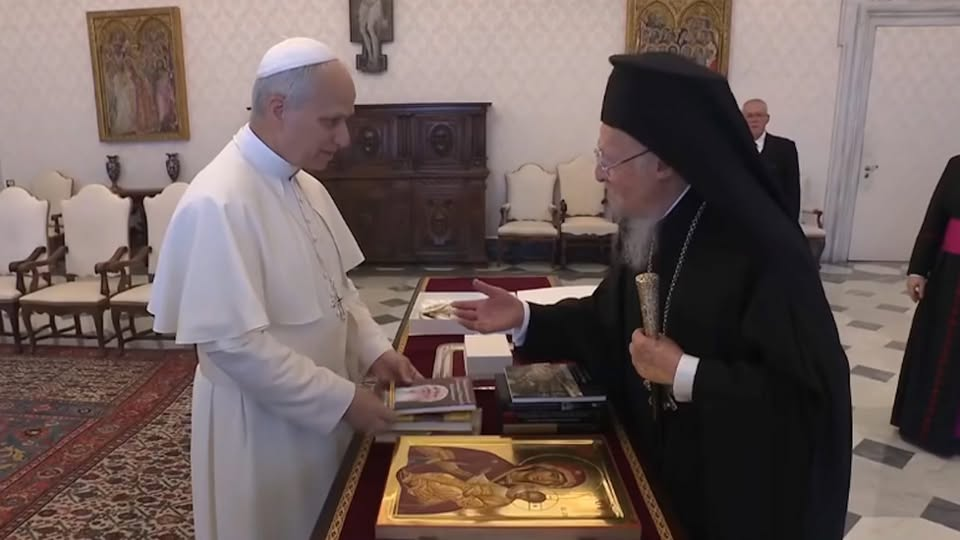
Attending the Doxology at the Patriarchal Church of Saint George in Constantinople on Saturday with Ecumenical Patriarch Bartholomew and Pope Leo XIV will be Patriarch Theodore of Alexandria and Hierarchs of the Churches of Rome and Constantinople.(Archons of the Ecumenical Patriarchate) 11/29/2025
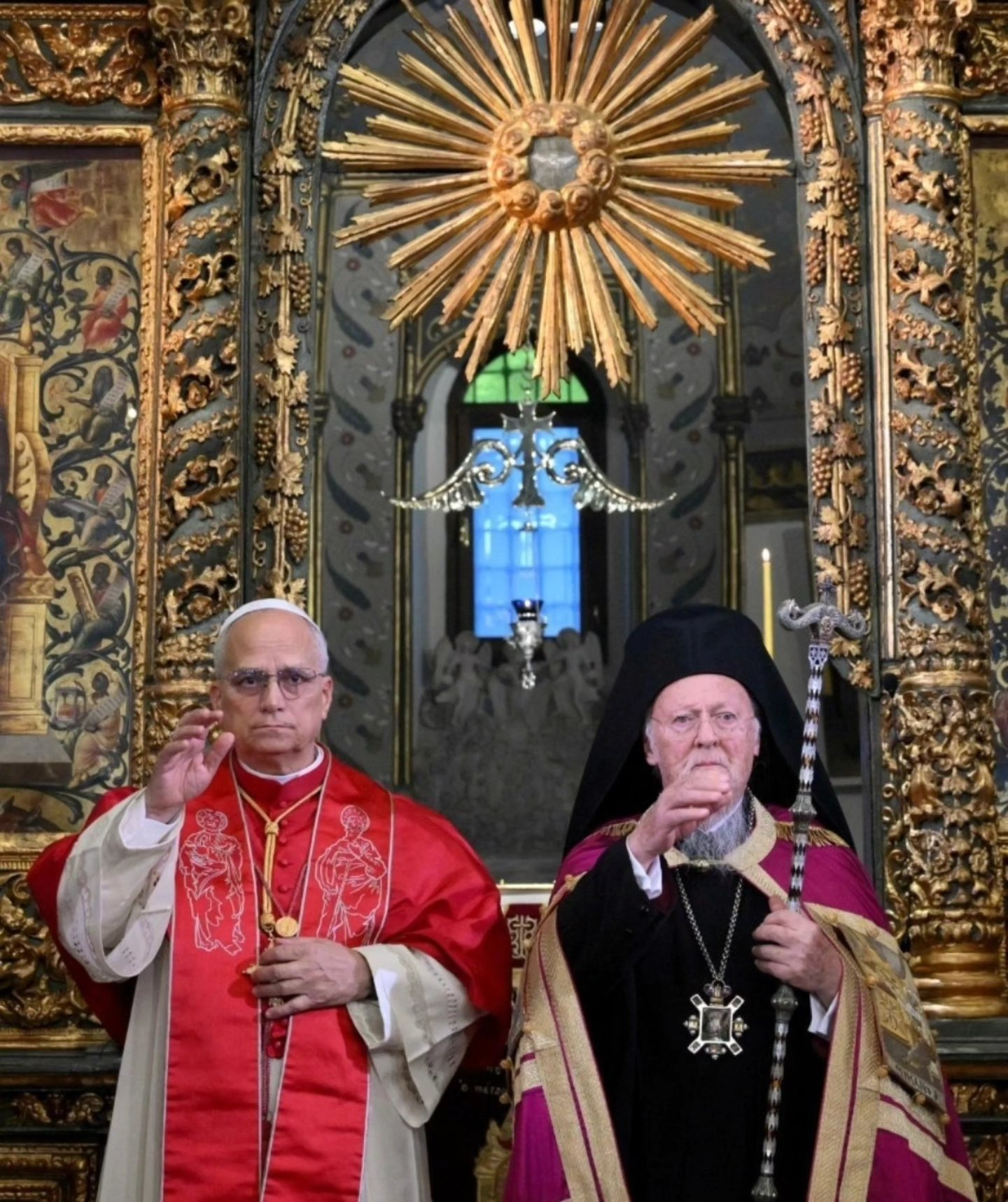
The Church can transform the world if it breaths with both lungs! East and West! Let us unite! (Santa Familia) 11/29/2025
Holy Father: Confession of Christological faith is fundamental on the path to full unity. (Vatican News) 11/29/2025

 Daily Sauntering
You must be logged in to post a comment.