
Alo–ha!
Hello, everyone. You may be wondering why I’m suddenly greeting you with “Alo–ha!” Today, I’d like to talk a bit about Hawaii, and also introduce some very special people I met there—people who praise God “just as they are,” with their whole lives.
Last month (August 10, 1997), for the first time in my life, my husband and I visited Hawaii, often called the jewel of the Pacific. We went to attend a program called “Crossroad Experience,” a missionary‑training course for pastors and their spouses held at the University of the Nations in Kona. During that time, we received deep spiritual challenges and experienced a new relationship with God—something we had never known before. We also discovered how much we could learn from the Christian culture woven into the Hawaiian islands and from the way the people there live.
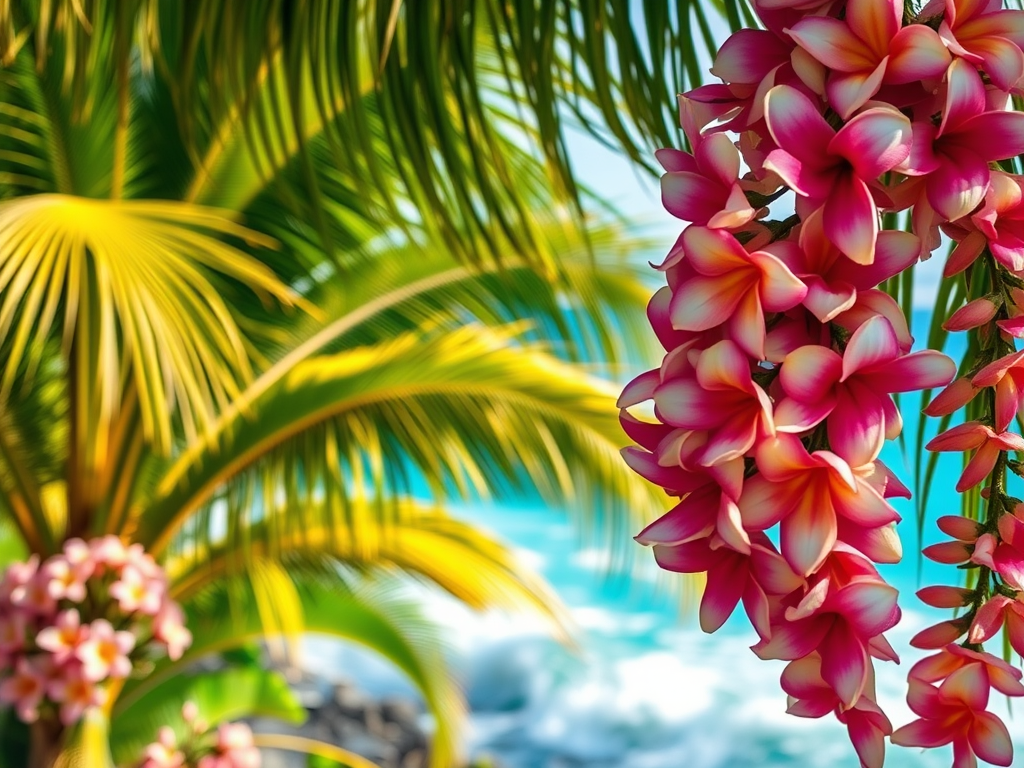
The moment we stepped off the plane and onto the stairs, a sweet floral fragrance touched our noses. Then came the overwhelming sight of the beautiful tropical palms and the many varieties of coconut and palm trees swaying in the breeze. The unfamiliar flowering trees along the roadsides and the inky blue waves of the Pacific surrounding the island opened our hearts—hearts that had long been closed while living on the mainland. But what touched us most deeply were the people’s greetings and their warm, smiling faces.
Let us listen to a hymn.
When Hawaiians greet one another, they say “Alo–ha.” It can mean “I love you, I respect you, I welcome you,” or even “goodbye” and “farewell.” But its truest meaning is: “Standing in your presence, I breathe life into you.” What a beautiful greeting. Every living being needs life‑breath, and this greeting reminded me of the moment when the Creator God breathed life into humanity.
Another Hawaiian greeting is the lei, a garland made from the blossoms of the plumeria tree and placed around someone’s neck. It is a way of offering beauty, fragrance, and blessing. The unique scent of the flowers and the cool touch of the fresh petals on my skin made me feel truly welcomed and loved—encouraged and comforted at the same time. Women receive flower leis, while men receive leis made from ti leaves, a gesture traditionally reserved for honoring kings.
Hawaiians delight in welcoming and serving others in this way, never forgetting to encourage those around them. The native Polynesians live with a relaxed sense of time, enjoying abundant food, dance, and song. Many sustain themselves through traditional crafts—making baskets, hats, and leis from palm leaves—or by relying on welfare, yet they do not feel compelled to compete for survival. When they go out to sea, the clear water reveals schools of fish beneath them, and they seem to live simply enjoying the richness of nature. Kona, the place I visited, is the homeland of the ali‘i, the Hawaiian royalty, and the birthplace of King Kamehameha the Great, who unified the islands.
Christianity came to Hawaii on April 4, 1820, through missionaries from New England. But the story truly began when two Hawaiian boys—Henry Opukaha‘ia (Henry Obookiah) and Thomas Hopu (Nauhopo O‘ua hopo‘o)—accepted the gospel while living in New England. Obookiah had once served in his uncle’s home, where he was responsible for rituals honoring spirits. One day, the boys saw a merchant ship from Connecticut anchored at the harbor. They swam out to it and begged the captain to let them work on board. With his permission, they sailed to China and India, and eventually arrived in America in 1808.
After living for a time as servants in the captain’s home, they were introduced to a Christian family, where they worked and eagerly studied English. Obookiah later met Edwin D. Dwight, then a student at Yale, who taught him to read and write. Edwin once found him crying in a corner of a Yale building—because he longed so deeply to study more. Edwin brought him to his father, Timothy Dwight, the president of Yale, who tutored him personally and introduced him to Christianity, though Obookiah initially showed little interest.
Then came the moment that changed his life. One day, a guest visited President Dwight’s home—Samuel J. Mills Jr., a young man recently graduated from college, deeply committed to the growing movement to send missionaries overseas. Samuel had once been praying under a tree with friends when a violent thunderstorm nearly struck him. Saved from death, he vowed to dedicate his life to missions. He took Obookiah into his home, gave him work on the farm, and offered him an education. Through the people he met there, Obookiah accepted Christ and became a Christian.
Back in Hawaii, volcanic eruptions were believed to be the wrath of the goddess Pele, who destroyed all living things in her anger. To appease her, people built altars near the volcano and offered human sacrifices. After encountering Christianity, the two boys came to understand the God who loves humanity, and they began to question their traditional religion. They became convinced that Christianity was the faith their people desperately needed.
With the support of the Congregational Church, Samuel helped establish the Foreign Mission School, where Obookiah and Hopu studied.
But in February 1818, at the age of 26, Obookiah died suddenly of typhus before he could return to Hawaii with the gospel he longed to share. As he was dying, he said, “I am dying, but God knows what is best. He is accomplishing His good purposes.” Edwin Dwight, who had first taught him English, wrote a booklet titled “Memoirs of Henry Obookiah.” Many who read it were moved, and a great passion for Hawaiian missions was ignited.
Two years later, his friend Thomas Hopu arrived in Hawaii with American missionaries to plant the gospel.
The missionaries sailed 18,000 miles from Boston, arriving in Kona after 163 days at sea. They built homes and established the first church, Moku‘aikaua Church, which continues to grow today. Queen Ka‘ahumanu accepted the gospel, and Christianity spread rapidly across the islands. At one time, the world’s largest church was in Hilo, and its members were sent as missionaries to other islands.
One evening, while dining in the courtyard of our hotel, we watched a Hawaiian cultural performance called “The Wind That Blows Across the Island.” About 500 tourists were gathered. Suddenly, the host stepped forward and said, “I don’t know in whose name each of you prays before eating, but let us all give thanks to the One who has given us this precious food.” Then he prayed. The entire crowd bowed their heads, and the atmosphere became solemn. He ended with, “In Jesus’ name we pray. Amen.” We were astonished. To pray so boldly in Jesus’ name in a tourist setting—knowing that Muslims, Buddhists, Confucianists, and others were surely present—was remarkable.
Throughout the performance, they celebrated wedding anniversaries and birthdays among the guests, blessing their families and honoring life itself—so deeply Christian in spirit. And when they spotted Korean visitors, they even evangelized in Korean, saying, “Believe in Jesus!” between musical numbers. Later we learned that they were lay missionaries, using culture and traditional dance as tools for evangelism. I felt so proud. They even visited our classroom at the training school to greet us and perform.
We listened to a recording of their music—Island Breeze.
Though we had just met, they felt like true brothers and sisters in Christ. They were offering themselves to God exactly as they were. On Sundays, they served on their church’s worship team, and whenever possible, they traveled to share the gospel. Last year, they prepared for a mission trip to North Korea, fasting in rotation for 40 days, but were unable to go due to lack of funds. Still, they held a sincere hope that, if God allowed, they would one day bring “the Aloha of Christ” to the people of North Korea. Their passion humbled me.
Why? Because I had never once considered sharing Christ through my own culture or traditions. Living in America, I often brushed aside our customs, perhaps because, deep down, I felt they were inferior to Western culture. So I never imagined using them to share the gospel.
As I left Hawaii, I offered them an “Alo–ha” and prayed that the gospel would flourish even more on the islands. God heard the prayers of that young boy who once served idols, who longed with tears to bring the gospel to his people. Through his prayer, God evangelized the islands, and now the descendants of Obookiah praise God “just as they are.” And God planted “Alo–ha” deep within my own heart.
Today, we explored the meaning of the Hawaiian greeting “Aloha,” the Christian roots of the islands, and my encounter with the native Hawaiian missionaries known as “The Wind That Blows Across the Island.” Next time, we’ll continue sharing stories from our lives in this space called “Just As I Am.”
Your participation is always welcome. If you have a testimony of faith, or a story of despair or pain you wish to share, please reach out. You may call, write, or fax us. Christian Broadcasting: (212) 447‑0780 Fax: (212) 725‑9190 Address: KCBN, 1204 Broadway, Suite 400, New York, NY 10001 Please address your letters to the “Just As I Am” program.
I pray that God’s breath of life will fill your week. Alo–ha!
— Wanhee Yoon, Korean Christian Broadcasting, “Just As I Am” Live Broadcast, September 9, 1997

 Daily Sauntering
You must be logged in to post a comment.