Behold—the wail of fifty million people!
Deep in the chest,
pressed tightly,
a spring of water
on the verge of bursting.
Between reality and unreality,
January 21, 2026
and December 3, 2024
were bound together in han.
Beneath the sacred Sindansu tree,
the forgotten Hongik Ingan
began to breathe again—
as mummies rise
from erased history.
Zombies,
holding pig heads,
dancing the shaman’s dance,
crying out—
eternal rule, eternal rule.
Once again,
on a national day of humiliation,
a small number who danced
for their private eternity—
judges, prosecutors, lawyers, bureaucrats,
those honored as yeonggam, exalted as daegam—
Now their voices
seep away
into the silent slopes
of Mukmang Mountain.
Over the East Sea,
the pattern of morning sunlight
rises without a sound,
gently etched
on the surface of a teacup.
And quietly,
the waves of fairness
and coexistence
are at last lifting a new sun.
Ah—
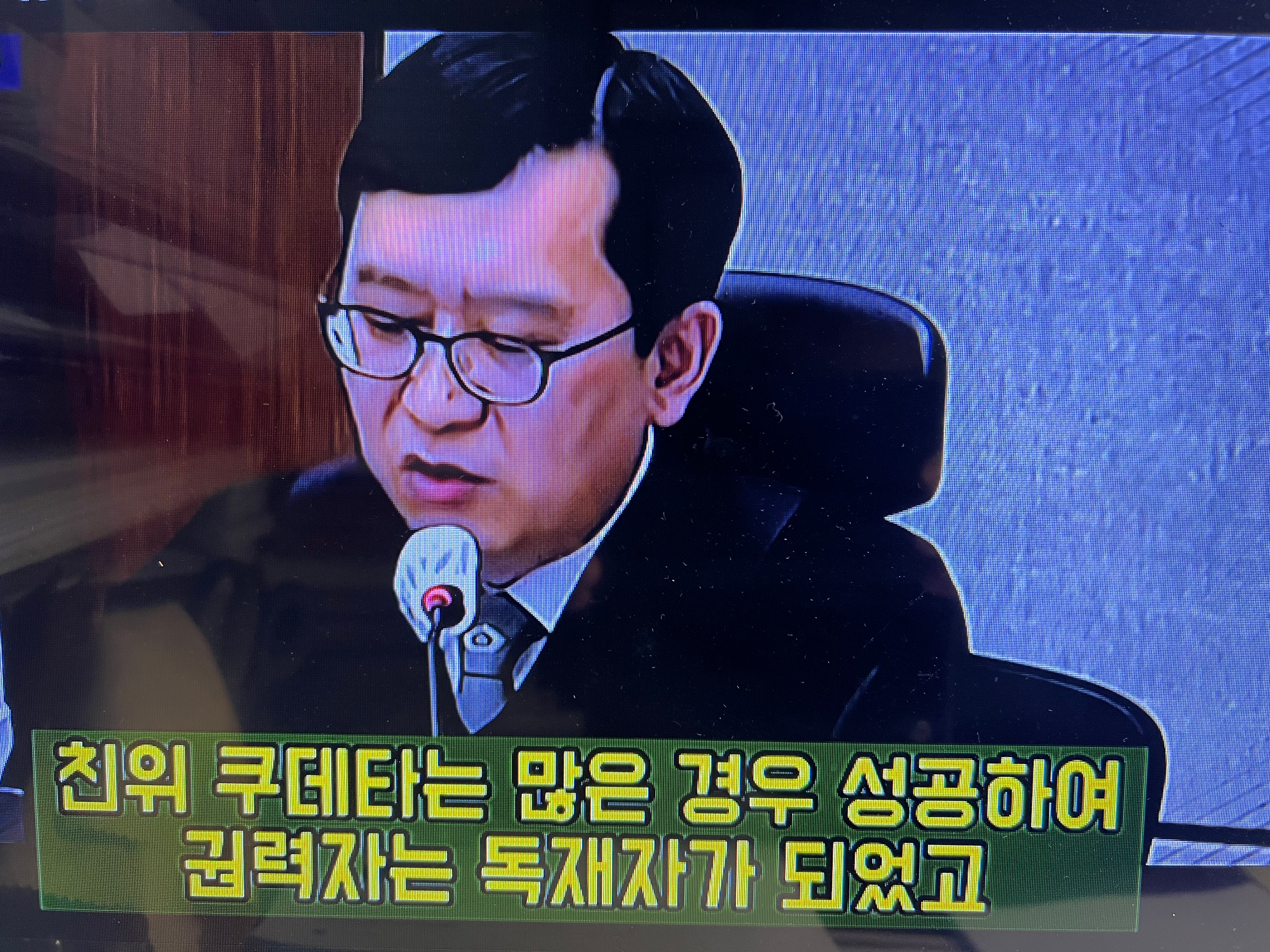
Judge Lee Jin-gwan,
you are not alone.
You are the heart of the people.
Can you not hear
the soundless roar—
the tears of fifty million
flowing toward
your dry eyes?
Can you not see it?
This trembling in the chest—
does it not already proclaim
the dawn of a new nation,
the first year
of peace and happiness?
Wherever we are in this world,
let us all rise
and dance the dance of Hanbalg.
Let us become
the hot tears we have long held back,
the fresh surge of overflowing tears,
the sacred tears
of Judge Lee Jin-gwan.
— Yoon Tae‑Hun
Note:
Judge Lee Jin‑kwan is a senior judge at the Seoul Central District Court (Criminal Division 33) who became nationally prominent for presiding over the historic trial of former Prime Minister Han Duck‑soo.
He sentenced Han to 23 years in prison for involvement in the December 3 martial‑law incident, which the court described as an attempted “civil war equivalent to a coup.”
This is the most widely known meaning today.
Han (한 / 恨) — emotional–cultural meaning
- A deep, unresolved sorrow
- A wound carried quietly
- A mixture of grief, longing, injustice, and endurance
- A collective emotional memory shaped by history
It’s not simply sadness; it’s a compressed emotional universe that seeks release or transformation.
Sindansu literally means “the Divine Tree” or “the Sacred Altar Tree.” It appears in the Dangun founding myth and represents the place where heaven and earth meet.
In the myth:
- Hwanung, the heavenly prince, descends from heaven
- He comes down beneath the Sindansu
- And there he begins teaching, governing, and guiding early humanity
- Later, Dangun Wanggeom is born, and the Korean nation (Gojoseon) is founded
So Sindansu is the axis mundi—the world’s center—where the divine touches the human world.
Hongik Ingan = “To broadly benefit all humankind.”
It is often translated as:
- “Live for the good of all people.”
- “Benefit humanity widely.”
- “Promote the welfare of all.”
It expresses an ethical ideal: a life not centered on oneself or one’s tribe, but on the flourishing of everyone.
Mukmang Mountain = “the mountain of silent disappearance.”
It symbolizes:
- a place where corrupt voices fade away
- the end of unjust power
- the quiet burial ground of arrogance and tyranny
- the vanishing point of those who abused authority
- the moral horizon where falsehood dissolves
In other words, it is the mountain where the noise of the powerful dies.
Hanbalg = the primordial great light / the brightness of heaven / the radiance of origin / the light of a people’s spiritual essence.
Its origins lie in:
- the ancient Korean root han (greatness, heaven, origin)
- the ancient root balg (light, brightness)
- the myths of heavenly descent and the traditions of sky‑worship
- layers of spiritual and cultural symbolism
All of these elements overlap to form the concept of Hanbalg.

 Daily Sauntering
You must be logged in to post a comment.