
Written in 2006 by Pastor Han Seong-su, 14th pastor of New York Korean Church
Looking back: A pharmacist at the New York Korean Church
The title of the history book chronicling the 70th anniversary of the New York Korean Church, published in May 1992, is “By the Riverside, We Wept.” This poignant and beautiful title is taken from Psalm 137:1. Watching the rising aspirations for national independence from a distant foreign land immediately following the March 1st Movement, our forefathers in the faith must have sat by the riverside, overcome with sorrow, and wept. The footsteps of those forefathers, who shed their sorrowful tears in the murky waters of the gently flowing Hudson River, were lost amidst the flood of Korean immigrants that arrived with the enactment of the 1960s immigration laws. The New York Korean Church, the first Korean church in the Northeastern United States (established in 1922) and the only Korean church until the 1960s, has endured a history as rich as its 81-year history.
On March 1, 1922, a commemorative event commemorating the third anniversary of the March 1st Movement was held at New York Town Hall. Immediately following the event, a commemorative review meeting was held at the office of Mrs. Angie Graham Kimberland, who supported the Korean independence movement. At this meeting, specific discussions about founding a church began at Mrs. Kimberland’s suggestion. Rev. Dr. Ralph W. Sockman suggested holding services at the Madison Avenue Episcopal Methodist Church (Madison Ave. & 23rd St.), where he was pastor. The proposal was accepted, and the first service was held sometime in March or April, led by Rev. Im Jong-sun. Most of the approximately 40 members were international students.
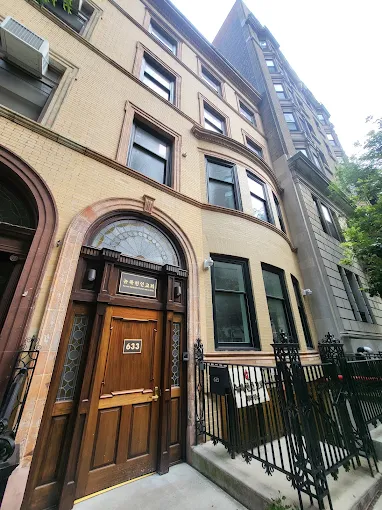
On April 15, 1923, we purchased a building (459 W. 21st Street) and held our first inaugural service (financially assisted by the City Missions and Church Extension Committee of the Methodist Church). We named the church “Korean Church & Institute,” which remains our official name. We subsequently moved to our current location (633 W. 115th St., New York, NY 10025), half a small building across the street from Columbia University, in 1927. The financial support of the New York Annual Conference and the cooperation of Methodist leaders played a significant role in both the initial founding of the church and the purchase of the new building.
During the 1920s and 1930s, our church played a central role in the Korean-American movement for independence in New York. During this time, our church served as a hub for various Korean gatherings. Until the passage of the Immigration Act in the 1960s, our church was the only church in the New York area, and indeed the Northeastern region (for approximately 40 years). We established a proud tradition and established our status as the national church of the Baedal people.
The New York Korean Church, struggling to survive amidst the sorrows of racial discrimination in the 1920s and the threat of the Great Depression in the 1930s, housed around 20 homeless people in its small four-story building, helping them navigate their everyday challenges (hence the name “Institute,” which remains a lingering legacy). Most of the church’s proudest members hail from this period. Many were students or homeless at the time, but later returned to Korea and became leading figures. Cho Byeong-ok, Kim Hwal-lan, Park Maria, Park Eun-hye, Park In-deok, Jang Ri-wook, Ahn Ik-tae, and others are among them. Beyond these individuals who shaped an era in the Republic of Korea, many others have passed through the New York Korean Church (even the first President Syngman Rhee visited several times). Even now, when entering the old church, the walls that must have heard their voices, their prayers, and the floors that must have drank their tears, evoke a sense of solemnity. As ancestors in the faith who lived by accepting Jesus as Christ, it seems that they are speaking a silent message to us even today.
From the first pastor, Rev. Im Jong-sun (1922-1923), to the 14th pastor, Rev. Han Seong-su (2003-present), 81 years have passed, and 14 generations of pastors have served the New York Korean Church. There simply isn’t enough space to list all the pastors who have served. The most well-known pastors in recent times are Rev. Choi Hyo-seop, the 11th pastor (1975-1988), and Rev. Cha Won-tae, the 12th pastor (1988-2000). Both were renowned preachers, yet the unprecedented division of the church, a wound so profound, must have been a divine design to humble our church.
During Pastor Choi Hyo-seop’s tenure, immigration laws helped bring a large influx of Korean immigrants to Manhattan, and for the first time, Sunday service attendance exceeded 400. To secure a space for worship, he began renting the chapel at St. Hilda School for Sunday services.
Even in the 1960s and 1970s, our church continued to play a central role in the Korean community in New York. Many Korean theologians led Bible studies at the church during this period (Kim I-gon, Kim Deuk-joong, Seo Jung-seok, Kim Hong-gi, Han Wan-sang, Han Ho-seok, Han Seong-su, etc.). Furthermore, under the leadership of Professor Kim Byeong-seo, the “Youth Department Ideology Lectures” were held, where scholars and intellectuals presented diverse theological and ideological lectures, playing a significant role in opening up the youth department’s progressive perspectives. Many renowned musicians in Korea today also performed at the church during this period.
The role of the “New York Thursday Prayer Meeting” is also noteworthy. Founded in June 1975 by progressive figures in the New York area, including Elder Han Seung-in, the “New York Thursday Prayer Meeting” met monthly in a church basement for over 20 years, praying and working for the nation’s struggle for democracy. The South Korean government even considered them representatives of an anti-government organization. Speakers include Kim Jae-jun, Ham Seok-heon, Moon Dong-hwan, Lee Woo-jeong, Baek Gi-wan, Kim Chan-guk, Han Wan-sang, and Kim Dae-jung.
The ‘New York Korean Association’, which today represents 450,000 Koreans in the New York area, also started at our church, and for a while, most of the meeting places and central figures were members of our church.
However, as the saying goes, “good things bring many evils,” just when the church was at its peak, it experienced division. Pastor Choi Hyo-seop resigned, and a new church was established across the Hudson River toward New Jersey. During Pastor Cha Won-tae’s tenure, the church overcame a major crisis by abolishing the so-called “spiritual officers” (elders, evangelists, deacons, etc.) on the grounds of hierarchy within the church. The ripple effects of this event still reverberate today, but I believe it was something only the New York Korean Church could accomplish. I hope this will serve as a milestone for the church of the future. How humble and beautiful it is to see the elders of that time remain in the church despite the abolition of the elder system!
Looking Ahead: Pastor Han Seong-su’s Apology and Hope
Despite its long 81-year history and illustrious past, the New York Korean Church is now, frankly, mired in a deep swamp. After having many children and sending them off to be ordained, it has become as shabby as a mother’s wretched image. This leaves us with a certain sadness. Currently, the New York Korean Church is a small church, with an average Sunday service attendance of about 100 adults, Sunday school attendance of 15, and an English-language service attendance of about 40. Compared to its former glory, it is truly a shrunken mother. Located across from Columbia University in Manhattan, the church was initially established primarily for Korean students studying abroad, and it has served well as a transit point for these students.
But things are different now. First, unlike in the past when being in Manhattan was advantageous, our church now faces the challenge of not having a parking lot. Most of our members drive to church from as far away as New Jersey and upstate New York.
Second, the reality built on this church tradition doesn’t quite fit with the religious realities of the students from affluent families who recently came to study abroad. Because Korean churches in New York are often seen as a bridgehead for progressive faith in the New York area, young people indoctrinated with so-called evangelical (or even conservative fundamentalist) beliefs flock to the more convenient Korean immigrant churches that are far more prevalent nearby. Despite being fully aware that young people who thrive in large churches in Seoul are turning their backs on the progressive leanings of Korean churches in New York, Korean churches in New York remain determined to defend Manhattan as a bastion of progressive faith.
Third, the proliferation of small churches, where even a single member is being competed for as many as possible, is also prevalent in the New York area. It’s truly heartbreaking that the very survival of churches has become a problem. Every Sunday, a church bus parks in front of Columbia University’s main gate, transporting students. We, the members of the New York Korean Church, who are within walking distance, simply feel sorry for the students who have to travel so far. Overwhelmed by the practical urgency of having to live first, we cling to the adage that the hawk is the pheasant, not the other way around.
Fourth, there are now many relatively stable, well-equipped churches located outside the city center. There’s no longer a compelling reason to drive long distances, circle the congested streets of Manhattan, and find parking. With this in mind, the conditions for growth for the Korean church in New York are not ideal.
Despite its small size, the New York Korean Church still commands extraordinary attention. It bears a special mission, overseeing the journey of Korean Americans and setting a milestone for the future. This church must exist under the New York sky. It’s not simply a matter of tradition or the humble claim to be the mother church of the New York area. It’s a church that possesses a unique capacity, a mission that many other churches cannot, and a sense of mission that must be fulfilled.
This is a church where many churchgoers say they learned a lot from even Professor Hyun-Kyung Jeong, who is notorious(?) in Korean churches (and not only because Union Theological Seminary is just a few blocks away), who came to speak at a church forum. This is a church where a Buddhist monk would give a special lecture in the youth study room and it was welcomed. Therefore, this is a church that is ready to respond with an open heart when it comes to religious pluralism, a church that accepted a female pastor as its senior pastor (Geun-Ae Lee, the 13th senior pastor, 2000-2002), a church that recognized the evils of the spiritual office system and abolished it, and a church that currently supports the special independent ministry (Rainbow Center) of the pastor’s wife (Rev. Geum-Hyeon Yeo).
This church, where the progressive sermons of Pastors Lim Chang-young, Lim Soon-man, Choi Hyo-seop, and Cha Won-tae have actually brought great grace to its congregation, shares the belief among many that preachers should not be captives of the pulpit. This is why many leading figures who have visited New York have long since delivered valuable messages from the pulpit during Sunday services. This church welcomes even non-ordained laypeople to the pulpit, where those with a voice and voice to share are encouraged to speak. While not discriminating between progressive and conservative, New York Korean Church welcomes significant criticism for its sermons. The fact that it has cultivated these qualities alone gives it ample value, and I believe it embodies our unique mission.
We currently have over $2 million in building funds. While we could secure a substantial building outside the city with this money, the New York Korean Church has decided to hold onto this site, both with an eye to the future and a reflection on the past. After undergoing the first major renovations since moving in in 1927, a multi-purpose church facility will be unveiled, providing a small but cozy cultural space for Koreans on Manhattan’s cultural scene. We will rise as a church that is one step ahead of the future, one that values the old while boldly embracing the new.
The English Language Ministry (ELM), the first English congregation established in the New York area, is firmly centered around its own pastor (currently Rev. Mark Kim). The children of the past, who have grown to be equal partners with the Korean Language Ministry (KLM), are no longer considered children. While remaining financially and administratively independent, they collaborate and support public concerns such as foundation trustees, building maintenance, and education. Rather than being a church for the so-called second-generation, a cornerstone of the Korean church community, they proudly maintain their independence while maintaining a balance as descendants of Korean Americans, working together under the same roof as their elders. The English Language Ministry is also the first English congregation established in the East Coast, transcending denominational boundaries. This complete independence is a source of great pride and joy for our church.
Above all, it will be a church that humbly accepts all the academic findings of modern intellect, a church that rejects the coercion that obliterates reason under the guise of faith, a church that focuses its eyes, ears, and heart on the spirit of Jesus rather than on doctrines, creeds, and traditions, a church where common sense prevails over oppressive, dogmatic, and dictatorial tyranny, a church where democratic order is established, a church where the lives of the laity are truly more important than the power and fame of the pastor, a church where financial transparency is established, a church that values beauty and aesthetic sensibility and seeks to learn from it in life rather than engaging in divisive struggles over the truth, a church that is sensitive to social justice but emphasizes the spirituality of love that affects individual character, a church that is relatively passive and critical of overseas missions but has a much more forward-looking attitude in its approach to national issues and is actively interested in the issue of reunification following the democratization movement, and above all, a church that has overcome the Confucian-style hierarchy within the church, the elder system.
Over the past 30 years, we’ve attempted to relocate our church several times. This led to the most painful division in church history in 1988. Now, having learned and endured enough, we stand anew as we embark on a new journey. I ask for your encouragement and applause for the small, yet confident, and enterprising New York Korean Church. We pray for those who have been pushed out of the mainstream conservative faith, and for your understanding and prayers as we endure our own suffering with an open heart.

 Daily Sauntering
You must be logged in to post a comment.