
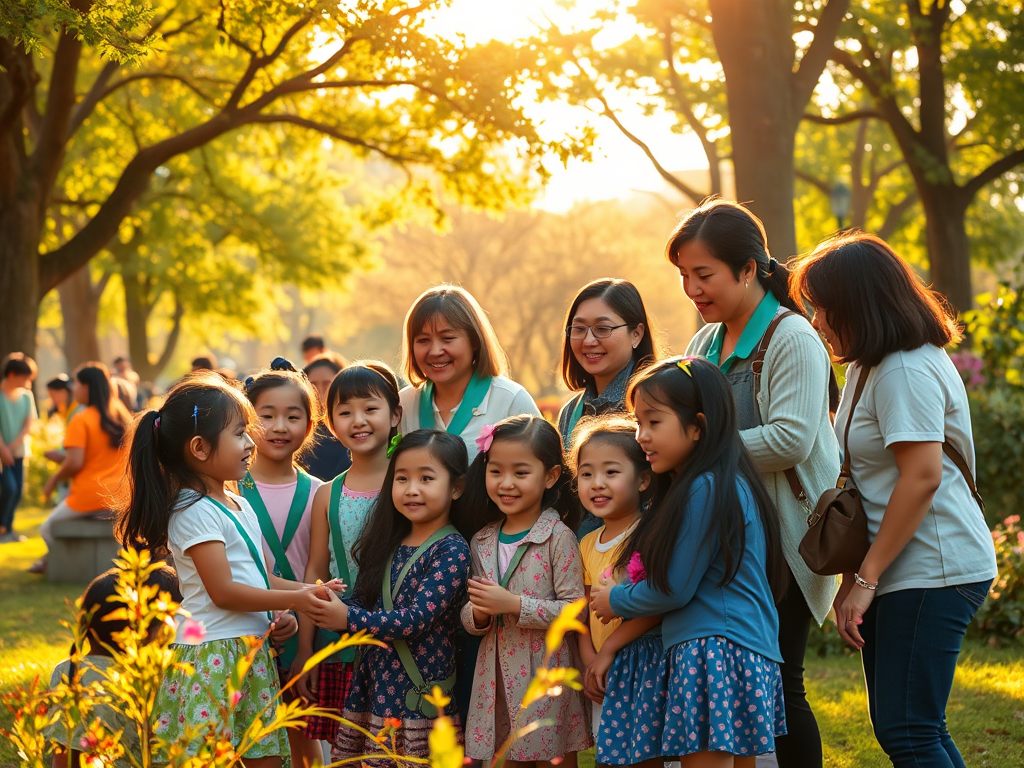
For several months I prayed and worked hard to help introduce the Girl Scout movement into the Korean‑American community in Long Island, New York. When my own children were young, I sent them to Girl Scouts, and through that experience I became closely acquainted with the scouting movement. I grew deeply drawn to its ideals—holistic education, community service, stewardship of nature, and the pursuit of human harmony—values that have developed for nearly a century on a foundation of Christian faith.
Before long, the Girl Scout Council told me they needed someone who could build a bridge to the Korean community, and half willingly, half reluctantly, I found myself stepping into various responsibilities. But the deeper motivation was this: at a time when reports of youth‑related family crises were rising every year in the Korean community, here was a precious program—one that required no cost to adopt—ready to be integrated. I could not help but feel energized to take part.
Yet just because I believed in it did not mean others would easily join. Especially when I ran into the limitations of immigrant life, I could not help feeling disappointment and discouragement. When I explained the Girl Scout ideals, the benefits, and the meaningful direction it could offer our youth, people agreed in principle—but when it came to the question of who would step forward as a leader or partner, the conversation always ended with, “There’s no one who can do it,” or “It’s not the right time yet.”
I repeatedly asked myself, “Is there truly no one? Is it really not the right time? Even when our children are wandering—facing teen pregnancy, running away from home—is it still not the time?” Holding onto the faint hope that somewhere, someone might be willing to volunteer, I knocked on many doors. Out of nearly two thousand conversations, only one person expressed interest in volunteering. I placed great hope in that single “yes” and began working diligently to organize local troops.
But then another obstacle arose. When I asked Korean churches in the area to provide space for troop meetings, many expressed reluctance for various reasons.
I could not help recalling the American church where my husband once pastored. That church kept its doors open to the community throughout the week. Even non‑members freely used the building for countless activities. There were groups for people struggling with overeating, support groups for those recovering from alcoholism or drug addiction, and local senior‑citizen orchestras that practiced regularly. And among them, the church proudly hosted a Girl Scout troop.
In American society, churches function like town halls—public spaces open to anyone for wholesome programs, gatherings, celebrations, worship, and ceremonies. Because of that openness, many Korean immigrant churches were able to borrow worship space in their early years. We all experienced that generosity.
With no other choice, I once again turned to the openness of American churches. I wrote to the pastor and board of a nearby American church, asking for permission to use their space. To my surprise, they responded with great warmth and an enthusiastic “Yes!” The pastor and board added, “We congratulate the Korean community for taking interest in such a wonderful program. We are delighted and proud to see it growing.” Their attitude left me momentarily speechless, and for the first time I felt a deep sense of relief—I am doing the right thing.
For a moment, I tried to see our immigrant community through their eyes. Among ourselves, we pride ourselves on deep faith, and our churches multiply on every corner. But how do Korean Americans appear within the broader American society? Have we not, like a closed tribe, built our own walled churches and locked the gates to the outside world? Any society, organization, religion, or individual grows only when hearts remain open—learning from one another, maturing together.
This year again, many teenage girls received the Girl Scout Gold Award. Each girl had designed her own project and served the community—projects very similar to what churches call “mission work.” One girl recorded books with her own voice for the Helen Keller Foundation, donating hundreds of tapes for the visually and hearing impaired. Another, an African American girl, researched and created a booklet honoring Black women who had served society. A Latina girl created a simple coloring booklet in Spanish for children waiting in hospital emergency rooms with parents who did not speak English. Another learned emergency first aid and taught it to her neighbors. Yet another organized local shops to prepare holiday gifts for elderly people living alone. These girls gave their time and resources purely for the good of society—and naturally, college scholarships awaited them.
A mature faith and a healthy society grow only when we learn to care for others, recognize each person’s uniqueness, and step into the shared space of community. Today again, I hope that we will not remain a “we” that thinks only of “me,” but become a “we” that embraces everyone. And I pray that the mission of scouting may become a bridge connecting the church and the wider community.
— Wanhee Yoon, September 9, 1999

 Daily Sauntering