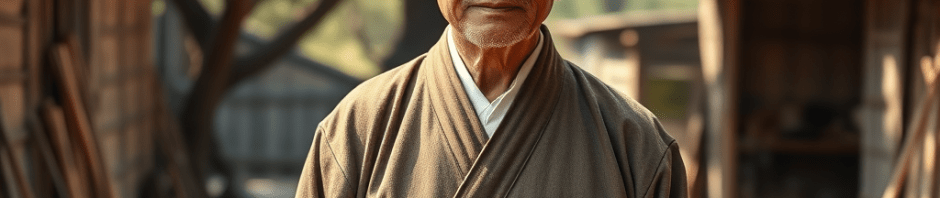
Father! Just calling your name makes me feel as though you might open the door at once and say, “I’m right here.” As the years pass, the dreams you held in your lifetime ripen quietly in my heart and return to me.
My father passed away when I was in elementary school. He was poor, and so pure‑hearted that people often deceived him or took advantage of him. Yet in every circumstance, he never lost himself, never wavered. He lived his whole life carrying others’ burdens, giving whatever he could. That is how he remains in my memory—gentle, steady, selfless. This year marks thirty‑five years since he left us. Perhaps it is age, but somehow I feel his warmth and presence more closely now than ever.
In the early 1900s, when my father was growing up, the nation was in turmoil. Most people survived on roots and tree bark. Born to a poor farming family, he finished elementary school and, at seventeen, went to Japan under colonial rule. He worked in a glass factory for more than ten years. But when his older brother sent a telegram saying their mother had died, he returned home.
At twenty‑nine, he married my mother, who was only seventeen. According to her, Father had lied through the matchmaker and claimed he was twenty‑five. A few months after the wedding, officials came to check the family registry, and my mother discovered she had married a man far older than she imagined. She was so upset that she locked herself in her room and cried for a week, refusing to eat. Perhaps because of this, Father cherished her deeply and cared for her tenderly all his life.
After the wedding, he returned to Japan, but my mother insisted they settle in Korea. Eventually they moved to a village called Hwangdeung‑myeon in Jeolla Province.
Father was the kind of man who would work through the night for someone else’s sake, never thinking of himself. The neighbors called him “Choi who could live without the law,” meaning he was so upright he needed no rules to guide him. But no matter how hard he worked, he could not escape poverty.
When he came to believe in Jesus, his service and sacrifice shone even more brightly. He became an elder and took on many responsibilities. He was blessed to run a small mill. During the Korean War, he refused to flee and stayed behind to guard the empty church, faithfully keeping the altar at dawn each day. Even when communist soldiers roamed the streets like they owned the world, he sought out those who had been left behind and cared for them. Eventually he was labeled a “dangerous reactionary, a Jesus‑believer,” and was awaiting execution when the war ended.
He chose ruined Seoul as the place to begin again. He followed someone who claimed to know the city well, but what awaited him was deception, betrayal, and despair. His dreams scattered like dust in a fierce whirlwind.
Seoul’s streets were overflowing with war orphans, refugees from the North, and people who had lost their families. Beggars with tin cans knocked endlessly on the gates of wealthy homes. Our home was only a shabby shack among other refugees, yet beggars swarmed in and out constantly.
Whenever Father saw a child wandering with a tin can, he brought them home—washed them, clothed them, fed them—and cared for them for months or even years until their families could be found. Many had frostbitten hands, feet, and ears, swollen and cracked. They had not bathed or changed clothes for months; their bodies were covered in sores and lice. Often, in the middle of the night, we would wake to find our parents bathing those children.
In the morning, a strange boy would be wearing my favorite clothes, or my siblings’ clothes, and we would be horrified. When several unfamiliar children arrived at once, we six siblings complained endlessly. Neighborhood kids teased us: “Wan‑hee’s family lives with beggars!”
But after a week, those children’s faces would regain color, their rough skin would soften, and their frostbite would heal. Some stayed for weeks, then disappeared—taking books, clothes, or dishes with them. Yet Father never blamed them. When we or the neighbors grew angry, he simply laughed and said, “They took it because they needed it.” His laughter drenched me like a summer downpour.
But life in Seoul was unbearably hard for him. He faced betrayal from those he trusted, harsh prejudice against people from Jeolla Province, the brutality of city life, pollution, and separation from beloved relatives. His health collapsed—heart disease and tuberculosis confined him to bed, where he spent his days praying in repentance.
There were hymns he loved to sing then. Whenever he sang “I wandered far from God, now I’m coming home,” I felt uneasy, afraid he might leave us. Yet he spent his final days preparing himself with dignity. He confessed one thing to my mother with deep remorse: deceiving her about his age. “I wronged you terribly,” he said. Watching her struggle to raise six children must have broken his heart. He also grieved that he had left the church he served in Hwangdeung‑ri, unable to fulfill his duties as an elder.
A few days before he passed away at age fifty‑two, he dreamed of climbing to heaven:
“…I went to a hospital, and everyone was dressed in white. Light poured down as they climbed a ladder to the second floor. I tried to follow them, but a kind‑faced man smiled and said, ‘Come back in three days.’”
The joy that lit his face as he told this dream—while gasping for breath—made us realize the end was near. My mother, only forty at the time, was overwhelmed with fear and grief. I felt myself falling endlessly into loneliness. “How will I live without Father?”
After the funeral, on my first day back at school, nothing had changed. Yellow poplar leaves trembled in the wind. Cosmos flowers in every yard held their seeds close, playing with the bright morning sun. But as I walked along the stream toward the schoolyard, my legs kept giving way, as though I were falling into an endless hollow space. I felt like a completely different child from the one I had been just days before.
When I entered my sixth‑grade classroom, the chatter of dozens of children stopped abruptly. My teacher looked at the suddenly quiet room, then turned to me. She called my name gently, asked me to come closer, and stroked my head. I stood before her and burst into tears.
“My father was sick for more than ten years before he died!” I cried out to no one in particular. My poor father. I had dreamed of growing up, curing his illness, and honoring him greatly. But he had let go of my hand far too soon.
My father— He lived as a humble blade of grass in a turbulent era, leaving no trace behind. He struggled through rivers of failure and disappointment. Yet even as his life flickered, he never stopped reaching toward the light. To his naïve children, to the countless orphaned beggar children, to the wounded neighbors living in despair, he became the unseen hand of “God the Father,” lifting them up quietly.
Though he could not return to his hometown, he spent his days and nights finding lost children, helping them find their families, restoring them to their homes. In the wilderness of life, he dug wells of living water and found simple joy there.
Now, as I grow older, I realize he never truly let go of my hand. I am grateful to know this at last. I wonder how far that distant horizon was—the one he gazed upon until his final breath. The more deeply I long for him, the faster the pages of time seem to turn.
— Yoon Wan‑Hee, 6/7/1999

 Daily Sauntering
You must be logged in to post a comment.