“GPS” (목사관 신앙칼럼 #15, LA 크리스찬 투데이, 9/10/2008) © 윤 완희 사모

개인 적인 일로 여행을 자주 다닐 수밖에 없는 나에게 자동차 안의 GPS(Global Positioning System) 얼
마나 귀한 존재인지 모른다. 운전대에 앉아 목적지의 주소를 넣으면, 순식간에 도착지를 향해 지도와 시 간표까지 다 마련해 놓고, 이리가라 저리가라고 눈과 귀를 통해 다 일러준다.

처음 얼마간에는 GPS를 사용하는 것이 익숙치 않아 GPS가 안내하는 길을 외면하고 내 생각과 직감에 의해 다니기도 했었다. 그러다가 조금씩 GPS의 성능과 정확성을 믿고 따라가다 보니, 내가 생각하고 판단했던 길보다도 훨씬 더 가깝고 편리한 길로 늘 인도됨을 발견케 되었다. 때로는 실수로 GPS가 가라는 길을 지나쳐버리기라도 하면 순식간에 새로운 길과 시간을 계산하여 다시 목적지로 인도한다. 행여나 길을 잃어 잠시 헤맬지라도 GPS는 지구공간의 어느 지점에 내가 있는지를 정확하게 파악해낸다.

지도가 있는데 GPS가 왜 필요해? 괜한 사치 아닐까? 몇 년 전에 GPS를 처음 대했을 때의 나의 생각이었다. 그러나 요즈음엔 GPS를 통해, 낯선 길에 더 이상 헤매이지 않게 되었고, 교통이 혼잡한 지역을 미리 피할 수 있으며, 시간과 개스비를 최소한 절약할 수 있다는 잇점에 GPS가 나에게 있어 여간 고마운 것이 아니다. 그러나 실상 GPS의 존재는 운전자들의 필수용품 만이 아닌 군사 기밀, 세계의 과학. 지질과 지진, 상업, 취미, 전신전화 등은 물론이요, 범죄수사에 까지 쓰여지고 있다하니 그 사 용도의 한계는 어디에까지 이르고 있는지 나로서는 상상 하기도 어렵다.

인공위성을 이용한 GPS의 기본적인 아이디어의 배경은 1939년 독일의 우주 과학자인 칼 한스 생크에 의해 군사적 목적으로 발명되었다. 그러다가 구 소련과 미국의 과학자들에 의해 더 연구 발전되다가 1978년 2월에 오늘의 GPS에 도달케되었다. 그러나, GPS의 존재가 일반화된 것은, 1983년도에 구 소련에 의해 격추되었던 Korean Air Lines Flight 007 사건 이후였다. 무고한 생명들이 국가 간의 정치적 목적으로 공중분해 된 후, 레이건 대통령은 시민들의 안녕과 복지를 위해 GPS의 일반화를 열게하였고, 오늘날 우리들은 그 혜택을 보게 된 것이다.

인간이 상상하여 만들어낸 GPS의 성능을 대할 때마다, 나는 그 어느 때보다도 하나님의 현존을 더욱 더 가까이 느끼며, 그 위대하심에 놀라움을 갖게된다. 또한 ‘사람을 지으시고, 언제나 사람과 함께 동행하시길 원하시는 하나님께서 누구인들 중요치 않고 귀하지 않은 이들이 어디있겠는가?’ 라는 인간의 존엄성과 가치이다.

시편기자의 “내가 바위틈에 숨을지라도, 하나님은 거기 계시다”는 고백처럼 오늘의 내가 처해있는 모든 상황을 나 자신보다도 정확하게 파악하시고 아시는 하나님. 내 영혼이 이 세상에서 잠시 방황할지라도 영원한 목적지인 천국을 향해 주소를 넣기만 하면 그 순간부터 내 삶은 더 이상 헤매이거나 낭비함 없는 길을 간다는 명확한 증거. 내가 하나님을 외면한 적은 있을지라도, 하나님은 한번도 나를 떠나시질 않으셨으며, 앞날도 그리 하신다는 사실이 그 어느 때보다도 감격스럽기만 하다


The current image has no alternative text. The file name is: image-25.png
Posted in Essay by WanHee Yoon, faith-column | Leave a comment

Flowing Water

In the valley soaked in love—
from beneath its arms,
rose the scent of human sweat.

Even death itself was, in truth,
a fragment drifting through the sky,
a sip of wine,
a single sigh,
the sweet lips of a woman—
a bridal procession.

Turn your head.
Look back.
The one who has changed… is you.

The birds fly toward the western sky.
[He comes. I go.
He comes. I go.
He comes. I go.]

Now go—before the sun rises.
From afar,
the cry of a cow
echoed like a ghost of memory.

I am water.
Once, I tried to ride the clouds.
Stones. Shards of flint.
A few crooked trees.
Through the cracks of the steep cliff,
a single pine stretched sideways.
Upon a jutting rock,
two crows crouched in silence.

People climbed the cliff.
A dog with black fur
and red spots on its coat
appeared suddenly, tongue lolling.

At that moment,
the gorge turned into a graveyard—
trees stood thick
like headstones.

Ride the black horse
into the desert of heaven.
The scent it carries,
the saddle it bears—
that is the horse I must ride.

The setting sun
seemed to sink into blood.
A hawk beat its wings violently,
searching for its own flesh
beneath the trees—
and then,
it returned into itself.

Everything longs to belong.
Countless faces—
when one vanishes,
another comes
to caress the empty place.

The golden tomb waits
to give birth
to the child of the sun.

Grave, grave, grave…

In the valley soaked in love—
from beneath its arms,
rose the scent of human sweat.

Even death itself was, in truth,
a fragment drifting through the sky,
a sip of wine,
a single sigh,
the sweet lips of a woman—
a bridal procession.

– Note:

This poem was born in 1980, amid the confusion and inner turmoil that followed my arrival in America.
At that time, I stood between two worlds—
one, the homeland I had already left behind,
and the other, a foreign land that had yet to accept me.

“Flowing Water” is a record of that sense of disconnection and longing,
and of the “human instinct to belong.”
The images of rivers and valleys, rocks and beasts, and wedding rituals
symbolize the crossings between life and death, love and loss, homeland and estrangement.

Through this poem, I wished to say that immigration is not merely
a movement across space,
but a dismantling and rebirth of the soul.

The water flows on,
yet within it remain the scent and memory of its source.
Like that water, I too have flowed—
and even now, I am still flowing.

© TaeHun Yoon, 1981

The current image has no alternative text. The file name is: image-20.png
Posted in Poetry | Tagged , , , , | Leave a comment

“흐르는 물”

사랑에 젖은 골짜기—
그 겨드랑이 밑에서 인간의 땀 냄새가 피어올랐다.

죽음조차도, 실은
하늘에 떠도는 조각,
한 모금의 포도주,
한 번의 신음,
여인의 달콤한 입술—
혼례 행렬이었다.

고개를 돌려라.
뒤를 보라.
변한 사람은… 너다.

새들은 서쪽 하늘로 날아간다.
[그가 온다. 나는 간다.
그가 온다. 나는 간다.
그가 온다. 나는 간다.]

이제 가라— 해가 뜨기 전에.
멀리서 소의 울음이
메아리처럼 들려왔다.

나는 물이다.
한때 구름을 타려 했었다.

돌들. 부싯돌 조각들.
비뚤게 선 나무 몇 그루.
가파른 절벽 틈새로
가로로 뻗은 소나무 한 줄기.

돌출된 바위 위,
까마귀 두 마리가 웅크리고 있었다.

사람들은 벼랑을 기어올랐다.
검은 털에 붉은 반점이 박힌 개 한 마리가
갑자기 나타나 혀를 내밀었다.

그 순간,
협곡은 묘지로 변했다—
나무들이 묘비처럼
촘촘히 서 있었다.

검은 말을 타고
하늘의 사막으로 달려라.
그 말이 품은 향기,
그 말이 짊어진 안장—
그것이 내가 타야 할 말이다.

막 지는 태양은
핏물 속으로 가라앉는 듯했다.
매 한 마리가
거칠게 날개를 쳤다.

자신의 살점을
나무 밑에서 찾으려
그것은 다시
자기 속으로 들어갔다.

모든 것은
속하고자 한다.
무수한 얼굴들—
하나가 사라지면
또 하나가 와서
그 빈자리를 어루만진다.

황금 무덤은
태양의 아이를 낳기 위해 기다린다.
무덤, 무덤, 무덤…

사랑에 젖은 골짜기—
그 겨드랑이 밑에서
인간의 땀 냄새가 피어올랐다.

죽음조차도, 실은
하늘에 떠도는 조각,
한 모금의 포도주,
한 번의 신음,
여인의 달콤한 입술—
혼례 행렬이었다.

  • – 후기:

이 시는 1980년, 내가 미국에 도착한 직후의 혼란과 내적 격동 속에서 태어났다.
그 시절, 나는 두 세계 사이에 서 있었다—
하나는 이미 떠나온 고향,
다른 하나는 아직 나를 받아들이지 않은 낯선 땅이었다.

〈흐르는 물〉은 그 사이에서 느낀 단절과 그리움,
그리고 “속하고자 하는 인간의 본능”을 기록한 시이다.
강과 골짜기, 바위와 짐승, 그리고 혼례의 이미지들은
삶과 죽음, 사랑과 상실, 고향과 낯섦의 경계를 넘나드는 상징들이다.

나는 이 시를 통해 “이민”이라는 말이 단순히
공간의 이동이 아니라,
영혼의 해체와 재탄생임을 말하고 싶었다.

물은 흘러가지만,
그 안에는 언제나 처음의 냄새와 기억이 남아 있다.
그 물처럼, 나 역시 흘러왔고—
지금도 여전히, 흘러가고 있다.

© 윤 태헌, 1981

The current image has no alternative text. The file name is: image-19.png
Posted in Poetry | Leave a comment

(Boss) — Pastor’s Wife Faith Column #14 © Yoon Wan-Hee, LA Christian Today, September 28, 2011

In our family, my mother-in-law was affectionately known as “the Boss.” Of course, she was the eldest, so it was only natural—but behind that title lay a will that no one could sway, a sharp discernment and memory unmatched by any of her descendants.

After my marriage, I lived in circumstances that made it difficult to care for her closely or visit often, as I was supporting my husband’s ministry. She raised her three sons—now a physician in his seventies, a pastor in his sixties, and a businessman nearing sixty—with strict discipline. They called her “the tiger.” And she was no less exacting with her daughters-in-law.

She always kept a watchful eye on our faith and household management. When we brought her gifts—new blankets, shoes, clothes, or food—she rarely accepted them as they were. She would ponder whether they were truly the best, and often insisted they be exchanged several times before she was satisfied.

Even after moving into a nursing home years ago, she would scold her children if they brought gifts meant only for her. She wanted every visit to include something for the hardworking staff and fellow residents. Visits without such consideration never pleased her.

At the end of August, my mother-in-law passed away at the age of 95. Born in Pyeongsan County, Hwanghae Province, of the Hanyang Jo clan, she died in a nursing home in New Jersey, USA. Only then did I begin to understand more deeply who she truly was.

She married at sixteen and moved to Seoul with her in-laws to support her fourteen-year-old husband’s studies. Exceptionally bright, she lived in a time when girls were not taught to read. Later, through church, she taught herself Hangul and began reading the Bible.

In Seoul, she once practiced superstition with devotion. But one day, when the husband of a Christian neighbor passed away, she was moved by their funeral—not filled with wailing, but with hymns and prayer. That moment led her to church.

She lived her faith with the same precision and intensity as her character. Despite poverty, she sent her eldest son to medical school, shedding countless tears to cover tuition. Yet every Saturday, she would iron wrinkled bills or exchange them at the bank for crisp ones, offering her tithe and thanksgiving with reverence.

After the Korean War broke out, during the bitter cold of the retreat south, she traded her precious gold ring for a piece of rice cake to save her second son, whose frostbitten hands were swollen red. How did she know that one day, that son would feed and care for hungry souls in a foreign land?

My mother-in-law was a daughter of Korea who survived poverty, ignorance, discrimination, and isolation through faith. She raised her children in that faith, and passed it on to her grandchildren. She lived by the principle: whatever you do, do it as unto the Lord—with the very best.

I held her cold hand and said goodbye in silent sobs. “Mother… thank you. You are my eternal Boss.

Posted in Essay by WanHee Yoon, faith-column | Tagged , , , , , | Leave a comment

“보스” (목사관 신앙칼럼 #14, LA 크리스찬 투데이, 9/28/2011) © 윤 완희 사모

시어머님은 우리 가정에서 “보스”라는 별 명을 가지고계셨다. 물론 제일 어른이시니까 당연한 것이지만, 그 이면에는 아무도 말릴 수 없는 그 분 만의 고집과 까다로움, 예리하신 판단력과 기억력은 그 어느 자손들도 따라갈 수 없을 정도였기 때문이다.

나는 결혼 이후, 목회를 돕는다는 이유로 시어머니를 곁에서 모시거나 자주 찾아 뵐 수 없는 형편 속에 살아왔다. 시어머님은 칠순이 넘으신 의사이신 큰 아드님과, 육순이 넘은 목사인 둘째, 회갑이 되어가는 사업가인 세 아들들이 “호랑이”라 불렀던 분으로 자녀들을 엄하고 절도있게 키우셨다. 며느리들에게도 예외 일수가 없는 분이었다. 며느리들이 신앙생활과 살림을 잘하고 있는지 늘 살피는 것은 물론이요 종종 새 이불이나, 신발, 옷, 잡수실 것들을 사다드리면 그것을 그냥 그대로 받지 않으셨다. 과연 이것이 최상의 것인지 아닌지 두고두고 생각하시다가, 받으신 선물들을 거의 몇번 씩 다른 것으로 바꿔다 드려야 만 성이 풀리시는 분이었다.

또한 수년 전에 연로하신 시어머님이 양로원으로 거처를 옮기신 후, 자손들이 어머님을 방문할 때는 어머님 만을 위한 선물을 가져 갖다가는 늘 불호령이 떨어지곤 하였다. 수고하는 병원의 직원들과, 같은 병동에 계신 모든 분들을 위한 배려가 없는 자식들의 방문은 결국 즐거워하질 않으셨다.

지난 8월말, 시어머님이 95세의 연세로 그분의 생을 마치셨다. 한양 조씨로 황해도 평산군에서 태어나시어 이곳 미국의 뉴져지 양로원에서 생을 마치시던 날, 나는 비로소 시어 머님이 어떤 분이었는가를 더욱 깊이 알 수가 있었다. 시어머님은 16세의 어린 나이에 결혼하시어 14세의 남편 유학을 위해 서울로 시부모를 따라 이사를 하시게 되었다.

유난히도 총명하시었으나 여아는 언문을 배울 수 없던 시절이어서 훗날 교회를 다니면서 독학으로 한글을 깨우치시 고 성경을 읽으셨다. 서울에서의 생활은 미신을 지성으로 섬기셨었다. 그러나 어느날, 앞집의 예수쟁이의 남편이 사망 했을 때, 그들은 통곡 대신 찬송과 기도로 장례식을 하는 것 에 감동이 되어 교회에 나가기 시작하셨다.

시어머님은 자신의 성품처럼 철저하고 예리하게, 신앙생활을 하셨다. 가난 속에서 큰 아들을 의대를 보내신 후, 학자금 마련에 늘 눈물이 마르실 날이 없으셨으나 그럼에도 불구하고, 주일 전에는 구겨진 지폐는 다리미질을 하거나, 은행에 가셔서 새돈으로 바꿔 십일조와 감사헌금을 평생을 하셨다.

그리고, 육이오 사변후, 일사후퇴의 엄동설한의 피난길에 는 등에 업힌 둘째 아들을 살리기 위해 당신의 금지환을 한조각의 개피 떡과 선뜻 바꾸셔, 동상으로 빨갛게 부어오른 어린 아기의 손에 쥐어주셨다. 시어머님은 그 아들이 이국의 땅에서 허기진 영혼들을 먹이고 돌볼 것을 어찌 아셨는지!

시어머님은 한국의 척박한 역사 속에 가난과 무지, 차별과 소외 속에서도, 신앙으로 꿋꿋이 살아 남은 한국의 딸이었다. 험란했던 시대의 풍랑 속에도 굴하지 않으시고 자녀들을 신앙으로 키우셨고, 그렇게 손주 손녀들에게도 가르치셨다. 무엇을 하든 최상의 것으로 주님께 하듯 하라고 몸소 실천 하셨다.

나는 어머니의 찬 손을 잡고 소리없는 오열로 하직인사를 드렸다. “어머님! 감사합니다! 당신은 저의 영원한 보스이십니다!”

Posted in Essay by WanHee Yoon, faith-column | Leave a comment

“Heartbreak”

The sun turned its face away,
and what fell—drop by drop—upon my feet
were the tears of a thousand stars.
Only hollow eyes shimmered in the dark,
and I struck the fading sun
with fists that could no longer burn.

Inside me, something trembled—
the door creaked open,
and I stood there,
a bankrupt soul,
holding the silence of two worlds.

If pride still existed,
it meant nothing—
not to the drunkard,
not to the liar,
not to the one who leaves.

You became a hill of stones and thistles,
a mound of forgotten bones—
and I,
a shadow walking west,
carrying the ache of home
that never left my chest.

© TaeHun Yoon, 1980

  • Note: (after leaving my homeland) This poem was born from the ache of leaving my homeland, Korea, and crossing the vast distance to America. It carries the silence that lingers between loss and beginning—between what must be left behind and what cannot be forgotten. The “sun” here is both my country and my youth, turning away as I depart. The “tears of stars” are memories—each drop a fragment of the people, places, and dreams I could not take with me. To emigrate is to become a “bankrupt soul,” emptied yet somehow still alive, walking westward toward an uncertain promise. Through this poem, I grieve not only for what I lost but also for the part of myself that remains forever Korean—rooted in the soil I can no longer touch.
The current image has no alternative text. The file name is: image-13.png
Posted in Poetry | Leave a comment

“실연”

태양은 얼굴을 돌리고,
내 발끝에 떨어진 것은
별들의 눈물,
한 방울, 한 방울이었다.

어둠 속엔 비어 있는 눈만이 반짝였고,
나는 더 이상 타오르지 못하는 주먹으로
저무는 태양을 두드렸다.

내 안에서는 무언가 떨리고 있었다.
문이 삐걱 열릴 때,
나는 서 있었다 —
두 세계의 침묵을 껴안은
파산한 영혼으로.

만약 자존심이란 게
아직 남아 있다면,
그건 아무 의미가 없었다 —
주정뱅이에게도,
거짓말쟁이에게도,
떠나는 자에게도.

그대는 돌과 가시로 된 언덕이 되었고,
잊힌 뼈들의 무덤이 되었다.
그리고 나는,
서쪽으로 걷는 그림자 —
가슴 속에서 떠나지 않는
고향의 아픔을 안고 있었다.

© 윤 태헌, 1980

  • 후기: (고향을 떠난 뒤) 이 시는 나의 조국, 한국을 떠나 미국으로 건너오던 그 아픔에서 태어났다. 잃음과 시작 사이, 떠나야만 했던 것과 결코 잊을 수 없는 것 사이에 남아 있는 고요를 품고 있다.

여기서 “태양”은 나의 나라요, 나의 젊음이다. 내가 떠날 때 그것은 얼굴을 돌렸다. “별의 눈물”은 기억들이다 — 한 방울, 한 방울이 내가 가져올 수 없었던 사람들과 장소, 그리고 꿈의 조각이다.

이민(移民)이란 “파산한 영혼”이 되는 일이다. 텅 비었으나 여전히 살아 있는 존재로서, 나는 서쪽으로 걸었다. 아직 약속조차 불확실한 땅을 향해.

이 시를 통해 나는 잃은 것들을 애도할 뿐 아니라, 여전히 한국인으로 남아 있는 내 안의 한 부분 — 더 이상 손으로 만질 수 없는 그 땅의 흙에 뿌리내린 나 자신 — 을 그리워한다.

Posted in Poetry | Leave a comment

(The Rainbow-Colored Fish) — Pastor’s Wife Faith Column #13 by Yoon Wan-Hee, LA Christian Today, September 26, 2007

Among children’s storybooks, there is one titled The Rainbow Fish by Marcus Pfister. It’s a book you’ll find in nearly every elementary school library. The story teaches children the joy of living in community and the value of sharing—and I found it deeply applicable to my own life.

In the story, a rainbow-colored fish lives in the sea. Unlike any other, it has shimmering, multicolored scales that make it the envy of all the other fish. The rainbow fish, proud of its beauty, believes it is special and avoids mingling with others. One day, a small fish approaches and asks for just one of its beautiful scales. The rainbow fish refuses. After that, the other fish stop speaking to it, and it becomes lonely.

Eventually, the rainbow fish seeks advice from a wise old octopus, who tells it to share its scales. So the next time the small fish appears, the rainbow fish quickly gives away one scale. Soon, other fish gather and ask for one too. The rainbow fish shares all but one of its scales. In doing so, it discovers a new kind of beauty—one that shines among others—and finds joy and happiness living together with them.

Growing up in Seoul during the 1960s, I lived in an environment so harsh it could be described as chaotic. The streets were filled with disabled war veterans, orphaned children, reconstruction sites, clouds of dust, displaced families, and the stench of waste from Cheonggyecheon stream*.

My family was part of that struggle. My parents worked tirelessly to make ends meet, and my father, in his late forties, suffered from heart disease. Yet day and night, my parents brought homeless children into our home—washing them, feeding them, dressing them in our saved clothes, and letting them sleep under our roof. They searched for their relatives, wrote letters, and sent them back to their hometowns when possible.

As a child, I resented this. I was hurt when my cherished clothes were given away without hesitation. I often thought, “We’re not rich—why should we help others?” That rebellious question lingered in my heart.

But sharing one’s resources and life is a sacred act—a key that opens the door to miracles. Though giving brings more joy than receiving, I still find myself stingy with generosity. Sending a card, making a call, picking flowers for a neighbor, visiting the sick and lonely, looking deeply into someone’s eyes… these simple acts are often pushed aside with the excuse of being too busy.

This autumn, the rainbow-colored fish has returned to my life—like a whisper from the Lord, reminding me to rediscover joy and worth through true sharing.

The current image has no alternative text. The file name is: image-12.png

  • Cheonggyecheon (Korean: 청계천, Korean pronunciation: [t͡ɕʰʌŋ.ɡje.t͡ɕʰʌn]) is a 10.9-kilometre-long (6.8 mi) stream and public space in downtown Seoul, South Korea. A natural stream sourced from the Suseongdong Valley in Inwangsan, it was historically maintained as part of Seoul’s early sewerage until the mid-20th century, when post-Korean War rapid economic development and deteriorating conditions prompted the filling of the stream with concrete and the construction of an elevated freeway, the Cheonggye Expressway, in its place. In 2003, the city government began an urban renewal project to remove the expressway and restore the stream, which was completed in 2005 at a cost of over ₩386 billion (approximately US$281 million). The Cheonggyecheon restoration project initially attracted significant public criticism, but since its opening in 2005 it has become popular among residents and tourists. (Wikipedia)

Posted in Essay by WanHee Yoon, faith-column | Tagged , , , , , | Leave a comment

“무지개 빛 물고기” (목사관 신앙칼럼 #13, LA 크리스찬 투데이, 9/26/2007) © 윤 완희 사모

동화 책 가운데 <무지개 빛 물고기>(The (The Rainbow Fish: by Marcus Pfister)라는 이야기가 있다. 이 책은 거의 모든 초등학교 도서실에서 발견될 수 있는 책이다. 아이들에게 공동체 안에서 함께 살아가는 기쁨과 나눔에 대한 가치가 담긴 글인데, 내 자신에도 적용되는 글이었다.

어느 바다에 무지개 빛 물고기가 살고있었는데, 그 물고기는 어느 물고기보다 특이한, 오색찬란한 비늘을 갖고 있어 모든 물고기들의 선망의 대상이었다. 무지개 빛 물고기도 자신은 어느 물고기보다도 늘 특별하다고 생각하고 다른 고기들과는 잘 어울리질 않았다. 어느 날 작은 고기 한 마리가 다가와 그 아름다운 비늘하나 만 나눠달라고 하자 거절하였다. 그 후로 다른 물고기들도 무지개 빛 물고기와 더 이상 말을 건네질 않았다. 무지개 빛 물 고기는 어느덧 외톨이가 되고 말았다. 그는 나이가 많은 지혜로운 문어를 찾아가 자문을 구하였다. 문어는 말하길 그 아름다운 비늘을 하나씩 나눠주라고 하였다.

어느 날 무지개 빛 물고기는 지난 번, 비늘 하나만 나눠 달라는 물고기를 만나자마자 비늘 하나를 얼른 떼 주었다. 그러자 다른 물고기들도 몰려와서 비늘을 하나씩 나눠달라고 하였다. 무지개 빛 물고기는 자신의 비늘을 하나만 남겨놓고 모두 나눠주었다. 그러자 무지개 빛 물고기는 모든 고기들 속에서 자신만이 갖고있었던 아름다움을 볼 수 있었으며 모든 물고기들과 함께 재미있고 행복하게 살아 갈 수 있었다 라는 이야기다.

내가 자라나던 60년대의 서울은, 도시전체가 수라장이라고 표현해도 좋을 정도의 열악한 환경이었다. 전쟁이후 거리로 쏟아져 나왔던 상이군인들과, 부모를 잃은 전쟁 고아들, 여기저기서 시작되는 도시 복구공사들, 신작로의 먼지, 실향민들의 무리, 청계천*의 오물 썩는 냄새 …

그 틈에 우리가족도 끼어 부모님은 하루의 생계를 위해 고심 분투해야 만했으며, 40대 후반이던 아버지는 심장병을 앓고 계셨다. 그런데, 부모님들은 밤이고 낮이고 거리에서 거지 아이들을 데리고 와서 그들을 씻기고 먹이고, 우리들의 아껴뒀던 옷을 입히고, 밤이면 재우기까지 하셨다. 그리고 그들의 연고자를 찾아, 고향 길로 내려보내기도 하고 일가친척을 찾아, 편지를 써보내기도 하였다.

나는 어린 마음에 부모님의 이런 모습이 싫었고, 내 아끼는 옷들을 서슴없이 거지에게 내줌으로 인해 늘 상처를 받곤 하였었다. 내 마음 속에는 ‘우린 부자도 아닌데 왜 남을 도와주어야 하나요?’ 라는 반항심이 있었다.

자신의 물질과 생명을 남과 나눈다는 것은 거룩의 행위이며 기적을 여는 열쇠임에 틀림없다. 받는 기쁨보다 주는 기쁨은 그 배를 더함에도 불구하고 내 자신이 나눔에 대해 몹시 인색해져있음을 때때로 발견케 된다. 시간을 내어 아는 이들에게 카드를 보내는 일, 안부전화를 하는 일, 이웃에게 꽃을 따다 주는 일, 아프고 외로운 이들을 방문해 주는 일, 상대방의 눈빛을 깊게 바라보는 일 … …. 모두가 시간이 없다는 핑계로 젖혀두기 일쑤이다.

이 가을 녁에 무지개 빛 물고기가 문득 나의 삶에 찾아 옴은, 진정한 나눔을 통해 나의 기쁨과 가치를 되찾으라는 주님의 음성으로 들려진다.

The current image has no alternative text. The file name is: image-11.png
  • 청계천(淸溪川)은 대한민국 서울특별시 시내에 있는 지방하천으로, 한강 수계에 속하며 중랑천의 지류이다. 최장 발원지는 종로구 청운동에 위치한 ‘백운동 계곡’이며,[2] 남으로 흐르다가 청계광장 부근의 지하에서 삼청동천을 합치며 몸집을 키운다. 이곳에서 방향을 동쪽으로 틀어 서울의 전통적인 도심지를 가로지르다가, 한양대학교 서울캠퍼스 옆에서 중랑천으로 흘러든다. 발원지에서부터 잰 본류의 길이는 10.92 km, 유역 면적은 50.96 km2이나, 백운동 계곡 언저리를 제외한 상류 2.50 km 구간은 일제강점기 이래 전면 복개되어 타 용도로 전용되는 등 사실상 하천의 기능을 상실하였다. 현재는 서울 이곳저곳에서 취수한 물을 중류의 청계광장에서 하루에 40,000 세제곱미터씩 인공적으로 방류하는 형태로 하천을 유지하고 있다. 발원지의 계곡은 서울특별시 기념물로 지정되었으며, 청계광장에서 중랑천 합수머리까지의 중·하류 8.12 km[3] 구간은 서울시설공단의 관리 하에 공원으로 쓰인다. (위키 백과)
Posted in Essay by WanHee Yoon, faith-column | Leave a comment

저녁에

핏빛 광휘가 지평선을 따라 번져가고,
동녘 하늘의 가장자리가
옅은 푸름과 부드러운 흰빛으로 피어오른다.

어둠의 이빨 사이에 끼인 꽃향기가
옆으로 흘러—
바람 속으로 고요히 향기를 쏟는다.

하나는 피어나고, 하나는 스러진다—
너의 죽음과 나의 배신이
떨리는 땅 위에 머물러,
희미한 공기 속에서 연기처럼 말린다.

뼈를 핥는 소리와 함께
그것은 깊숙이 파고들어,
영혼의 빈 틈 속에 뿌리를 내리고,
온전하던 마음을 산산이 부쉈다.

우리의 눈은, 허무 속에서 얽혀
한마디 말도 없이 싸웠다.

나는 쓰러져 있었네,
돼지가 구유 속에 몸을 비비며 헐떡이듯—
그러나 피어나는 나무 하나를 본 순간,
내 몸은 이미 절망의 진흙탕에서
스스로 일어서 있었다.

그 꽃나무—
죽음이 내 앞에 서 있는 형상.

이제 나는 더 이상
자유를 찾아 떠돌고 싶지 않다.
설령 떠날 수 있다 해도,
다만 한 인간의 얼굴을
다시 보고 싶을 뿐.

마침내,
거대한 달이 고요히 떠오른다—
아마 이제,
그 달의 차례가 되었나 보다.
슬퍼할.

© 윤 태헌

  • 후기:

이 시는 겟세마네의 예수를 마음에 두고 쓴 작품이다.
붉게 번지는 저녁빛 속에서 나는,
죽음과 배신, 사랑과 용서를 동시에 바라보았다.

예수의 고뇌는 단지 한 사람의 비극이 아니라
인간 모두의 내면에서 일어나는 싸움이다.
우리 안의 ‘배신하는 자’와 ‘용서하는 자’가
서로를 향해 눈을 마주보며 침묵 속에서 싸운다.

그러나 절망의 진흙 속에서도
한 그루 꽃나무가 피어나는 것을 본다.
그것은 부활의 징표이며,
끝내 사라지지 않는 생명의 약속이다.

이 시를 통해,
나는 예수가 겪은 ‘밤의 고독’을
조금이나마 함께 걷고자 했다.
그리고 그 침묵 속에서,
하늘로부터 스며드는 한 줄기 빛을 느끼고 싶었다.


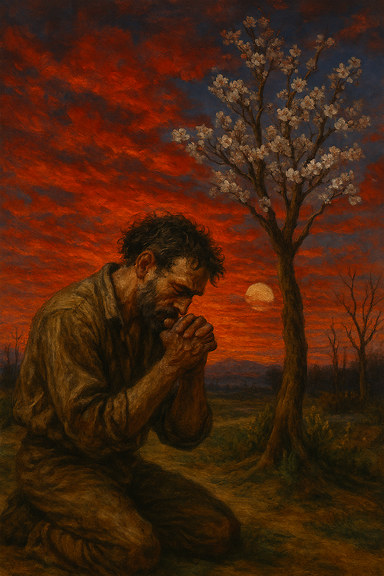
A symbolic and emotional painting inspired by the poem 'In the Evening' — a twilight landscape where a crimson sky fades into pale blue at the eastern horizon. A flowering tree stands in the foreground, its blossoms glowing faintly in the dimming light. Nearby, a shadowy figure kneels beside a trough, half-emerged, as if awakening from despair. In the distance, a large, silent moon rises over a barren field. The atmosphere is heavy with sorrow and longing, yet touched by the quiet presence of hope and transcendence. The style is impressionistic with surreal undertones, using deep reds, blues, and muted earth tones.
Posted in Poetry | Leave a comment