© TaeHun Yoon
Among the living,
a heart is always knotted—
yet never lost.
It threads itself
through the secret hems of time.
A child cries for milk,
and the moment fogs,
like breath upon glass.
Every toy feels like mine,
just after the first step,
when the world could rest
inside one hand.
I ran breathless,
laughed too loudly,
dreamed through nights
measured by gates and exams,
while the power to create
slept beneath a skull
heavy with borrowed words.
Then work arrived—
a ladder climbed,
a rung missed.
Paychecks paused
before youth
could finish its speech.
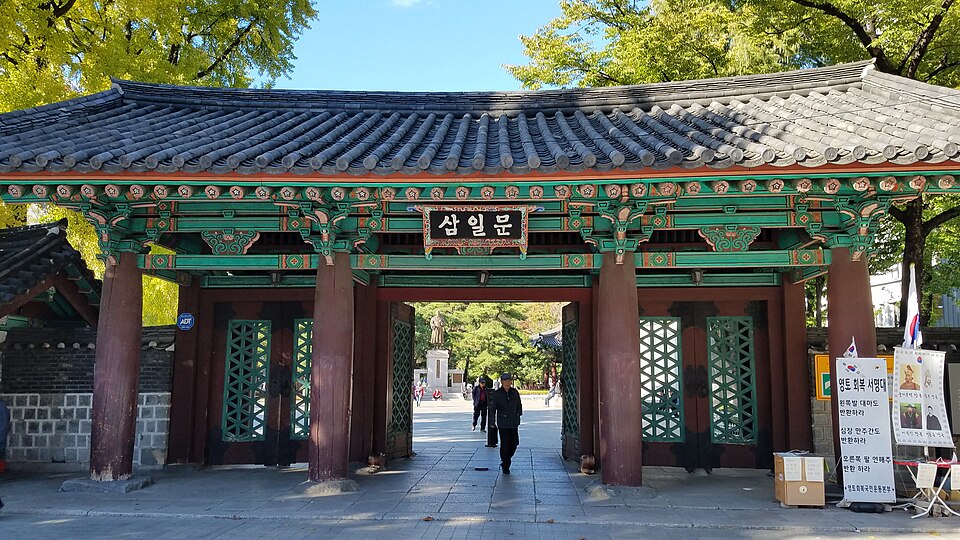
So I walk to Tapgol Park*,
fold into silence,
let the years
settle like leaves.
But swaddled days
do not vanish.
They are strength
wrapped in memory,
waiting—
ready to rise
when the wind calls again.
- * [Wikipedia] This park was once the site of the 15th-century Buddhist temple Wongaksa. The word tap means “pagoda“, and the park gets its name from the Wongaksa Pagoda, a 10 storied stone pagoda (National Treasure No.2[3]) located in the park.[1] It did not become a park until 1897, when it was organized as a garden via the proposal of John McLeavy Brown, an Irish advisor to King Gojong.[2]
- One of the monuments in the park is the Monument of Wongaksa built in 1471 to record the founding of Wongaksa (temple) in 1465.[3][4] On the front is an inscription composed by Kim Suon with the calligraphy done by Seong Im. On the back is found an inscription composed by Seo Geo Jeong with the calligraphy done by Jeong Nam Jong.[3] The turtle shaped base is constructed from granite and the body is cut from marble. The monument measures 1.3 meters/4.3 feet wide and stands 4.9 meters/16.2 feet in height. Two elaborately carved intertwined dragons rising toward the sky holding a Buddhist gem reside on the top of the monument.
- Tapgol Park is historically important as the site of the origin of the March First Movement 1919, an important part of the Korean independence movement as the first location for the reading of the Proclamation of Independence.[2] There are a number of bas-relief statues representing Korean national heroes, as well as a monument to independence movement.[2]
- Appearance in K -Drama
- The park is also briefly featured in Squid Game Season 2 episode 1 “Bread and Lottery.” In the scene, the recruiter passes out lottery tickets and bread to the homeless there before stamping down the remaining bread. This contrasts the ideals of the Proclamation of Independence against the lived reality of modern day Korea.

 Daily Sauntering
You must be logged in to post a comment.