At our church, we have begun holding a special communion service on the first Sunday of each month where three generations worship together. By “three generations,” we mean grandparents, parents, and children gathered in one service. At first, since we had never tried such a worship before, there were worries and even some opposition. Yet after several months, it became a service that families eagerly awaited, and so I wish to share about it.
It began at last year’s summer retreat. At the request of Rev. Hyun Yong-Soo (author of IQ Belongs to the Father, EQ Belongs to the Mother), the entire family was asked to gather in the sanctuary to hear a lecture on biblical child-rearing. Even before the retreat, such a request had been made, but parents, students, and the pastor in charge of the second generation strongly opposed it. On the day of the retreat, confusion continued. Yet the guest pastor persuaded us, saying, “Obedience is better than sacrifice,” and so we reluctantly gathered in one room, though our hearts were uneasy.
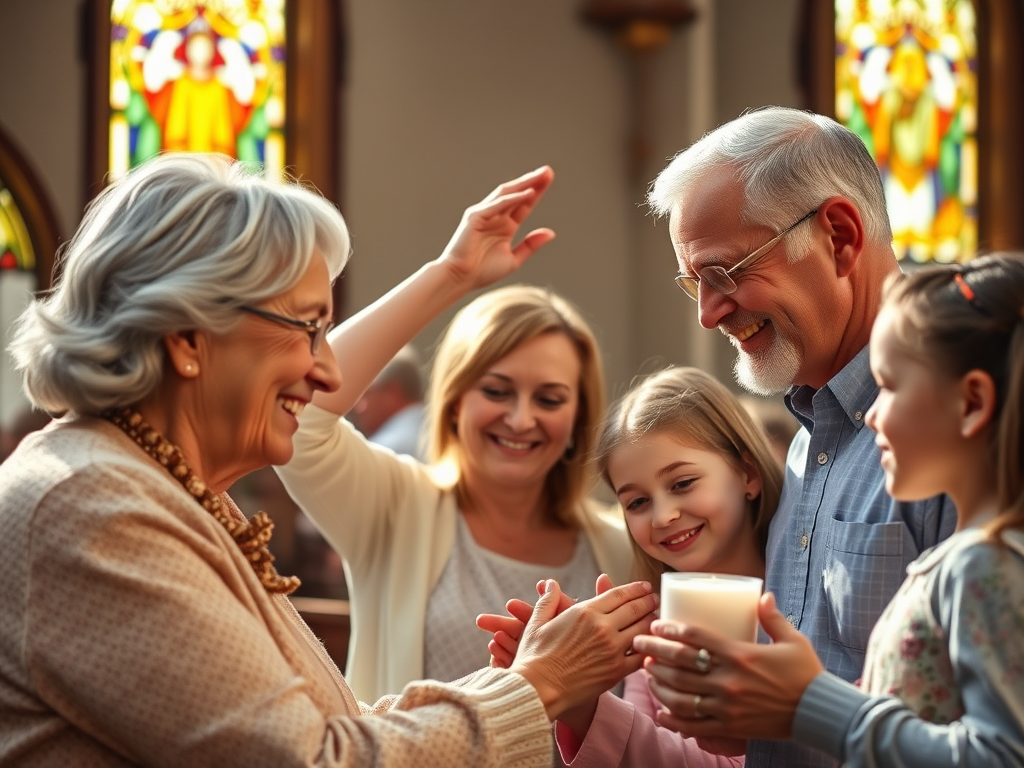
The children had come with their own plans, and when told they would spend three days with their parents, they were visibly upset. As the Korean lecture began, some closed their eyes as if to sleep, others wandered in and out claiming to go to the restroom, expressing silent protest. But surprisingly, as time passed, those who pretended not to listen began to open their eyes and respond to the pastor’s words. Afterward, the youth pastor summarized the lecture in English, and even those who did not understand Korean began to open their hearts. On the final day, under the guidance of the pastors, the head of each family (or the eldest, if grandparents were present) served communion and prayed blessings over their children. Though believers often pray for their families, laying hands directly on a child’s head or embracing them while praying for God’s blessing is not easy. Yet when families experienced this at the retreat, many were moved to tears of gratitude.
Afterward, the responses posted online by the youth were remarkable. Some confessed that receiving a blessing prayer from their father, mother, or grandparents for the first time was shocking. Others said they felt comfort and peace when their parents laid hands on their heads to pray. Children from broken homes or single-parent families shared painful realizations of how precious family truly is. Parents also responded positively, as if reclaiming their authority to bless. Of course, some parents who had only emphasized IQ-based education resisted, fearing this was merely emotional. Yet no one can deny the importance of EQ—the blessing of emotional connection.
Following the retreat, the church board decided that communion services would henceforth be held with the entire congregation together. At first, we worried that children might disrupt worship. But from the very first service, we realized those fears were unfounded. For a church of immigrants who had lived in America for thirty years, worshiping in Korean with children was a bold step. Yet now, youth lead praise before worship, children read Scripture haltingly in Korean, and families participate in communion together, with parents laying hands on their children in blessing. Each time, we feel God’s powerful presence, and tears accompany the prayers.
One member, a man in his late thirties who attends only occasionally, is the son of a famous Korean entertainer. Having grown up lonely in America, he joined the three-generation communion and prayed for his daughters for the first time. As he laid his hands on their heads, he felt overwhelmed by the holiness of the act. He was pierced with conscience: “Can I truly bless my children with these hands?” Returning to his seat, he resolved, “If I am to bless my children, I must live clean before God and people.” His wife rejoiced, and their family visibly changed.
Some traditional members still find this unfamiliar. Yet the world changes daily, and fear of change cannot dominate. When a creative minority steps forward in the Spirit, unexpected blessings follow.
At the 80th anniversary service of the March 1st Independence Movement, the sanctuary was filled with families. Girl Scouts carried the cross and the Korean flag, the choir and pastors entered, and the Declaration of Independence was read in both Korean and English. Together, families sang the national anthem and the March 1st song, remembering the courage of ancestors who gave their lives for freedom. Our souls were united in the identity of one people.
After that service, parents felt proud before their children, and children seemed more lovable and free. We recognized that our place in this land is rooted in the tears and blood of our ancestors, and we gave thanks to God together.
Now, through three-generation worship, our church is drawing families closer spiritually, healing wounds in immigrant society, and even sensing the hope of Korean reunification beginning here. If the Jewish diaspora could remain united across generations and cultures, how much more should we not allow ourselves to be divided before God? Immigrant churches must not only seek temporary growth but pass on faith, tradition, and culture without generational barriers.
Three-generation worship is transforming our church. Through it, many souls will surely find healing and comfort in God. And we are confident that the sad rumor—“when children leave for college, they leave their faith”—will no longer be heard among us.
- WanHee Yoon, 3/9/1999

 Daily Sauntering
You must be logged in to post a comment.