When the New Year comes, one of the most common greetings we exchange is, “May you receive many blessings!” This is not only an expression used by people in the East; people all over the world share similar words. Because every human being carries some fear of the future, we comfort one another by wishing blessings—hoping that peace and reassurance will follow.
At the beginning of each year, our family would take the children and bow deeply before my mother and my husband’s parents, praying for God’s peace and blessing in the coming year. But this year, unlike previous years, my mother‑in‑law politely refused to receive the New Year’s bow from her grandchildren. The reason was that my elderly father‑in‑law had spent the past year moving between the hospital and the nursing home due to a stroke and various complications. With tears welling in her eighty‑year‑old eyes, she said she could not accept the children’s bows alone while her husband lay ill. Perhaps blessings without her husband beside her held no meaning for her.
As we remembered how Father‑in‑law used to embrace all eleven grandchildren—each one bigger than he was—after receiving their bows, laughing heartily with pride, the whole family fell into a solemn silence.
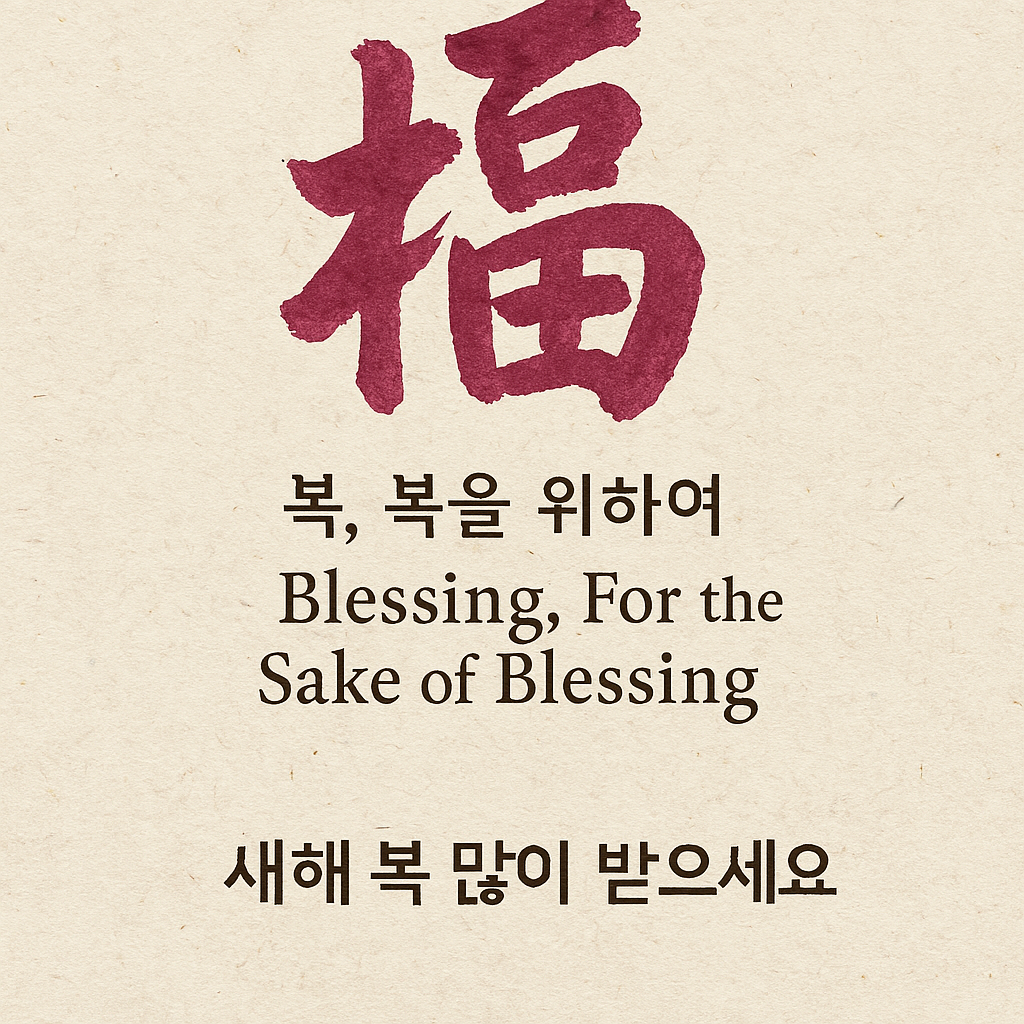
Years ago, I visited a church member’s home on New Year’s Day. In their living room, a large calligraphy of the Chinese character 福 (blessing) was hanging upside down on the wall. Knowing they had lived in America for a long time but were certainly able to tell which side of the character was up, I asked, puzzled, “Why did you hang the blessing character upside down?”
The wife glared at her husband and said, “He put it up like that. He said it would make the blessings pour in!” I couldn’t help but laugh, though my heart sank. Ah… they desire blessing, but do not know where blessing truly comes from.
What is blessing? Where is its source? And what is genuine blessing?
People understand blessing in different ways. For some, health is a blessing. For others, material wealth is blessing. Some believe that having many children who become leaders in society is a sign of being blessed.
But through years of ministry, living closely with those whom society calls “blessed,” I discovered that many of them were not blessed in the biblical sense at all. Most were like hollow rice cakes—beautiful on the outside, empty within.
One person trusted too much in his health, relying on it excessively, only to collapse suddenly one day. Another treated his abundant wealth as his own possession, living in luxury and extravagance, measuring people by material worth, and never once experiencing genuine fellowship of the heart. I also saw children admired by the world who ignored the loneliness and sorrow of their aging parents.
But I have come to believe that true blessing in God is to taste and experience God’s holiness. How can sinners—how can I, we, or our community—experience holiness? It happens when we gather in the sanctuary on the Lord’s Day, acknowledge God as the Lord of our lives, bow before Him, and share the fellowship of love He commands among believers.
Even when such fellowship is difficult, when we must endure and embrace one another, imitating God’s holiness again and again—entering into His nature—that is the path to true blessing. Only when we recognize that the weaknesses, shortcomings, and brokenness we see in our church community are also our own, and when we comfort and uphold one another, can we fully participate in God’s blessing and holiness.
Then I think of those who, like squirrels skipping acorns, casually skip the Lord’s Day—the day God set apart as the completion of creation, the day He blesses and makes holy. How beautiful and precious are the believers who gather to praise and worship Him! Blessed saints! Today, the sound of the winter rain falls into the dry depths of my soul like the very first raindrops at the dawn of creation.
On a day when the mischievous winter rain fell endlessly, I was reading Genesis and experienced a deeper opening of the Word than ever before.
The words, “In the beginning God created the heavens and the earth” (Genesis 1:1), always cover my soul with awe and trembling. As I meditate on each step of creation, I see myself—a lump of clay—and feel the urge to fall to the ground in worship before God.
Then I came to the words about the seventh day: “God blessed the seventh day and made it holy, because on it He rested from all the work of creating that He had done” (Genesis 2:3). Reading this, I found myself making a new confession of faith.
Looking out the window at the pouring winter rain, I prayed: “God, it is true. Because of this day, I came to know You—the source of my life. Because of this day, I discovered the living spirit dwelling in this clay body. I confess that I am a creature being nurtured within Your holy law of love. I believe in Your delicate and vast love that blessed and sanctified the seventh day, making rest possible. Amen.”
— Wan‑Hee Yoon, January 15, 1999

 Daily Sauntering
You must be logged in to post a comment.