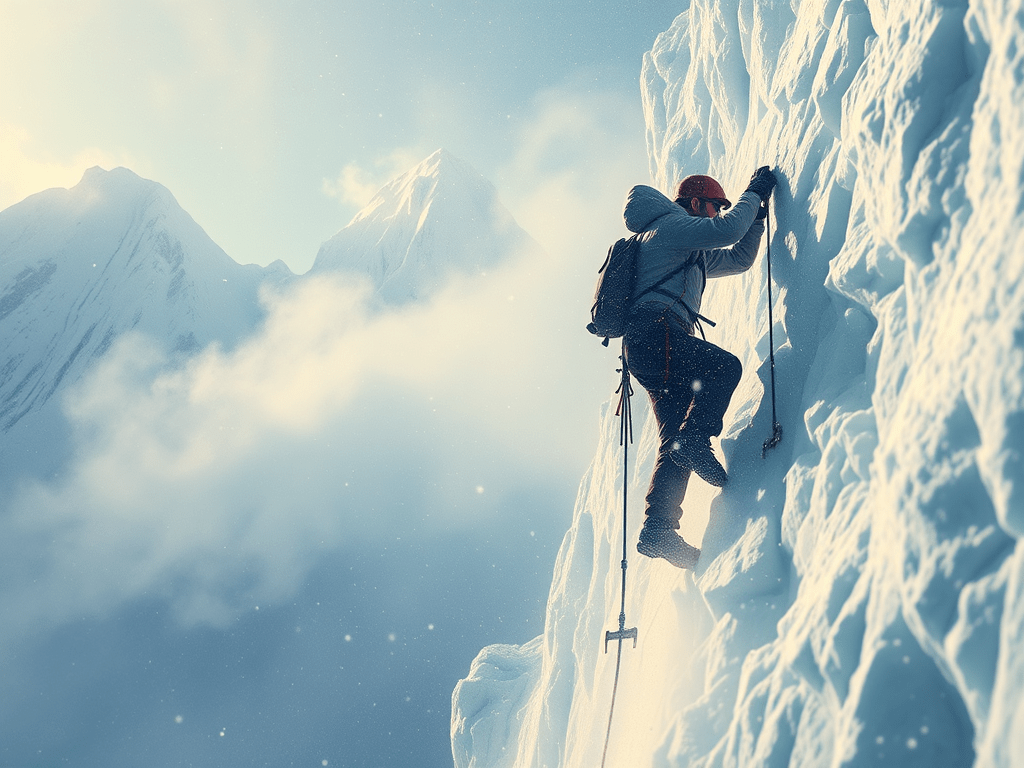
Among those who climb mountains, ice‑wall climbing is said to be in full swing these days. These climbers deliberately seek out the steepest and most dangerous places—frozen waterfalls and icy cliffs sealed hard by bitter cold. They drive their axes into the ice, push through blizzards and treacherous frozen paths, and ascend with nothing but a single rope between themselves and death. They say the tension of that ascent is part of the sport’s thrill.
A single misstep can send a heavy, sharp block of ice crashing down on one’s body. A cracked sheet of ice can suddenly shatter, leaving one’s foothold suspended in midair. Many have reached such extreme moments and lost their lives. Yet people still savor the winter mountains.
If those of us who have never tasted the challenge or the exhilaration of victory ask, “Why put yourself through such hardship?” they would likely turn away and say, “Don’t ask unless you’ve tried it!”
On December 12, 1995, on the icy continent of Antarctica—on Vinson Massif (5,140m), the highest peak where the breath of ancient ages lies asleep—Korean climber Heo Yong‑ho unfurled the Taegeukgi he had carried close to his heart and fully savored the joy of conquest upon that frozen ground. Born in 1954, he began climbing at sixteen, and in 1982, when he summited Makalu (8,463m), the world’s fifth‑highest peak, his ascetic, seeker‑like approach to mountaineering began drawing public attention. In time, he became the first person to conquer the Three Poles and the Seven Summits, raising the banner of human triumph before the entire world—a feat that fills us with deep pride.
I paused to trace, even briefly, the icy mountains he trod, the brutal cold, the days when he wandered from one mountain to another unable to find direction, dragging legs numbed by exhaustion and frostbite. I thought of the storms that nearly claimed his life, the loneliness, hunger, regret, fear, and the battles with his own self. In his words—“Don’t ask why I strive to climb so high…”—spoken like a solitary confession, we glimpse the human instinct to reach toward the unknown.
His approach into that primordial emptiness is surely one of humanity’s greatest attempts. Only weeks ago, when a snowstorm paralyzed our entire city, we were reminded of how fragile human beings are before the forces of nature. And yet, humanity’s attempts to conquer nature continue across the world.
Even when we eat well, sleep well, and live in comfort, we find we cannot be fully satisfied. Even if someone were to claim perfect happiness in this world, that too would be incomplete and immature. Human wholeness and joy are gained little by little through hardship and adversity. Through risk‑laden pursuits—rock climbing, bungee jumping, ice‑wall climbing, hang‑gliding—people taste the thrill of conquest and the challenge of new worlds. Because of such quests, our lives take on the richness of self‑achievement. As long as human history continues, the challenge toward the new and the unknown will not cease.
Just as humanity challenges the natural world, so too is the challenge toward the world of truth and eternity difficult and demanding. To move daily toward an unseen summit is impossible without the help of the Holy Spirit; we feel this at every moment. Fierce winds of life and gentle breezes that tempt our weary bodies to rest both try to slow or halt our steps.
Scripture tells us that God created humanity and placed within us a longing for eternity (Ecclesiastes 3:11). Those who long for the soul—those who climb toward that summit with the rope of prayer—are already those who have attained victory in faith. Those who have tasted the freedom, joy, and peace found in truth never give up their ascent toward the summit until their final breath. Until they reach that summit of truth, rest is not permitted.
I too have fallen many times, stumbled, and trembled in fear and pain. I do not know how many more moments of discouragement await me, or how often I will feel tempted to abandon the climb. Yet I cannot hesitate, for the summit I must reach—my destination—is already set. Before the sun darkens, before my body grows frail, I cannot give up the rugged mountain pass I must cross.
Even today, people journey to the ends of the earth or climb icy cliffs to seek meaning and fulfillment in their lives. They pour their lives into the pursuit of purpose and challenge. Yet unless God grants the eyes to see, no one can discern whether the things we assign meaning to truly hold meaning at all.
And so, I resolve once more: in the battle toward eternity, I must not cease until the day I raise the flag of victory.
— WanHee Yoon, January 29, 1995

 Daily Sauntering
You must be logged in to post a comment.