다문화 속의 교회, 교회생성을 향한 변형 연습이란? (제 1 장) 뉴욕, 1995

교회생성(Ecclesiogenesis)을 향한 변형연습(The Transforming Praxis)이란?

            본 논문의 제목은 뉴욕 신학원에서 목회학 박사학위 프로그램을 담당하고 있는 Dr. T. Richard Snyder의 사회변혁과 교회의 역할에 대한 저서, Once You Were No People 와 남미 브라질의 빈민을 위한 선교 경험에서 산출된 현재의 거대한 교회조직을 재 평가하면서 미래의 하나님 나라를 위한 새로운 교회를 현 교회의 전통 위에서 재 발명하기 위한 기초(基礎) 공동체(共同體) 운동(運動)의 내용을 정리 발표한 Fr. Leonardo Boff 신부(神父)의 저서 Ecclesiogenesis 에서 비롯한다.

            서론에서 밝혔듯이 이중문화 결혼 한국여성은 비인간화(非人間化) 하는 경험 즉 (1) 正體性의 疎外 (Alienation from Self-Identity)와, (2) 關係自我의 疎外 (Alienation from Relational-Self), 그리고 (3) 責任自我의 疎外 (Alienation from Responsible-Self)를 경험하게 된다. 이러한 세 가지 소외 형태는 한국에서 결혼해서 미국에 도착하여 정착하면서 시작되는 것으로 일반적으로 알고 있으나, 사실은 이중문화 결혼 여성의 성장과정에서 부터 이러한 소외현상을 경험했고,1 이러한 삶의 세 단계를 반복 경험하고 있으며, 그 이상의 인간화된 삶 즉 소외에서 탈피하는 삶에 대하여 오히려 적응이 쉽지 않을 뿐 만 아니라 두려워 하기 조차 함을 발견했다.

            이들은 <1> 개인 성실과 책임성으로 부터 소외당한 인간성으로 낯선 사람들과 환경 속에서 오는 문화 충격과 부적응은 이중문화 결혼 한국 여성들의 부부생활, 가정 생활, 더 나아가서는 사회생활에 더욱 말할 수 없는 압박(OPPRESSION)을 주며, <2> 이중문화 가정의 부부가 이러한 압박을 견디지 못하면 인간 상호간의 존중으로 부터의 소외당했다고 믿는 상태에 이르고 만다. 대부분의 이중 문화 부부가 이혼에 이르며, 이혼에 이르고 나면, 여인들은 낯선 곳에서의 사회생활 경험의 부족함과 미 사회에 대한 정보 부족으로, 그들의 빈곤은 생존 문제에 까지 이르고 만다. 끝으로 <3> 이러한 이중문화 결혼 한인 여성의 소외 문제는 그들 자신에서 비롯되기 이전에 이들의 부모에게 있었던 문제로 그들이 어린아이 시절에 몸 담았던 가정환경에서 형성된 문제로 인한 희생양인 것도 있다. 또한 미국 땅에서 그들이 의지할 곳 없이 되었을 때, 한국인 이민 공동체 속에 인간다운 삶의 새 출발을 위한 협조와 이해가 없다는 것이다. 더우기 이들은 같은 한국인 이민 자임에도 불구하고 “삼등인생”으로 천하게 취급당하고 있다. 한인 이민 사회에서는 그들을 위한 아무런 조직이나 권익 옹호 단체도 없는 형편이다. 따라서 이 단계에 이르면 무기력해지며 자신과 사회에 대하여 혼돈을 갖고 끝내는 술집 종업원, 마사지 팔러, 거리의 여인, 마약사용(판매), 정신병원, 감옥, 심지어는 홈레스로 전락하는 혼돈과 무기력(POWERLESS)의 단계에 이르게 된다. 이것이 이중문화 결혼을 한 한국인 여성의 소외로 인하여 당하는 고난의 모습인 것이다.

1. 소외란 무엇인가?

            “교회 생성을 위한 변형 연습”이 다루고 있는 “소외”란 무엇을 말하는가? 소외(疎外, ALIENATION)란 새 국어 사전에 의하면 명사와 타동사로 쓰이며, 그 의미는 “서로 사이를 벌어지게 하여 물리침 (ESTRANGEMENT)”이며 그 동의어로는 소척(疏斥)과 소원(疎遠)을 들고 있다.2 소원(疎遠)의 의미는 “서로 정분(情分)이 성기어 사이가 탐탁하지 아니하고 먼 것”이라고 말하고 있으며, 그 동의어로는 소적(疏狄)을 들고 있다.(3)

            Webster’s New Universal Unabridged Dictionary에 의하면, 소외란 “<1> 그 소유권을 법에 있어서 명의변경(名義變更)하거나 재산을 타인에게 합법적으로 양도(讓渡)함을 말한다. <2> 소외되여진 상태를 말한다. <3> 심정이나 애정이 버성김, 사이가 나빠져서 멀어짐, 혹은 물러남, 탈퇴(脫退), <4> 정신착란, 황홀(恍惚), 광희(狂喜), 교란(攪亂), 발광(發狂), 미친짓(狂氣)”로 나타나 있다.(4)

            New Encyclopaedia Britannica 에서는 사회과학이 말하는 “소외”를 다음과 같이 설명하고 있다.(5) 한 사람의 주의환경이나 일 또 일의 생산, 더 나아가서는 심지어 자신으로 부터 멀어지거나 분리 단절되는 기분의 상태를 두고 일컫는다. 다음과 같이 가장 보편적인 소외의 6가지 의미를 소개하고 있다. <1> 소외란 무력함(POWERLESSNESS)을 의미한다; 자신의 운명이 자신에게 달려있는 것이 아니라 자신 밖에 있는 외부적 기관이나, 운명, 행운, 혹은 구조적 조직에 자신의 운명이 달려 있다고 본다. <2> 두번째로, 소외는 의미없음(MEANINGLESSNESS)을 의미한다; 이해력 부족이나, 세계적인 일이나 혹은 개인 인간관계에 있어서 현재 계속적으로 지배하는 행동의미, 혹은 생의 목적상실이 일반화된 감각등을 말한다. <3> 세째로, 소외란 규범이 없음(NORMLESSNESS)을 말한다; 인간행위를 위한 사회 공동 치유(治癒) 처방책(處方策)들을 위한 헌신이 결핍(缺乏)된 것을 말한다. 그러므로 사회에 널리 퍼져 있는 사회상식을 예사로 벗어나는 일이나 불신용(不信用), 멋대로의 개인 경쟁등이 일어난다. <4> 넷째로, 소외란 문화적 소원(疎遠, CULTURAL ESTRANGEMENT)을 의미한다; 사회 안에 기존 가치관념으로부터 제거(除去)됨을 의미한다. 예를 들자면 관례적인 기구나 기관들을 향하여 반항하는 지식인이나 학생들 속에서 찾을 수 있겠다. <5> 다섯째로, 소외란 사회적 고립(孤立, SOCIAL ISOLATION)을 의미한다. 사회관계에 있어서 제외(배척)됨이나 외로운 감을 말한다. 예를 들자면, 소수민족들을 들 수 있다고 하겠다. <6> 여섯째로, 소외란 자기고립(自己孤立, SELF-ESTRAGEMENT) 을 의미한다. 아마도 가장 어려운 정의며 주된 의미라고 볼 수 있는 것으로, 개인이 자신과의 관계에 있어서 도저히 미치지 못한다고 이해하는 것을 말한다.

            소외에 대한 사고가 서양의 사회과학분야에서 인정되기 시작된 때가 1935년 이후였지만 19세기와 20세기의 고전적 사회학자 Karl Marx, Emile Durkheim, Ferdinand Tonnies, Marx Weber, 그리고 Georg Simmel등의 저술등에 은연중에 혹은 명백히 존재해 있었다.(6)

자본주의 아래 소외당한 노동에 대하여 언급하면서, 맑스는 이 말을 가장 유명스럽게 사용한 장본인이 되였다. 소외당한 노동이란(?): <1> 일이 자발작이고 창조적이기 보다는 강제적이며, <2> 일하는 사람이 일의 과정을 결정하는데 거의 참여할 수가 없다든가, <3> 노동의 생산이 노동자가 아닌 다른 사람에 의해서 몰수되어 노동자의 의사에 반해 사용되는 경우라든지, <4> 일꾼 자신이 노동시장의 상품이 되어 버리는 경우를 말한다. 따라서 맑스의 소외 개념은 인간이 일에 있어 그의 ‘종(種)의 존재 (SPECIES BEING)’를 성취하지 못하는 사실로 이루어 진다고 본다. 즉 이것이 바로 맑스가 말하는 불가지(不可智)에 빠진 인간의 본질인 것이다.(7)

이러한 Marx주의 전통은 소외의 한 가지 흐름 만을 말하고 있)는 것이다. 또 다른 두번째의 흐름은, 소외를 막을 수 있는 전망에 대하여 훨씬 덜 낙관적이지만, 소위 ‘대중사회(MASS SOCIETY)’ 이론이라 일컽는 것으로 형성되었다. 19세기와 20세기 초기에 일어났던, 산업화에 의한 혼란을 관찰해 볼 때, Durkheim과 Tonnies 그리고 나중에는 Weber와 Simmel 까지도 각자 나름대로, 잇달아 일어나는 공동체감의 상실과 전통적 사회가 사라져감을 슬퍼했다. 현대인은 이전에 경험해보지 못했던 ‘고립(ISOLATION)’을 맛보게 되었다. 즉 관료적인 질서나 새로운 이론적 근거 없는 상태에서, <1> 도시화 되가는 대중 속에서 익명(ANONYMOUS)과 비인간적 (IMPERSONAL) 경험을 맛보며, <2> 옛 가치로부터 뿌리가 뽑혀나가는 경험을 하게 됐다.(8)

아마도 이에 대하여는 Durkeim이 말한 ‘ANOMIE’ 정의가 가장 분명한 정의라 본다. 이 말은 희랍어 ‘ANOMIA’에서 비롯된 말로서 ‘무법(無法, LAWLESSNESS) 이라는 원래의 뜻을 지니고 있다. 이는 사회 규범을 묶어 나가는 것의 ‘분열(分裂, Disintergration)’과 만연해가는 ‘개인주의(個人主義, INDIVIDUALISM) 로 성격짓는 사회 상황을 가리킨다. Weber와 Simmel이 이러한 Durkheim의 이론을 더 발전 시켰다. Weber는 사회 조직 속에 합리화(RATIONALIZATION)와 형식화(FORMALIZATION) 를 향한 근본적 표류를 강조하면서, 인간관계가 희박해지면서 비인간적인 관료성이 커진다고 했다. 또한 Simmel은 한편의 주관작이고 개인적인 삶과 또 다른 한편의 성장해가는 객관적이고 익명(匿名)적인 삶과의 긴장을 강조했다.(9)

앞서 말한 소외에 대한 분류, <1> 무력(無力, POWERLESSNESS), <2> 무의미 (無意味, MEANINGLESSNESS), <3> 무명(無名, NORMLESSNESS), <4> 문화적 소원(文化的 疎遠, CULTURAL ESTRANGEMENT), <5> 사회적고립(社會的孤立, SOCIAL ISOLATION), 그리고 <6> 자기고립 (自己孤立, SELF-ESTRANGEMENT) 은 개괄적이고 더욱 발전된 개념 을 내기 위한 길 안내잡이 일 뿐이였다. 예를들자면, 자기소원(自己疎遠)의 경우 한 인간이 여러가지의 아주 다른 경로를 통해서 ‘단절(斷絶)’이 될 수 있는 것이다.

그 후, 정의와 가설이 판이하게 발전되었다. 두 가지의 대조적인 가설은 <1> 규범성과 <2> 주관성이다. 첫째로 Marx의 전통 가까이 하고 있는 미국의 Herbert Marcuse와 Erich Fromm이나 불란서의 Georges Friedmann와 Henri Lefebvre등은 소외를 규범적 개념으로 보면서, 인간성에 근거한 어떤 원칙의 빛 아래서 일과 사건들의 고착화된 상태를 비판하기 위한 도구, 즉 ‘자연법’이나 ‘도덕원칙’과 같은 것이라 보았다.(10)

둘째로, Marx 이론가들은 소외를 개인 의식으로부터 독립된 객관적 상황이라고 주장하고 있다. 즉, 직장에서의 ‘행복한 로봇트’가 되는 것은 일하는 사람의 일의 경험이 받아들여짐에 상관없이 소외당하는 것을 말한다.(11)

다른 한편에서는, 대부분 미국의 경험론 학자들과 저자들은 소외란 사회 심리적 사실이라고 강조하고 있다. 즉 소외는 무력(無力)함의 ‘경험(經驗, EXPERIENCE)’이고, 소원(疎遠)의 ‘감각(感覺, SENSE)’이라고 주장한다. 이러한 가정은 Robert K. Merton과 Talcott Parsons등의 이론가들이 조사한 이상성격자 행동의 분석과 설명속에 자주 나타나는 현상이다.(12)

T. Richard Snyder는 소외된 인간은 이름이 없으며, 참 인간 대우를 받지 못하므로 참 인간이라 할 수 없다고 보면서, 소외의 형태를 다음과 같이 여섯가지로 분류를 했다: <1> 이웃으로 부터의 疎外13; 흑백인 사이의 구획, 앵글로와 히스페닉의 구분, 젊은이와 늙은이와의 구분, 부자와 가난한 자와의 구분, 유대인과 이방인과의 구분, 개신교와 구교신도들과의 구분, 토백이와 새로 이사온 사람들의 구획 속에 서로의 ‘미움으로 나누어진 벽’이라 볼 수 있다. 이는 심지어 국수주의나, 이미 지나간 동서의 냉전, 더나아가서, 남북의 심화된 경제차등에 까지도 언급할 수 있다고 본다. 우리가 경험할 수 있는 구획은 대부분이 그 규모가 적고 국부적인 것에 지나지 않으나 이것이 쌓이면 크게는 남아프리카 연방의 인종차별정책이나, 나치 정권 아래 유대인 학살이나, 현대 경제, 서로 위협하는 이웃으로 서게 됨을 말한다. 한국의 기지촌 여인들은 일반 사회로 부터 노예화의 성장된 소외의 모습을 볼 수 있다. 이는 인간 서로가 소외로 말미암아 소외되여, 미군병사들이 관계하는 특수 구룹의 여성으로 취급받고 있다. 미국내에서 이중문화 가정의 한인 여성들이 이혼 후에 한국 이민사회 내에서 음성적 공동체인 마사지 팔러에 몸 담고 생계유지를 하며 살아간다. 이것이 이민 한인사회와의 소외현상이며 한걸음 더 나아가서, 인종차별과 여성학대의 대표적인 경우가 되는 것이다.

<2> 일로부터의 疎外;(14) 일은 필요 악으로서 현대 인간은 노동을 팔아 살아가고 있다. 하나님은 세상을 창조하실 때에, 먼저 계획하시고 해동하셨으며, 창조하신 후에 보시며 즐기셨으나, 인간은 그들이 하고 싶은 일을 하는 사람이 그리 많지 않을 뿐 만 아니라, 일의 결과에도 만족치 않으며 또한 볼 수도 없는 형편이다. 따라서 Marx는 타인과 자신과 더욱이 세상으로 부터의 소외가 노동자들의 인간관계로 부터 노동 수단으로 전락시켰다고 보고 있는 것이다. 왜냐하면 근본적인 인간 소외의 상태를 감소시킬 수 있는 대중이, 생산 수단의 소유권을 갖고 조정하는 소수의 손 안에 있기 때문이다. Marx는 다른 모든 소외의 형태들은 바로 이러한 근본적인 소외의 원인에서 비롯된다고 보았다.(15)

이민 사회에서 많은 사람들이 그들이 하고 싶은 일을 하는 것이 아니라, 직업 전환으로 인해 일의 결과에도 만족지 않고 있는 것을 본다. 인간 관계보다 노동 수단이 중요하기 때문이다. 이에 이중문화 가정에서 실패한 여인들도 한인사회와의 관계 수축보다는 노동 수단으로 자신을 사용하여 생계유지를 하게된다.

물론 Marx가 인간의 경제적인 삶 만을 취급한 한계를 우리는 너무나도 잘아는 사실이다. 그는 인간 삶의 여러 다른 측면을 다루지 못했다. 가난과 실직이 범죄를 몰고 오는 것은 사실이나, 중요한 점은 수입 뿐 만 아니라 한 인간이 자신의 삶을 다룰 수 있는 능력이 역부족일 때 오는 결과가 격노와 파괴적인 행동을 낳는다는 것을 맑스나 그의 추종자들은 간과했던 것이다. 노동성 이해와 그 결과가 우리에게 주는 영향에 대한 맑스주의자들의 분석을 이용하던 하지않던 간에, 우리 대부분은 노동이 소외의한 형태임을 거절할 수 없는 갓은 사실이다.

<3> 環境으로 부터의 疎外;(16) 도시에 살고 있는 사람들은 자연으로 부터의 소외를 직접 경험하게 된다. 자연환경을 지배하기 위해 노력 경주해온 현대 문명은 이제 병마와 두려움, 죽음의 가능성등의 급증으로 위협을 받고 있다. 따라서 다른 어느 시대 보다도 소외가 극대화 되었다고 볼 수 있다. 우리가 자연을 ‘이용될 수 있는 것’으로 마구 취급할 때 환경의 전체성과 균형을 온전히 감지할 수 있는 가능성을 우리는 잃고 마는 것이다. 우리 자신도 일부인 주변 환경으로부터 우리 스스로가 소외당하고 있기 때문이다.

<4> 機關으로부터의 疎外;(17) 우리는 선진국인 미국의 국민 보건을 담당하는 구조가 쿠바보다 멀리 떨어져있음을 느낀다.(18) 교육 구조에 문제가 있다. 뉴욕시의 교육정책은 실패했고, 문맹퇴치는 이제 미국의 국가차원의 문제로 대두되고 있다.(19) 우리의 필요에 섬기도록 만들어진 기관들이 우리의 삶으로부터 오히여 우리를 소외시키고 있다.

<5> 自身으로부터의 疎外;(20) 부서진 거울로 자신을 바라보면 거울 속의 자신을 똑똑히 볼 수가 없듯이, 인간이 자신에 대한 진리를 깨닫기란 불가능하다고 본다. 우리는 자신이 원하는 모습으로 되여 살아가지 못하는 경우가 많다.

<6> 하나님으로부터의 疎外;(21) 인간 소외는 인간이 이루고 있는 관계에서 시작하고 그 끝을 맺는다. 인간이 스스로 의로와 질 때에 인간은 소외당하는 것으로 성서의 눈은 보고 있다. 인간 소외의 뿌리는 인간이 하나님(制一原因)으로 부터 소원(疎遠)될 때에 비롯된다고 볼 수 있다.

이러한 우리의 소외들은 서로 연관되여 있다. 다른 사람과 소외되지 않고는 우리는 일로 부터 소외될 수 없고, 우리 자신으로 부터 소외되지 않고는 다른 사람으로 부터 소외될 수 없으며, 하나님으로 부터 소외되지 않고는 세상과 자연으로 부터 소외될 수가 없는 것이다. 우리의 이러한 비극적 상황을 하나님과 인간 사이에 놓여 있는 골짜기로 표현할 수 있다고 보겠다.

우리의 상황은 소외의 한 경우이다. 우리는 다른 사람으로 부터, 우리의 일로 부터, 우리의 세상으로 부터, 우리의 기관으로 부터, 우리 자신으로 부터, 그리고 하나님으로 부터 잘림 당했다. 이렇게 소외당한 인간은 인간이 아니며 또한 아무것도 아니다.

T. Richard Snyder는 이러한 소외는 우리의 정체성(正體性, IDENTITY)에 거짓을 가져오며 우리의 관계에 거짓을 가져 온다고 보았다.(22) 우리의 정체성에 거짓을 가져 온당함은 열등(劣等, INFEREIORITY)을 암시하고 있다고 Snyder는 보았다.(23) 이스라엘 민족이 애급에서 이스라엘 민족으로서의 정체성이 거절당했고, 이스라엘 민족은 그들의 조상을 잃었음으로 그들에게는 더 이상의 미래를 향한 추진력을 기대할 수 없게 되었다. 그들의 정체성이 사라질 때 그들은 철저한 땅 위에 소외자가 되어 버리고 말았다. 왜냐하면 자기정체를 가리는 것은 열등을 나타내는 것이기 때문이다. 그러나 그들의 해방의 역사는 모세가 다시 돌아와 이스라엘 민족의 정체성을 일깨워 주는데서 비롯한다고 본다.

둘째로, 우리의 관계에 있어서 오는 거짓을 말함이란 바로 그 소외의 구조를 말함이다. 우리의 소외는 단순히 정체성의 문제 뿐 만이 아닌 것이다. 사회복지 구조는 수혜자의 사회내의 그들의 무용성을 인정할 때 수여하는 것으로 만들어졌고 그 기능이 발하기 때문에, 수혜자들을 사회내에 수동적이고 의존적인 관계로 암암리에 전락시킨다. 이러한 구조와 관계가 우리의 삶을 그 현실로 특색지우고 만다. 예를 들면, 미국에서 여성의 투표권을 1920년 이전에는 갖을 수 없었다. 이혼시에는 경제관리권이 1980대 까지도 여성에게 주어지지 않았다.

Snyder는 사회 속에 존재하고 있는 계층을 다음 세기지를 들고 있다;(24) <1> 사용하는 자, <2> 사용당하는 자, 그리고 <3> 무용지물인 자등 세계층을 말하고 있다. 이 가운데서 <2> 사용당하는 자 이외의 <1> 사용하는 자와 <3> 무용지물인 자가 모두 소외당한 자로 보고 있다. 왜냐하면 인간의 본래의 모습인 하나님의 현상은 상호관계적이요, 상호 의존적 기본관계이기 때문이요, <1>과 <3>은 이를 상실했기 때문이다. 따라서 이렇게 우리가 경험하듯이 소외의 수단은 우리의 정체성의 숨김이고 억압의 관계의 숨김을 말한다.

따라서 잘못하면 오늘의 교회가 이러한 소외라는 연극의 주연 배우가 될 수도 있는 것이다. 과거 미국의 선교사들이 자신들이 알고 있던지 모르던지 그들의 선교 활동이 선교사들의 조국인 선진국의 새로운 경제 식민정책에 이바지하는 결과가 되었던 것은 자타가 공인하는 사실인 것이다. 심지어 신학도 종종 소외의 형태를 정당화하기 위하여 봉사하는 때가 종종 있을 뿐 만 아니라, 이러한 형태와 그에 대한 잘못된 반응등에 강요의 구조적 수단으로 우상숭배나 행정 및 목회가 이용당할 때, 신학은 이에 잘못 반응할 때가 종종 있어왔음을 우리는 이미 알고 있음을 두 말할 나위도 없다. 소외에 대한 잘못된 구조적 반응들 중심에는 이에 대한 실천과 더욱 그것이 교리로 스며든 종교의 탑이 종종 우뚝 서 있는 것을 우리는 간과할 수 없는 것이다.

Snyder는 소외를 향한 잘못된 다섯가지의 반응을 다음과 같이 말하고 있다.

            [1] 운명을 향한 체념:(25)

운명론은 어떤 것을 바꿀 때, 필연성과 무기력의 감각을 동원 시킨다. 이것이 매일의 생활에 작용되고 있는 것이 사실이다. 예를 들자면, 우리는 시청을 향하여 싸울 수가 없다든가(?) 또는 여자가 무엇을 할 수 있으랴(?), 더 나아가서는 인생이란 다 그런거야(!) 라던지 또는 그 나이에 우리가 무엇을 재기할 수 있으랴(?)등 그들의 능력을 자동적으로 결정짓고 마는 것이다. 즉 운명론 안에는 예상된 결론에 불가피하게 이르도록 하는 어떤 외부적 힘이나 어떤 내적 원칙에 의하여 결정되고 고착화된 것 즉 그릇된 감각이 있는 것이다.

            [2] 문제있음 자체를 거부:(26)

사람이 상황의 현실을 대면할 수 없을 때, 실망과 거절과 실패를 부정한다. 어떤 사실을 부정함으로 소외의 고통으로 부터 벗어나려는 것을 말한다. 사회학자들과 심리학자들은 사람들이 그 들의 삶의 불협화음을 다루는 원칙적인 방법 가운데 한가지로 부정(否定)을 들 수 있다. “인식적 불협화음은 우리가 기대하는 방법이나, 일어날 일들, 그것들이 그리될 것과 그러한 존재가 될 것을 원하는 것과 실제의 그들의 존재 방법 사이에 있는 모순을 말한다.”(27)

            [3] 희생자를 책망함(28)

예수님 시대에는 빈곤자과 병인과 불구자, 그리고 사회가 원치 않는 자들의 무리가 제법 큰 덩치였다. 이들은 흔히 ‘무법자(無法者)’, ‘죄인(罪人)’, 혹은 ‘불결(不潔)한 자’로 알려져 있고, 그들은 생명을 유지하기 위하여 구걸하도록 강요하는 사회제도 속에 살고 있었다. 대부분의 사람들은 그들에게 ‘꼬리표’를 붙이고, ‘추방’을 시키고, 결국은 그들의 형편을 두고 그들에게 그 모든 불평으로 책임을 묻는다. 이 모든 것을 죄로 보고 그죄가 그들이나 그 들의 조상 탓이라고 보았다. 요한복음 9장에 나타난 불구자의 탓을 사람들은 예수님에게 묻기를, “이 죄가 이사람의 것입니까 아니면 조상의 죄입니까?” 라고 했다. 무법자들을 예수님은 그의 친구로 선언했다. 무법자들을 하나님의 백성으로 선언하면서 비난자가 되기보다는 스스로 희생자 중에 하나가 되셨다. 희생자를 비난하는 것이 오늘날 우리 사회안에서 소외를 다루는 보편적으로 쓰이는 형태로 쓰이고 있다. 오늘의 교회도 이처럼 희생자를 책망하면서 청교도적인 죄의식을 희생자들에게 강요하고 있다. 그러나 우리가 명심해야 할 것은 축복이 하나님으로 부터 왔으면 소외는 우리로 부터 온 것이다.

            [4] 계속 바쁘게 살아감:(29)

우리의 삶이 어려워지고 두려워질 때, 우리는 흔히 무엇인가 아무일이나 해결을 위해서 해야된다고 믿고 바쁘게 움직이기 일쑤이다. 우리는 실용적이고 매우 활동적인 사회 속에서 살고 있다. 무엇인가 하는 것이 아무것도 않하는 것도 낳다고 믿는 사회 속에서 살고 있다는 말이다. 그러나 어떤 상황을 처리하기 위한 정책적이고 효과적으로 행동하는 것과 그저 단순한 행동주의와는 분명한 차이가 있다. 우리는 바벨탑 을 바쁘게 짓던 이스라엘을 기억할 수 있다. 그래서 우리는 소외된 상황에 대체할 때, 잉여분이나, 동정심으로나, 집없는 사람들에게 쉘터를 제공하는 행동을 한다. 그러나 여기에는 두가지의 위험이 있다고 Snyder는 말하고 있다.(30) 첫째 문제는, 우리의 기분이 우리의 행동에게 지시할 때, 기분이 바뀔 때 마다 우리의 결단과 헌신도 쉽사리 바뀔 수가 있다는 것이다. 3년에서 5년을 주기로 일어났던 흑인인권운동, 베트남전쟁 반대운동, 여권운동, 동성연애운동, 비무장운동등은, 각각 운동이 일어 날 때에는 대단한 흥미와 관심 그리고 행동을 가지고 일어났다가는, 지쳐서 결국에는 흥미들을 잃어버리고 마는 결과들을 흔히들 가져오는 것이다. 두번째 문제는, 단순한 행동주의 같은 종교적 자선사업은 효과가 없음이 이미 확인되여 왔다. 교회예산의 많은 부분이 선교 헌금으로 쓰여지되 세상의 소외 현상(빈곤, 홈레스, 가난한자)에는 크게 변화되여 이바지된 모습이 보이지를 않는다. 근본적인 변형의 사역이 필요한 것이다. 바쁘게 프로그램을 하며 움직인다는 것이 우리의 소외문제를 향한 해결책은 아니다. 그것은 잠시 잠깐의 성취감은 주지만, 먼지가 다 가라않으면, 전과같이 모든 것이 그대로 있음을 발견하게 된다.

            [6] 마술에다 희망을 거는 것:(31)

히스기야왕은 바벨론 포로로 잡혀갈 이스라엘의 운명을 두고 점쟁이들을 불러 들였다. 그러나 예레미야는 진정한 정치적인 분석과 기도에 의지하는 일 이외에 모든 마술에다 희망을 걸거나 의지하는 일을 과감히 배척했다. 마술이란 특정한 공식과 요소와 예식을 사용해서 나오는 것을 사람이 조정하는 과정을 말한다. 이것은 기대하는 것을 확실시 해주는 확인되지 않은 행동들로 신중한 생각과 성실한 일을 대신하게 되는 것이다. 교회가 사회 속에서 우리로 하여금 뜬 소망을 가지고 소외되도록 하는 마술의 주인 노릇을 흔히한다.

Richard Snyder에 의하면 소외란 “이간(離間)하여 사이를 멀리 떼어놓아 낯설게 만들거나 짤려나가게 되는 과정(過程 PROCESS)이다. … 소외 당하는 것은 한 사람이 적당한 장소와 올바른 상황과 합당한 관계로 부터 가혹하게 떼어 취급당함을 말한다.”(32) 그는 더 나아가서 이러한 소외의 그 원인과 실제를 밝혀내지 않는 한 우리는 결코 삶의 변형을 위한 가능성을 찾을 수 없다고 단언하고 있다.(33) 그는 소외를 단순히 풀려질 수 있는 문제로 보질 않는다. 소외로 부터 화해로의 바꾸어지는 변형(TRANSFORMATION)이 바로 ‘하나님의 예수 그리스도 내에 계심을 뜻한다’고 주장하고 있다.(34) 한 때 ‘인간취급받지 못하던 사람’이 그리스도인으로서 신음하고 고통하는 우주의 변형을 위하여 변형받았다고 Snyder는 고백하면서, 세계를 변형하는 것이 하나님의 의지이지만, 하나님 홀로 완성될 수 있는 것이 아니라고 보고, 그리스도인은 이를 위하여 소명을 받았다고 주장한다.(35)

2. 변형연습 (TRANSFORMING PRAXIS)이란?

폐쇄(閉鎖)에서 열림(더불어, 함께 삶)을 향한 자유화(自由化, 解放化)에서 사용할 수 있는 말이 변형(變形, TRANDFORMATION)과 연습(姸習, PRAXIS)이다. 같은 의미가 되겠으나, 변형 연습은 변화를 연습한다는 의미로 쓰고 있다.

Richard J. Bernsteind은 ‘연습’에 대하여 다음과 같이 말하고 있다. “PRAXIS는 희랍어로 ‘연습’이라는 뜻이다. 때로는 ‘행동’ 혹은 ‘행함’이라는 실천을 의미하기도 한다. PRAXIS는 일반적인 활동을 의미하기 보다는 ‘특별한 활동을 행하는 행위’를 의미한다. 다시말하면, 사회 변형을 목적해서 사회적 현존에 직접적으로 주는 영향을 연습하는 것을 의미한다.”(36)

변형연습은 폐쇄된 개인과 사회를 열린 개인과 사회로 전향을 위한 시도이다. 여기에는 세가지 형태의 이론적인 가설을 세울 수가 있겠다: <1> 성격(性格), <2> 행동(行動), <3> 가치(價値)/성격(性格)이라 함은 칭찬받을 만한 사람의 성품과 비난 받을 만한 사람의 성질을 말하는 덕목을 의미하고, 행동이라 함은 윤리적으로 당연히 해야할 책임을 말하고, 끝으로 가치라 함은 일의 목적이나 그 설명이 좋건 나쁘건 그것을 통한 인간의 삶의 목적을 말 한다.

실천(PRAXIS)은 해방신학과 해방 그리스도론의 방법과 핵심이라고 Paul F. Knitter는 말하고 있다.(37) 실천은 이론의 적용 혹은 목표인 것만은 아니다. 그것은 “이론 자체를 일으키고 스스로를 교정 하는 기반”이다.(38) 사람들은 먼저 진리를 알고 그리고 나서 그것을 실천에 옮기는 것은 아니다. 진리가 실로 알려지고 정당화되는 것은 행위, 행동에서이다.

            특히 해방신학이 “교리적인 것에 대한 비판적 요소의” 우위성, 즉 “정론(正論, ORTHODOX)에 대한 정행(正行, ORTHOPRAXIS)”의(39) 우위성을 강조한 것은 예수의 유일회성을 이해하려는 우리의 관심과 맞아 떨어진다. Gustavo Gutierrez는 이것을 더 예리하게 파헤쳤다: “해방신학의 주어는 신학이 아니라 해방이다.”(40) 이것은 과거의 교리적 정경적 형식들은, 규범적인 것이 남아 있다 하더라도 절대적 규범이 아니라는 것을 의미한다. 교리 혹은 전통의 ‘진리’는 항상 진리의 ‘궁극(窮極)적 중재(仲栽)자’에, 즉 ‘실천의 변형적 응답’에 드러나 있어야 한다. ‘올바른 행동'(ORTHOPRAXIS)없는 ‘올바른 지식’ (ORTHODOXY)이란 있을 수 없다.

Paulo Freire는 그의 저서 Pedagogy of the Oppressed 에서 행동과 반성은 함께 유지해야 함의 중요성을 강조하고 있다. 해방의 고민 속에서는 이들을 떼어 놓을 수가 없다. 그는 오직 진실한 말이 있다면 그것은 변형의 언어라고 보았다. 사상과 행동이 함께 갈 때에 참 변형은 깨달아진다고 보았다. 행동이 반성과 분리될 때에, 행동과 반성은 홀로서고, 반성은 평가를 받을 수 없어서 행동은 비정상이 되고 만다. 우리가 말하는 인종차별과 성차별주의와 연령차별과 계급차별등의 변형 연습에도 <1> 행동, <2> 반성, <3> 차후 비판적 반성등이 따라야 한다. [표1]에서 보듯이 변형연습의 성격은 다리 셋을 가지고 있는 관계적 얼개를 보면 분명해진다.

            여기의 얼개는 인간 삶의 연합과 상관성 그리고 서로 의존성을 보여주고 있다. “이 얼개는 삶 그 자체 속에 있는 ‘늘 현재’와 ‘피할 수 없는 구조’를 말하는 것이다”라고 Bernard M. Loomer는 그의 발간되지 않은 논문, “The Web of Life”에서 밝히고 있다.(41)                         

            인간적인 도덕과 개인적인 실체는 그것을 형성하는 역동적인 관계들의 얼개에 끼어져 가면서, 또한 그 얼개로부터 생성하기를 계속한다. 그래서 Allan Aubrey Boesak은 격언적인 말을 하기를, “인간이 인간일 수 있는 것은 타인의 타인과 함께, 그리고 타인을 위할 때이다”라고 했다.(42)

변형연습은 폐쇄된 개인과 사회를 열린 개인과 사회로 전향을 위한 시도이다. 여기에는 세가지 형태의 이론적인 가설을 세울 수가 있겠다: <1> 성격, <2> 행동, <3> 가치. 성격이라 함은 칭찬받을 만한 사람의 성품과 비난 받을 만한 사람의 성질을 말하는 덕목을 의미하고, 행동이라 함은 윤리적으로 당연히 해야할 책임을 말하고, 끝으로 가치라 함은 일의 목적이나 그 설명이 좋건 나쁘건 그것을 통한 인간의 삶의 목적을 말 한다.

[1] 정체성확인 (해석적)            

[2] 행동 (상관적 보완과 상호의존)

[3] 반성 (사회행동)

[4] 차후 예언적, 비판적 그리고 자기성찰적 반영

이와같은 해석학적인 4 단계를 본다면, 교회생성의 변형연습의 첫 단계는 치료(HEALING)로서, 개인, 가정 그리고 단체의 정체성 형성의 진행을 의식하도록 돕는 단계이다. 즉 해석적인 방법이다. 그 둘째 단계로는 연습자체(PRAXIS)로 구체적인 상황들 속에서 정체성과 자아 성찰적 활동으로 비롯된 앎과 행동의 한 방법을 말한다. 즉 연습(演習)은 반성적으로 이룬 행위를 말한다. 이것은 상관적 보완관계이며 상호 의존적이다. 또한 셋째 단계는 사회적 행동이다. 사회 속에서 공동체의 의식과 구조 변형을 위한 일들에 자원함이며, 그리고 넷째 단계는 예언적, 비판적, 그리고 자아 성찰 이라는 반성은 첫 단계로 연결되여 변형된 개인과 사회의식, 구조등 속에서 새로운 정체성을 다시 찾아나가는 변형연습을 계속 진행하게 되는 것이다.

1) 개인적 방법의 치유:

비판적 해석적 역할의 시도가 치료를 낳는다. 살아계신 하나님의 현존을 위한 증인으로서의 한인 이중문화 가정교회는 함께 모여 예배드리고 친교를 위해서 모이는 장소가 될 뿐 아니라 또한 비판적인 해석을 하는 역할을 담당하고 있다. 해석학적 역할이란: 자아존중, 믿음, 행동을 격려하기 위해서, 이중문화가정의 역사와 문화적인 배경을 이해하는 것; 이중문화 가정의 식구들의 삶을 제한 하고 주시하는 사건들 속에서 책임적인 관련을 짖는 믿음으로 연결하는 것; 성서의 말씀을 재해석하여 우리 시대의 억눌린자들을 위하여 능동적으로 돌보시는 하나님의 현존에 중간 역할을 하도록 관계적 치료적 양식(본보기)들을 양육하는 것등을 말한다. 이중문화가정 교회는 자본주의자들의 계층에게 있어서 일반적으로 잘 알려져 있지않은 작업들과 착취적인 사회 관계들을 야기시키는 보조적 계통을 조명하기 위하여 도전을 받는다. 또한 이중문화가정 교회는 과거 한국문화 전통이 여성을 노예화했음의 의미와 역사를 재 해석하고 이에 변화를 돕고, 스스로의 결단을 내릴 수 있도록 희생자들의 능력을 돋우어주며, 더 나아가서 관계적 양식들을 양육하는 기관들이 되도록 도전을 받는다.

주된 일반사회 속에서 억눌린자들이 연합하고 평등하도록 돕는 정도의 일로는 이중문화가정 교회의 사역으로 충분치 못하다고 본다. 이중문화가정은 그 역사에 의해서 도전을 받는다. 이들 가정을 억압하고 있는 변하지 않는 사회구조 속에서 가족과의 관계나 상속권을 포기당한 채, 좀더 나은 계층으로 연합하는데 관심을 갖는 것 이상의 일을 하도록 도전을 받고 있다. 그 도전과 사명은 바로 인간화된 사회 관계를 향해 일과 사회 질서를 변형하는 것이다. 이러한 점을 깨닫게 하는 과정이 해석학적 방법의 치료로서 정체성 확인 과정인 것이다.

열린사회에로의 길은 의식화의 문제로 결집된다고 본다. 자신의 정체를 확인하는 과정도 의식화이며, 참 인간이 다른 인간이 교통하는 것은 자신과 타인을 참 인간으로 대할 수 있는 인간의 방법은 바로 의식화를 통해서 의식 개혁이 되어야 가능하다.

만약 인간이 그들의 개인의 역사와 사회의 역사를 실현할 책임을 가지고 있다면, 그들은 세계를 실현하는 일에 그들의 잠재적인 행동을 배우기 위한 자아 의식의 과정이 필요하다. 행동을 취하기 위하여 새로운 의식과 새로운 능력에 도달하려는 이 과정은 일반적으로 의식화라고 한다. 이 의식화란 말은 라틴 아메리카 신학에서 통용되는 말이며, Helder Camara, Paulo Freire, Gustavo Gutierrez와 같은 사람들의 저서들을 통해서 브라질과 그 이외의 나라에서 보편화되었다.

Freire에 의하면, 의식화는 “사회적, 경제적, 정치적인 모순을 감지하고 현실을 압박하는 요인들을 대항하여 행동하는 계속적인 과정이다”라고 말하고 있다.(43) 따라서 의식화는 사람들이 ‘보다 더 좋은 감정’을 갖도록하는 심리적인 기술이나 교육이 아니다. 이 의식화 문제를 설정한 목적은 개인이나 사회를 변화시키는 공동사회를 의미한다.

2) 상관적 보완과 상호 의존:

한인 이중문화 가정 교회는 그 성격상 상관적 교회가 되도록 강요당하고 있다. 즉 치유가 필요하고 보완이 필요하고, 그 가정을 뒷바침해야 하고, 소외된 사람들, 정신적 혼란에 빠진 사람들, 그리고 사회적으로 버림받은 이들을 도와 주어야하고, 영적 기아(飢餓)를 채워 주어야만 한다.

가정과 일반사회로 오는 인종차별과 한인사회로 부터오는 여성차별은 이중고(二重苦)의 비 인간화 문제를 안고 있다. 이로서 전체 사회의 의식과 구조 속에 치료가 시작되어야 이중문화 가정의 상처에도 진정한 치료가 시작될 수 있다. 따라서 교회에는 이를 위한 새로운 신앙훈련 즉 비인간화하는 구체적인 상황 속에서 정체성과 자아 성찰로 상호 보완적이고 상호 의존적인 ‘함께 함’의 평등관계를 향한 해방연습이 필요하다는 것이다. 이 때에 이중문화 가정의 한인 여성들은 자신의 열등감(劣等感)과 자해(自害)는 인종차별과 여성차별 아래에서 비 인간화의 원인이 될 것이다. 그 결과는 한인 사회와 전체 사회가 온전한 사회로 구원되는 평등사회을 향한 변화 가능성을 가질 것이다. 이것이 긍극적 치유라 하겠다.    

여기서 둘째단계인 상관적 협조와 상호의존 방법의 치료를 살펴보기로 하자. 상기에 Snyder의 소외 개념의 6가지의 잘못된 길은, 우리가 닫힌 사회 속에서 발생된 의식으로 보고, 판단하고, 실행하기 때문에 오는 결과이다. 그러면 여기서 열린 사회가 무엇인지를 살펴 보는 것이 도움이 된다고 본다. 열린사회나 닫힌 사회에 대한 논의들은 오래전부터 있어왔지만, ‘열린사회 (OPEN SOCIETY)와 ‘닫힌 사회'(CLOSED SOCIETY)라는 대립되는 사회의 유형을 체계적으로 이론화시킨 최초의 사람은 20세기 프랑스의 철학자 H. Bergson이었다. Bergson은 그의 만년의 저서 “도덕과 종교의 두 원천”(44) 에서, 열린사회란 열린도덕 (OPEN MORALITY)과 동적 종교(DYNAMIC RELIGION)를 기초로 하는 사회이고, 닫힌 사회란 닫힌 도덕(CLOSED MORALITY)과 정적 종교(STATIC RELIGION)을 기초로 하는 사회라고 규정했다.

한편 K. R. Popper는 Bergson과는 조금 다른 각도에서 열린사회의 이념을 제시했다. 그는 그의 유명한 저서 “열린사회와 그 적들” (45) 에서 신비적 직관에 기초한 열린사회 대신에 합리적 이성에 기초한 열린사회를 옹호했다. Popper는 Bergson이 주장하는 인류애에 기초를 둔 열린사회의 이념은 승인하지만, 궁극적으로 신비적 정신이 열린사회를 창조하지 않으면 안된다는 주장에는 동의하지 않는다. 왜냐하면 비합리적 신비주의는 오히려 열린사회의 적이 될 수도 있기 때문이다. Popper에 의하면 닫힌 사회와 열린사회는 다음과 같은 점에서 서로 대립되는 성격을 지닌다.

<1> 닫힌사회는 생물학적 유기체의 사회이며, 부족이나 집단이 존재하지 않는다면 개인이란 전혀 존재할 수 없다고 생각하는 부족주의 내지 집단주의 사회이다. 반면 열린사회는 먼저 유기체적 특성을 갖지 않는 추상적 사회이다. 모든 의사교환은 타이프된 편지와 전보로 행해지고, 모든 일이 밀폐된 자동차로 다니는 고립된 개인에 의해 처리되는 사회이다. 즉 비 인격적인 사회인 반면 자신들이 자유롭게 선택할 수 있는 새로운 인간관계가 나타난다. 이것은 정신적인 결속이 생물학적 내지는 육체적인 결속을 대신하는 것으로 나타나는 현상이다. 적십자 회비를 내는 회원들 끼리는 만나 본일이 없으나 불우한 이웃을 돕는 정신에서 한 식구가 되는 것이다.

<2> 닫힌사회는 계급을 포함한 모든 제도와 규범을 신성불가침한 금기로 보는 성격이 나타난다. 역사운명이 지배하는 것으로 사는 일원론에 기초한 사회이다. 반면, 열린 사회는 창조적인 사회이다. 창조적 특성은 사실과 가치를 엄격히 구별하고자 하는 비판적 이원론에 의해서 뒷바침된다. 이것은 행위 규범의 책임을 자연이나 신을 향하여 물을 수 없으므로 인간이 그것을 개선해 나가야 한다고 보는 것이다.

<3> 닫힌 사회는 국가가 크든 작든 시민생활의 전체를 규제하려드는 특성을 갖는다. 이것은 정치적 전체주의의 사회를 말한다. 국가는 우상숭배의 대상이 된다. 그래서 Aristotle은 국가가 국민의 덕을 보살피는 것이 이상적이라고 보고있는 것이다. 따라서 개인은 무엇이 옳고 그른지 판단 내릴 수 있는 권리가 없다. 반면 열린사회는 개인들이 스스로 판단을 내리고 독자적인 결단을 내릴 수 있는 사회이다.

이러한 특징들을 전체적으로 고려해 볼 때, Popper의 열린 사회는 결국 개인의 자유와 존엄이 확보된 사회이며, 개인이 그의 이성에 입각해서 스스로 판단을 내리고 자신의 행위에 대해 책임을 지는 사회로서 해석된다. 이러한 사회는 자유와 평등과 사랑을 이상으로 하는 민주주의 사회라고 볼 수있다.

Bergson과 Popper의 두 종류의 열린사회 중에서 신비주의적 종교에 기초한 Bergson의 열린사회보다는 합리적 이성에 기초한 Popper의 열린사회가 더욱 더 열린사회로 판단된다. 왜냐하면 신비주의는 상실된 닫힌사회를 그리워하는 동경의 표현으로 해석될 수도 있고, 그러므로 열린사회의 합리주의에 대한 반동으로 해석될 수도 있기 때문이다. 따라서 우리는 열린사회를 다음과 같이 요약 정의할 수 있다고 본다. 열린사회는: <1> 혈연을 포함한 생물학적 결속을 넘어선 사회이다. <2> 개인의 자유와 독창성을 최대한으로 허용하는 사회이다. <3> 개인의 복지를 사회구조의 주된 목적으로 생각하는 사회이다. <4> 독선을 거부하고 비판적 논의를 허용하는 합리주의 사회이다.

즉 모든 개인이 그 자체로서 중요시되는 사회, 특별히 재능이 있는 자의 능력과 성취를 포함해서 모든 자원이 전체 국민의 행복을 위해서 사용되는 사회, 자유와 안전이 정의와 평화와 함께 있는 사회, 자유로운 사람들이 함께 모든 사람들의 자유를 보장해 줄 의무가 있는 사회, 이성에 의한 비판적 논의가 권장되는 사회가 바로 열린사회라보겠다.

우리가 열린사회를 이런식으로 규정한다면 우리는 인류의, 역사를 닫힌사회에서 열린사회로의 이행의 역사로 해석할 수도 있다. 자연 그대로의 사회나 자연에서 갓 벗어난 사회는 닫힌 사회였다. 이에 반해 이성에 의해 창조된 사회는 열린 사회였다. 그러나 완전히 닫힌사회도 완전히 열린사회도 실제로는 존재하지 않았다. 모든 사회는 이 두 요소를 동시에 포괄하고 있다. 그러므로 닫힌사회와 열린사회의 구별은 닫힌 성격과 열린 성격 중 어느 것이 더욱 지배적인가에 달려있다고 보겠다.

닫힌 사회와 열린사회의 갈등과 투쟁은 인류의 역사와 더불어 시작되어 왔다. 인간의 이성은 열린사회를 지향하고자 한다. 그러나 인간의 본능은 닫힌 사회를 갈망한다. 열린사회는 인간의 자유와 존엄을 보장해 주지만, 그 댓가로 긴장과 책임감을 요구한다. 닫힌사회는 인간을 운명의 노예로 만들지만, 그 대신 사회의 안정과 질서를 보장해 준다. 인류의 역사에서 기회있을 때마다 닫힌사회로 되돌아가고자 하는 시도가 되풀이 되어 온 것도, 열린사회가 요구하는 긴장을 인류가 견뎌낼 수가 없었기 때문이다.

닫힌 사회는 긴장대신에 휴식과 마음의 평안을 가져다 준다. 그러나 열린사회를 향해서 떠난 인간사회는 동물사회와 달라서 결초 닫힌 사회의 순진함과 소박함에로 되돌아갈 수는 없다. 일단 이성에 의존을 시작했고, 비판력을 활용하기 시작한 이상, 개인적인 책임의 요구와 더불어 지식의 증진을 위해 노력해야 한다는 책임감을 느끼기 시작한 이상, 인간은 닫힌 사회로 되돌아갈 수는 없다. 지식의 열매를 먹은 자는 천국을 잃어버린 것이다. 우리가 인간다움과 이성과 책임의 십자가를 지는 일에 위축되어 버린다면, 인간 앞에 놓인 문제들을 분명하게 이해함으로서, 인간 자신을 강화하도록 노력해야 할 것이다. 이것은 상당한 노력을 요구한다. 이것은 이간답게 살기위한 최소한의 댓가이다. 우리는 다시 원시 사회나 동물의 사회로 돌아갈 수가 있다. 그러나 인간이 인간으로 남고자 한다면, 오직 하나의 길, 열린사회로의 길이 있을 뿐이다.

거울의 반사에 비유되는 자기성찰로 부터 비롯되는 열린사회에로의 길은 의식화의 문제로 결집된다고 본다. 자신의 정체를 확인하는 과정도 의식화이며, 참 인간이 다른 인간이 교통하는 것은 자신과 타인을 참 인간으로 대할 수 있는 인간의 방법은 바로 의식화를 통해서 의식 개혁이 되어야 가능하다.

3) 사회적 행동:

Peter L. Berger는 그의 책 Facing Up to Modernity 에서 다음과 같이 말하면서 개인(個人)과 체재(體栽) 사이의 관계를 간단하게 요약해주고 있다. “사회는 신비로운 힘인 개인과 부딛친다. 즉 개인이란 그의 삶을 형성해 가는 근본적인 힘의 무의식이다.”(46) 이는 다른 말로 표현한다면, 개인 자신의 실체란 관계 속에 존재한다고 볼 수 있다. 사회는 개인들의 의식적이고도 의도적인 행위로 부터 전적으로 유출되었다기 보다는, 사람들 사이에서 상대적으로 자율적인 반면 서로 관계를 참아나감으로 유출된다. 사회는 그래서 인간 주체의 변형하는 행위를 향해 개방되여 있음을 알 수 있다. 사회적 자유화와 변형은 생산과 재 생산의 형태와 사회적 관계들의 조직적 성격을 알도록 추구해야만 하고 또한 이를 견뎌 나감을 진술해야 만한다. 사회는 경험과 이성적 조사를 통한 심각한 반영과 지식의 객체가 될 수가 있으며 재 생산될 수 있을 뿐만 아니라 수정되기도하고 더욱이 인간의 행위나 실천(연습)을 통해서 변형될 수가 있다. 실천(연습)은 구체적인 상황 속에서 자의식(自意識, SELF-CONSCIOUS)과 자성(自省, SELF-CRITICAL ACTIVITY)의 행위로 부터 일어나는 앎(KNOWING)과 행함(DOING)의 한 길이다. 그러므로 실천(연습)은 반사적으로 된 행동인 것이다.

개인과 체재는 자신, 인격적 체재들, 가족 체재들, 체재들로서의 기구들, 관료적 그리고 사회적 체재등으로 많은 이미지를 불러올 낼 수가 있다. 이러한 모든 체재들 사이에서 연관된 놀이를 능동적으로 함으로 개인은 아기 때부터 이러한 체재에 익숙함 속으로 자신을 형성해 나가고, 더욱 상세하게 동질화된 것이 그 사람의 한 인격체를 이루는 것이다. 개인을 통해서 보여지는 것은, 이러한 아기는 좀더 강하고 커다란 사회 문화적 그리고 정치적 체재에 끼어들기 위해 종속적인 태도를 취하게 된다.

개인’과 체재’라는 말은 폭넓은 사회문화적 그리고 정치적 체재와 개인들 사이의 상호 연결을 향한 말들이다. Roy Bhaskar는 개인과 체재(사회) 사이에 연결을 생각함에 다음과 같은 모델을 제시하고 있다.(47)
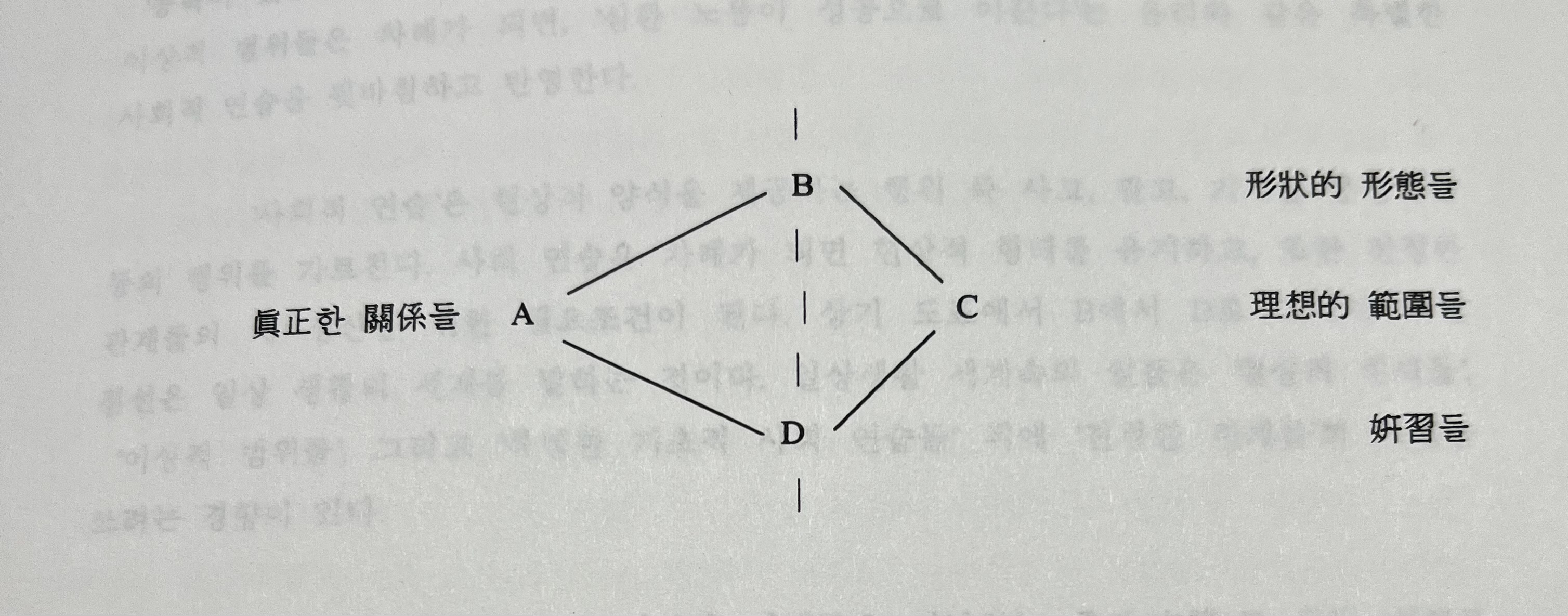
‘진정한 관계들’은 사회 내의 물질적 생존의 하부구조를 의미하는 것이다. 예를 들자면 생산의 자본주의자적 방식을 말한다. 이러한 생산 방식은 지배계층과 노동계층과 가난한자의 계층 사회를 필요조건으로 갖고있다. 현대 자본주의 구조는 생산 관계들의 대단히 복한적인 체재인 것이다. 하부 구조나 진정한 관계들은 현상적 형태의 양성을 제공한다.

‘현상적 형태들’은 인간의 경험속에 개념화되는 사회적 실체의 특별한 나타남을 가리킨다. 자본주의 아래 임금과 노동의 관계들이나, 복합적 상하 직업구조, 복합적 계층구조등 처럼 사회 내의 현상적 형태들은 기구화 되고, 사회적 조정을 하게 된다.

현상적 형태들은 ‘우세한 실체’나 ‘객관적 진실’ 혹은 ‘그런 식으로’ 나타나게 된다. 그것들을 창조한 종속적 구조들위에 비판적 반영을 하기 위한 사회적 형태들 뒤로 돌아가지 않는 한 현상적 형태들은 진리로 나타난다. 현상적 형태들은 그들의 차례가 돌아오면, 특정한 이상적 범위들 안에서 반영한다.

‘이상적 범위’들은 존재하는 사회 실체들을 급진적으로 변화시키려는 시도나, 사회의 현상유지를 합법화함을 설명하고 정당화함을 가리친다. 이상(理想)들은 객관적 사회 구조를 향해서 주관적으로 잡은 신념들을 연결시키려고 기능한다. 자본주의 생산의 현상유지를 합법화하기 위해서 섬기는 이상들의 예로는 ‘가지고 있는 자가 앞장서지,’ ‘능력이 있는자가 성공하지,’ ‘가난은 하나님이 일하기 싫은 자를 벌주신 것’ 등이 있다. 이상적 범위들은 차례가 되면, ‘심한 노동이 성공으로 이끈다’는 윤리와 같은 특별한사회적 연습을 뒷바침하고 반영한다.

‘사회적 연습’은 현상적 양식을 제공하는 행위 즉 사고, 팔고, 가격을 흥정하는 등의 행위를 가르친다. 사회 연습은 차례가 되면 현상적 형태를 유지하고, 또한 진정한 관계들의 재 생산을 위한 필요조건이 된다. 상기 도표에서 B에서 D로 그어져 내린 점선은 일상 생활의 세계를 말하는 것이다. 일상생활 세계속의 일들은 ‘현상적 형태들’, ‘이상적 범위들’, 그리고 ‘특별한 기초적 사회 연습들’ 뒤에 ‘진정한 관계들’의 가면을 쓰려는 경향이 있다.

요점은 사회는 권위의 심오한 자원이 지각하는 주체(主體)으로 독립하는 실체로 존재하나, 연습을 통해서 주체와 원인적으로 연결된 것이다. 이것을 알아보기 쉽게 도표를 만들어 보면:
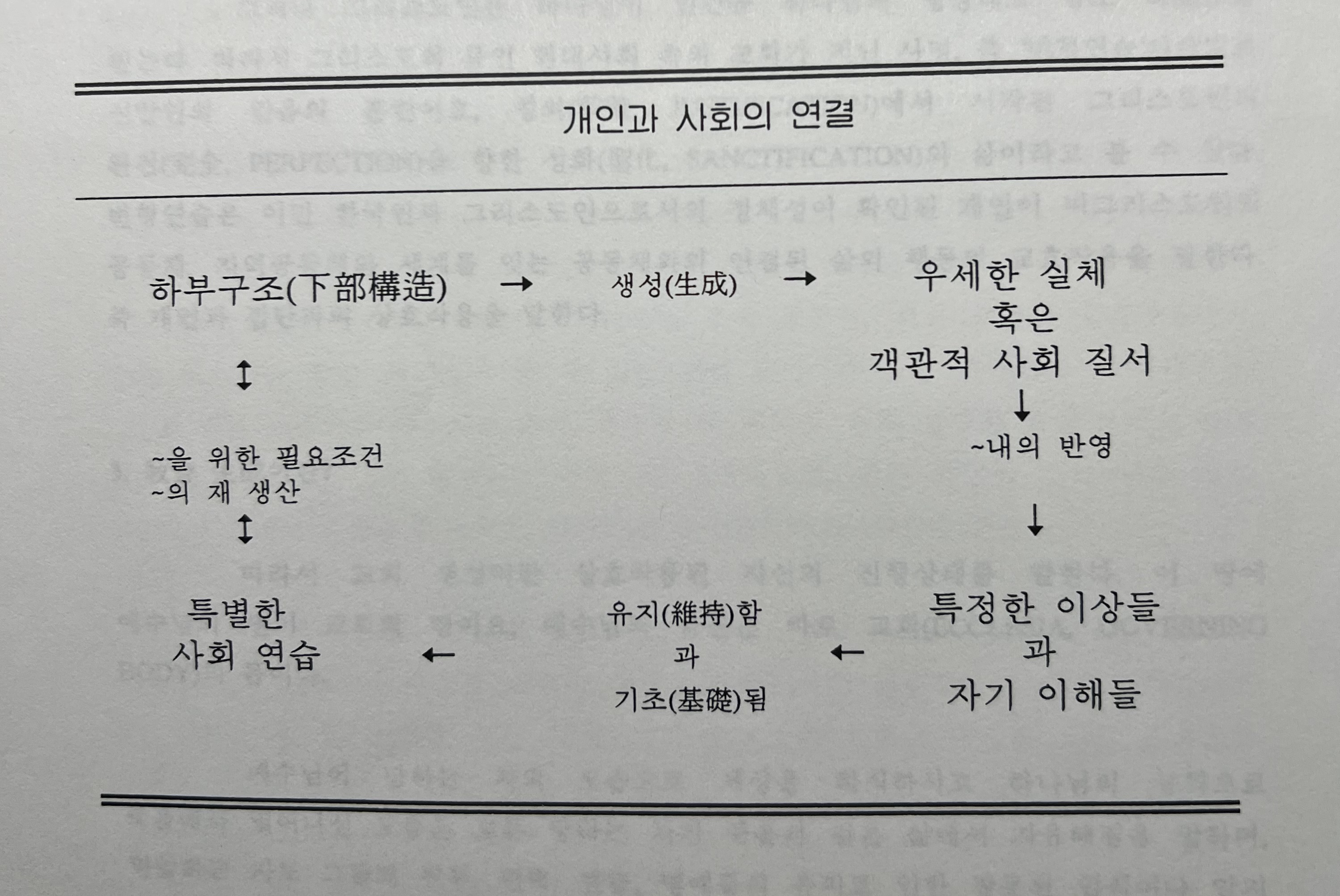
해석과 치유와 유지와 인도 그리고 도전은 모두 통합해야만 될 사회적 행동들이다. 해석은 실천(연습)과 연결되여져야만 한다. 사회행동은 억압의 고착화된 적절한 구조와 이를 유지하는 사회적 조정(배열)과 과정을 온전한 이해와 변형을 찾으려 노력해야만 한다. 교회는 모자잌 교회 창문 너머로 나와 어머니가 울고 있는 곳, 배고픈 아이들이 있는 곳, 직업을 없는 어머니/아버지가 있는 곳, 식구들이 병으로 앓으나 보험이 없는 곳으로 나와 함께 있어야한다. 사회행동의 사역은 교회 공동체와 일반 사회 공동체가 돌봄과 해방과 사회적 변형의 실천(연습)을 계속해서 발전 전개 시켜나가는 것 처럼, 타인들의 비판적인 관점을 수용할 수 있는 자세가 되여야 한다.

4) 예언적, 비판적, 그리고 자기성찰의 반영:

이중문화 가정 교회는 인종차별주의와 여성차별주의의 구조적 불평등과 잠행적 형태를 확보하는 착취적 경제 사회 조직위에 복음의 능력으로 심판을 선언할 때에, 때로는 예언자적인 역할을 하게 되는 것이다. 이러한 예언자적인 역할은 반영적이라야만 하고, 오늘의 교회와 이중문화가정 교회가 성서와 억눌린자의 빛 안에서 지금 무엇을 하고 있는가(?)고 심각하게 질문을 해야한다. 이 역할은 교회의 해석하는 작업과 사회적 행동 사역과 일관성이 있어야만 의미가 있는 것이다.

그러나 그리스도인은 하나님이 인간을 하나님의 형상대로 창조 하셨음을 믿는다. 따라서 그리스도의 몸인 현대사회 속의 교회가 지닌 사명, 즉 ‘변형연습’이야말로 신앙인의 믿음의 훈련이요, 칭의(稱義, JUSTIFICATION)에서 시작된 그리스도인의 완전(完全, PERFECTION)을 향한 성화(聖化, SANCTIFICATION)의 삶이라고 볼 수 있다. 변형연습은 이민 한국인과 그리스도인으로서의 정체성이 확인된 개인이 비그리스도인의 공동체, 지역공동체와 세계를 잇는 공동체와의 연결된 삶의 행동의 교호작용을 말한다. 즉 개인과 집단과의 상호작용을 말한다.

3. 교회 생성이란?

따라서 교회 생성이란 상호작용된 자신의 진행상태를 말한다. 이 땅에 예수님의 영이 교회의 영이요, 예수님의 육신은 바로 교회(ECCLESIA, GOVERNING BODY)의 몸이다.

예수님이 당하는 자의 모습으로 세상을 하직하시고 하나님의 능력으로 죽음에서 일어나신 모습은 모든 당하는 자가 죽음과 같은 삶에서 자유해짐을 말하며, 억압하는 자도 그들의 전통, 권력, 관습, 명예등의 유지로 인한 잘못된 인식이나 알지 못하는 가운데 행했던 억압을 통한 비인간화의 행위에서 자유해 또 하나의 죽음에서 일어나 자유화되는 것을 말한다.

이를 위한 운동이 교회생성(ECCLESIOGENESIS)이다. 이 말을 쓴이는 독일계 부라질 태생인 Leonardo Boff 프란시스칸 신부로, 구원의 매체로 이 땅에 그리스도의 몸의 역할과 하나님 나라의 확장의 터인 교회를 기초 공동체(The Base Communities Reinvent the Church) 를 통하여 새로 발명하자는 주창을 했다. 교회의 본래의 사명을 찾은 교회다운 교회가 되기위하여 교회를 옛 터전위에다 다시 출생시키자는 말이다. 새장소와 새 사람의 시작이 아니고, 현재 있는 교회를 새롭게 주님이 진정 원하시는 모습으로 재 출생 시키자는 뜻이다. 이와같이 기성 교회가 순수한 원칙에 입각해서 그 형태를 갖추어 ‘변형위치’를 갖는 것을 ‘교회생성(ECCLESIOGENESIS)’라 한다.

오늘날 교회성장을 강조한 나머지 교회갱신의 호소를 미쳐 들어주지 못하고 있다. 그러나 필자는 분명히말하지만, 교회 부흥은 교회갱신의 끝임없는 과정이라고 말하고 싶다. 교회가 교회로 남을 수 있는 길은 <1> 현재 교인의 개인 신앙의 변형, <2> 교회의 변형, 그리고 <3> 대 사회를 향한 교회의 관계 변형을 통한 교회공동체의 현재구조에 대한 초월적 변형이 없는 한, 교회는 주님의 영을 빙자한 사회 친교단체나, 사회 사업단체나, 아니면 사회 일반기업과 다를 바가 없어 하나님의 나라확장을 위한 자유, 평화, 평등, 사랑, 믿음, 소망의 역사와는 거리가 먼 단체로 전락하고 마는 것이다.

우리는 교회를 건물로 생각할 수 없듯이 교회생성은 살아 있는 교회를 기초공동체를 통해서 지어나가는 것을 말한다. 교회생성을 위한 새로운 교회의 기초공동체내에서는 소외된 구조가 없는 상태를 말한다. 이것은 직접적인 관계, 상호관계, 깊은 관계(성찬), 상호협조, 복음을 이해하는 점에 공통성, 회원 수준의 공통성등에서 온다. 여기에는 일반 사회에서 볼 수 없는 것이 있다: 즉 굳은 규칙들, 상하명령계통, 기능을 위한 기존화된 직무와의 관계, 내용의 질, 직위등. 흔히 중심이 없는 문제로 앓고 있을 때 복음으로 쉽게 해결되는 분위기를 호흡함으로, 또는 개인이 서로 서로 상호 연결되여 묶여지는 공동체 삶으로, 감격하는 열심(ENTHUSIASM)이 생긴다.

사회학자 Pedro Demo의 Sociological Problems of Community 에 의하면, 오늘의 사회학은 F. Tonnies가 말하는 사회와 공동체를 대조하는 전통적인 이해를 넘어간다고 보고 있다. 즉 상호이익을 위한 협력관계와 소속감에 의하여 적응된 인간 존재속의 사회적 형성을 공동체라 말하고, 사회는 대조적으로 익명의 사람과 간접적인 인간관계가 주로 보급되 유행해서 이룬 사회적 형성을 말한다. Demo는 말하기를 “공동체와 사회간의 관계는 마치도 공동체를 사회의 유토피아라고 말할 수 있는 것이다.”(48)

인간의 함께 함이란 언제나 “비인간적(非人間的)인 조직(組織)”과 인간적(人間的)인 내밀(內密)” 사이의 긴장으로 차있게 마련이다. 동등한 공동체내의 최고 우월자가 있는 문제는 구조악을 방지하는 문제와 실체성을 상승시키는 문제와 연결되여 있다. 그래서 고민은 인간존재의 인간화와 복음의 가치와 인간을 인간끼리 좀더 친밀해질 수 있는 인간존재로 이끄는 문제인 것이다. 사회활동적 사회위에선 동등한 공동체의 최고 우월성은 쉽사리작은 모임의 단체로 분활된다. 따라서 동등한 공동체인 교회 재창조를 위한 기본인 기초공동체가 매우 중요하고, 이는 교회라는 사회적 조직 내의 동등한 인간공동체를 말한다.

사랑과 용서와 연대성과 억압적인 힘의 포기와 다른 사람을 용납함등에 뿌리를 내린 기독교는, 근본적으로 동등한 공동체적 정신과 사회적 구조 속에서 충돌과, 이기성, 개인주의, 개인 및 단체 이익, 명령과 규칙을 갖는 압력, 그들의 목표 달성을 위한 매우 딱딱한 과정으로 목적을 설정함등에 대항하여, 새 창조를 향해 적응되여 있다.

      예수님께서는 인간을 횡적관계로 부르셨다. 즉 상호 존경, 상호 관대함, 형제자매로서 함께함, 관계의 단순성등의 상호 횡적관계롤 부르셨다. 종적으로는 예수님께서는 인간에게 하나님과의 진실한 효성의 관계를 열어 놓으셨다. 즉 예술성이 없는 단순한 기도와 하나님을 향한 관대한 사랑으로 인도해 내셨다. 예수님은 사람이 살기위하여 함께 함의 모든 표현하는 정신을 강조함에서 떠난, 인간의 조직과 기관에 대하여 전혀 관심이 없으셨다.

지구촌 속에 교회는 동등한 차원에서 구체적이고 사회 조직적 차원과 절대적으로 공동한다. 교회 안에는 특정한 공동체들로 부터 초월하는 조직적 요소와 그 공동체들 모두를 상호 연관관계를 맺어주는 조직적 요소가 있다. 여기에 교회의 권위가 있는데 그것이 바로 사랑과 희망 속의 하나됨이다.거기에 신앙 안에 기본적인 하나됨을 표현한 신앙고백(신경)이 있다. 또한 각 개체 지역 공동체들을 향한 지구촌의 공통의 목표가 있다. 교회의 제도적 골격(하부구조)을 현재 교회의 역사적 핵심을 왜곡함이 없이 또한 그러한 전통교회의 정체성을 잃지 않으면서, 진실로 갱신할 수가 있는데, 그것은 일반인(민중)들의 공동체들의 충격과 추진으로만이 가능하다. 왜냐하면 사람들로 부터 일어난 교회는 사도들로 부터 일어난 교회와 동일하기 때문이다.

       교회가 사회내에서 다른 사회공동체와 동일한 모습으로 한 종교단체로 남을 수가 있고 또 하나의 선택은 생명 공동체가 되여 사회내의 모든 공동체간의 협조와 양육을 담당한 창조적 역할을 하면서 모든 공동체의 중심에서 또한 모든 공동체 속에서 예언자적인 사명을 감당 할 수있으리라 본다. 교회가 이같이 예언자적인 선교의 사명을 회복할 때에 비로서 지구 촌의 구석 구석에서 일어나는 정의를 향한 부르짖음에 하나님의 면류관을 가지고 나갈 수가 있을 것이다. 그렇지 못할 때에 교회는 불안전하고, 사무적으로 불쾌함을 맛보고, 결국 에수님을 배반한 제자들로 전락하고 말 것이다.

그러면 교회 생성을 위한 기초 공동체를 위해서는 무엇을 해야하나? 기초공동체는 기관구조로서의 교회에 반대되는 점으로 서는 교회의 모습을 제공하는 영원한 미래 제공한다. 영원히 이룰 수 없는 경지를 바라는 것이 아니며 또한 이것 만이 유일한 교회 조직이라는 것도 아니다. 다만 동등 공동체의 정신을 살리고 지켜서 관료적인 기구적 기관의 교회의 모습에서 떠나 교인들 상호간의 직접적인 인간관계 속에서 하나님의 임재를 체험하도록 하려는 것이다. 이것은 현재의 회중을 없애고 다른 것으로 대치하는 것이 결코 아니다. 전체 교회와 단단히 결속됨을 잃지 않고 교회생성을 계속하는 것은 서로가 변형 훈련을 게을리 하지 않을 때, 교회가 조직으로 고착화되지 아니하고 영원한 믿음 운동으로 생성될 것이고, 이것이 하나님의 나라의 진정한 모습이리라 믿는다.

다음의 세가지 제시를 연구할 수 있겠다: <1> 교회 공동체는 ‘개인 구원’의 노력에서 ‘인간구원’을 위한 단합과 행동이 구체화되어야 할 것이다. ‘나’는 ‘우리’의 집합적 역사창조에 가담할 때 비로소 사회적 정체(SOCIAL IDENTITY)가 형성된다. <2> 교회가 서로 섬기고 나누는 공동체가 되려면 신념체제의 개방성을 갖고 이견을 이해하는 자세와 이탈마저 포용하려는 동등대화의 자세로 임해야한다. 행동적 차원에 있어 좀더 넓은 안목으로 새로운 생활양식을 용납 내지 수용할 수 있는데서 자유로운 소통, 친교가 이루어 질 수 있다. <3> 교회 공동체는 사회안에 존재한다. 세속적 공동체의 삶은 교회 공동체와 직접, 간접의 관계가 있기 때문에 교회 동동체는 지역사회건설에 적극적인 참여가 필요하다.

의식화(意識化), 인간화(人間化), 그리고 생성(生成) 공동체(共同體) 형성(形成)으로 인종(人種)과 성차별(性差別)로 인한 소외(疎外)에서 참 하나님이 원하시는 자유 평등 평화 사랑 소망의 변형연습(變形縯習)이 바로 교회생성(敎會生成) 과정(過程)인 것이다.

[주]

  1. Embury 한인회중 가운데 이중문화결혼여성 13명을 대상으로, 청소년 시절 (7살에서
    18살 까지)을 어떠한 가정환경에서 보냈는가를 구두로 조사한 결과 다음과 같은 결과를 보여 주고있다: (1991년 11월 현재) (1) 성장과정의 가정형편은; 부모와 동거
    1명, 부모이혼 6명, 편부슬하 1명, 편모슬하 3명, 계부슬하 0, 계모슬하 5명, 고아원
    1명, (2) 부모의 버릇; 부친 술중독 8명, 모친 술중독 2명, 부친놀음 5명, 모친놀음
    1명, (3) 성장과정의 부모의 생활정도; 상 0명, 중 1명, 하 9명, 극빈 3명.
  2. 양주삼 감수, 새국어 대 사전, 한영출판사, 서울, 1975, p. 953.
  3. Ibid., p. 954.
  4. Webster’s New Universal Unabridged Dictionary, Second Edition, Dorset & Baber,
    New York, NY, 1979, P. 46.
  5. The New Encyclopaedia Britannica, Vol. 1, Micropaedia, 15th Edition, Chicago, 1988, p.
    270.
  6. Ibid.
  7. Ibid.
  8. Ibid.
  9. Ibid.
  10. Ibid.
  11. Ibid., p. 271.
  12. Ibid.
  13. Ibid., pp. 6-8.
  14. Ibid., pp. 8-10.
  15. Marx의 모든 이론의 출발점인 소외개념은 Eric Fromm이 Marx를 해설한 그의 저서, Marx’s Concept of Man (New York: Frederick Ungar, 1966)에서 밝혔듯이 Marx의 초기 저서들에 그 근거를 두고 있다: Dirk J. Struik, ed. The Economic and Philosophic Manuscripts of 1944, (New York: International Pub. Co., 1964). I & C. Leroy Gaylord, The Concept of Alienation: An Attempt at a Definition, in Marxism and Alienation, ed. Herbert Aptheker (New York: Humanities Press, 1965)를 참고하기 바란다.
  16. T. Richard Snyder, Ibid., pp. 10-11.
  17. Ibid., pp. 11-13.
  18. Health Policy Advisory Committee, The American Health Empire: Power, Profits, Politics (New York: Random, 1971).
  19. Jonathan Kozol, Iliterate America (New York: Doubleday Anchor, 1985).
  20. T. Richard Snyder, Ibid., pP. 13-14.
  21. Ibid., pp. 14-15.
  22. Ibid., p. 16.
  23. Ibid.
  24. Ibid., P. 29.
  25. Ibid., P. 33.
  26. Ibid., p. 40.
  27. The Encyclopedia of the Social Science, ed. David Sills, vol. 15. (New York: MacMillan and the Free Press, 1968), pp. 618-621.
  28. T. Richard Snyder, Ibid., p. 43.
  29. Ibid., p. 47.
  30. Ibid., p. 49.
  31. Ibid., pp. 50-52.
  32. T. Richard Snyder, Once You Were No People, – The Church and the Transformation of Society, (Meyer Stone Books, Bloomington, IN, 1988), p. 2.
  33. Ibid.
  34. Ibid., p. xv.
  35. Ibid.
  36. Richard J. Bernstein, Praxis and Action (Philadelphia: University of Pennsylvania Press, 1971), p. IX.
  37. Paul F. Knitter, No Other Name? – A Critical Survey of Christian Attitudes Toward the World Religions (New York: Orbis Books, 1986), p. 193.
  38. David Tracy, “Theologies of Praxis”, in Creativity and Metho: Essays in Honor of Bernard Lonergan, Matthew L. Lamb, ed. (Milwaukee: Marquette University Press, 1981), p. 36;
    Lamb, “Dogma Experience, and Political Theology”, Concilium, 113(1979) 81; Lamb, “the Theory-Praxis Relationship in Contemporary Christian theologies”, Proceedings of the Catholic Theological Society of America, 1979, p. 171.
  39. Leonard Boff, Jesus Christ Liberator: A Critical Christology for Our Time (Maryknoll, NY:
    Orbis, 1978), p. 44-47.
  40. Quoted in Rosemary Ruether, To Change the World (New York: Crossroad, 1981), p. 27.
  41. Bernard M. Loomer, “The Web of Life.” The Graduate Theological Union, Berkley, California, October, 1977, p. 1.
  42. Allan Aubrey Boesak, Farefell to Innocence (Maryknoll, NY: Orbis Books, 1977), p. 152.
  43. Preire, Pedagogy, Ibid., p. 19.
  44. H. Bergson, Les Deux Sources de la morale et de la religion Paris, 1932
  45. K. R. Popper, The Open Society and its Enemies Volume 1, Plato and Volume 2, Hegel & Mark (London: Routledge & Kegan Paul, 1945
  46. Peter L. Berger, Facing Up to Modernity (Washington, D.C.: American Enterprise Institute for Public Policy, 1977), p. 2.
  47. Roy Bhaskar, The Possibility of Naturalism: A Philosophical Critique of the Contemporary Human Sciences (New York: Humanities Press, 1979), p. 27.
  48. Demo, article in Comunidades: Ingreana base, Estudos da CNBB No. 3 (Sao paulo:
    Paulinas, 1975), 00. 67-110
Union Theological Seminary - Wikipedia

Posted in Doctor of Ministry | Tagged , , , , | Leave a comment

The Church in a Multicultural Context, “The Background and Issues of the Church” for the Transforming Praxis toward Ecclesiogenesis (Introduction) New York, 1995

Church Background and Context

  1. Regional Background

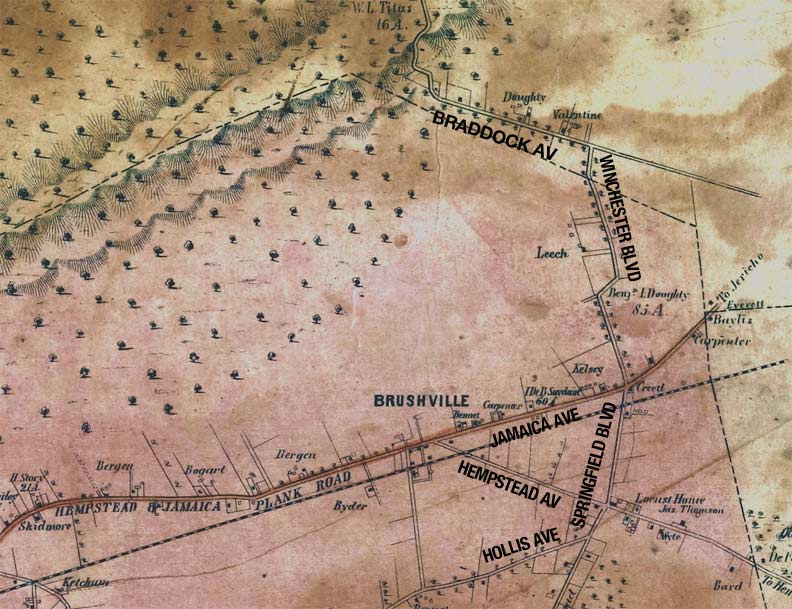
This church is located geographically on the eastern boundary of the borough of Queens, New York City, adjacent to the western edge of Nassau County, New York. The boundaries of the area include Union Turnpike to the north, Francis Lewis Boulevard to the west, Murdock Avenue to the south, and Belt Parkway, Cross Island Parkway, and Winchester Boulevard to the east. The Grand Central Parkway, which connects to the Northern State Parkway, runs through the northern part of the neighborhood, as does the Long Island Expressway, making this location a major transportation hub between Long Island and New York City. The Clearview Expressway, which connects to the Throgs Neck Bridge leading to the Bronx and Connecticut, ends at Hillside Avenue in the northern corner of the neighborhood. The church itself is located just one block north of the well-known Jamaica Avenue and 220th Street, making it easy to find even for first-time visitors.

According to The Story of Queens Village (1), settlers from Connecticut arrived in the 1640s and settled in Hempstead. Around 20 families among them wanted to move westward, so they traded with the Native Americans for land between Hempstead and Canarsie in exchange for two guns, a coat, and some gunpowder and lead. On March 21, 1656, they settled in Jamaica (near Hawtree Creek, Lewis Boulevard, and 206th Street). On March 7, 1663, they purchased additional land from Native Americans between Spring Creek to the west (now the Brooklyn-Queens border) and Hook Creek to the east (now the Queens-Nassau border).

Queens Village slopes from a height of 200 feet above sea level along the Grand Central Parkway in the north to about 60 feet along Murdock Avenue in the south. While the plain stretching from western Queens to Wantagh was known as the “Great Plain,” Queens Village was known as the “Little Plain” until the 1600s (2). Because only coastal grass grew without any trees, a law was passed in the 1600s forbidding people from cutting grass before July 8 to ensure fodder for animals. In 1661, anyone who cut grass before August 10 had to pay a fine (3).

The church is part of the Queens Village administrative district in New York City. It belongs to Community Planning Board #13 and is within School District 29. The public schools in the area include one high school (grades 9–12), one middle school (grades 6–8), and four elementary schools (grades K–5). Private schools include one prep school (K–8), one Lutheran school (K–8), and two Catholic schools (K–8). Religious institutions include 3 Jewish synagogues, 3 Catholic churches, 1 Episcopal church, 3 Lutheran churches, 1 United Methodist Church, 1 Reformed Presbyterian church, 1 United Presbyterian church, 1 Korean church, 3 Baptist churches, and 1 Pentecostal church. There is also a YMCA, a library, a police precinct, and two post offices. The area is divided into three postal code zones: 11427, 11428, and 11429.

It is estimated that Queens Village became part of New York City’s administrative structure between 1898 and 1919 (4). According to the Queens County Times, a local newspaper published on September 23, 1971, the village was named Queens Village in 1685 in honor of Queen Catherine of Braganza, wife of King Charles II of England (5). The first post office was established in 1850, and the first school district was designated in 1857. A train station was established in 1871. In 1889, the village had its first fire department and firehouse. Telephones became publicly available in 1896, and trolleys began running along Jamaica Avenue in 1897. Electricity was introduced in 1898, and water supply from the city began in 1899. The subway arrived in 1905, and a city bus depot was built in 1924, with over 10 bus lines running through or terminating in the area. The first high school in the village was established in 1955 (6).

According to the 1980 census, the population of the village was 59,734. By 1989, it had grown to 60,680—a modest increase of 946 people over nine years. While overall growth has been slow, the population is changing due to the arrival of Indian, Filipino, and West Indian immigrants, who are replacing retiring and relocating white residents. Though population growth is moderate, the demographic makeup is shifting significantly toward minority groups. The number of households grew from 18,909 in 1980 to 20,447 in 1989, an increase of 1,538 households. This 16% growth is much lower than the global population growth rate of 1.72%, the U.S. growth rate of 9.8%, and New York State’s 2.5%, indicating a modest, steady growth. This increase is not due to natural births, but to the in-migration of minority populations such as Indians, Filipinos, and Jamaicans, significantly changing the area’s demographic composition.

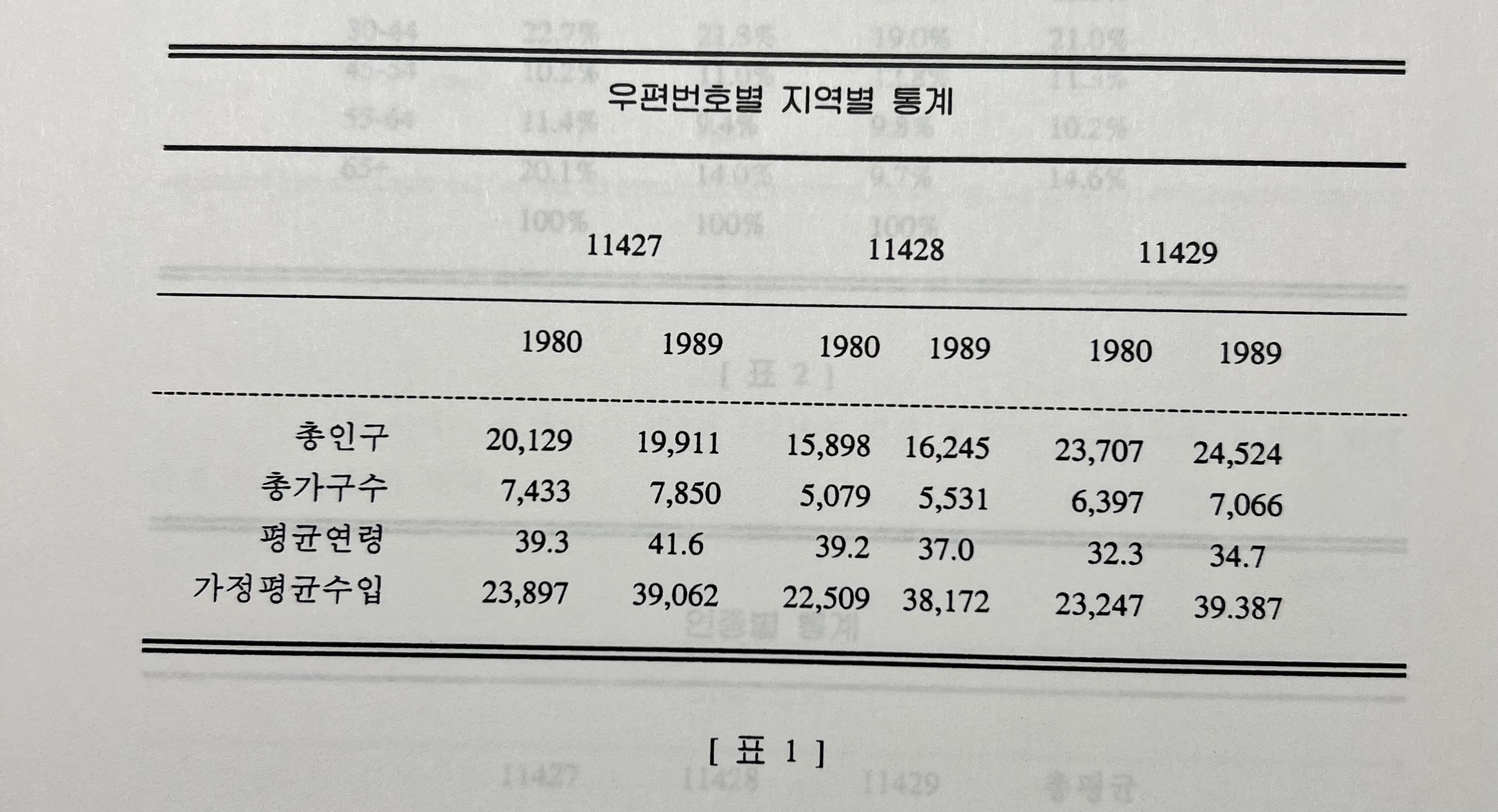
Average household income rose from $23,217.67 to $38,873.67 over ten years—an increase of $15,656—showing that the village is home to a typical American middle-class population. The details of household income by ZIP code are as follows (7):

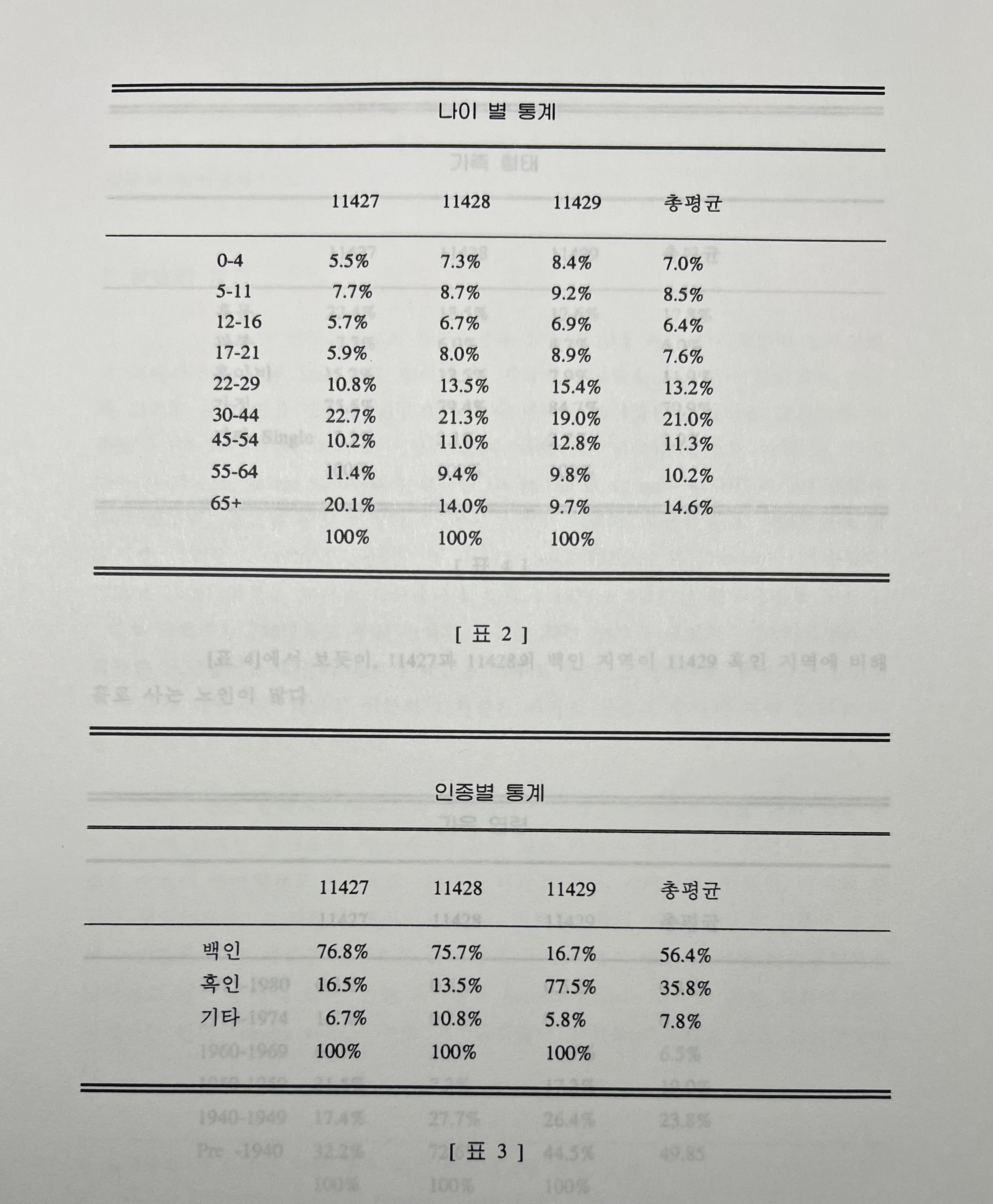
As shown in [Table 1], the average age has increased from 35.6 to 37.7, indicating an aging trend of 2.1 years. However, as seen in [Table 2], the areas where the church is located—zip codes 11427 and 11428—have significantly higher elderly populations (65 years and older), at 20.1% and 14%, respectively, compared to 9.7% in the 11429 area. Additionally, as [Table 3] shows, there is a racial contrast between these regions. In zip codes 11427 and 11428, where the church is located, White residents make up 76.8% and 75.7% of the population, respectively, whereas in 11429, Black residents make up 77.5%, revealing a stark racial difference within neighborhoods of the same village. The 11429 area, which begins just across the street to the south of Jamaica Avenue, one block from the church, is a region with a concentrated Black population.

The “Others” category, Table 3, is primarily composed of Indians, Filipinos, and a very small number of Chinese and Hispanic people.

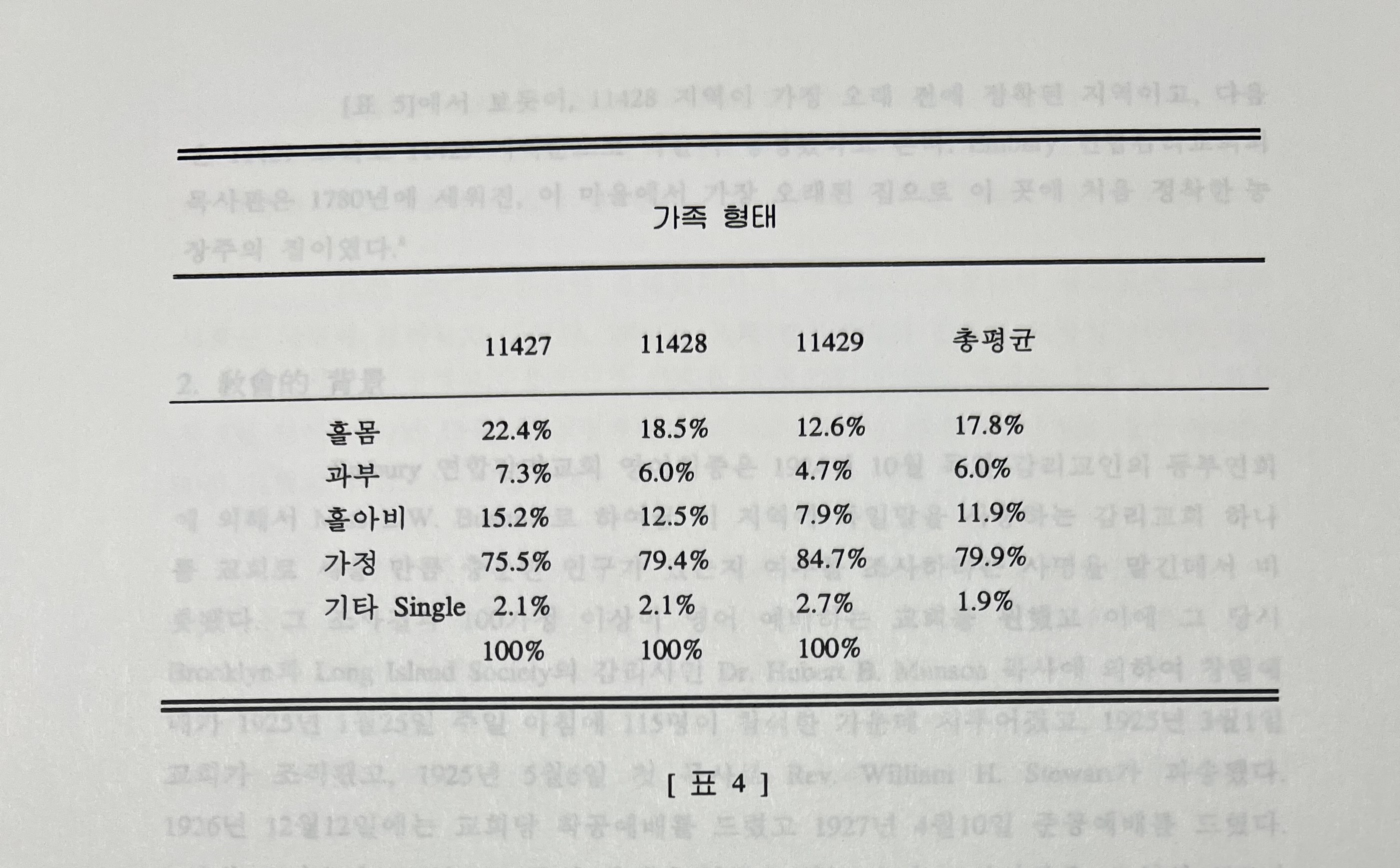
As shown in [Table 4], the White-populated areas of 11427 and 11428 have more elderly people living alone compared to the predominantly Black-populated area of 11429.

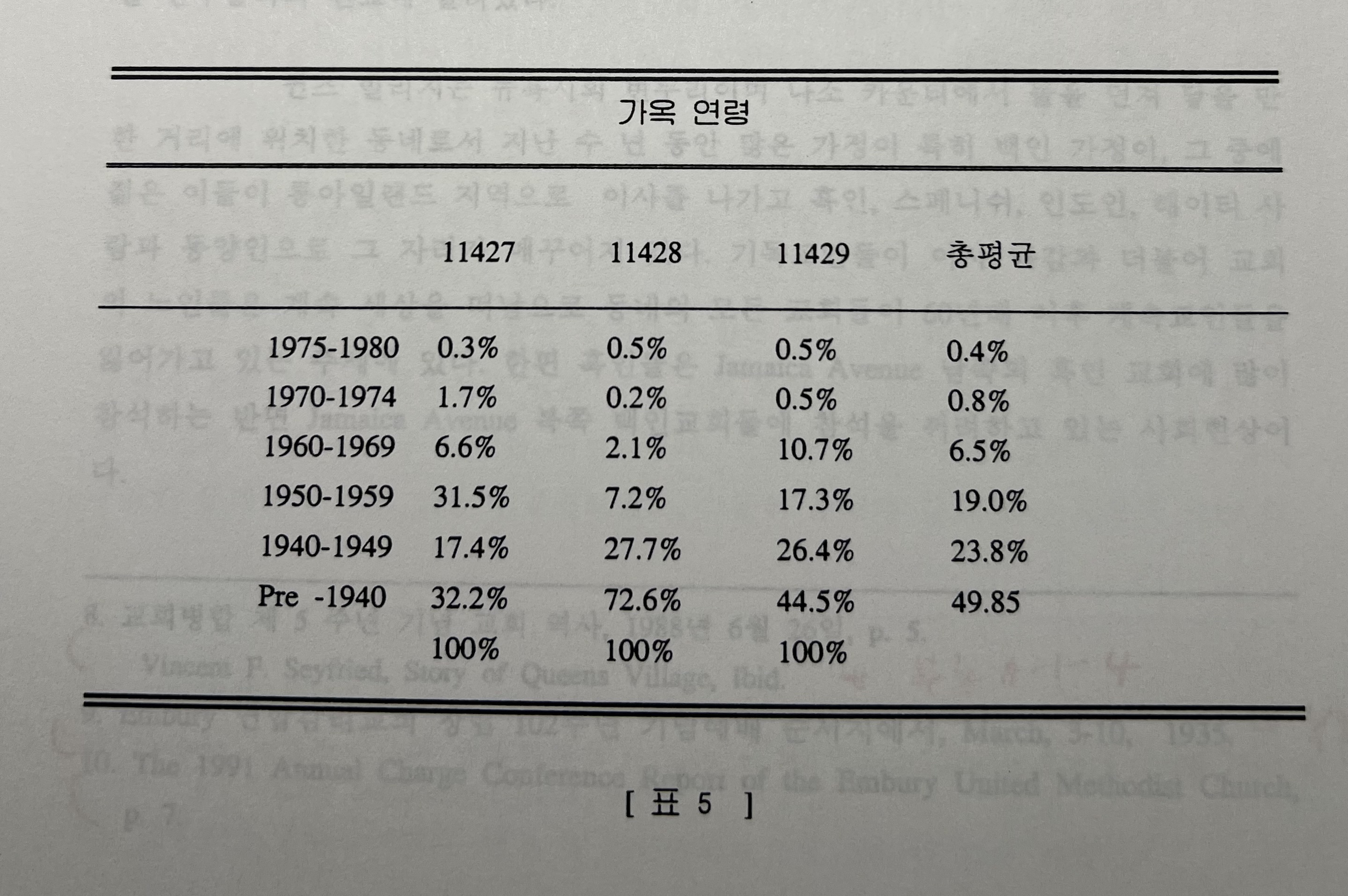
As shown in [Table 5], the 11428 area is considered the earliest settled part of the neighborhood, followed by 11427 and then 11429. The parsonage of Embury United Methodist Church, built in 1780, is the oldest house in the area and was originally the home of the first settler and farm owner in the village.(8)

2. Ecclesial Background

The English congregation of Embury United Methodist Church traces its origins to October 1924, when the Eastern Conference of German Methodists commissioned Miss L. W. Buettner to investigate whether there was a sufficient population in the area to establish a German-speaking Methodist church. The survey revealed that over 100 families desired a church offering worship in English. As a result, a founding worship service was held on Sunday morning, January 25, 1925, with 115 people in attendance, under the leadership of Rev. Dr. Hubert B. Munson, then the District Superintendent of the Brooklyn and Long Island Society. The church was officially organized on March 1, 1925, and Rev. William H. Stewart was appointed as its first pastor on May 6, 1925. Groundbreaking for the church building was held on December 12, 1926, and the dedication service was held on April 10, 1927.(9)

As of now, the church has 256 registered members, with an average of 99 attendees participating in worship and giving offerings on Sundays.(10) About 60% of the congregation are retired elderly people, and 75% are white. The church’s administrative board, which makes decisions about church activities, is composed of 90% white members. Therefore, their values tend to be rooted in past customs, nostalgic memories, and social fellowship with longtime friends.

Queens Village is on the outskirts of New York City, near enough to Nassau County that it could be reached with a stone’s throw. Over the past several years, many families—particularly young white families—have moved to the Long Island area, and in their place came African Americans, Hispanics, Indians, Haitians, and Asians. As Christian families moved away and older church members continued to pass away, churches in the area, including Embury, have steadily lost members since the 1960s. Sociologically, many African Americans attend churches south of Jamaica Avenue and tend to avoid the predominantly white churches north of it.

On June 26, 1983, Embury Methodist Episcopal Church merged with the neighboring Calvary United Evangelical Church.(11) Rev. Thomas Fisher was appointed to the new church and, with a ministry focus on African Americans, the congregation began to see an increase in younger Black families.

In 1987, Rev. Taeheon Yoon, a Korean pastor, was appointed to lead the church, marking a new phase. In 1989, the church board unanimously decided to start a Korean-language ministry.(12) Rev. Yoon began holding Korean-language services at 1 PM with his family, and within a year, the Korean congregation held its founding worship service on December 9, 1990. By the first anniversary in December 1991, the Korean ministry had grown to 31 members with an annual budget of approximately $40,000.(13)

A notable characteristic of the Korean congregation is that 13 members have been involved in intercultural marriages. Of them, five are currently in stable intercultural marriages, two are in the process of divorce, two are divorced and living alone, one has remarried a Korean man after divorce, and one is cohabiting with a Korean man after divorce. They range in age from their 30s to mid-50s and come from various areas such as Astoria, Woodside, Jackson Heights, Elmhurst, and Flushing—not necessarily because of proximity, but due to the human relationships and the unique nature of the church.


Overview of the Issues

To prepare for this study, the author worked with a research team of seven members from the church, and they identified the following facts. The adult Korean congregants can be classified into the following nine types:

  1. Recently immigrated Korean couples
  2. Korean couples who have lived in the U.S. for over ten years
  3. Women living alone after divorcing Korean husbands
  4. Women in the process of divorcing Korean husbands
  5. Couples in separation
  6. Women divorced from African American or Hispanic husbands
  7. Women in the process of divorcing African American or Hispanic husbands
  8. Women currently in their first intercultural marriage with African American, Hispanic, or white husbands
  9. Women in their second intercultural marriage with African American, Hispanic, or white husbands
  10. Women divorced from such husbands and now engaged or remarrying Korean men

It was discovered that more than half of the Korean congregation struggles with serious family issues, and the severity varies. Often these issues are not visible on the surface—not because they’ve been resolved, but because they have become more deeply internalized. These hidden problems are not exclusive to Embury’s Korean congregation but are widespread among Korean immigrant communities, especially those involving intercultural marriages.

Many adults are receiving psychological counseling or therapy. Korean women with intercultural marriage experience are often seen at the Embury Homeless Shelter, and some end up in state mental hospitals or even prison. T. Richard Snyder refers to such individuals as “the used, the marginalized, the unstable, the despised, the discarded.”(14)

Among the Korean-speaking congregation at Embury, 41% are women with intercultural marriage experience, and 8 out of 13 have been divorced. Due to the psychological, economic, social, moral, and spiritual consequences of divorce, these women often suffer from low self-esteem and severe depression or mental illness, leading to daily lives of poverty and alienation filled with anxiety and struggle.


Root of the Problem: Alienation from Wholeness of Life (Shalom)

The root of this alienation is partially the neglect of established immigrant churches. These churches are often preoccupied with numerical growth, traditional charismatic spirituality, and educational policies focused on church school growth. Several issues emerge here:

  1. Alienation within Christian families
  2. Alienation of Christians from society

Following Christ requires a faith that can present the unchanging Christ to new times, places, and cultures—even within the same congregation as society evolves. Alienation occurs when individuals cannot adapt to new cultures. Therefore, even within the same church, there must be continual regeneration for a new era. This requires transformation and sensitive, ongoing responses from the church.

The more critical problem is that no current research, strategy, or practical implementation exists within the church to guide those with “broken wings” or “marginal value” toward the wholeness of life—toward shalom.

This study identifies that the issues at Embury are rooted in alienation from this wholeness and is presented as a humble attempt to respond to the need for transformation through urgent Christian prayer.


Theological Response: Three Areas of Ministry Toward Ecclesiogenesis

  1. Healing Ministry for Personal Transformation
    • Practices for personal transformation toward recovery, aimed at discovering individual identity (Exodus generation).
  2. Communal Ministry for Church Transformation
    • Practices for building a community of equality through collective humanization (Cruciform generation).
  3. Preventive Ministry for Social Transformation
    • Practices by small communities to transform social structures into communities (Peace generation).

Problem Analysis

1) The Human Condition in Immigration

This study addresses the suffering of immigrants who face racial and gender-based discrimination and identity crises. After five years or more in the “land of opportunity and freedom,” many immigrants begin to ask, “Who am I?” They wrestle with:

  1. Economic survival
  2. Generational conflicts due to cultural and linguistic differences with their children
  3. Personal struggles in understanding American culture
  4. Shame and frustration from not being able to utilize their professional skills or credentials

These struggles cause a loss of self-realization and dissatisfaction in key areas of life:

  1. Physical needs
  2. Safety needs
  3. Social needs
  4. Self-esteem needs

Immigrants experience invisible pressures and tensions from many directions.

God sees those who suffer—immigrants who have lost freedom in a land of freedom. God desires their liberation. America is a land of pioneers, competition, and enterprise. While it promises crowns to those who demonstrate ability, free competition can also lead others into poverty, hunger, or even death. This creates moral stains in society.

Behind these issues lies the power of systems that dominate individuals. The paradox of religious and social abundance is continually controlled by the demon of conflict. Human relationships are dehumanized, unrecoverable by respect, religion, or social means. Immigrants need help.

Churches must humanize invisible systemic powers while securing the well-being and stability of suffering individuals. Depression results when immigrants lose their dignity. They need motivation to fulfill their hopes.

Therefore, the church must engage in:

  1. Healing ministry for consciousness-raising: Helping individuals rediscover their identity
  2. Transformational ministry for humanization: Empathy training for group equality
  3. Preventive ministry for generative community: Becoming leaven through voluntary suffering to transform society

2) Immigration Process

The history of Korean immigration, particularly the pioneer wave (1882–1905), is generally recognized as beginning with the Treaty of Amity and Commerce in 1882, which established diplomatic relations between Korea and the United States. This treaty allowed Koreans the opportunity and freedom to visit and reside in the U.S. While diplomats and students came over soon after, formal immigration is considered to have begun between 1903 and 1905, when 7,226 Koreans traveled on 65 ships to work on sugar plantations in Hawaii. Over 80% were adult men, mostly farmers, laborers, soldiers, church workers, and students. A significant portion—about 40%—were Christians, and most immigrants participated in church life in Hawaii. This initial immigration ended when, in 1905, the Korean Ministry of Foreign Affairs issued an order to ports including Incheon to prohibit Koreans from emigrating.

From 1906 to 1949, immigration resumed with around 2,000 Koreans entering Hawaii and the U.S. West Coast between 1906 and 1924. Immigrants of this era fell into two groups: political exiles and students, and “picture brides”—women who immigrated after agreeing to marry men they had only seen in photographs. A significant number of those early Hawaiian immigrants later relocated to the mainland U.S. and Mexico. Over 2,000 moved to California to work in rice farming and railroad construction, while another 1,000 moved to Yucatán, Mexico, to work in sugar plantations, with many later relocating to Cuba. Today, notable Korean communities still exist in Mexico and Cuba due to these migrations.

In 1924, a highly restrictive U.S. immigration law passed, greatly limiting immigration from Eastern and Southern Europe and completely halting immigration from Korea and other Asian countries. From 1924 to 1945, fewer than 20 Koreans immigrated to the U.S. annually.

Between 1950 and 1969, immigration gradually increased and accelerated in the 1960s. Two reasons contributed to this: (1) U.S. military, political, and economic involvement in Korea following the division of the peninsula and the Korean War, and (2) the reform of restrictive immigration laws in 1965, which opened up immigration from Asian countries. Initially, only 100 immigrants per year were allowed from Pacific Rim nations, but between 1950 and 1969, 32,957 Koreans immigrated to the U.S., and 75,241 entered as students, government delegates, or temporary visitors. Many of these visitors overstayed or obtained permanent residency.

Korean immigrants during the 1950s and 1960s can be categorized into four main groups:

  1. Women married to U.S. servicemen stationed in Korea. Since 1950, over 40,000 Korean women immigrated as spouses of U.S. citizens, most of whom were soldiers.
  2. Orphans adopted by American citizens. A New York Times article (March 1, 1977) noted that over 1,300 Korean orphans had been adopted between 1955 and that date; today, the number is much higher.
  3. Students, trainees, employees of Korean branches, correspondents, and temporary visitors who later gained permanent residency. According to Korea’s Ministry of Education, over 10,000 students studied in the U.S. between 1953 and 1973, most of whom did not return to Korea.
  4. Professionals such as nurses, doctors, and pharmacists, who immigrated after the 1965 law revision along with their families.

Unlike Korea, where the gender ratio is balanced, Korean-American communities have a female majority—a unique characteristic. In 1970, the male-to-female ratio among Korean immigrants was 33:67. By 1984, this had balanced somewhat to 42:58. This female predominance is attributed to three factors:

  1. Many U.S. soldiers stationed in Korea married Korean women and brought them to the U.S.
  2. A higher proportion of adopted Korean orphans were girls.
  3. A large number of Korean nurses immigrated to the U.S.

The gender ratio became more balanced in the 1980s due to the decline in nurse immigration.


Professor Byung-Kap Min identifies two primary reasons why gender equality is difficult to achieve within Korean immigrant communities:

  1. Many Korean families run small businesses, where women often work alongside their husbands. However, this shared labor does not translate into independent economic power unless the woman is independently employed and paid under her own name.
  2. Since most work in Korean-owned environments, Korean language and culture are preserved longer, reinforcing traditional male-dominant customs. Korean language and customs inherently reflect gender distinctions, making gender equality difficult without broader cultural assimilation.

3) Understanding Bicultural Families

Bicultural families typically refer to international and interracial marriages—households formed between partners of different nationalities or cultural backgrounds. As a multicultural society built through immigration, the U.S. has been the subject of numerous sociological studies on such families. With the rise of Korean immigration, many churches have begun focusing pastoral care on bicultural families.

In particular, the families this study focuses on are those formed by about 130,000 Korean women who married U.S. servicemen stationed in Korea after the Korean War. Many 1.5 or second-generation Korean-Americans are also entering interracial marriages, especially in smaller cities or rural areas with low Korean populations, where interracial marriage rates exceed 50%. Thus, ministry for international and bicultural families must expand and diversify.


4) Historical Background of Bicultural Families

According to Korean Ministry of Health and Immigration data, Korean immigration surged after the 1965 law reform. But even before this, many immigrants were family members or acquaintances invited by Koreans in international marriages. Post-Korean War society suffered from poverty, instability, and urbanization, and women faced unequal access to education, jobs, and fair treatment. For many young women—especially from rural or low-income urban areas—international marriage offered a rare chance to immigrate to the “dreamland” of America.

Korean women who married U.S. servicemen endured deep loneliness. Leaving their homeland to marry foreigners often meant permanent separation from their families. In the 1950s, ’60s, and early ’70s, cultural isolation and poor adaptation led to serious emotional distress, unlike today when Korean churches, restaurants, airlines, and media provide some cultural connection.


5) Understanding Bicultural Families

Military families formed through international marriage face frequent relocations and cultural misunderstandings, including conflicts over food and family norms. These challenges often lead to divorce or separation. Difficulties also arise in transmitting Korean culture to children and maintaining relationships with American in-laws. Women face language barriers, adjustment issues, feelings of alienation, stress, abuse, and social neglect. Emotional distress can manifest as instability in marriages and church communities. Yet many women endure and build successful bicultural families through faith and pride in their heritage.

These women exhibit patience, loyalty, cooperation, adaptability, strong faith, patriotism, and familial devotion. Many became exemplary figures in the immigrant community through perseverance and moral strength.

They contributed significantly to Korean society, both financially and socially, and played a cornerstone role in developing immigrant churches. Many quietly supported family reunification and welfare, though their efforts remain largely unrecognized. They acted as ambassadors, sisters to students, relatives to adoptees, and advocates for minority rights in the U.S. Despite being isolated and unsupported in a foreign land, their contributions deserve gratitude and recognition.

(1) Three Stages of Alienation Experienced by Most Internationally Married Women in the U.S.

The first stage of alienation begins when internationally married women arrive in the U.S. with high hopes and dreams, only to experience disappointment and disillusionment. In many cases, these women come from difficult family backgrounds or adverse life circumstances in Korea. Marrying American soldiers, they crossed the Pacific dreaming of a Cinderella-like happiness in the U.S. However, upon arriving at their “homes,” their dreams often collapse. Their husbands’ low income, communication difficulties with in-laws due to language barriers, cultural differences, and the husbands’ indifference—stemming from the end of their own isolation in a foreign country—all contribute to marital tension, especially when the wives face language and cultural shocks. One Korean woman married through international marriage reported that 85–90% of such couples divorce within a few months of marriage.

Some husbands provide no financial support at all, leaving women—who lack language skills and understanding of societal norms—completely abandoned. They are suddenly thrust into a state of anxiety and fear of the future, feeling completely rejected by society. In extreme cases, they lack shelter, income, access to their children, stable employment, and even worry about getting three meals a day. They become what society would call “third-class citizens,” suffering severe psychological trauma.

The second stage of alienation manifests as follows: women who leave their homes often move to cities where their friends live. With no job skills or preparation for the workforce, about two-thirds end up working in massage parlors, where prostitution is frequently practiced alongside massage services. In an attempt to forget their past and escape from extreme loneliness and fear of the future, many turn to alcohol and drugs.

The third stage of alienation is the final phase of life for some of these women. Due to mental instability, schizophrenia, or chronic illness, they lose their jobs and often end up moving from one homeless shelter to another, or are institutionalized in mental hospitals. When they are deemed a threat to themselves or others, local clinics or hospitals in each borough diagnose them and transfer them to state psychiatric hospitals (e.g., in Queens Village). Since hospitals do not release patient information, it is difficult to determine the exact number of Korean patients. Some women are imprisoned for drug use or trafficking, awaiting the end of their sentence in city or state correctional facilities. Even when released on probation, they lack shelters or advocates to support them, leading many to return to massage parlors or drug-related activities. This is clearly a form of social evil created by the system. Yet, there are no shelters specifically for Korean women to address these issues. This is the tragic reality of being alienated from a life of wholeness—SHALOM—in a foreign land.


(2) Three Forms of Alienation Among Korean Women in International Marriages in the U.S.

The dehumanizing issues faced by internationally married Korean women can be categorized into three forms of alienation. A wholeness of life comes from personal integrity and responsibility, mutual respect in human relationships, and commitment to social justice. However, society fails to provide the foundation for such a life for internationally married families. Thus, the following categorization of alienation helps us seek directions toward solutions.


I. Alienation from Personal Integrity and Responsibility (Issue of Consciousness)

Our church’s research group has found that the intense loneliness (the first stage of alienation) experienced by international marriage women leads easily to low self-esteem. While they are aware that their problems are serious, they often do not understand the root causes. These women, underestimating their abilities, fail to achieve inner peace even as homemakers. Without understanding the question, “Who am I?,” peace and a whole life are not possible. This paper views the discovery of personal identity (Who I Am) as the foundational starting point in the transformation process toward biblical ecclesiogenesis.


II. Alienation from Mutual Human Respect (Issue of Humanization)

Our church study group discovered that international marriage couples often struggle to form genuine relationships due to differences in language, culture, food, and thought between husbands and Korean wives. Deep-seated jealousy disrupts even church life and causes frequent conflict with close friends. These issues often occur against the will of the women. Although they try to overcome their alienation, their lack of training in patience and resilience means that church life has little positive effect on their relationships.

Consequently, many women hesitate to participate in church events, although they are comfortable sharing feelings and thoughts with each other. Nevertheless, conflict and confrontation frequently arise among them, only to disappear as if nothing happened. They also tend to change churches often rather than settling in one place. These interpersonal issues reflect a lack of experience with personal responsibility and perseverance. Thus, peace cannot be found within family, friendships, or community. These women live in isolation from the Korean community, missing many opportunities to serve or engage. Some even hide the fact that they are in international marriages, avoiding social contact altogether. This is similar to how some Korean churchgoers avoid social service. It is deeply unfortunate, yet undeniable, that the Korean community has historically discriminated against international marriage women, both verbally and behaviorally. Without knowing who we are or understanding others, a whole and peaceful life is not possible.


III. Alienation from Structural Peace (Issue of Dialogical Community)

Most internationally married couples maintain personal relationships within their own circles, often based on the husband’s race. Thus, no strong or effective social organization exists for them. Though some women once formed a social club with about 30 members, it dissolved after three years. When their husbands abandon them, these women have no institutions to turn to for help—and often hide their situations out of shame. There is one shelter run by the Asian Women Center in Manhattan, but it only accepts victims of domestic violence, making it largely inaccessible to many Korean women.

Additionally, we must not overlook the invisible but deeply rooted discrimination within the Korean community against internationally married women. It is rare to find peace or reconciliation grounded in social justice within the immigrant community on behalf of these women. Considering how few Korean parents approve of their children marrying someone of another race, it is clear that the Korean immigrant community needs a strong awakening of communal consciousness to escape structural racism and achieve genuine social justice.

The Embery faith community models a church that forms a faith-based community for women on the margins, much like Jesus ministered to outcast women and focused his mission on ecclesiogenesis. This may seem a small effort, but the theories and methods applied here can be used in any situation of alienation so that the church may continuously be generated as the living body of Christ.


Our church research group has come to a shared understanding of these issues. We agree that these problems must be deeply studied and addressed at their root. The church, as the Body of Christ, is not merely an institution or building—it becomes a healing and transforming community through the recognition of individual identity (self in the image of God), relational identity (dialogue within community), and responsible identity (creative, outward engagement for social transformation). This transformation moves through a continuous process of personal awareness, church humanization, and social creation. Through such a repeated and ongoing practice, the church—together with its structures, buildings, and members—can become a newly generated church, equipped for true mission.

[Notes]

  1. Vincent F. Seyfried, The Story of Queens Village, New York, The Centennial Association, 1974, p. 11.
  2. Ibid., pp. 7 & 9. See Appendix [A-1-2]
  3. Ibid., p. 11
  4. Ibid., p. 87.
  5. Queens County Times, September 16–23, 1971, pp. 8–9. See Appendix [A-1-1]
  6. Queens Village Chamber of Commerce, The Queens Village Guide, 1989, p. 19.
  7. [Tables 1, 2, 3, 4, 5] are from MARKET STATISTICS, a division of Bill Communications, Producers of the Survey of Buying Power, 633 Third Avenue, New York, NY 10017, May 15, 1990.
  8. The 5th Anniversary of the Church Merger: Church History, June 26, 1988, p. 5.
    Vincent F. Seyfried, Story of Queens Village, Ibid., and Appendix [A-1-4]
  9. From the 102nd Anniversary Worship Program of Embury United Methodist Church, March 3–10, 1935, and Appendix [A-1-3]
  10. The 1991 Annual Charge Conference Report of the Embury United Methodist Church, p. 7.
  11. The 5th Anniversary of the Church Merger: Church History, Ibid., p. 1.
  12. Minutes of the Administrative Board of Embury United Methodist Church, September 1989.
  13. 3rd Congregational Report of Hallelujah United Methodist Church, December 29, 1991. See Appendix [D-1]
  14. T. Richard Snyder, Once You Were No People (Bloomington, IN: Meyer Stone Books, 1988), p. xiv.
  15. Min, Byung-Gab, Minority Ethnic Groups in the United States, (New York: Queens College, 1990), p. 158.
  16. Ibid., p. 159.
  17. Ibid., pp. 170–171.
  18. Ibid., pp. 185–186.
  19. Lee, Boo-Duk, “The Direction of Ministry for Intercultural Families,” United Methodist Family, Vol. 5 No. 2, Fall Issue, pp. 14–15.
  20. The term Ecclesiogenesis was coined by Father Leonardo Boff in Brazil, South America, in a context of poverty and political dictatorship, to express the idea that traditional church structures could not realize freedom, justice, and love. He combined the words Ecclesia (church) and Genesis (creation) in his book Ecclesiogenesis. In this paper, the author adopts and interprets this term as “Church-Birthing.”

In this paper, Ecclesiogenesis is defined as the spiritual practice and collective process of Christians who strive to transform the deeply rooted causes of alienation in society and in the church. This ongoing process of transformation is referred to as “transforming praxis.” Thus, the author regards church not as a building or institution, but as a dynamic event and process.

Posted in Doctor of Ministry | Leave a comment

다문화속의 교회, 창조적 교회생성을 향한 변형연습 (결론) 뉴욕, 1995

1. 요약

            ‘聖書的 敎會 生成을 향한 變形縯習'(THE TRANSFORMING PRAXIS TOWARD ECCLESIOGENESIS)이라는 제목은 필자가 다음의 몇권의 책을 읽는가운데 붙여지게 돼였다: Leonardo Boff’s Ecclesiogenesis, T. Richard Snyder’s Once You Were No People, Byung-Moo Ahn’s Christ in the Minjung Event, John Bradshow’s The Family & Home Coming, Paul f. Knitter’s No Other Name, Orlando E. Costas’ Christ Outside the Gate, Joe Holland and Peter Henriot’s Social Analysis, and Fred & Anita Prinzing’s Mixed Messages – Responding to Interracal Marriage, James H. Cone’s God of the Oppressed, Quentin Lauer’s Hegel’s Concept of God, Richard M. Zaner’s the Context of Self, Donald Dorr’s Intergral Spirituality, Sallie McFague’s Metaphorical Theology & Models of God, andrew Sung park’s the Wounded Heart of God, H. Richard Niebuhr’s the Responsible Self, Walter Brueggemann’s Finally Comes the Poet, Roger G. Betsworth’s Social Ethics.

          변형 연습(變形縯習, TRNASFORMING PRAXIS)이라는 개념은 필자에게 23년전에 한국 서울에 소재한 감리교 신학대학을 다니면서 본훼퍼 목사의 신학과 신앙에 심취하면서 시작이 되였다. 그 후 청계천 빈민지역에서 도시산업선교회의 훈련생으로 ‘변형연습’ 즉 의식화, 인간화, 조직화에 몸을 담은 것이 신학교 2학년 때부터 시작됐다.

그 이후의 모든 사역이 한국과 미국에서 어디에서든지 변함이 없었다. 장소과 교인은 한국사람에서 미북부 백인으로, 다시 백인에서 이민 한국인으로 바뀌였을지라도, 변형연습에는 변함이 없다. 앞으로도 꾸준히 이 발걸음을 할 것이다. 이것은 하나님이 나에게 주신 길이요, 내가 걸어왔고 앞으로도 가야할 길이다. 특히 이길위에 하나님은 특별한 사람들을 만나게 하셨다. 그것은 인종의 차별을 받으며 살아가고 있는 이민자들이요 둘째로는 그 여성들이다. 이중에 인종차별과 성차별을 동시에 받아야하는 사람들이 한인 이중문화가정의 여성들이다. 이들 중 많은 여성들은 미 주류 사회에서 놀라운 일을 담당하거나, 이상적인 가정과 자녀 양육에 성공한 사례가 적지 않은 것은 고무적이다. 한편 사회 저변에 방관 되여있는 이들을 위한 선교기관으로 한미여성연합선교회를 세우고, 소외되여 비인간화된 이들을 만나고 섬기고 있다. 특히 본 논문의 한 부분에서는 소외의 극심한 예로 가정이 이민가정의 기능상실이 표면화되는 가정폭력을 위한 변형전략과 여성차별을 넘어 비인간화에 이르러 전 사회를 병들게하는 매춘부를 향한 변형전략에 촛점을 맞추고 있다.

            세계 2차 대전 이후, 미국의 교회들이 사람들로 가득했으나, 사회가 전쟁의 두려움이 사라지면서 경제적 안정이 되어감과 더불어 사람들은 다른 신들(gods)을섬기려고 교회를 떠났다. 마치도 히브리인들이 약속의 땅 가나안에 들어간 후, 주위의 이방신에 저들의 마음을 내어준 것과 비교가 될 것이다. 이것은 이 시대를 결국 두가지의 벙어리 모양으로 만들고 말았다. ‘나’밖에 모르는 극도의 주관주의에 빠진 개인주의는 자신 속에 갇혀 극도의 소외의 심연에 빠져 버렸고, 반면 하나님 밖에 모르는 극도의 객관주의에 빠진 맹신주의는 극도의 분노와 두려움의 심연에 빠져 버렸다. 이 모두가 한 가지의 공통점이 있는데, 그것은 양쪽 모두 대화를 잃었다는 것이다. ‘더불어 삶’을 잃은 그들은 바로 하나님의 형상을 잃은 결과를 낳은 것이다. 그들의 존재 근거 즉 ‘관계적 실체’를 잃어버린 까닭에 오늘의 교회는 성서적으로 볼 때, ‘변형’의 내용인 대화의 형태를 지니고 있어야하며, 그 대화로 인해서 공동체는 비로서 현재 속에 실재하는 실체가 되는 것이다. 교회의 현재가 바로 공동체적인 인간 자아의 정체성인 것이다. 회중이라 함은 바로 공동체의 삶 자체를 말하는 것이다. 따라서 그리스도인의 삶은 하나님과 인간과의 계속적인 관계룰 통한 변형적 생성을 말하는 것이다.

            1970년 이후 한국인 이민자의 급증으로, 천천히 그러나 분명히 일어나고 있는 현상은 한인 이민 사회 속에 이중문화가정이 늘어가고 있다는 사실이다. 한국내에서 미군과 결혼해서 미국으로 건너온 여성들만이 아니고 한인 이민 2세, 1.5세 그리고 간혹 1세 사이에서 까지도 이중문화결혼을 하는 수가 날이 갈 수록 늘어간다는 말이다. 이민 생활의 어려움으로 인해 파괴되고 삐뚤어진 가정이 늘어가고 있다. 분명한 것은 한인 이민 사회는 이제 생성 공동체로 저들의 고향을 삼아야하는 때를 맞은 것이다. 인종차별과 성차별의 외국 땅에서 평등의 가치와 참 자유의 삶을 누릴 생성 공동체를 역사적인 안목으로 볼 때, 분명히 요구되고 있는 것이다.

            본 논문은 엠버리교회 미국인 회중으로 연구반이 시작되었고, 저들에 의해서 한인 교회가 창립되였다. 그 이유는 미국인 교회에 남편 따라 나오던 한인 여성들에 의해서 한인교회가 시작되였고, 그 후 한인교회를 중심으로 한미여성연합선교회가 설립되였다. 따라서 본 논문은 소외되고 변두리 인생으로 살아가는 이들의 인간화를 위한 변형연습을 위한 시도로 보아야할 것이다. 크게는 이민 한국인 전체의 소외당한 삶으로부터 평화 (Shalom)의 삶에로의 생성을 위해서, 기초 공동체에로의 변형연습 의 노력이 요구되는 때라고 믿는다.

            단절되고 소외된 변방(邊方)적 삶으로, 싫던, 좋던 삶의 정황 속에 던져진 이민자들 가운데 이민자의 여성 특히 이중문화가정의 한인 여성들에게는 생성을 위한 변형연습이 절실히 필요한 것이라고 사려된다. 변형연습은 3가지의 단계를 갖고 있다.

첫째 단계는 개인의 의식화(意識化)의 단계로서 바로 인간의 고귀한 평등한 가치를 깨닫는 정체성(正體性)의 확인단계(確認段階)이요, 이는 관계적 생성의 기초가 되는 것으로 필자는 이것을 ‘출애급생성’ (出埃及生成, EXODUS-GENESIS) 이라 부른다. 둘째단계는 이렇게 정체성이 확인이된 개인들이 모여 대화(對話)를 이루되 평등(平等)하게 이루어질 때, 비로서 교회적 변형을 일어난다. 이렇게 비인간화의 인간화(人間化)에로의 변형은 ‘관계적(關係的) 자아(自我) 정체성(正體性)’에로의 변형으로 가능한 것으로, 이를 십자가 생성(CROSS-GENESIS)이라고 필자는 부른다. 의식화(意識化)는 인간화(人間化)의 기초요, 인간화는 생성화(生性化)의 기초이다. 생성화는 영원히 쉬임없는 내용이요, 책임적(責任的) 자아(自我) 속에 있는 것이다. 따라서 선교(宣敎)는 생성(生成)공동체가 다른 공동체를 향한 공동체 간의 관계를 말하는 것이다. 이익사회가 잃어버린 인간관계를 회복하는 자원봉사(自願奉事)를 통해서 공동체롤 생성이되는 것이다. 누룩이요 빛으로 서는 것이다. 성육신 이후에도 하나님은 끊임없이 인간을 위하여 자원하시며 관계 맺으시고, 봉사하고 계시지 않는가? 이러한 새 생명을 향한 공동체적 부활이 바로 삶의 생성이다. 책임적(責任的) 자아회복(自我回復)을 필자는 삶의 생성(LIFEGENESIS)이라고 부른다.

            관계는 하나님의 본질이요 인간이 실존할 근원이다. ‘더불어 삶’ (COMMUNION)은 소외와 분노 속에 대화 잃은 이민자와 여성에게 생성으로 서는 교회의 본질이 되어야 한다. 성서적(聖書的) 교회(敎會) 생성(生成)을 향한 변형연습(變形縯習)은 하나님의 선교(宣敎)자체(自體)이다.

2. 발견

            첫째로 성서는 아담에서 상실된 인간의 원형을 예수에게서 회복하고 있다. 하나님의 거룩한 역사는 이것을 인식함으로 시간의 과거와 미래가 현재에서 의미로 살아난다. 그리스도 안에서 치료받은 자아가 회복하는 것을 정체성을 찾는 다고 말할 수 있다. 모세의 정체성은 3번 바뀐다. 바울도 사울이였다. 이민사회내에서의 자아 변형은 교회의 정체성 분열과 가정의 분열로 그 모습을 드러낸다. 이혼은 겉으로 드러나지만, 노름 술 매춘등에 중독자와 가정내의 폭행자들은 표면으로 드러나는 보고가 크게 없어 드러나지 않는 무서운 자기분열의 모습으로 증가하고 있다. 자기의 정체성을 발견하는 의식화 문제가 더욱 심각한 것을 연구를 통해서 깨달았다.

            둘째로 교회의 모습이 자신과 가족의 사업과 성공을 위해서 하나님께 충성하는 자기중심의 신앙과 하나님께 모든 것을 맡긴 타자 중심의 맹종의 양극단에 빠져서 사실상 인간으로서의 대화를 잃고 있다는 점이다. 예배를 보고, 교육을 하고, 찬양을 하고는 있는데, 이것도 기능주의와 이익사회의 연장된 모습으로 보일 때가 있다. 행사가 커진 것은 복받은 것이고 작은 것은 믿음이 부족한 것으로 보는 기복신앙이나, 물질만능주의적 교회내에의 신앙의 태도와 실천에는 막상 대화를 잃은 소외된 모습을 보게된다. 대화를 잃고 자시 속에 갖힌 교만한 사람들은 부족함 없이 행동하기 위해서 늘 피곤한 삶을 살아가며, 더우기 부족함을 인식하는 겸손의 힘의 부족으로 서로를 위하여 중보기도할 수 있는 영적 대화 능력도 부족한 상태에 빠지게 된다. 자기의 정체를 잃은 분열된 모습 중에 하나이다. 이러한 분열의 극대는 철저한 대화의 상실이다. 따라서언제나 지배와 피지배의 원리가 대화의 자리를 차지하고 공동체 대신 이익사회의 모습을 교회 내에 자리를 피는 보습을 보게 된다. 교회가 일반 사회보다 더 지배와 그 희생자가 많음도 발견의 배용이라 할 수있다.

            셋째는 사회 속에 선 교회의 모습이다. 교회가 사회의 다른 단체와 경쟁 상대가 되어서는 않될 것이다. 오늘날에는 기업체가 그 이익금 중의 얼마를 사회에 환원을 한다. 교회가 사회 단체와 다른 것이 무엇인가 술 담배를 않하기 때문에 다른가? 아니면 주일 날 운동경기를 않함으로 다른가? 교회가 다른 것은 ‘먼저’ 찾아가고 되돌려 받는 것 없이 ‘거저”주는 ‘더불어 삶’을 살아 감으로 ‘자원 봉사적’ 삶을 사는 것을 말한다. 나누는 일을 책임으로 안다는 것이다. 이것은 선택 사항이 아니고 이것 때문에 교회가 교회일 수 있고, 이것 때문에 교인이 그리스도인 일 수 있음을 발견했다.

3. 제안

            첫째로는 그리스도인이란 하나님 앞에선 진실한 인간을 말한다. 즉 인간이 인간일 수 있는 것은 인간이 자신의 모습을 찾는 데 있다. 하나님께서 본래 창조하신 인간의 모습은 에덴동산의 아담인데 그것은 예수 그리스도 안에서 인간원형을 찾을 수가 있다. 체면문화는 내가 남에게 어떻게 보이느냐에 지대한 관심을 보이나 정체성 확인으로 하나님께 어떻게 보이느냐를 더욱 관심을 갖게 되어야하리라 본다. 정체성을 찾는다는 것은 하나님과 늘 대한다는 것이다. 그리스도는 바로 거울이 되는 것이다. 자신을 찾아야 한다. 자신을 찾아보지 않은 사람은 자신과 남을 학대한다. 잘못된 상상의 모습을 가지고 지배고 누른다. 자기 정체를 아는 사람은 무리가 없다. 한국인이며 동시에 미국인으로 그 특징을 자랑하며 행복해질 수 있다. 이중문화가정한인여성은 한국인으로 미국인으로, 그리고 이미 한단계 앞장선 인종화해의 선구자로, 여성해방의 기수로 그 정체성을 찾는 것이다. 여기에는 분열증이 있을 수가 없다. 창피의 근거가 아니요 오히려 특징이요 자랑 거리가 된다. 자아 정체성의 생성이란 하나님과 대면한 끊임없는 자기성찰로 끊임없이 자기해방(출애급)을 체험하는 의식화이다. 이것이 시어머니를 따라 고향 땅을 떠나 새로운 이국의 땅에서 정착했던 룻의 정체성로 다윗 왕의 조모가 되였음을 우리는 알 수 있다.

            둘째로는 교회가 교회일 수 있는 것은 더불어 사는 모습이다. 교회는 관계의 탄생지이다. 죽음과 탄생이 만나는 장소요. 과거와 미래가 만나는 장소이다. 교회의 주인인 예수로 인해서 시간의 과거와 미래가 재 해석된다. 인간과 하나님이 만나는 장소이며 시간이다. 사회는 교회로 인해서 그 존재의 의미가 재 해석되어야 한다. 그런데 교회가 재 해석될 수 있는 근원을 상실하면 세상은 그 표준을 잃고 어두움의 깊은 늪으로 빠진다. 그 곳과 그 시간에는 철저한 단절을 상징한다. 어둠의 실체는 단절이다. 그러나 빛의 실체는 관계이며 대화이다. 그것이 십자가의 생성이다. 하나님이 인간을 만나는 장소와 시간이며, 인간이 다른 인간을 평등하게 만나는 장소와 시간이 된다. 인간이 인간일 수 있는 것은 대화 속에서 그 자아의 정체를 발견할 때이다. 인간이 인간이기 위해서 만나는 곳이 교회이며 이를 가능하게 하기 위해서는 기초생성공동체를 이루어야한다. 법보다 사랑으로 지배하는 곳이 가정이라면 교회는 가정의 확대된 모습이다. 대화는 서로의 위치를 평등하게 인정하고 서로 존경할 때에 성립된다. 몸의 피의 순환은 마치 대화와 같은 모습이다. 사회 속에 가장 모범된 대화의 모체가 교회이다. 예수가 대화 자체이기 때문이다. 환언하면 예수는 관계 자체이다. 태초에 관계가 있었고 관계가 육신을 입고 우리 가운데 거하셔서 단절되고 왜곡(병든)된 관계를 변형하여 참된(건강한) 관계를 생성코자 오신 것이다. 교회는 세상에 모범된 관계의 형식을 보여주어야만 한다. 이를 위해서 끊임없는 관계의 훈련을 서로 해야할 것이다. 개발도 해야할 것이다. 잘 듣는 훈련과 말하는 훈련을 해야할 것이다. 물론 하나님과 이웃과 더불어. 이것이 인간화를 이루는 십자가의 생성이다. 이중문화가정에 대한 새로윤 인식으로 이중문화가정한인여성과 교회의 관계가 새로와지고 한인사회의 통념의 변화롤 한인이 바라보는 이중문화가정의 미래를 향한 공헌을 볼 수 있어야 한다.

            셋째로는 온전한 관계를 이루는 교회가 교회내의 사업에 만 머무르면 그것은 이미 폐쇄적인 친교단체에 불과하고, 이 땅위에 존재하며 확장되가는 하나님의 나라는 아닌 것이다. 교회가 교회로서 그 생명을 유지하기 위해서는 대내적인 관계 자아의 개발과 더불어 교회가 처해 있는 사회 속에서 생명세포의 역할을 잘 감당해야 할 것이다. 대내적인 교회 사업에 만 신경을 쓰면, 교회는 닫힌 사회로 전락 과거의 실체가 된다. 그러나 그 문을 열고 ‘먼저’ 그리고 ‘거저’ 생명세포로서의 손을 내밀면, 이익사회는 교회의 내용인 공동체로서의 관계를 모방할 것이다. 그 관계의 원형인 하나님이 말씀과 복음 자체인 예수 그리스도가 전해지는 것이다. 대외적인 관계를 지니는 것은 교회의 책임적 자아의 회복이며, 이것을 다른 말로 선교라고도 한다. 여기에서 생명을 유출되고 비로서 그리스도인으로서의 개인의 새로운 자아 정체성이 확인되며, 관계적 자아가 완성되는 책임적 자아로 서는 것이다. 이것으로 인해 미래의 부패(腐敗)나 발병(發病)을 예방(豫防)한다. 이 생명은 인류의 죄악인 인종차별과 성차별의 문제를 해결하며 넘어갈 것이다. 하나니의 나라 확장은 하나님의 목적이고, 예수의 본질인 것이다. 이것은 선택사항이 아니고 교회의 존재의 근거이다. 따라서 이중문화가정을 향한 사역을 필수적인 선교라 하겠다.

            이로서 성서적(聖書的) 교회(敎會) 생성(生成)을 향한 변형연습(變形縯習)의 방법은 의식화(意識化), 인간화(人間化), 생성화(生性化)이고, 내용물은 관계(關係)의 사건(事件)인 것이다. 이것은 기존 교회와 교인 가운데서 일어나야하는 사건이다. 여기에서 시간(時間)은 영원(永遠)해진다. 그것은 현재(現在)의 거룩함을 뜻한다.

Posted in Doctor of Ministry | Leave a comment

The Church in a Multicultural Context, “THE TRANSFORMING PRAXIS TOWARD ECCLESIOGENESIS” (Conclusion) New York, 1995

1. Summary

The title of this dissertation, “The Transforming Praxis Toward Ecclesiogenesis”, was inspired during my reading of several key works: Leonardo Boff’s Ecclesiogenesis, T. Richard Snyder’s Once You Were No People, Ahn Byung-Moo’s Christ in the Minjung Event, John Bradshaw’s The Family and Homecoming, Paul F. Knitter’s No Other Name, Orlando E. Costas’ Christ Outside the Gate, Joe Holland and Peter Henriot’s Social Analysis, Fred & Anita Prinzing’s Mixed Messages: Responding to Interracial Marriage, James H. Cone’s God of the Oppressed, Quentin Lauer’s Hegel’s Concept of God, Richard M. Zaner’s The Context of Self, Donald Dorr’s Integral Spirituality, Sallie McFague’s Metaphorical Theology and Models of God, Andrew Sung Park’s The Wounded Heart of God, H. Richard Niebuhr’s The Responsible Self, Walter Brueggemann’s Finally Comes the Poet, and Roger G. Betsworth’s Social Ethics.

The concept of “transforming praxis” first took root in me 23 years ago when I was a theology student at Methodist Theological University in Seoul, Korea. I was deeply influenced by the life and theology of Dietrich Bonhoeffer. My participation in urban industrial mission training in the Cheonggyecheon slum introduced me to praxis through conscientization, humanization, and organization. This journey began in my second year of seminary and has remained unchanged throughout my ministry—whether in Korea or the United States, among Koreans, English-speaking Americans, or Korean immigrants. This path is God-given, and I intend to continue walking it.

On this journey, God has introduced me to particularly marginalized communities—immigrants facing racial discrimination and, most painfully, women in interracial marriages who suffer both racial and gender-based discrimination. I founded the Korean American Women United Mission to serve such people, focusing particularly on the dehumanized and the ostracized.

This dissertation highlights two extreme forms of marginalization: domestic violence within immigrant families and prostitution as a symbol of deep social and personal brokenness. In both cases, the need for transforming praxis is urgent. At the same time, I fully acknowledge that there are many successful cases of women in intercultural marriages between Koreans and Americans who have built truly happy families and play significant roles in mainstream American society.

After World War II, American churches were full, but as fear of war receded and economic stability increased, people began to leave the church to follow other “gods.” Like the Israelites who, after entering the land of Canaan, were seduced by surrounding pagan gods, modern people abandoned divine communion. This led to two forms of brokenness: individualism locked in narcissism and fundamentalism trapped in fear and anger. Both lost the capacity for dialogue—thus losing the essence of divine image. Biblical ecclesiology requires that the church embody transforming dialogue, through which genuine community becomes real and embodied in the present. The identity of the church is found in the communal life of transformed selves. Thus, Christian life is a continuous transforming relationship between God and human beings.

Since the 1970s, Korean immigrant communities in the United States have seen a growing number of intercultural marriages. This demographic shift includes not only Korean women who married U.S. servicemen but also 1.5 and second-generation Korean Americans, and even some first-generation Koreans. As the number of broken families increases due to the challenges of immigrant life, Korean immigrant communities must now view themselves as generative communities rooted in this new reality.

This dissertation emerged from a research group within an American congregation, which eventually gave birth to a Korean immigrant church through the initiative of Korean women married to American men. From this congregation also came the Korean American Women United Mission. The core of this dissertation is therefore the pursuit of humanization for marginalized individuals through transforming praxis. More broadly, it represents the effort to move the Korean immigrant community from alienation to shalom by fostering transforming base communities.

For immigrant women—especially those in intercultural marriages—transforming praxis is urgently needed. This praxis involves three stages:

  1. Conscientization—a rediscovery of identity and the noble, equal value of all human beings, which I call Exodus-Genesis.
  2. Dialogue in equality—where individuals with affirmed identities engage in communal conversation, leading to ecclesial transformation. I call this Cross-Genesis, the transformation of dehumanization into relational identity.
  3. Lifelong transformation—an ongoing practice of Life-Genesis, where responsible selves are continually formed through voluntary service, echoing God’s incarnational self-giving.

Transforming praxis is not optional. It is the Missio Dei—God’s very mission. The church must embody communion with the marginalized—especially women and immigrants—for it to be biblically authentic.

2. Discovery

First, the Bible presents the recovery of the human archetype that was lost in Adam through the person of Jesus. God’s holy history comes alive in the present with meaning when this truth is recognized—bringing the past and future into the now. In Christ, the self that has been healed finds restoration, and this can be understood as the discovery of true identity. Moses’s identity changed three times. Paul was once Saul. In immigrant communities, the transformation of the self often reveals itself in the form of divided church identity and fractured families. Divorce may be visible, but addictions such as gambling, alcohol, prostitution, and domestic violence remain hidden, with little reported, yet they are increasing as frightening signs of inner self-fragmentation. Through research, I realized that the issue of consciousness and identity is far more serious than it appears.

Second, the church tends to fall into two extremes: a self-centered faith that seeks God’s favor for personal and family success, and an other-centered blind obedience that leaves everything to God. Both lose the essence of being human—dialogue. People attend worship, participate in education and sing praises, yet at times, these appear to be mere extensions of functionalism or a profit-driven society. When big events are considered a sign of God’s blessing and smaller ones seen as a lack of faith, a prosperity gospel and materialistic mindset dominate. In such religious attitudes and practices, we see alienation and a loss of genuine dialogue. Those who lose the ability to converse spiritually often become proud, trapped in themselves, and lead exhausting lives trying to prove they lack nothing. Without the humility to recognize their need, they also lose the spiritual capacity to intercede for others. This is another form of brokenness and loss of identity. The peak of such fragmentation is the complete loss of dialogue. Consequently, the dynamics of domination and subjugation take the place of dialogue, and instead of community, the church begins to mirror the structures of a profit-oriented society. It is worth noting that the church may sometimes have more cases of domination and victims than the broader society.

Third is the church’s role within society. The church must not position itself as a competitor among other social organizations. Today, many corporations donate part of their profits for social good. Then what makes the church different? Is it because we don’t drink or smoke? Because we don’t play sports on Sundays? No—the church is different because it “goes first” to seek out others and “gives freely” without expecting anything in return. It lives the life of “communion”—a shared life through voluntary service. This means taking responsibility for sharing. It is not an optional matter; rather, it is what makes the church truly the church, and the Christian truly a follower of Christ. This was a key discovery.

3. Proposal

First, a Christian is someone who stands as a truthful human being before God. In other words, to be truly human means to discover one’s true self. The original image of humanity, as God created, is represented by Adam in the Garden of Eden—but the archetype of this humanity can be found in Jesus Christ. While honor-based cultures are deeply concerned with how others see us, we must be more concerned with how we appear before God in the context of identity. To seek our identity is to constantly stand before God. Christ becomes the mirror. One must seek oneself. A person who has never searched for their true self tends to harm both themselves and others—imposing dominance with distorted ideas of self. A person who knows their identity does not struggle unnecessarily. One can be proudly both Korean and American, embracing that dual identity with joy. A Korean woman in an intercultural family can be proud to be Korean and American, and further, to be a pioneer in racial reconciliation and a leader in women’s liberation. This identity carries no sense of shame—it is, rather, a distinctive trait and a source of pride. The formation of a true self is a continual process of self-reflection before God, leading to ongoing personal liberation (an exodus). This is what Ruth experienced when she left her homeland with her mother-in-law and settled in a foreign land, eventually becoming the grandmother of King David.

Second, the church is truly the church when it lives a life of communion. The church is the birthplace of relationships. It is where death and life meet, where the past and future converge. Through Jesus, who is the Lord of the Church, past and future are reinterpreted. It is the time and place where humans meet God. Through the church, society must rediscover the meaning of its existence. But when the church loses the source of this reinterpretation, society also loses its standard and plunges into the deep mire of darkness. That place and that time represent absolute disconnection. The essence of darkness is disconnection, while the essence of light is relationship and dialogue. This is the meaning of the “generation of the cross.” The cross is the time and place where God meets humanity, and where human beings meet one another as equals. To be human is to discover one’s identity in the midst of dialogue. The church is the place where this happens, and to make it possible, a foundational community of becoming must be established. Just as the home is a place where love, not law, governs, the church is an expanded form of the home. Dialogue happens when we mutually recognize each other’s dignity and offer mutual respect. The circulation of blood in the body is like dialogue. The church is the most exemplary model of dialogue within society—because Jesus Himself is dialogue. To put it another way, Jesus is relationship itself. In the beginning was relationship, and this relationship took on flesh and dwelled among us, transforming broken and distorted (sick) relationships into true (healthy) ones. The church must demonstrate exemplary relationships to the world. For this, we must continuously train in relationships, develop our ability to engage in dialogue—learning to listen well and speak well—with both God and neighbors. This is how we form the “generation of the cross,” which brings about true humanity. With a new awareness of intercultural families, the relationship between Korean women in such families and the church can be renewed. This also contributes to changing common assumptions in the Korean community and shaping the future of intercultural families in a positive light.

Third, if the church focuses only on its internal affairs, it becomes nothing more than a closed social group, not the expanding kingdom of God on earth. For the church to sustain its life, it must not only develop relational identity within but also function as a vital cell within the society where it exists. If the church is only concerned with its internal operations, it degenerates into a closed-off entity—a relic of the past. But when it opens its doors, reaches out “first” and gives “freely” as a life-giving cell, the profit-driven society may begin to imitate the relational community found in the church. At the core of this relationship is God, and the one who embodies this is Jesus Christ, who is the Word and the Gospel. Forming external relationships is the recovery of the church’s responsible self. In other words, this is what mission truly is. Through this, life flows outward, and the individual Christian also confirms a new sense of identity—standing as a responsible self in completed relational identity. This helps prevent future corruption or disease. This life will transcend and address the evils of racism and sexism. The expansion of the kingdom of God is God’s purpose and the very essence of Jesus. It is not optional but is the very foundation of the church’s existence. Therefore, ministry for intercultural families must be recognized as an essential mission.

In conclusion, the method of transforming praxis toward the generation of a biblical church is conscientization, humanization, and communal becoming—and its content is the event of relationship. This must occur within existing churches and among believers. In this, time becomes eternal—and that eternity signifies the holiness of the present.

Posted in Doctor of Ministry | Tagged , , , , | Leave a comment

생성 공동체를 향한 변형 실천 (참고도서) 뉴욕, 1995

Abbott, K., & Abbey, E., “Juvenile Delinquency in San Francisco’s Chinese-American Community” Journal of Sociology . 1968, 45-56.

__________, Harmony and Individualism. Taipei: Orient Cultural Press, 1970.

Albright, William F., The Old Testament World, Vol. 1 of The Interpreter’s Bible.  Nashville: Abingdon, 1952.

Alinsky, Saul D., Rules for Radicals: A Pragmatic Primer for Realistic Radicals.. New York: 1972. A Division of Random House.

Allen, James Paul, and Eugene James Turner, We the People: An Atlas of Ethnic Diversity New York: Macmillan, 1988.

Allport, Gordon W., The Nature of Prejudice. New York: Doubleday, 1954.

Alves, Rubem, A Theology of Human Hope. New York: Corpus Books, 1969

Anderson, Gerald H., & Thomas F. Stransky, Edited by, Mission Trends No. 4: Liberation Theologies, – North American and European Perspectives on Liberation, with Contributions from the Black, Feminist, Native American, Asian American, and Chicano Experience. New York: Paulist Press, 1979.

Angelou, Maya, I Know Why The Caged Bird Sings.. New York: A Bantam Book, 1970.

Arkoff, A. Need, “Patterns of Two Generations of Japanese-Americans in Hawaii” Journal of   Social Psychology. 1959, 75-79.

Arndt, William F., and F. Wilbur Gingrich (eds.), A Greek-English Lexicon of the Testament. The University of Chicago Press, 1975.

Arthur, Lewis, “What Does the Bible Say about Mixed Marriage?” The Standard. Junes, 1987

Asedilli, Rebecca C., & B. David Williams, Editors, Rice in the Storm: Faith in Struggle in the Philippines. New York: Friendship Press, 1989.

Askew, C. Eugene, “Should My Daughter Marry a Negro?” in Marrying Across the Color Line, ed. Cloyte M. Larsson, Chicago: Johnson, 1965.

Atkinson, K. R., Maruyama, M., & Matsui, S., “The Effects of Counselor Race and Counseling Approach on Asian Americans’ Perceptions of Counselor Credibility and Utility”  Journal of Counseling Psychology. 1978.

Baker, Robert, & Frederick Elliston, Editors, Philosophy & Sex.. Buffalo, New York: Rometheus Books, 1975.

__________, Paul’s Idea of Community: The Early House Churches in their Historical Setting .Grand Rapids, Michigan: William B. Eerdmans Publishing Company, 1980.

Barth, Karl, Die Kirchliche Dogmatik. III/1,3. Zurich: Evangelisher Verlag A.G., 1956.

Baum, Gregory, and John Coleman, Eds. The Church and Racism. New York: Seabury, 1982.

Bay, Christian, The Structure of Freedom.. Stanford, CA: Stanford University Press, 1965.

Benedict, R., Patterns of Culture.. Boston: Houghton Mifflin, 1959.

Berger, Peter L., Facing Up to Modernity. Washington, D.C.: American Enterprise Institute for Public Policy, 1977.

Berger, Peter L., The Sacred Canopy, Garden City, N.Y.: Doubleday & Co., Anchor Books, 1969.

Bergson, H., Les Deux Sources de la morale et de la religion, Paris, 1932

Berk, Joseph & Susan, Managing Effectively. – A Handbook for First-Time Managers, New York: Sterling publishing Co., 1991.

Bernard, J., The Sociology of Community. Glenview: Scott, Foresman and Co., 1973.

Burstein, Richard J., Praxis and Action. Philadelphia: University of Pennsylvania Press, 1971.

Bestworth, Roger G., Social Ethics: An Examination of American Moral Traditions.. Louisville, Kentucky: Westminster/John Knox Press, 1990.

Bhaskar, Roy, The Possibility of Naturalism: A Philosophical Critique of the Contemporary Human Sciences (New York: Humanities Press, 1979.

“The Bible Speaks on Race,” The Students. March, 1984. p. 43.

Birch, Bruce C., & Larry L. Rasmussen, The Predicament df the Prosperous. Philadelphia, The Westminster Press, 1978.

Bode, Janet, Different Worlds.. New York: Franklin Watts, 1989.

Boesak, Allan Aubrey, Farefell to Innocence. Maryknoll, NY: Orbis Books, 1977.

Boff, Leonardo, Ecclesiogenesis: The Base Communities Reinvent the Church. Translated by Robert R. Barr, New York: Orbis Books, 1986.

_________, Jesus Christ Liberator: A Critical Christology for Our Time. Maryknoll, NY: Orbis,1978.

Bogardus, E., “Measuring Social Distance” Journal of Applied Sociology. 1925, 229-308.

Bonhoeffer, Dietrich, The Communion of Saints. New York: Harper & Row, 1963.

_________, New York, Act and Being.. New York: Harper & Row, 1962.

_________, The Cost of Discipleship.. Translated by R. H. Fuller, London: SCM Press, 1948.

_________, Life Together.. Translated by John W. Doberstein, New York: Harper & Brothers, 1954.

_________, Ethics.. Translated by N. Horton Smith, London: SCM Press, 1955.

_________, Letter and Papers from Prison . London: SCM Press, 1953.

_________, Prisoner for God.. New York: MacMillan Co., 1954.

Bono, Edward de, Six thinking Hats, Unit 1, 2, 3, 4, 5, Des Moines, Iowa: Advanced Practical Thinking Training, Inc., 1992.

Born, Ethel, A Tangled Web: A Search for Answers to The Question of Palestine. The Women’s Division, General Board of Global Ministries, New York; The United Methodist Church, 1989.

Boxley, R., & Wagner, N. N., “Clinical Psychology Training Programs and Minority Groups: A. Survey” Professional Psychology. 1971, 75-81.

Branshow, John, Homecoming: Reclaiming: Reclaiming and Championing Your Inner Child..New York: Bantam Books, 1990.

Brogan, Dick, Comp. Not Our Kind of Folks? Nashville: Broadman, 1978.

Brownmiller, Susan, Against Our Will: Men, Women and Rape. New York: Bantam Books, Simon & Schuster, 1975.

Brown, T. R., Stein, K. M., Huang, K., & Harris, D. E., Mental Illness and the Role of Mental Health facilities in Chinatown. In S. Sue & N. N. Wagner (Eds.), Asian  Americans: Psychological Perspectives. Palo Alto: Science & Behavior Books, 1973.

Brueggemann, Walter, Finally Comes the Poet, Minneapolis: Fortress Press, 1989.

Bruno, Leone., Racism. Greenhaven: St. Paul, Minn.: 1986.

Buber, Martin, I and You,. Translated by Ronald Gregor Smith, T. Clark, Edinburgh: 1953.

Bultmann, Rudolf, Primitive Christianity: In Its Contemporary Setting. Translated by Reginald H. Fuller, Philadelphia: Fortress Press, 1956.

Buren, Paul Van, Discerning The Way: A Theology of the Jewish-Christian Reality, New York: The Seabury Press, 1980.

Buswell, J. Oliver, III., Slavery, Segregation and Scripture. Grand Rapids: Eerdmans, 1964.

Capps, Donald, Pastoral Care and Henneneutics, Fortress Press, Philadelphia, 1984.

Castee, John L., Spiritual Renewal Through Personal Group. New York: Association Press, 1957.

Chai, Alice., “Korean Women in Hawaii” (1903-1945) in Women in New Worlds. by Thomas and Keller, Editors, Nashville: Abingdon, 1981.

Chalfant, H. Paul, Robert E. Beckley, & C. Eddie Palmer, Religion in Contemporary Society,. Alfred Publishing Co., Sherman Oaks, CA, 1981.

Chan, W.T. A Source Book in Chines Philosophy. Princeton, N.J.: Princeton University Press, 1963.

Chardin, Teihard de, The Phenomenon of Man,. New York: Harper & Row, 1959.

Charnofsky, S. Counseling for Power. Personnel and Guidance Journal,. 1971, 351- 357.

Chinatown Gangs. San Francisco Chronicle,. July 5, 1972.

Chin, R. New York Chinatown today: Community in crisis. Amerasia Journal,. 1971, 1-24.

Chittister, John, & Mary Lou Kownacki, Psalm Journal,. Kansas City: Sheed and Ward, 1985.

Chun, Hoon, L. Jade Snow Wong and the Fate of Chinese- American Identity. Amerasia Journal,. l(1), 52-63, 1971.

Cobbs, P., Ethnography in Groups. In L. Solomon & B. Berzon (Eds.), News Perspectives in Encounter Groups. San Francisco: Jossey-Bass, 1972.

Cone, James H., God of Oppressed,. New York: The Seabury Press, 1975.

___________, Speaking the Truth: Ecumenism, Liberation, and Black Theology. Grand Rapids, Michigan,William B. Eerdmans Publishing Co., 1990.

___________, “Black Theology and Reconciliation,” Christianity and Crisis, Jan. 22, 1973.

Cordova, F., “The Filipino-American, there’s Always and Identity Crisis.” In S. Sue & N. N. Wagner (Eds.), Asian Americans: Psychological Perspectives.. Palo Alto: Science & Behavior, 1973.

Costas, Orlando E., Christ Outside the Gate: Mission Beyond Christendom. New York: Orbis Books, Maryknoll, 1989.

Crester, Gary A., and Joseph J. leon, eds. “Intermarriage in the United States” Marriage and Family Review 5, no. 1(1982)

Cullmann, Oscar, The Christology of the New Testament. Philadelphia: The Westminster Press, 1957.

Daniels, R. Concentration Camps USA: Japanese Americans and World War II:. New York: Holt, Rinehart & Winston, 1971.

David, Alan T., Edited, Anti-Semitism and The Foundation of Christianity. Paulist, New York 1979.

Davies, Alan, Infected Christianity. Montreal: McGill Queens U., 1988.

Dechanet, J. M., Christian Yoga, New York: Harper & Row, 1972.

Demo, article in Comunidades: Ingreana Base, Estudos da CNBB No. 3 (Sao Paulo: Paulinas, 1975.

DeVos, G., & Abbott, K., The Chinese Family in San Francisco. MSW Dissertation, University of California, Berkeley, 1966.

Dewey, John, Democracy and Education: An Introduction to the Philosophy of Education.                    New York: The Free Psychological Press, 1944.

Dicks, Henry V., Marital Tensions: Clinical Studies Towards a Psychological Theory of Interaction. New York: Basic Books, 1967.

Dittes, James E., Bias and the Pious. Minneapolis: Augsburg, 1973.

Does Khaki Become You? : the Militarization of Women’s Lives, Boston, Mass: South End Press, 1983.

Doi, T., The Anatomy of Dependence.. New York: Harper & Row, 1973.

Door, Donald, Integral Spirituality: Resources for Community, Peace, Justice, and the Earth.New York: Orbis Books, 1990.

Drummond, Richard Henry, Toward a New Age in Christian Theology. Maryknoll,  New York: Orbis Books, 1985.

Dumas, “Biblical Anthropology,” in Concerning the Ordination of Women Durkheim, Emile, The Division of Labor in Society, Tr. by G. Simpson, Chicago: Free Press, 1933.

Eliade, Mircea, Myths, Dreams and Mysteries. – The Encounter between Contemporary Faith and Archaic Realities, Translated by Philip mairet, New York: Harper & Row, 1957.

Emry, Pastor, What does the Holy Bible Say? Phoenix, Ariz.: Lord’s Covenant Church, 1969. Pamphlet.

The Encyclopedia of the Social Science, ed. David Sills, vol. 15. New York: MacMillan and the Free Press, 1968.

Enloe, Cynthia, Bananas, Beaches & Bases, : Making Feminist Sense of International Politics. Berkerey, California., 1990.

Erickson, E.H., Childhood and Society, New York: Norton, 1950.

Evans, Anthony T., America’s Only Hope: Impacting Society in the ’90s. Chicago: Moody Press, 1990.

Fanon, Frantz, The Wretched of the Earth: The Handbook for the Black Revolution that is Changing the Shape of the World. Translated by Constance Farrington, New York: Grove Press, 1968.

Fenz, W., & Arkoff, A., Comparative Need Patterns of Five Ancestry Groups in Hawaii.Journal of Social Psychology. 1962, 67-89.

Fong, S. L. M., Assimilation of Chinese in America. Changes in Orientation and Social Perception, American Journal of Sociology. 1965, 265-273.

Fox, Matthew, The Coming of the Cosmic Christ: The Healing of Mother Earth and the Birth of a Global Renaissance, San Francisco: Harper & Row, 1988.

__________,      Originaal Blessing,. New Mexico: Bear & Company, 1983.

Frame, “Race and the Church: A Preogress Report,” pp. 16-17.

Fromm, Eric, Marx’s Concept of Man. New York: Frederick Ungar, 1966.

Galloway, Allan D., The Cosmic Christ,. Harper & Brothers Publishers, New York, 1951.

Gay, Kathlyn, The Rainbow Effect. New York: Franklin Watts, 1987.

Gaylord, C. Leroy, The Concept of Alienation: An Attempt at a Definition, in Marxism and Alienation. ed. Herbert Aptheker, New York: Humanities Press, 1965

Gendlin, Eugene T., Focusing, New York: Bantam Books, 1979.

Gittings, James A., Breach of Promise, – Portraits of Poverty in North America.. Friendship Press, New York, 1988.

Gondolf, Edward W. with Ellen R. Fisher, Battered Women as Survivors: an Alternative to Treating Learned Helplessness,. Lexington, Mass.: Lexington Books, 1988.

Gonzalez, Justo Stephen Kim, Homer Noley, Tallulah Williams, & Kil Sang Yoon(Staff), Planning Team, Uncover the Myths: Proceedings of the Roundtable of Ethnic Theologians with the Motifs of Creation and Hermeneutics.. The Cabrini Retreat Center, Des Plains, IL, October 20-23, 1988.

Gorden, Albert L., Intermarriage-Interfaith, Interracial, Interethnic. Boston: Beacon, 1964.

Greeley, A.M., Why Can’t They Be Like Us? New York: Institute of Human Relations Press, 1969.

Gretz, Karl F., & Steven R. Drozdeck, The Effective Manager-Being the Best in Financial Sales Management. New York: New York Institute of Finance, 1991.

Groat, Janet, “Augsburg Learns Major Benefactor Sent Hostile Mail,” Minneapolis Star-Tribune,. February 16, 1988, sec. A.

Gustafson, James M., Ethnics from a Theocentric Perspective, Volume One, Theology and Ethnics. The University of Chicago Press, 1981.

Gutierrez, Gustavo, Chicago:The Power of the Poor in History. Translated from the Spanish by Robert R. Barr, New York: Orbis Books, Maryknoll, 1990.

___________, A Theology of Liberation, Tr. and Ed. Sister Caridad Inda and John Eagleson New York: Orbis, 1973.

Harrison, Beverly Wildung, Our Right to Choose: Toward a New Ethnic of Abortion. Boston:Beacon Press.

Haseldon, Kyle, Mandate for White Christians. Richmond, Va.: Knox, 1966.

___________, The Racial Problem in Christian Perspective. New York: Harper, 1959.

Hauerwas, Stanley, and William H. Willimon, Resident Aliens-A Provocative Christian Assessment of Culture and Ministry for People Who Know That Something is Wrong. Nashville: Abingdon Press, 1989.

Health Policy Advisory Committee, The American Health Empire: Power, Profits, Politics. New York: Random, 1971.

Hegel, G. W. F., The Phenomenology of Mind. Translated be J.B. Baillie, New York: Harper & Row, 1967.

Henry III, William A., “Beyond the Melting Pot,” Time (April 9, 1990): 28-31.

Hick, John, and Paul F. Knitter, Editors, The Myth of Christian Uniqueness: Toward a Pluralistic Theology of Religions. New York: Orbis Books, 1987.

Holland, Joe, & Peter Henriot, Social Analysis: Linking Faith and Justice. Dove Communications and Orbis Books in Collaboration with the Center of Concern, 1986.

Hollingshead, A., & Redlich, F. Social Class and Mental Illness. New York: Wiley, 1958.

Hu, H.C., The Chinese Concepts of Face. In D. G. Haring (Ed.), Personal Character and Cultural Milieu. Syracuse, N.Y.: Syracuse University, 1975.

The Human Rights Office, National Council of Churches of Christ in the U.S.A, Life in All its Fullness: The Word of God & Human Rights. NY: American Bible Society, 1976.

Jacobs, P., Landau, S., & Pell, E. To Serve the Devil. Vol. 2 Colonials and Sojourners. New York: Vintage Books, 1971.

James, William, Pragmatism and Four Essays from The Meaning of Truth. New York: Meridian, 1907.

__________, The Will To Believe and Other 5 Essays in Popular Philosophy & Human Immortality Two Supposed Objections to the Doctrine. New York: Dover Publications, Inc., 1956.

James, Alsdurf & Phyllis, Battered into submission: the Tragedy of Wife Abuse in the Christian Home,. Downers Grove, Ill.: Inter Varsity Press, 1989.

Jones, William, “Toward an Interim Assessment of Black Theology,” Reflection. Yale Divinity School, Jan. 1972.

Johnson, Joseph A., “Jesus, the Liberator,” in James J. Gardiner and J. Deotis Roberts (eds.), Quest for a Black Theology. Pilgrim Press, 1971.

Jordan, Winthrop. White Over Black. Chapel Hill, N.C.: U. of North Carolina, 1968.

Kagiwada, G., & Fujimoto, I., Asian-American Studies: Implications for Education. Personnel and Gu idance Journal,. 1973, 400-405.

Kane, M. B., Minorities in Textbooks: A Study of their Treatment in Social Studies Texts. Chicago: Quadrangle, 1970.

Kaneshige, E., Cultural Factors in Group Counseling and Interaction. Personnel and Guidance Journal, 1973, 407-412.

Karno, M., & Edgarton, R. B. Perception of Mental Illness in a Mexican-American Community.Archives of General Psychiatry. 1969, 233-238.

Kasemann, Ernst, Jesus Means Freedom. Philadelphia: Fortress Press, 1977.

Katz, Phyllis, ed. Towards the Elimination of Racism. New York: Perganon, 1976.

Kelsey, Morton, Encounter With God-A Theology of Christian Experience. Minneapolis, Minnesota: Bethany Fellowship, Inc., 1972.

Kelsey, Morton, Christianity As Psychology-The Healing Power of the Christian Message.Minneapolis: Augsburg Publishing House, 1986.

Kikumura, A., & Kitan, H. H., Interracial Marriage: A picture of the Japanese Americans. Journal of Social Issues,. 1973, 67-81.

Kimmich, R. A., Ethnic Aspects of Schizophrenia in Hawaii. Psychiatry. 1960. 97-102.

Kim, Bok-Lim, et. al. Women in Shadows. 1981.

___________, “Casework with Japanese and Korean Wives of Americans”, Social Casework. 53:3 (May, 1972). PP. 272-279.

___________, Asian Americans: Changing Patterns, Changing Needs. New Jersey:AKCS, 1978.

Kim, Yong Bock, Editor, Minjung Theology: People as the Subjects of History. The Commission on Theological Concerns, The Christian Conference of Asia, Singapore, 1982.

Kind woman, Jan, & Ron Ozier, Editor, Journey Toward Justice: Commemorating the 80th  Anniversary of the Social Creed of the People Called Methodists. New York:Methodist Federation for Social Action, 1988.

King, Charles, – An Interview with, “White People Must Change”, Sojourners. May 1981. 21.

Kirwan, T. William, Biblical Concepts for Christian Counseling-A Case for Integrating Psychology and Theology. Grant Rapids, Michigan: Baker Book House, 1984.

Kitano, H. H. L., Changing Achievement Patterns of the Japanese in the United States. Journal of Social Psychology,. 1962, 257-264.

_________, H. H. L. Inter- and Intragenerational Differences in Maternal Attitudes Toward Child Rearing. Journal of Social Psychology. 1964, 215-220.

_________, H. H. L. Japanese-American Crime and Delinquency. Journal of Psychology. 1967, 253-263.

_________, H. H. L. Japanese-American Mental Illness. In S. C. Plog & R. B. Edgarton (Eds.), Changing Perspectives in Mental Illness.. New York: Holt, Rinehart & Winston, 1969a.

_________, H. H. L. Mental Illness in Four Cultures. Journal of Social Psychology,. 1970, 121-134.

Kittel, Gerhard & G. Friedrich, ed., Theological Dictionary of the New Testament. Grand Rapid: Eerdmans, vol. III, 1965.

Klausner, Joseph, Jesus of Nazareth: His Life, Times, and Teaching. Translated from   the Original Hebrew by Herbert Danby, Boston: Beacon Press, 1964.

Klausner, Pamaia, Korean Massages in New York City. University of Delawoare, 1987.

Klein, J., Jewish Identity and Self-Esteem: Healing Wounds through Ethnotherapy. New York: Institute on Pluralism and Group Identity, 1980.

Kleinman, A.M., Eisenberg, L., & Good, B. Culture, Illness, and Care: Clinical Lesson from anthropologic and Cross-Cultural Research. Annals of Internal Medicine, 88, 1978.

Klimek, David, Beneath Mate Selection and Marriage: The Unconscious Motives in Human Pairing. New York: Van Nostrand Reinhold, 1979.

Knitter, Paul F., No Other Name?: A Critical Survey of Christian Attitudes Toward the World Religions. Maryknoll, New York: Orbis Books, 1986.

Kohak, Erazim, Idea & Experience-Edmund Husserl’s Project Of Phenomenology in Idea. Chicago and London: University of Chicago Press, 1978.

Kouzes, James M., & Barry Z. Posner, The Leadership Challenge – How to Get Extraordinary Things Done in Organizations, San Francisco: Jossey-Bass Publishers, 1987.

____________, Credibility – How Leaders Gain and Lose it, Why People Demand it, San Francisco: Jossey-Bass, 1993.

____________, The Leadership Practices Inventory (LPI) Self-Assessment and Analysis, San Francisco: Jossey-Bass Publishers, 1993.

Kozol, Jonathan, Illiterate America. New York: Doubleday Anchor, 1985.

Kung, Hans, On Being a Christian. Translated by Edward Quinn, New York: Simon & Schuster, 1978.

Lane, Dermot A., The Experience of God-An Invitation To Do Theology. New York; Paulist Press, 1981.

Larsson, Clotye M., ed. Marriage Across the Color Line. Chicago: Johnson, 1965.

Lauer, Quentin, Hegel’s Concept of God. Albany: State University of New York Press, 1982.

__________, A Reading of Hegel’s Phenomenology of Spirit. New York: Fordham University Press, 1982.

Leas, Speed B., Time Management-A Working Guide for Church Leaders. Creative Leadership Series Edited by Lyle E. Schaller, Nashville: Abington, 1978.

Lee, Jung Young, The Theology of Change-a Christian Concept of God in an Eastern Perspective. New York: Orbis Books, Maryknoll, 1979.

Lee, Sang Hyun, Editor, Korean American Ministry: a Resourcebook. The Consulting Committee on Korean American Ministry, The Program Agency, Presbyterian Church(U.S.A.),Princeton Theological Seminary, 1987.

Levine, Irving, Personal Communication, Monterry, Calif.: Brooks/Cole, 1981.

Lewis, Arthur, “What Does the Bible Say about Mixed Marriage?” The Standard. Junes: 1987.

Linn, Dennis, & Matthew Linn, Healing Life’s Hurts-Healing Memories Through The Five Stages of Forgiveness. New York: Paulist Press, 1978.

Little, Sara, To Set One’s Heart: Belief and Teaching in the Church. Atlanta, GA: John Knox Press, 1983.

Lockwood, Edgar, South Africa’s Moment of Truth. New York: Friendship Press, 1988.

Loder, James E., The Transforming Moment-Understanding Convictional Experiences. San Francisco: Harper & Row, 1981.

Logan, William H., Editor, The Kairos Covenant: Standing with South African Christians. New York: Friendship Press, 1988.

Loomer, Bernard M., The Web of Life. The Graduate Theological Union, Berkley: California, October, 1977

Ruether, Rosemary Redford, Sexism and God-Talk – Toward a Feminist Theology. Boston: Beacon Press, 1983.

Lyman, S. M. The Asian in the West.. Reno; Nev.: University of Nevada Press, 1970.

MaCiver, R.M., Community. London: Routledge and Kegan Paul, 1951.

Maloney, George A., The Breath of the Mystic. New Jersey: Dimension Books, Denville, 1974.

Marsella, A. J., Kinzie, D., & Gordon, P. Depression Patterns Among American College Students of Caucasian, Chinese, and Japanese Ancestry. Paper Presented at the Conference on Culture and Mental Health in Asia and the Pacific. Honolulu, March 1971.

Martin, Bogdan & Deidre, The Psychological Way/ The Spiritual Way. Minneapolis: Bethany Fellowship, 1979.

Martin, Del., Battered Wives, San Francisco:: Glide Publication, 1976.

Maston, T. B., Segregation and Desegregation. New York: Macmillan, 1959.

Matsumoto, G. M., Meredith, G., & Masuda, M. Ethnic Identification: Honolulu and Seattle Japanese-Americans. Journal of Cross-Cultural Psychology. 1970, 63-76.

McFague, Sallie, Models of God-Theology for and Ecological, Nuclear Age.. Philadelphia: Fortress Press, 1987.

_________, Metaphorical Theology-Models of God in Religious Language. Philadelphia: F Ortres Press, 1982.

McGee, Robert S., The Search for Significance. Houston. Texas: Rapha Publishing, 1990.

McGoldrick, Monica, John K. Pearce, Joseph Giordano, edited by., Ethnicity and Family Therapy, New York: The Guilford Press, 1982.

McLaughlin, Rosemary Ruether & Eleanor., Women of Spirit – Female Leadership in the Jewish and Christian Traditions. Meredith, G. M. Amae and Acculturation Among Japanese-American College Students in Hawaii. Journal of Social Psychology,  1966, 171-180.

Miles, Margaret R., Fullness of Life-Historical Foundations for a New Ascetics. Philadelphia: The Westminster Press, 1981.

Miller, S. C., The Unwelcome Immigrant. Berkeley: University of California Press 1969.

Millett, Kate, Sexual Politics. New York: A Von Books, 1971.

Minunchin, S., Families and Family Therapy. Cambridge: Harvard University Press, 1974.

Meeks, Wayne A., The First Urban Christians: The Social World of the Apostle Paul. New Haven: Yale University Press, 1983.

Merton, Thomas, Faith and Violence: Christian Teaching and Christian Practice. Indiana: University of Notre Dame Press, 1981.

Metz, Barbara, & De N. John Burchill, The Enneagram And Prayer-Discovering Our True Selves Before God. New Jersey: Dimension Books, Inc., Denville, 1987.

Min, Pyong Gap, Ethnic Business Enterprise: Korean Small Business in Atlanta. New York: Center for Immigration Studies, 1988.

Mindel, Charles H., Robber W. Habenstein, & Roosevelt Wright, Jr., Ethnic Families in America: Patterns and Variations. New York: Elsevier, 1988

Moltmann, Jurgen, Theology Today. Translated by John Bowden, Philadelphia: PA, Trinity Press International, 1989.

__________, Translated by James W. Leitch, Theology of Hope: On the Ground and the Implications of a Christian Eschatology. New York: Harper & Row Publishers, 1965.

__________, The Crucified God: The Cross of Christ as the Foundation and Criticism of Christian Theology. New York: Harper & Row, 1974.

Montague, Ashley, Man’s Most Dangerous Myth: The Fallacy of Race. New York: Oxford U., 1974.

Moser, Leslie E., The Struggle for Human Dignity. Los Angeles: Nash Publishing, 1973.

Moxon, Reginald S., The Doctrine of Sin. New York: George H. Doran Co., 1922.

Myrdal, Gunnar, An American Dilemma. New York: Harper & Row, 1962.

Nachmias, Davis & Chava, Research Methods in the Social Sciences. Third Edition, New York: St. Martin’s Press, 1987.

Nelson, Jack A., Hunger for Justice: The Politics of Food and Faith. New York: Orbis Books, Maryknoll, 1981.

The New Encyclopaedia Britannica, Vol. 1, Micropaedia, 15th Edition, Chicago, 1988.

New York Times, “Struggling to Find Stability in Families Where Divorce Has Become a Way of Life”, March 19, 1995, p. 42.

Niebuhr, H. Richard, Christ and Culture. New York: Harper & Row, 1956.

__________, The Responsible Self: An Essay in Christian Moral Philosophy. San Francisco: Harper & Row, 1963.

Nogosek, Robert J., Nine Portraits of Jesus-Discovering Jesus Through The Enneagram. New Jersey: Dimension books, Inc., Denville, 1987.

Nouwen, Henry J. M., The Wounded Healer: Ministry in Contemporary Society, New York: Image Books, 1972.

___________, In the Name of Jesus. New York: The Crossroad Publishing Company, 1990.

Osseo-Asare, Francislee. A New Land to Live In.. Downers Grove, Ill.: InterVarsity, 1977.

Ogle, George E., Liberty to the Captives: The Struggle against Oppression in South Korea. Atlanta: John Knox Psychological Press, 1977.

O’Grady, Ron, Bread and Freedom-Understanding and Acting on Human Rights. The   Risk Book Series, Switzerland: World Council of Churches, 1979.

Ogletree, Thomas W., The Use of The Bible in Christian Ethics. Philadelphia: Fortress Press, 1983.

Owen, David G., Transparent Worship. New York Del: Women’s Division, General Board Of Global Ministries, The United Methodist Church, 1988.

Pannell, William E., My Fiend the Enemy. Waco, Tex.: Word, 1968

Park, Andrew Sung, The Wounded Heart of God: The Asian Concept of Han and the Christian Doctrine of Sin. Nashville: Abingdon Press, 1993.

Park, Bong Lang, Dereligionization of Christianity: Study on Dietrich Bonhoeffer. Seoul, Korea: Bim Moon Sa, 1975.

Park, R. E., Race and Culture. New York: Free Press, 1950.

Pascoe, Elaine, Racial Prejudice. New York: Franklin Watts, 1985.

Patton, Bruce, Roger Fisher, & William Ury, Getting to Yes – Negotiating Agreement Without  Giving In, New York: Penguin Books, 1981.

Perkins, John, With Justice for All. Ventura, Calif.: Gospel Light, 1982.

Perrin, Norman, Rediscovery of the Teaching of Jesus. New York: Harper & Row, 1967.

Petry, Ray C., Editor, Late Medieval Mysticism. The Library of Christian Classics. Philadelphia, The Westminster Press, 1967.

Pieris, Aloysius, An Asian Theology of Liberation. Orbis Books Maryknoll, New York, 1988.

Popper, K. R., The Open Society and Its Enemies: Volume I, The Spell of Plato. London: Routledge & Kegan Paul, 1973.

__________, The Open Society and Its Enemies: Volume II, Hegel & Marx. London: Routledge & Kegan Paul, 1973.

Poterfield, Ernest, Black and White Mixed Marriages. Chicago: Nelson- Hall, 1978.

Prinzing, Fred & Antia, Mixed Messages. Chicago: Moody Press, 1991.

Progoff, Ira, Translated be, The Cloud of Unknowing. Dell Publishing Co., New York, 1983.

Rabaya, V., Filipino Immigration: The Creation of a New Social Order. In A.Rad, Gerhard von, Theologie Des Alten Testaments, I. Munchen: Chr. Kaiser Verlag, 1969.

Raboteau, Albert J., Slave Religion-The “Invisible Institution” in the Antebellum South. New York: Oxford University Press, 1980.

Reich, Charles A., The Greening of America. New York, The Bantam Books, 1971.

Rendtorff, R., Die Offenbarungsvorstellungen …, in: Offenb. als Genschichte, 1961

Resolution Adopted by the General Assembly, “Declaration on the Elimination of Violence Against Women, New York: the United Nations, February 23, 1994.

Rhim, Soon Man, Women of Asia: Yesterday and Today. New York: Friendship Press, 1983.

Rich, Adrienne, Woman Born: Motherhood as Experience and Institution. New York: W.W.  Norton, 1976.

Richardson, Frank, “Ministries to Asian Wives of Servicemen: A 1975 Inquiry”. Ministry Chaplains Review, Pamphlet 1965, P. 108, Washington, D.C., Qinter, 1976.

Riso, Don Richard, Personality Types-Using the Enneagram for Self-Discovery. Boston: Houghton Mifflin Company, 1987.

Rosenthal, R., & Jacobson, L. Pygmalion in the Classroom. New York: Holt, Rinehart & Winston, 1968.

Ruether, Rosemary Radford & Eleanor McLaughlin, Edited, Women of Spirit-Female Leadership in the Jewish and Christian Traditions. Simon and Schuster, New York, 1979.

___________, Faith and Fratricide: The Theological Roots of Anti-Semitism. New York: The Seabury Press, 1979.

___________, To Change the World. New York: Crossroad, 1981.

Runyon, Theodore, Edited By, Wesleyan Theology Today-A Bicentennial Theological  Consultation. Nashville: Kingswood Books, 1985.

Russell, Letty M., Human Liberation in Feminist Perspective- a Theology. Philadelphia: The Westminster Press, 1974.

Salley Columbus, and Ronald Behm. What Color Is Your God? Secaucus, N.J.: Citadel, 1988.

Saiving, Valerie, “The Human Situation,” in Womanspirit Rising, ed. Carol Christ and Judith Plaskow, New York: Harper & Row, 1979.        

Scanzoni, Letha, & Virginia Ramey Mollenkott, Is the Homosexual My Neighbor? – Another Christian View. San Francisco: Harper & Row, 1978.

Schutz, William, Joy: Expanding Human Awareness. New York: Grore Press, 1968.

Shackford, Kate. “Children of Interracial Families.” Interracial Books For Children Bulletin 15, no. 6:4-15.

Shin, L. Koreans in America, 1903-1945. In A. Tachiki, E. Wong, F. Odo, & B. Wong  (Eds.), Roots: An Asian American Reader. Los Angeles: UCLA, 1971.

Sider, Ronald J., ed The Chicago Declaration. Carol Stream, Ill.: Creation House, 1974.

Smith, Archie, Jr., The Relational Self: Ethics & Therapy from a Black Church Perspective. Nashville: Abingdon, 1982.

Smith, M. E. Progress in the Use of English After Twenty-Two Years by Children of Chinese Ancestry in Honolulu. Journal of Genetic Psychology, 1957, 255-258.

Smith, M. E., & Kasdon, L. M., “Progress in the Use of English After Twenty Years by Children of Filipino and Japanese Ancestry in Hawaii” Journal of Genetic Psychology, 1961, 129-138.

Snyder, T. Richard, Once You Were No People: The Church and the Transformation of Society. Bloomington, IN: Meyer Stone Books, 1988.

Sobrino, Jon, Spirituality of Liberation: Toward Political Holiness. Translated by Robert R. Barr, New York: Orbis Books, Maryknoll, 1985.

Sommers, V. S., Identify Conflict and Acculturation Problems in Oriental-Americans.  American Journal of Orthopsychiatry, 1960, 637-644.

Song, Choan-Seng, Third-Eye Theology: Theology in Fomation in Asian Settings. New York: Orbis Books, Maryknoll, 1979.

Sparckard, Paul R. Mixed Blood – Intermarriage and Ethnic Identity in Twentieth-Century America. Madison, Wis.: U. of Wisconsin, 1989.

Struik, Dirk J., ed., The Economic and Philosophic Manuscripts of 1944. New York: International Pub. Co., 1964.

Stuart, Irving R., and Lawrence E. Abt, eds. Interracial Marriage: Expectations and Realities. New York: Grossman, 1973.

Success Story of One Minority Group in the U.S. U.S. News & World Report, December 1966.

Success Story: Outwhiting the Whites. Newsweek, June 1971.

Suchocki, Marjorie Hewitt, God Christ Church-a Practical Guide to Process Theology. New York: Crossroad, 1982.

Sue, D. W., Ethnic Identity: The Impact of Two Cultures on the Psychological Development of Asians in America. S. Sue & N. Wagner (Eds.), Asian Americans: Psychological Perspectives, Palo Alto, Calif.: Science and Behavior Books, 1973.

__________, & Frank, A. C., A typological approach to the study of Chinese- and Japanese-American College Males. Journal of Social Issues. 1973, 129-148.

__________, & Kirk, B. A., Asian Americans: Use of Counseling and Psychiatric Services on a College Campus. Journal of Counseling Psychology, 1975, 84-86.

__________, B. A., Differential characteristics of Japanese-American and Chinese-American College Students. Journal of Counseling Psychology.1973, 142-148.

__________, B. A., Psychological Characteristics of Chinese-American College Students. Journal of Counseling Psychology. 1972, 471-478.

__________, & Sue, S. Ethnic minorities: Resistance to Psychological Being Researched. Professional Psychology. 1972, 11-17.

Sue, S., & Kitano, H. H. L., Stereotypes as a Measure of Success. Journal of Social Issues. 1973, 83-98.

Sue, S., & McKinney, H. Asian Americans in the Community Mental Health Care System.  American Journal of Orthopsychiatry. 1975, 111-118.

__________, & Sue, D. W. Chinese-American Personality and Mental Health. Amerasia Journal. 1971a, 36-49.

__________, D. W. MMPI Comparison Between Asian-American and Non-Asian Students Utilizing a Student Health Psychiatric Clinic. Journal of Counseling Psychology, 1974, 423-427.

__________, & Mckinney, H. Asian Americans in the Community Mental Health Care System. American Journal of Orthopsychiatry, 45(1), 111-117, 1975. The Reflection of  Culture Conflict in the Psychological Problems of Chinese and Japanese Students. Paper Presented at the American Psychological Association Convention, 1971, Honolulu Asian American as a Minority Group. American Psychologist. 1975, 906-910.

Sung, B.L., Mountian of Gold. New York: Macmillan, 1967.

Swidler, Leonard, Editor, Toward a Universal Theology of Religion. New York: Orbis Books, Maryknoll, 1988.

Tachiki, E. Wong, F. Odo, & B. Wong (Eds.), Roots: An Asian American Reader. Los Angeles: UCLA, 1971.

Takayama, G. Analysis of Data on Asian Student at U.C. Berkeley, 1971. Project Report, As 150, Asian Studies Division, University of California, Berkeley, Winter, 1971.

Tarplee, Cornelius C., Racial Prejudice.. Greenwich, Conn.: Seabury, 1962.

Theology Today. Vol. 67, No. 4, Princeton, January, 1991.

Theology Today. Vol. 67, No. 3, Princeton, October, 1990.

Thielicke, Helmut, Theological Ethics vol. 3. Michigan: W.B. Edmans Publishing Co., 1979.

Thistlethwaite, Susan Brooks, Metaphors for the Contemporary Church. New York: The Pilgrim Press, 1983.

Thomas, Clemens, A Christian Theology of Judaism. Translated By Helga Croner, A Stimulus Book, New York: Paulist Press, 1980.

Thomas, Hilah F., & Rosemary Skinner Keller, Edited By, Women in New Worlds: Historical Perspectives on the Wesleyan Tradition. Nashville: Abingdon, 1981.

Thomas, Piri, Down These Mean Streets. Vintage Books, New York: A Division of Random House, 1974.Thomasma, David C., Human Life in the Balance. Kentucky Louisville: Westminster/John Knox Press, 1990.

Tillich, Paul, Love, Power, and Justice: Ontological Analysis and Ethical Applications. London: Oxford University Press, 1960.

__________, Systematic Theology. Volume Three, Life and the Spirit, History and the Kingdom of God, Chicago: The University of Chicago Press, 1976.

__________, The New Being. New York: Charles Scribner’s Sons, 1955.

Tinker, J. N., Intermarriage and Ethnic Boundaries: The Japanese American Case. Journal of Social Issues. 1973, 49-66

Tonnis, Ferdinand, Community and Society, Tr. by C.P. Loomis, New York: Harper & Row, 1957.

Tracy, David, “Theologies of Praxis”, in Creativity and Metho: Essays in Honor of Bernard Lonergan. Matthew L. Lamb, ed. Milwaukee: Marquette University Press, 1981.

Trible, “Eve and Adam,” Andover Newton Quarterly, March, 1973.

Trippe, George E., and Richard D. Thomson, Study Guide to Encounter With God by Morton Kelsey. Minneapolis, Minnesota: Bethany Fellowship, Inc., 1975.

Urban Associates. A Study of Selected Socioeconomic Characteristics Based on the 1970 Census. Asian American, Vol. 2 Washington, D.C.: U.S Government Printing Office, 1974.

Vontress, C. E., Racial Difference: Impediments to Rapport. Journal of Counseling Psychology. 1971, 7-13.

Walker, Lenore E., The Battered Women: from a Theology of Suffering to an Ethic of Empowerment. New York: Division for Mission in North America, Lutheran Church in America, 1986.

Ward, Barbara, The Home of Man. New York: W.W. Norton & Company, 1976.

Washington, Joseph R., Jr., Marriage in Black and White. Boston: Beacon, 1971.

Watanabe, C., Self-Expression and the Asian- American Experience. Personnel and Guidance Journal, 1973, 390-396.

Webster’s New Universal Unabridged Dictionary, Second Edition, Dorset & Baber, New York, NY, 1979.

Weiss, M.S., Selective Acculturation and the Dating Process: The Patterning of Chinese-Caucasian Interracial Dating. Journal of Marriage and the Family. 1970, 273-282.

West, Charles C., Outside The Camp. Garden City, New York: Doubleday & Company, 1959.

White, Steve, and Ruth, Free Indeed: The Autobiography of an Interracial Couple. Gardena, Calif.: A Place for Us, 1989.

Whitehead, Alfred North, Process and Reality, New York: Free Press, 1978.

Williamson, Joel, New People: Miscegenation and Mulattoes in the United State. New York: New York U., 1980.

Wood, Barry, The Magnificent Frolic. Philadelphia: The Westerminster Press, 1970.

Wright, B. R., Social Aspects of Change in the Chinese Family Pattern in Hong Kong. Journal of Social Psychology. 1964, 31-39.

Yamamoto, J., James, J.C., & Palley, N., Cultural Problems in Psychiatric Therapy. Archives of General Psychiatry. 1969, 45-49.

Yoder, John Howard, The Politics of Jesus. William B. Eerdmans Publishing Company, Michigan, Grand Rapids, 1983.

Young, Pamela Dickey, Feminist Theology/Christian Theology: In Search of Method. Minneapolis: Fortress Press, 1990.

Zaner, Richard M., The Context of Self-A Phenomenology Inquiry Using Medicine as a Clue. Athens, Ohio: Ohio University Press, 1981.

__________, The Way of Phenomenology-Criticism As a Philosophical Discipline. Indianapolis: Pegasus, 1970.

Zimmerli, W., Grundriss der alt testl. th., 1975.

Zborowski, P., People in Pain. San Francisco: Jossey-Bass, 1969.

Zola, I.K., The Concept of Trouble and Sources of Medical Assistance. Social Science and Medicine, 6, 1972.

__________, Culture and Symptoms: An Analysis of Patients’ Presenting Complains. American Sociological Review, 5, 1966,

Zseng, W.S. & McDermott, J.F., Culture, Mind and Therapy: An Introduction to Cultural Psychiatry, New York: Brunner/Mazel, 1981.

김광일, “구타 당하는 아내 50명의 정신 의학적 연구”, 정신건강연구, pp. 235-256.

__________, 편집, 가정폭력, 서울: 탐구당, 1988.

김광자, “아내 구타에 대한 태도 조사”, 정신건강연구, pp. 218-234.

김균진, “개방성에 대한 신학적 해석” 기독교사상, 서울: 대한기독교서회, 1982년  6월호.

김병서, “교회 공동체의 사회적 이해”, 기독교 사상, 서울: 대한 기독교 서회, 1984년  1월호, pp. 16-27.

김명수, “초대 그리스도교의 사회이념과 행태”, 기독교 사상, 서울: 대한 기독교 서회,  1984년 1월호, pp. 28-44.

김성재, “민중의 외침 하나님의 외침: 해방신학으 역사적 상황”, 기독교 사상, 서울: 대한기독교 서회, 1984년 9월호, pp. 70-91.

김순영, “여성의 신앙 공동체 참여에 대한 신학적 고찰”, 사회와 신학, 뉴욕: 사회신학연구소, 1991년 봄, pp. 190-193.

김애영, “통일희년운동과 여교역자: 교회갱신에 대한 여성신학적 접근” 기독교 사상, 서울: 대한기독교 서회, 1991년 5월호, pp. 110-124.

김윤옥, “한국 여성신학의 현 단계” 기독교 사상, 서울: 대한 기독교 서회, 1991년  5월호, pp. 52-66.

김이봉, 여성신학, 서울: 도서출판 양서각, 1985.

김일수, “미국사회에서의 동양인의 계층분화”, 사회와 신학, 뉴욕: 사회신학연구소, 1991년 봄, pp. 194-202.

김정수, 양미강, “여성신학과 평화신학” 기독교 사상, 서울: 대한 기독교 서회, 1991년  5월호, pp. 89-99.

김혜경, 김애령역, 여성해방 이론의 쟁점, Linda Burnham, Miriam Louie, A Marxist  Critique of Socialist Feminism. 서울: 태암사, 1989.

그리스도 대사전, 서울: 대한 기독교서회, 1972.

다비타의 집, “부활하라 금이야!” 동두천: 다비타의 집, 1993년 3,4월호, pp. 15-16.

주한미군 범죄근절을 위한 자료집, “우리들의 금이”, 서울: 주한 미군의 윤금이씨 살해사건 공동대책위원회, 1993년 3월 24일.대화모임, 편집부제공, “윤락여성이 있는 사회”, 서울: 월간 대화사, 1977년 1월호, pp.120-135.

문동환, “한국의 미래 공동체와 교회”, 기독교 사상, 서울: 대한 기독교 서회, 1984년 1월호, pp. 67-27.

미주크리스챤 (주간), “가정폭력에 대한 교회의 처방” 로스 엔젤레스: 1995년 3월  11일.

민병갑, 미국의 소수민족, New York: Queens College, 1990.

박도식, “해방신학과 마르크스 주의”, 기독교 사상, 서울: 대한 기독교 서회, 1984년 9월호, pp. 44-56.

박충구, “성차별 문화와 한국교회(I)”, 기독교사상, 서울: 대한 기독교 서회, 1995년 2월호, pp. 148-165.

손봉호, “한국적상황과 해방신학”, 기독교 사상, 서울: 대한 기독교 서회, 1984년 9월호, pp. 57-69.

양주삼 감수, 새국어 대 사전, 한영출판사, 서울, 1975

엄마리, “여성이 참여하는 교회” 기독교 사상, 서울: 대한 기독교 서회, 1991년 5월호, pp. 100-109.

오성춘, “치유 목회를 통한 공동체 형성의 가능성”, 기독교 사상, 서울: 대한 기독교 서회, 1984년 1월호, pp. 56-66.

오재식, “교회 공동체와 시대적 증언”, 기독교 사상, 서울: 대한 기독교 서회, 1984년 1월호, pp. 45-55.

유복님, “여성과 성폭력 사회의 문제” 기독교 사상, 서울: 대한 기독교 서회, 1991년 5월호, pp. 80-88.

이경숙, “구약성서에 나타난 성폭력과 여성옹호” 기독교 사상, 서울: 대한 기독교 서회, 1991년 5월호, pp. 7-18.

이규태, 한국여성의 의식구조: 제 1 권 생구인가 사람인가, 서울: 신원문화사, 1993.

___________, 한국여성의 의식구조: 제 2 권 여성해방과 개화기, 서울: 신원문화사, 1993.

이순임 역, “떼제 공동체” – 새로운 공동체 운동의 전망, 기독교 사상, 서울: 대한기독교서회, 1989년 5월호.

이우정, 기독교 여성 백년의 발자취, 서울: 민중사, 1985.

이원규, “공동체성의 위기와 한국교회의 상생적 책임”, 기독교 사상, 서울: 대한 기독교 서회, 1992년 1월호, pp. 55-64.

이은선, “여성신학과 기독론” 기독교 사상, 서울: 대한 기독교 서회, 1991년 5월호, pp. 33-51.

장상, “새질서를 위한 진통: 바울과 여성” 기독교 사상, 서울: 대한 기독교 서회, 1991년 5월호, pp. 19-32.

전망, 뉴욕: 뉴욕 아시안 여성센터 뉴스레터, 1994년 가을/겨울호

Convention on the Elimination of All Forms of Discrimination Against Women, New York: United Nations, 1989.

정신대문제 자료집, “왜 우리는 이 문제의 해결에 적극 나서야만 하는가?” 뉴욕: 미동부지역 정신대문제 대책 협의회, 1992년 11월.

주영희, “가출 아동을 통한 학대 조사연구”, 사회복지, 80. pp. 71-133.

중앙일보, “배우자 폭행 여전히 많다”, 뉴욕: 1992년 3월 14일, 미주판 5면.

중앙일보, “교포 1세, 자녀들 너무 모른다”, 뉴욕: 1992년 3월 25일, 미주판 2면.

한국여신학자협의회, 한국 여교역자 실태조사, 1989.

한국염, “한국역사에 나타난 여성차별” 기독교 사상, 서울: 대한 기독교 서회, 1991년  5월호, pp. 67-79.

한국일보, “이중문화 결혼의 실태” 뉴욕: 1995년 1월 31일, A7면.

_________, “한인 여학생 10대 임신 늘고 있다” 뉴욕: 1995년 3월 21일, 1면.

_________, “뉴욕시 도시 인구” 뉴욕 타임즈 한국어판, 1995년 3월 30일, B면.

한정자역, 현대여성해방사상, Hester Eisenstein, Contemporary Feminist Thought, 서울: 이대출판사, 1986.

황무연, 단전호흡법, 서울: 의약사, 1979.

Posted in Doctor of Ministry | Tagged , , , , | Leave a comment

다문화 속의 교회,”창조적 교회 생성을 향한 변형 연습” (목회학 박사 논문, 뉴욕, 1995)

성서적 교회 생성을 향한 변형 연습

미주 한인 인중 문화 가정을 위한 목회형성

윤 태헌

“.. 어머니께서 가시는 곳에 나도 가고, 어머니께서 유숙하시는 곳에서 나도 유숙하겠나이다. 어머니의 백성이 나의 백성이 되고 어머니의 하나님이 나의 하나님이 되시리니” (롯기 1:16)

목회학 박사학위 취득에 필요한 내용 중 일부인,
본 논문을 이에 제출합니다.

뉴욕신학대학원

5 West 29th Street New York, New York

1995년 3월 4일

목 차


서론: 교회 배경과 문제

  1. 지역적 배경 2. 교회적 배경 3. 문제 개요 4. 문제 분석

제 1 장 : 성서적 교회을 향한 변형연습이란?

  1. 소외란 무엇인가? 2. 변형연습니란? 3. 교회생성이란?

제 2 장 : 교회생성을 향한 변형연습의 성서적 관점

  1. 출애급 생성
  2. 십자가 생성
  3. 변형 생성

제 3 장 : 교회생성을 향한 변형연습의 신학적 관점

  1. 상관적 자아의 신학
  2. 어떤 그리스도의 몸이 될까?
  3. 어떻게 그리스도의 몸 안에서 살까?
  4. 생성 활동

제 4 장 : 이중 문화 결혼을 향한 태도

제 5 장 : 한인 가정의 기능 마비

제 6 장 : 역사내의 여성차별의 현상

제 7 장 : 교회 내에서의 성차별과 공동체 회복

제 8 장 : 변형 연습의 역사적 실례

제 9 장 : 변향 연습을 위한 목회의 여정

  1. 자아 정체성 변형 연습
  2. 관계적 자아 생성 연습
  3. 책임적 자아 생성 연습

제 10 장 : 변형 연습을 위한 발전적 목회력

  1. 변화 목표 설정
  2. 목표 달성을 위한 시행 전략
    1)변화목표 달성을 위한 시행전략 계획
    2)변화목표 달성을 위한 시행전략 계획에 대한 실행
  3. 시행 전략 실행에 대한 평가
    1)변화 목표 달성을 위한 시행전략 계획
    2)변화 목표 달성을 위한 시행전략 실행에 대한 평가
  4. 실험 목회에 대한 종합 평가

제 11 장 : 변형적 목회를 위한 능력 개발과 평가

  1. 목회능력 사정
  2. 목회능력 개발 분야설정
  3. 목회능력 개발을 위한 시행전략
  4. 목회능력 개발 분야에 대한 평가
  5. 목회능력 개발에 대한 종합평가

결론 : 생성 공동체

참고 도서

부록 : 실험목회연습 실제와 관계된 자료

1.연구반 모임과 관계된 자료 2. 자아 정체성 생성 연습 실제와 관계된 자료 3. 관계적 자아 생성 연습 실제와 관계된 자료 4. 책임적 자아 생성 연습 실제와 관계된 자료 5. 목회 능력 계발 연습 실제와 관계된 자료

헌 정

이 글을 이국 땅에서 다문화 결혼을 통해 소외의 고통을 경험했거나 지금 경험 중이거나 앞으로 경험할 친구들, 그리고 자발적인 마음으로 타인을 섬기는 이들에게 바칩니다.

감사의 글

무엇보다 먼저, 다문화 결혼이라는 주제—성서 역사와 오늘날에도 계속되는 문제—에 참여하도록 부르신 하나님께 감사를 드립니다. 나는 이 목회학 박사 과정을 통해 한 학문적 여정이, 그와 같은 경험으로 상처 입은 이들을 위한 치유 여정의 일부라고 믿습니다.

둘째로, 나의 사랑하는 아내 완희에게 깊은 감사를 전합니다. 그녀는 꼼꼼한 코멘트와 교정, 사역의 넉넉한 도움을 통해 아낌없이 지지해 주었습니다. 이 고된 작업에 몰두하는 동안, 그녀는 대부분의 가사와 일상의 책임을 감당해 주었습니다. 그녀의 헌신 없이는 이 프로젝트를 완수할 수 없었을 것입니다. 무엇보다도, 이 길고 힘든 과정을 견디게 한 그녀의 변함없는 사랑과 인내에 진심으로 감사드립니다.

나의 자녀들, 세나, 세림, 세준에게도 고마움을 전합니다. 너희의 이해와 인내에 감사하고, 이제 이 작업이 끝났으니 더 많은 시간을 함께 보내기를 기대합니다—너희는 그럴 자격이 충분합니다.

셋째로, 나의 신실한 멘토 차원태 박사님께 깊은 감사를 드립니다. 그의 인내로운 지도는 이 중요하고 어려운 작업을 완성하는 데 큰 도움이 되었습니다.

넷째로, 엠버리연합감리교회의 한국어 및 영어 회중들, 미주한인여선교회, 로렌스한인연합감리교회 교우들께도 진심으로 감사를 전합니다. 여러분의 기도, 시간, 재정적 후원이 나를 지탱해 주셨습니다. 여러분의 이해와 배려 없이는 이 작업은 빛을 보지 못했을 것입니다.

마지막으로, 이 프로젝트에 함께해 준 현장 팀원들 모두에게 깊이 감사드립니다.

1차 팀: 윤완희, 진릴링, 에드나 마이 퀴벨, 클리포드 퀴벨, 레스터 포레스터
2차 팀: 윤완희, 최완자, 채상락, 조셉 영자, 김영, 조이 산티아고, 김정애
3차 팀: 박용옥, 김충희, 박영범, 장하워드, 이용대, 김상휘

여러분은 이 여정의 모든 단계에서 함께 걸어주셨고, 여러분의 헌신과 기여는 이 프로젝트를 완성하는 데 필수적이었습니다.

요 약

“교회생성을 향한 변형적 실천”이라는 제목은 레오나르도 보프의 『교회생성』, T. 리처드 스나이더의 『한때는 백성이 아니었으나』, 안병무의 『민중사건 속의 그리스도』, 존 브래드쇼의 『가족』과 『귀향』, 폴 크니터의 『다른 이름은 없다』, 오를란도 코스타스의 『성문 밖의 그리스도』, 조 홀랜드와 피터 헨리오의 『사회분석』, 프린징 부부의 『다문화 결혼에 대한 응답』, 제임스 콘의 『억눌린 자들의 하나님』, 라우어의 『헤겔의 하나님 개념』, 리처드 자너의 『자아의 맥락』, 도널 도어의 『통합적 영성』, 샐리 맥페이그의 『은유신학』, 박성준의 『하나님의 상한 마음』, H. 리처드 니버의 『책임적 자아』, 서쵸키의 『하나님-그리스도-교회』, 아치 스미스 주니어의 『관계적 자아』, 브루게만의 『마침내 시인이 온다』, 베츠워스의 『사회 윤리학』 등 신학 및 사회학 고전에서 영향을 받아 형성되었습니다.

“변형적 실천”이라는 개념은 23년 전 서울 감신대에서 본회퍼 연구를 하면서 시작되었고, 서울 빈민 지역에서 공동체 조직가로 실천하였습니다. 이후 미국 여러 지역 교회에서 사역하면서, 기존 구조 안에서 새로운 교회를 생성하는 꿈을 품어왔습니다. 1984년부터 시작된 한국계 미국인 간의 다문화 결혼 가족과의 여정은 하나님의 부르심이었음을 뒤늦게 깨닫게 되었습니다.

2차 세계대전 이후, 사람들은 위로와 안정감을 찾기 위해 교회를 찾았지만, 점차 물질적 번영과 안보 중심 사회로 이동하면서 하나님을 떠났습니다. 이는 약속의 땅에 정착한 이스라엘 백성이 하나님 대신 다른 신을 섬기던 모습과 같습니다. 이런 하나님으로부터의 단절은 두 가지 영적 침묵으로 나타납니다. “오직 나”의 고립(주관주의)과 “오직 하나님”의 분노(객관주의)입니다. 이 둘은 모두 참된 공동체와 하나님의 형상을 왜곡합니다. 교회는 단순히 존재하는 것이 아니라, 공동체 안에서 함께 살아야 합니다.

1970년대 이후, 미국 내 한인 이민자는 크게 증가했고, 그 가운데 한 가지 뚜렷한 경향은 타인종과의 결혼이 꾸준히 늘고 있다는 점입니다. 이러한 결혼은 문화 간의 다리를 놓지만, 동시에 이민자로서의 삶에 또 다른 부담을 주기도 합니다. 특히 한인 여성들은 언어, 정체성, 차별로 인해 고립과 상실을 경험하며, 이로 인해 정서적, 영적 상처를 입습니다. 평등과 존엄, 사랑이 있는 “집”에 대한 갈망은 교회를 향한 긴급한 요청입니다.

이 프로젝트는 뉴욕시 지역의 엠버리연합감리교회와 한인 이민 공동체 내에서 진행되었습니다. 처음에는 7명의 교회 구성원으로 시작한 현장 팀은 점차 확대되었고, 기존의 사역 모델에서 출발했으나, 한인 다문화 가족의 구체적 필요에 따라 재구성되었습니다. 이 변형적 실천 모델은 뉴욕 외의 유사 가족뿐 아니라, 소외된 모든 공동체에 적용될 수 있는 템플릿이 될 수 있습니다.

샬롬으로부터의 소외

처음에는 많은 한인 여성들이 꿈을 안고 미국에 도착합니다. 주로 경제적 어려움 속에서 미군과 결혼한 경우가 많습니다. 그러나 도착 후, 일부는 남편에게 버림받고, 재정·주거·언어·문화 문제 속에 방치됩니다. 극도의 고립 속에서 일부는 약물에 의존하거나 생계를 위해 마사지 업소에서 일하게 되며, 최종적으로는 실직, 노숙, 정신질환으로 이어지는 경우도 많습니다. 이들은 평화, 존엄, 공동체로 상징되는 샬롬으로부터 깊이 소외되어 있습니다.

이 프로젝트는 다음 세 가지 소외 형태와, 이를 회복하기 위한 사명을 제시합니다.

  1. 자아 통합으로부터의 소외 (사명: 자아 정체성)
    자존감 결여, 감정 갈등, 질투심 등 내적 분열은 가정과 공동체의 불안정으로 이어집니다. “나는 누구인가”를 알지 못하면 샬롬도 없습니다.
  2. 관계적 존중으로부터의 소외 (사명: 관계 정체성)
    문화와 언어, 가치 차이로 인한 거리감은 배우자 및 공동체와의 단절을 가져옵니다. 교회는 ‘게젤샤프트’가 아니라 ‘게마인샤프트’가 되어야 합니다. “나는 너와 어떤 관계인가”를 알지 못하면 샬롬은 불가능합니다.
  3. 구조적 정의로부터의 소외 (사명: 책임 정체성)
    제도적 보호가 부족하고, 세대 간·국내외 간 차별이 존재합니다. 교회는 고통받는 이들과 함께 고통받고, 정의를 실현해야 합니다. “나는 세상에서 어디에 있는가”를 모르면 샬롬은 없습니다.

교회 생성(ecclesiogenesis)은 단절을 치유 공동체로 전환시키는 영적 실천을 지속적으로 요구합니다. 이 프로젝트는 그 변형적 헌신을 구현하고자 합니다.

이 프로젝트는 세 가지 실천 모델을 제안합니다:

  1. 출애급 생성 실천(Exodusgenesis): 자아 정체성 회복을 통한 개인 변형
  2. 십자가 생성 실천(Crossgenesis): 관계 정체성 회복을 통한 교회 변형
  3. 생명 생성 실천(Lifegenesis): 책임 정체성 회복을 통한 공동체 변형

교회는 고정된 기관이 아니라, 계속 움직이며 그 맥락 안에서 변화해 가는 공동체입니다.

하나님의 구속 행위는 본질적으로 관계적이며, 깨어진 인류를 해방시키는 것입니다.

Posted in Doctor of Ministry | Leave a comment

The Church in a Multicultural Context, “THE TRANSFORMING PRAXIS TOWARD ECCLESIOGENESIS” (for Doctor of Ministry, New York, 1995)

MINISTRY DEVELOPED FOR THE FAMILY OF THE INTERMARRIAGE IN THE KOREAN AMERICAN COMMUNITY

“Where you go, I will go; where you lodge, I will lodge; your people shall be my people, and your God my God.” (Ruth 1:16)

Submitted in Partial Fulfillment of Requirements for the Degree of Doctor of Ministry

NEW YORK THEOLOGICAL SEMINARY

5 West 29th Street New York, New York

March 4, 1995

DEDICATION

I dedicate this to my friends who have experienced, are experiencing, or will experience the pain of alienation through intercultural marriage in a foreign land, and to those who serve others with a willing heart.

ACKNOWLEDGEMENTS

    First and foremost, I give thanks to God, who has called me to engage with the issues of intermarriage—an enduring concern throughout biblical history and in our present age. I believe that my studies and writings in the Doctor of Ministry program have been part of a healing journey for those who bear the wounds of such experiences.

Secondly, I offer my deepest gratitude to my beloved wife, Wan-Hee. Her unwavering support—through thoughtful comments, diligent proofreading, and her generous assistance in ministry—has been indispensable. While I was immersed in this demanding work, she shouldered much of the household responsibilities. Without her devotion, I could not have completed this project. Above all, I am thankful for her enduring love and patience throughout this long and challenging process.

To my children, Sena, Seryhm, and Sejun: thank you for your patience and understanding. I look forward to spending more time with you now that this writing is complete—you have truly earned it.

Thirdly, I am deeply thankful to my faithful mentor, Dr. Won-Tae Cha, whose patient guidance helped me navigate and complete this important and difficult work.

Fourth, I express my sincere appreciation to my church community—both the Korean-speaking and English-speaking congregations of Embury United Methodist Church—as well as to The Korean American Women United Mission and The Lawrence Korean United Methodist Church. Your prayers, time, and financial support have sustained me. Without your understanding and care, this work may never have come to light.

Lastly, I would like to extend heartfelt thanks to all the members of my site team.

  • In the first round: Wan-Hee Yoon, Jean Liling, Edna Mai Quibell, Clifford Quibell, and Lester Forrester.
  • In the second round: Wan-Hee Yoon, Wan-Ja Choi, Sang-Rak Che, Young-Ja Joseph, Young Kim, Joyi Santiago, and Jung-Ae Kim.
  • In the third round: Yong Ok Park, Choong Hee Kim, Young Burm Park, Howard Y. Jang, Yong Dae Lee, and Sang Hwi Kim.

You have walked with me through every step of this journey. Your dedication and contributions have been essential to the completion of this project.  

ABSTRACT

The title “The Transforming Praxis Toward Ecclesiogenesis” emerged from my extensive reading of key theological and sociological works, including Leonardo Boff’s Ecclesiogenesis, T. Richard Snyder’s Once You Were No People, Byung-Moo Ahn’s Christ in the Minjung Event, John Bradshaw’s The Family and Homecoming, Paul F. Knitter’s No Other Name, Orlando E. Costas’ Christ Outside the Gate, Joe Holland and Peter Henriot’s Social Analysis, Fred and Anita Prinzing’s Mixed Messages: Responding to Interracial Marriage, James H. Cone’s God of the Oppressed, Quentin Lauer’s Hegel’s Concept of God, Richard M. Zaner’s The Context of Self, Donal Dorr’s Integral Spirituality, Sallie McFague’s Metaphorical Theology and Models of God, Andrew Sung Park’s The Wounded Heart of God, H. Richard Niebuhr’s The Responsible Self, Marjorie Hewitt Suchocki’s God-Christ-Church, Archie Smith Jr.’s The Relational Self, Walter Brueggemann’s Finally Comes the Poet, and Roger G. Betsworth’s Social Ethics.

My concept of “Transforming Praxis” began during my studies on Dietrich Bonhoeffer at the Methodist Theological Seminary in Seoul, Korea, 23 years ago. I first applied this praxis as a community organizer in the slum areas of Seoul. Later, in my ministry within various local churches in the United States, I continually held the vision of birthing a new church within existing structures. Since 1984, I have been closely connected with Korean American intermarriage families, a journey that I now recognize as a divine calling.

Following World War II, churches saw a rise in attendance as people sought comfort and stability. However, as society shifted towards security and material prosperity, many turned away from God—mirroring the Israelites’ turn to other gods after settling in the Promised Land. This turning away gave rise to two forms of spiritual muteness: the alienation of “Only Me” (a reductionist subjectivism), and the rage of “Only God” (a reductionist objectivism). Both extremes disrupted genuine communion and distorted the image of God, neglecting the dynamic foundation of communal reality. The church is called not merely to exist but to be present in and through the life of the community.

Since the 1970s, the Korean immigrant population in the U.S. has grown significantly. Among this growth, one notable trend is the steady increase in interracial marriages between Koreans and individuals of other racial and cultural backgrounds. While these unions represent cultural bridges, they have also introduced new stresses into an already burdened immigrant life. Many of these families experience emotional and spiritual harm, especially Korean women in such marriages, who often suffer isolation, identity loss, and systemic discrimination. The longing for a “home” where equality, dignity, and love are honored is an urgent call to the church.

This project was carried out within the Embury United Methodist Church and the broader Korean immigrant community in the New York City area. The site team began with seven members from Embury and expanded as the project progressed. While drawing from existing ministry models, the project was ultimately shaped to respond specifically to the needs of Korean American families in interracial marriages. This model of Transforming Praxis may serve as a template not only for similar families beyond New York but also for any marginalized community seeking the life of Shalom.

Alienation from Shalom
At the initial stage, many Korean women in interracial marriages arrive in the U.S. filled with dreams. Often coming from economically disadvantaged backgrounds, they married American soldiers in hopes of a better future. However, these hopes frequently dissolve upon arrival. Some are abandoned shortly after arriving, left without financial resources, employment, housing, or community, while facing language barriers and cultural shocks. These women fall into extreme isolation, some eventually turning to substance use or working in massage parlors to survive. At the final stage, some lose their jobs, become homeless, or are institutionalized with mental illness. Their alienation from Shalom—from peace, dignity, and community—has become both deeply personal and tragically widespread.

This project identifies three key forms of alienation and the corresponding missions required to restore wholeness:

  1. Alienation from Personal Integrity (Mission: Self-Identity)
    Site team members reported deep internal struggles, including jealousy and emotional conflict, even among those with close relationships. Many women suffered from low self-esteem, unaware of the root causes of their pain. This lack of personal peace and fragmented identity contributed to dysfunction within families and the broader community. There can be no Shalom without knowing “who I am.”
  2. Alienation from Interpersonal Respect (Mission: Relational Identity)
    Differences in culture, language, and values often create emotional distance between spouses. Many do not engage openly in relationships or community life. Furthermore, Korean American society—consciously or unconsciously—often marginalizes interracial families, deepening their sense of exclusion. The Korean immigrant church, rather than being a Gemeinschaft (community of belonging), has sometimes resembled a Gesellschaft (impersonal society). There can be no Shalom without knowing others and “what I am in relation to them.”
  3. Alienation from Structural Justice (Mission: Responsible Identity)
    These families often lack access to systemic support. Abandoned women have no institutional recourse. Discrimination persists within the Korean American community—between generations, and between immigrants and those in Korea. The church must rise as a space of justice and compassion for the marginalized. There can be no Shalom without the church’s willingness to suffer with and for the oppressed—without knowing “where I am in the world.”

Ecclesiogenesis—birthing the church—requires a continual spiritual practice that transforms forces of alienation into healing community. This project embodies that commitment, aiming to turn fractured lives into reconciled ones through the practice of integral spirituality.

The project proposes a threefold transformative model:

  1. Praxis on Exodusgenesis: Recovering Individual Identity for personal transformation—a journey of self-discovery.
  2. Praxis on Crossgenesis: Recovering Relational Identity for ecclesiological transformation—a journey of discovering the Reign of God.
  3. Praxis on Lifegenesis: Recovering Responsible Identity for communal transformation—a journey of discovering eternal life.

The birthing church is never static—it is always moving, always transforming within its existing context.

God’s redeeming action is fundamentally relational, aiming to liberate broken humanity from alienation and bring all into the fullness of Shalom.

Table of Contents


Introduction: The Church Context and Issues

  1. Regional Context
  2. Ecclesial Context
  3. Overview of the Problem
  4. Problem Analysis

Chapter 1: What Is Transforming Praxis Toward the Biblical Church?

  1. What Is Alienation?
  2. What Is Transforming Praxis?
  3. What Is Ecclesiogenesis?

Chapter 2: Biblical Perspectives on Transforming Praxis Toward Ecclesiogenesis

  1. Exodus Praxis
  2. Cross Praxis
  3. Transforming Praxis

Chapter 3: Theological Perspectives on Transforming Praxis Toward Ecclesiogenesis

  1. Theology of the Correlative Self
  2. What Kind of Body of Christ Shall We Become?
  3. How Shall We Live in the Body of Christ?
  4. Praxis as Creative Activity

Chapter 4: Attitudes Toward Intercultural (Interracial) Marriage

Chapter 5: Dysfunction in Korean-American Families

Chapter 6: Historical Patterns of Discrimination Against Women

Chapter 7: Gender Discrimination Within the Church and the Restoration of Community

Chapter 8: Historical Examples of Transforming Praxis

Chapter 9: The Pastoral Journey for Transforming Praxis

  1. Transforming Praxis for Self-Identity
  2. Praxis for Creating Relational Identity
  3. Praxis for Creating Responsible Identity

Chapter 10: Developing Transformative Pastoral Capacity

  1. Setting Goals for Transformation
  2. Implementation Strategies for Goal Achievement
    • Planning the Implementation Strategy
    • Execution of the Strategy
  3. Evaluation of the Implementation
    • Strategy Planning for Goal Achievement
    • Evaluation of Strategy Execution
  4. Comprehensive Evaluation of Experimental Ministry

Chapter 11: Capacity Building and Evaluation for Transformative Ministry

  1. Assessment of Pastoral Capacity
  2. Identifying Areas for Capacity Development
  3. Strategy for Developing Pastoral Capacity
  4. Evaluation of Each Development Area
  5. Overall Evaluation of Capacity Development

Conclusion: The Community of Becoming

References

Appendix: Materials Related to Experimental Pastoral Praxis

  1. Materials Related to the Study Group Meetings
  2. Materials for Self-Identity Creation Praxis
  3. Materials for Relational Identity Creation Praxis
  4. Materials for Responsible Identity Creation Praxis
  5. Materials for Pastoral Capacity Development Praxis


Posted in Doctor of Ministry | Tagged , , , , | Leave a comment

Doctrinal/Theological Statement for Elder Process, New York, 1986

For the paper which the process of Elder/Full connection status required submitted to the board of Ordained Ministry of the New York Annual Conference of the United Methodist Church

in March, 1986

  • Prayer

… It was Wesley’s witness in life and death.

I’ll praise my Maker while I’ve breath And, when my voice is lost in death, Praise shall employ my nobler powers. My days of praise shall ne’er be past, While life and thought and being last, And immortality endures. Amen.

[I] DESCRIBE YOUR PERSONAL EXPERIENCE OF GOD AND THE UNDERSTANDING OF GOD YOU DERIVE FROM BIBLICAL, THEOLOGICAL, AND HISTORICAL SOURCES.

I. PERSONAL EXPERIENCE AND UNDERSTANDING OF GOD: A Theological Reflection

Unless theology is rooted in real life, it becomes abstract and meaningless. Theology must begin not with speculation, but with the lived encounter with God. Before we speak of theology (the study of God), or Christology (the study of Christ), or even soteriology (the study of salvation), we must first encounter God, meet Jesus, and experience salvation. Theology is not primarily a system of ideas, but a living dialogue between Scripture (text) and the life we live (context).

II. A Journey of Faith in Three Movements

I understand my faith as a journey that moves through three continual, overlapping steps. These form a spiritual cycle I return to again and again until the fullness of redemption is complete.

1. Knowledge of Self through Humility

The first step is self-knowledge, which brings humility. In humility, I see my brokenness and regain spiritual clarity—what I call the purification of will. Humility comes through honest self-examination and leads to authentic faith. Without humility, one cannot truly know God, for “God resists the proud but gives grace to the humble.”

I was raised in the church, trained in seminary, and outwardly lived as a Christian for 25 years. Yet, I was, in many ways, a “whitewashed wall.” The turning point came after the Gwangju Uprising in Korea—a national tragedy that also marked a spiritual crisis for me. In the aftermath, I emigrated to the United States, leaving behind pride and familiarity. It was an Exodus, a journey from death to life. God met me in this wilderness and gave me a new heart—a true metanoia, or spiritual turning.

“But God, who is rich in mercy… made us alive together with Christ…”
(Ephesians 2:4–9)

I came to see that even my humility was not my own achievement, but a prevenient grace—a gift from God given before I ever knew how to seek Him.

2. Knowledge of Others through Love

The second step is knowing others by loving them and sharing in their suffering. Theology, when it is real, leads us toward others. In Korea, my work in community organizing amid political struggle was born out of a desire for justice and freedom. That work was love in action—what I now understand as my participation in the Missio Dei (the mission of God).

Love is not only an emotion but an imperative—God’s own love at work in us. This love leads us deeper into faith, pressing us toward what John Wesley called Christian perfection—a heart fully oriented toward God and others.

Even those who do not yet know Christ are loved by God. When I love others in His name, I encounter the mystery of faith made visible.

3. Knowledge of God through Contemplation

The third step is contemplation—the mystical awareness of God as Truth. One morning in winter 1981, at 6:00 a.m. at Drew University, I experienced the presence of God while meditating on 2 Timothy 4:6–8. That moment became a sacred memory of direct spiritual communion. I call this encounter the Communio Sanctorum—the fellowship of saints in the Spirit.

When I pray, when I listen deeply, when I behold the ordinary world with new eyes, I sense God’s transforming power:

“Be renewed in the spirit of your mind” (Ephesians 4:23)
“Behold, I make all things new.” (Revelation 21:5)

Through daily prayer—especially our 6:00 a.m. prayer at church—I begin each day in communion with God. This prayer has no vacation; it is a rhythm of life. Contemplation purifies the soul and fills it with God’s light.

III. Living Between Exodus and the Promised Land

Like Israel delivered from Egypt, I have left the land of uncertainty behind. But I have not yet entered the fullness of the Kingdom. I walk through the wilderness—a pilgrim, a messenger of hope, an ambassador of the world to come.

This waiting is not passive. It is filled with hope, faith, and love—and it is often marked by pain, which sanctifies us as we love.

“For the love of Christ compels us… if anyone is in Christ, he is a new creation… All this is from God, who reconciled us to himself through Christ and gave us the ministry of reconciliation… We are therefore Christ’s ambassadors.”
(2 Corinthians 5:14–20)

Conclusion

My understanding of God is rooted in personal experience, deepened by Scripture, and informed by theology and history. God calls us first to know ourselves in humility, then to love others through service, and finally to know Him through prayer and contemplation.

I am not yet fully home. But I walk in faith, hoping for the day when all things will be made new. Until then, I remain—
a follower,
a servant,
an ambassador of Christ.


[II] WHAT IS THE CHRISTIAN UNDERSTANDING OF HUMANITY, AND THE HUMAN NEED FOR DIVINE GRACE?

The Christian understanding of humanity begins with the truth that human beings are created in the image of God (imago Dei). This image consists not in physical form, but in the soul’s spiritual, rational, and moral capacities—our ability to know, to choose freely, and to live in holiness and righteousness. These divine qualities were bestowed as a gift, not inherently possessed, and they were fully present in Adam before the fall.

Adam, as the representative of humanity, had the posse non peccare—the ability not to sin—a freedom rooted in his likeness to God. However, he also possessed the posse peccare—the ability to sin. Had he used his free will to remain faithful, he might have been raised to a perfected state of non posse peccare—the inability to sin, a permanent and glorified union with God’s righteousness. But through his disobedience, Adam fell, and with him, all humanity inherited the consequences of sin.

Sin did not originate with God. Its root lies in the mutable nature of the human will, which, though created good, was capable of turning away from the good. With Adam’s fall, the original righteousness was lost, and in its place came a twofold corruption:

  1. The loss of original goodness—a defect in our nature;
  2. The invasion of evil into the space once occupied by righteousness.

Thus, original sin affects the whole person—body and soul. Every human being is now born into a state of alienation from God, unable by their own strength to reach toward divine grace.

Because of this inherited corruption, fallen humanity is enslaved by sin and completely unable to initiate or even cooperate with divine grace without God’s prior movement. The will is bound, not free, and apart from grace, the sinner cannot choose God. This bondage to sin is both a misery and a punishment. It culminates in eternal death—the full separation from God’s presence (poena damni) and the enduring torment of the soul (poena sensus), which is the conscious suffering of those apart from God.

In this hopeless condition, grace becomes not merely helpful but absolutely necessary.

The Role of Divine Grace

Repentance, then, is not a human achievement but a gift of grace. It is God’s merciful work in the heart, enabling the sinner to:

  • Acknowledge and grieve over sin,
  • Turn away from evil,
  • Long for righteousness, and
  • Practice love and holiness.

True repentance is an evangelical virtue, given only by God’s initiative. It is the response of a heart made alive by the Spirit—evidence of God already at work. The soul cannot even prepare itself for grace apart from grace itself. The ability to respond to the Gospel is itself a result of divine mercy.

Conclusion

In the Christian view, humanity is dignified as the bearer of God’s image, but that image has been distorted by sin. We are not merely wounded—we are spiritually dead, and our only hope is in God’s sovereign grace. Through the life, death, and resurrection of Jesus Christ, and by the power of the Holy Spirit, we are made new.

Grace alone awakens, restores, and redeems us. We are saved not by merit, not by effort, but by the sheer mercy of God—to whom belongs all glory.

[III] HOW DO YOU INTERRET THE STATEMENT “JESUS CHRIST IS LORD?’

To proclaim that “Jesus Christ is Lord” is to affirm a truth at the very center of Christian faith: that in the person of Jesus, God has entered fully into human life, and in Him, divine authority and human existence are perfectly united.

1. The Meaning of the Incarnation

When we speak of Christ’s incarnation, we are not talking about a divine spirit merely attaching itself to a pre-existing human being. Instead, in the mystery of the incarnation, the eternal Logos—the Word of God—took on human nature fully and completely. Without ceasing to be God, the Logos assumed our humanity, entering the fullness of human existence.

Jesus did not lose His divine nature, nor was His humanity diminished or overridden. Rather, in perfect unity, He lived fully as both true God and true man. His human body, emotions, thoughts, and will became the means through which the divine Word acted in the world. His humanity was not a costume or tool—it was real and complete, even while being perfectly obedient to the divine will.

2. Lordship Through Cross and Resurrection

Christ’s lordship is revealed not only in His divinity but in His obedience unto death and His resurrection. The crucified Jesus, raised from the dead by God, is declared Lord through the victory over sin and death. The resurrection is not only a miraculous event but the vindication of Christ’s identity and mission—the confirmation that the Crucified One is the Risen Lord.

The “raising of the dead” is a demonstration of God’s creative and life-giving power. It shows that in Christ, even death has been conquered, and new creation has begun. In Him, we see the promise of eternal life and the future kingdom of God, already breaking into the present.

3. Christ’s Kingship and Mission

To say “Jesus is Lord” also means that He reigns. His lordship is not abstract or symbolic; it is active and real, expressed in His ruling over the Church by His Word and Spirit. Through this lordship, Christ protects His people, sustains them, and equips them for mission in the world. His resurrection appearances were not simply mystical experiences—they were calls to service, commissioning the disciples to proclaim the gospel and continue His work in the world.

As King, Christ exercises divine authority now in the age of grace, and He will ultimately bring His kingdom to full completion in the age of glory. Even at the consummation of all things, when He delivers all to the Father, Christ remains forever the Redeemer, and His kingdom is the kingdom of salvation—eternal, unshakable, and glorious.

4. The Promise of His Lordship

Finally, the declaration that “Jesus Christ is Lord” is filled with hope. It points us to the future fulfillment of God’s promises: the resurrection of the dead, the renewal of all things, and the full revelation of the Kingdom of God. In this promise, we are drawn to worship, to obedience, and to mission.

Conclusion

To confess “Jesus Christ is Lord” is to acknowledge the full reality of His divinity and humanity, to receive the salvation He has accomplished through His death and resurrection, and to submit to His present and eternal reign. It is a confession of faith, hope, and allegiance—a declaration that changes everything.

영설서상환

[IV] WHAT IS YOUR CONCEPTION OF THE ACTIVITY OF THE HOLY SPIRIT IN PERSONAL FAITH IN THE COMMUNITY OF BELIEVERS, AND IN RESPONSIBLE LIVING IN THE WORLD?

The Holy Spirit is the third person of the Trinity, proceeding from the Creator (the Father) and the Redeemer (the Son). He is not a force or influence but fully God, co-equal and co-eternal with the Father and the Son.

1. The Person and Power of the Holy Spirit

The Holy Spirit is clearly identified as divine in Scripture:

  • Named as God (Acts 5:3–4)
  • Possessing divine attributes:
    • Eternal (Genesis 1:2)
    • Omnipresent (Psalm 139:7)
    • Omniscient (1 Corinthians 2:10)
    • Omnipotent (seen in His works throughout Scripture)

The Spirit’s divine works include:

  • Creation and sustaining of life (Genesis 1:2; Psalm 33:6)
  • Empowering the mission of Christ (Isaiah 61:1)
  • Distributing gifts such as tongues, prophecy, healing (1 Corinthians 12:4–11)
  • Indwelling, convicting, guiding, and sanctifying believers

He is to be worshiped, trusted, and obeyed. Our baptism is in His name (Matthew 28:19), and our prayers are offered through His help and presence (Romans 8:26–27).

2. The Holy Spirit and Personal Faith

In our individual lives, the Spirit is the one who awakens faith, convicts us of sin, and leads us to repentance and new birth. As John Wesley emphasized, the Spirit brings about inward holiness—transforming hearts to love God, to be filled with grace, and to seek righteousness.

The Spirit’s presence in a believer’s life produces:

  • A new identity in Christ (Romans 8:15–17)
  • Assurance of salvation (Romans 8:16)
  • Ongoing sanctification (Galatians 5:22–25)
  • Power for prayer, obedience, and witness (Acts 1:8)

The Holy Spirit is the breath of God in us—the divine life that enables us to live for God with freedom, joy, and power.

3. The Spirit in the Community of Believers

The Spirit does not only work within individuals but creates and sustains the Church as a living body. He unites diverse believers into one body of Christ (1 Corinthians 12:13), distributing spiritual gifts for the common good, fostering unity, and guiding the Church in truth and mission.

In the community of faith, the Spirit:

  • Builds fellowship through mutual love and service (Ephesians 4:1–6)
  • Equips each person with gifts for ministry (Romans 12; 1 Corinthians 12)
  • Inspires worship, teaching, and witness (Acts 2:42–47)
  • Convicts the Church toward justice, mercy, and prophetic engagement in the world

The Church, therefore, is a Spirit-led community, formed not by institutions alone but by grace, truth, and love empowered by the Holy Spirit.

4. The Spirit and Responsible Living in the World

The Holy Spirit empowers believers not only for worship and witness, but also for responsible living in the world. As Wesley taught, inward holiness must always lead to outward holiness—a life of love, service, and justice.

This includes:

  • Speaking truth to power
  • Advocating for the marginalized
  • Caring for creation
  • Promoting peace and reconciliation
  • Living ethically and courageously

To live in the Spirit is to live with a holy dissatisfaction with injustice and a Spirit-filled passion to serve others as Christ served.

Conclusion

The Holy Spirit is not only the giver of life but the one who sustains it in all its dimensions—personal, communal, and global. He is the breath of God moving through history, drawing us into deeper fellowship with God and active participation in God’s redemptive work in the world. As long as we have breath, we are called to praise, serve, and be transformed by the Spirit—“inwardly holy” and “outwardly faithful.”

[V] THE UNITED METHODIST CHURCH HOLDS THAT SCRIPTURE, TRADITION, EXPERIENCE, AND REASON ARE SOURCES AND NORMS FOR BELIEF AND PRACTICE, BUT THAT THE BIBLE IS PRIMARY AMONG THEM. WHAT IS YOUR UNDERSTANDING OF THIS THEOLOGICAL POSITION OF THE CHURCH?

The United Methodist Church affirms that Scripture, Tradition, Experience, and Reason are essential sources for understanding and practicing our faith. Among these, however, Scripture holds primacy as the foundational and authoritative guide for faith and life.

As United Methodists, we do not invent our faith in isolation or from scratch. Instead, we are heirs of a rich and faithful tradition that spans more than two millennia. We receive Christian belief as a gift, shaped and refined by generations of believers who have faithfully wrestled with Scripture, lived the faith in various contexts, and borne witness to God’s saving grace.

1. Scripture – The Primary Source and Norm

Holy Scripture is the Word of God, written under the inspiration of the Holy Spirit, through prophets, apostles, and evangelists. The Bible is the definitive witness to God’s revelation—the story of God’s covenantal love, culminating in the life, death, and resurrection of Jesus Christ.

The Bible teaches us who God is, what it means to be human, how we are saved, and how we are to live. It is the only sufficient rule of faith and practice for salvation, and all other sources—tradition, experience, and reason—must be measured against it.

Scripture is not just a historical document but a living word, relevant and authoritative in every generation. Its truths must be read prayerfully, interpreted in context, and applied faithfully.

2. Tradition – The Wisdom of the Church Through the Ages

Tradition refers to the living faith of the Church passed down through history. It includes the Church’s teachings on doctrine (like the Trinity and salvation), the sacraments (like Baptism and the Lord’s Supper), and practices such as worship, evangelism, and service.

Tradition helps us:

  • Learn how early Christians understood Scripture
  • See how beliefs developed in different contexts
  • Celebrate and preserve rich liturgies, hymns, creeds, and church practices

While tradition is valuable, it must always be tested by Scripture and open to reinterpretation in light of the gospel. We recognize that not all traditions are equally faithful, and some may need to be reformed. As Methodists, we value tradition, but we do not idolize it.

3. Experience – The Living Reality of God’s Grace

Experience refers to the personal and communal encounters with God’s presence, grace, and power. It is the inner witness of the Holy Spirit confirming the truth of God’s Word, and the transformation we undergo as we live by faith.

Through experience, we know:

  • That grace is real because we have received it
  • That prayer changes lives because we have prayed
  • That Jesus saves because we have been saved

Christian experience is both inward and outward—a personal relationship with God that leads to action in the world. The United Methodist tradition embraces spiritual disciplines (like prayer, fasting, and worship), but also calls us to live out our faith through ministries of justice, compassion, healing, and reconciliation.

Experience, however, must never override Scripture. Rather, true experience affirms the truth revealed in Scripture and bears witness to its power in our lives.

4. Reason – A Gift for Interpreting and Applying Truth

Reason is the God-given capacity to think, discern, question, and apply our beliefs to life. It enables us to:

  • Interpret Scripture with clarity
  • Discern the meaning of faith in complex situations
  • Evaluate tradition and experience thoughtfully
  • Engage faithfully with science, culture, and the moral challenges of the world

Reason does not replace revelation, but it helps us understand and live out revelation faithfully. It allows us to see God’s fingerprints in creation, to reflect on moral choices, and to respond to God’s call with both heart and mind.

Conclusion

Together, Scripture, Tradition, Experience, and Reason form a dynamic framework—sometimes called the Wesleyan Quadrilateral—that helps United Methodists faithfully discern God’s truth and live the Christian life.

  • Scripture is our foundation.
  • Tradition gives depth and continuity.
  • Experience brings vitality and transformation.
  • Reason guides interpretation and moral wisdom.

By holding these in faithful tension—with Scripture as primary—we honor the rich, living, and growing nature of our faith, trusting that the Holy Spirit continues to lead the Church into all truth.

[VI] HOW DO YOUR UNDERSTAND THE FOLLOWING TRADITIONAL EVANGELICAL DOCTRINES: <1 > REPENTANCE, <2> JUSTIFICATION, <3> REGENERATION, <4> SANCTIFICATION? WHAT ARE THE MARKS OF THE CHRISTIAN LIFE?

1. Repentance – Turning from Sin to God

Repentance is a spiritual change of mind and heart, brought about by the Holy Spirit. It leads a person from a state of sin and self-reliance to a life of humility, reverence, and dependence on God. This transformation includes:

  • A deep awareness of God’s holiness and justice
  • A recognition of one’s own sinfulness
  • A grief over past wrongs and a sincere desire to live differently
  • A turning away from sin and a renewed commitment to righteousness

Repentance is not a one-time event, but a lifelong journey. Believers must continually return to God, confessing their sins and renewing their obedience. It is a gift of grace, not something we can produce on our own. It is both a response to God’s mercy and the fruit of a heart made alive by grace.

2. Justification – Being Declared Righteous by Faith

Justification is a legal act of God in which He declares a sinner to be righteous—not because of anything we have done, but because of what Jesus Christ has done for us. Through Christ’s perfect obedience and sacrificial death:

  • Our sins are forgiven
  • Christ’s righteousness is credited (or imputed) to us
  • We are made right with God by faith alone, not by works

Justification is instant and complete. It means we are no longer under condemnation, but are accepted as God’s beloved children. It is grounded in the eternal plan of God, made real through Christ’s atonement, and applied to our lives by the Holy Spirit when we respond in faith.

3. Regeneration – New Life in Christ

Regeneration is the spiritual rebirth of a person through the power of the Holy Spirit. It is the beginning of the new creation in Christ. This work:

  • Implants new spiritual life
  • Unites the believer to Christ
  • Changes the heart and awakens the desire to love and obey God

Though a believer is regenerated once, the effects of regeneration continue throughout life. The struggle between the “old self” (flesh) and the “new self” (Spirit) remains. But by grace, the Holy Spirit preserves us, empowering us to grow and endure in faith. Even when we fall, God calls us to return to Him in repentance.

Regeneration leads to a life of transformation—a life that reflects Christ through obedience, self-denial, cross-bearing, and faithfulness to our God-given callings.

4. Sanctification – Growing in Holiness

Sanctification is the ongoing work of the Holy Spirit in the life of a believer. It is the process by which we are:

  • Set apart for God’s purposes
  • Made more like Christ in character and conduct
  • Enabled to live in joyful obedience and do good works

Sanctification begins at the moment of justification but continues throughout a believer’s life. Unlike justification, which is once and for all, sanctification is gradual and lifelong.

While justification happens outside of us as a declaration, sanctification happens within us as a transformation. God renews us in His image so that we may glorify Him by our lives.

What Are the Marks of the Christian Life?

A genuine Christian life is marked by:

  1. Faith in Jesus Christ – Trusting in His grace, not our own righteousness
  2. Ongoing Repentance – Turning daily from sin and toward God
  3. Spiritual Growth – A desire to know God and grow in holiness
  4. Love for God and Neighbor – Living out the two greatest commandments
  5. Obedience to God’s Word – Following Christ’s teachings with joy
  6. Fruit of the Spirit – Exhibiting love, joy, peace, patience, kindness, and other evidences of a Spirit-filled life (Galatians 5:22–23)
  7. Suffering with Hope – Enduring trials while trusting in God’s promises
  8. Service and Witness – Living as ambassadors of Christ in the world

These marks are not requirements we fulfill to be saved, but evidence of the salvation and transformation already at work in us through the Spirit of God.

[VII] FOR THE SAKE OF THE MISSION OF JESUS CHRIST IN THE WORLD AND THE MOST EFFECTIVE WITNESS TO THE CHRISTIAN GOSPEL, AND IN CONSIDERATION OF YOUR INFLUENCE AS A MINISTER, ARE YOU WILLING TO MAKE A COMPLETE DEDICATION OF YOURSELF TO THE HIGHEST IDEALS OF THE CHRISTIAN LIFE; AND END WILL YOU AGREE TO EXERCISE RESPONSIBLE SELF-CONTROL BY PERSONAL HABITS CONDUCIVE TO BODILY HEALTH, MENTAL AND EMOTIONAL MATURITY, FIDELITY IN MARRIAGE AND CELIBACY IN SINGLENESS, SOCIAL RESPONSIBILITY, AND GROWTH IN GRACE AND THE KNOWLEDGE AND LOVE OF GOD?

Yes, I am fully willing and deeply committed to dedicating myself to the highest ideals of the Christian life for the sake of the mission of Jesus Christ in the world and for the faithful witness of the gospel. As a minister of the Church, I understand that my personal life, character, and conduct carry significant spiritual influence. Therefore, I seek to live with integrity, humility, and holiness, both in private and in public.

To guide my life and ministry, I have embraced three foundational commitments:

  1. Love in Humility – I aim to embody Christ’s love not in word alone, but through action. True humility requires doing good without seeking recognition. My desire is to reflect the Word of God through a life lived in quiet obedience and service.
  2. Rejoice with the Poor – I choose to live simply and in solidarity with those I serve. I intentionally avoid accumulating personal possessions beyond what is typical for the local congregation, seeking instead to find joy in shared community and mutual dependence.
  3. Hope in Ministry – I offer my ministry without pursuit of personal prestige or honor. I recognize that all glory belongs to God, and I place my hope not in titles or rewards, but in the faithfulness of Christ and the fruitfulness of the gospel.

As I walk in this calling, I strive to exercise responsible self-control in all areas of life—maintaining habits that promote physical health, emotional stability, and mental clarity. I commit to fidelity in marriage or, if single, to celibacy, and to live in ways that reflect maturity, accountability, and grace.

I also recognize the pastoral office as a sacred trust. A pastor must not only proclaim the gospel but live it out in personal discipline and spiritual depth. This includes cultivating a life of regular prayer, meditation on Scripture, and contemplative reflection. Without an inner life rooted in God, I cannot lead others with spiritual authenticity.

In this calling, I rely not on my own strength but on the grace of God, trusting the Holy Spirit to continue shaping me in wisdom, love, and holiness for the glory of Christ and the building up of His Church.

[VIII] WHAT IS THE MEANING AND SIGNIFICANCE OF THE SACRAMENTS?

Sacraments are sacred acts instituted by God, through which divine grace is communicated to believers by visible and tangible signs. They are outward and visible signs of inward and spiritual grace, established by Christ as means through which God seals the promises of the gospel to His people. In receiving the sacraments, believers are not only reminded of God’s covenant but are also drawn into deeper obedience and relationship with Him.

The grace offered through the sacraments is the saving grace of Jesus Christ—grace that brings forgiveness, renewal, and communion with God—made real and effective by the presence and power of the Holy Spirit. The sacraments point us to the living Christ and mediate His gifts of redemption, reconciliation, and new life.

In the Old Testament, the central sacrament was the Passover—a continual sign of God’s deliverance of His people from Egypt. As Paul writes, the Israelites were “baptized into Moses in the cloud and in the sea” (1 Corinthians 10:1–2), pointing toward the future redemptive work of Christ. The Passover prefigured the ultimate sacrifice of Christ, the true Lamb of God.

In the New Testament, Christ instituted two primary sacraments for the Church: Baptism and The Lord’s Supper.

  • Baptism is the sign of initiation into the body of Christ, symbolizing the washing away of sin, rebirth in the Spirit, and new life in Christ.
  • The Lord’s Supper (Holy Communion) is the sign of continual nourishment and participation in the life, death, and resurrection of Christ. It is a sacred means of grace in which believers experience Christ’s real presence, remember His sacrifice, and are united in fellowship with one another.

Through these sacraments, the Church not only remembers but also lives into the mystery of Christ’s redemptive work. They are not empty rituals, but holy encounters through which God continues to transform and sustain the faithful.

[IX] DESCRIBE THE NATURE AND MISSION OF THE CHURCH. WHAT ARE ITS PRIMARY TASKS TODAY?

The Church is the community of all believers who are called to live in communion with God and with one another through Jesus Christ. Traditionally, the Church is recognized by four essential marks: one, holy, catholic (universal), and apostolic.

  • Apostolicity means the Church remains rooted in the faith and witness of the apostles, particularly their testimony to the life, death, and resurrection of Jesus Christ.
  • Unity reflects our future hope in Christ, who binds all believers together in love, regardless of our differences.
  • Holiness is the present reality of the Church as it strives to live faithfully in obedience to God.
  • Universality speaks not simply of global reach, but of God’s inclusive nature, inviting all people into divine fellowship through Christ.

The Church exists as both a historical and spiritual body, shaped by its past, active in the present, and hopeful toward God’s promised future. It is not merely a human institution but a divinely inspired community that reflects the very character of God—particularly God’s harmony, love, and justice. The Church is meant to be a sign and foretaste of God’s Kingdom on earth.

The mission of the Church—often described as the Missio Dei (Mission of God)—is to participate in God’s redemptive work in the world. This mission is not limited to preaching or worship alone but includes the full embodiment of the gospel through acts of compassion, justice, and peace. The Church’s mission is to love as Christ loved, and to bring the good news of salvation into every corner of human life.

At its core, the Church carries out its mission through:

  1. Proclaiming the Word of God
  2. Administering the sacraments faithfully
  3. Living a disciplined and faithful Christian life as a community

In today’s world, the Church’s mission takes on specific, urgent responsibilities. As the United Methodist Church affirms in its Social Principles, the Church must engage with the pressing social, moral, and ethical issues of our time. These include:

  • Strengthening families and promoting healthy relationships
  • Addressing human sexuality with compassion and biblical integrity
  • Protecting the sanctity and complexity of life in discussions around abortion
  • Welcoming the stranger and supporting sanctuary for the vulnerable
  • Opposing systems of injustice such as apartheid and racial discrimination
  • Practicing ethical stewardship, including divestment from harmful industries
  • Advancing peace initiatives and resisting the violence of war and militarism
  • Responding to hunger, poverty, and economic inequality
  • Advocating for strong social services and resisting their erosion
  • Rejecting the militarization of space and unjust weapons programs (e.g. “Star Wars”)
  • Addressing the feminization of poverty and the systemic oppression of women
  • Confronting all forms of violence and working for reconciliation
  • Witnessing against war and nuclear threat, and advocating for a sustainable, peaceful future

In short, the Church is not merely a place or an event—it is a living body called to embody Christ in the world. Its mission is both spiritual and social, both eternal and immediate. In loving God and loving neighbor, the Church bears witness to the good news of Jesus Christ, offering hope and healing to a broken world.

[X] WHAT IS YOUR UNDERSTANDING OF <1> THE KINGDOM OF GOD, <2> THE RESURRECTION, <3> ETERNAL LIFE?

1. The Kingdom of God:

The Kingdom of God is best understood not merely as a physical realm but as the dynamic and active reign of God. Jesus proclaimed the arrival of this Kingdom during his earthly ministry, pointing to the present reality of God’s rule breaking into human history while also anticipating its full realization at the end of time. It is both already and not yet—a present experience and a future hope.

The Kingdom reveals God’s redemptive will for all creation—a divine harmony in which diversity is held together in unity, fragmentation is made whole, and justice and peace prevail. It is not a distant place, but the very life of God reaching into the world through Christ. Jesus is the embodiment of the Kingdom, and through him, the Church is formed as a sign and foretaste of this reign.

The Church, then, is called to live as a community shaped by the values of the Kingdom—love, justice, humility, reconciliation, and service. To live under God’s reign is to be continually transformed by God’s grace and to participate in the healing and renewal of the world.


2. The Resurrection:

The resurrection of Jesus Christ is the cornerstone of Christian faith. It is not merely a metaphor, nor simply an existential symbol, but the real, historical act of God that confirms Jesus as the Son of God and Lord of life. The resurrection is God’s vindication of Christ’s obedience and suffering and the beginning of a new creation.

Christian faith in the resurrection is eschatological—it looks forward to the fulfillment of God’s promises. But it is also deeply rooted in the present, as it affirms that God has acted decisively in history through the raising of Jesus. The resurrection is the foundation of our hope, the assurance that death does not have the final word, and the beginning of God’s final victory over sin, suffering, and death.

To believe in the resurrection is to live in the power of new life—to embrace a way of life that resists despair and bears witness to the hope of God’s coming kingdom, where justice and righteousness will dwell.


3. Eternal Life:

Eternal life is not simply unending existence, but a quality of life grounded in relationship with the living God. It is life in its fullness—unambiguous, whole, and free from the brokenness and ambiguity of our present condition. Eternal life begins now in Christ and continues beyond death into the fullness of God’s presence.

This life is created by the Spiritual Presence of God, shaped by the reign of God (the Kingdom), and fulfilled beyond time in the life to come. These three—Spiritual Presence, Kingdom of God, and Eternal Life—are intimately connected, each pointing to God’s desire for wholeness in creation. Eternal life is thus the fulfillment of God’s redemptive work, where the ambiguities of our existence—sin, suffering, death—are overcome by grace, love, and everlasting communion with God.

[XI] HOW DO YOU PERCEIVE YOURSELF, YOUR GIFTS, YOUR MOTIVES, YOUR ROLE, AND YOUR COMMITMENT AS AN ORDAINED MINISTER?

​As an ordained minister in The United Methodist Church, my sense of calling is deeply rooted in a lifelong journey of spiritual formation, academic study, and practical ministry. My experiences—from serving as a chaplain during my military service to pastoring congregations in South Korea, the United States, and currently in Coxsackie, New York—have shaped my understanding of ministry as a holistic vocation encompassing being, knowing, and doing.​

Being: Spiritual Identity and Formation

My spiritual life is characterized by a commitment to personal holiness, disciplined prayer, and contemplative practices. During my time in South Korea, I experienced the power of the Holy Spirit during watch night and pre-dawn prayer meetings, particularly while preaching from the Book of Ezekiel. These moments deepened my sense of God’s presence and call. Theologically, I align with the United Methodist emphasis on personal faith in Christ, nurturing spiritual disciplines, and modeling Christian generosity and service.

Knowing: Academic and Theological Engagement

I hold a Bachelor of Divinity degree and have taught philosophy at Pusan Union Theological Seminary. My academic work includes a phenomenological analysis of John Wesley’s concept of the Holy Spirit, and I am currently developing a study on the Holy Spirit in Scripture. This scholarly engagement informs my preaching and teaching, ensuring they are rooted in sound theology and biblical understanding.​

Doing: Practical Ministry and Service

In ministry, I have served in various capacities, including as a chaplain, associate pastor, and senior pastor. I have been involved in church planting, community organization, and leading congregations in worship and service. Currently, I lead a congregation in Coxsackie, New York, focusing on healing ministries that address both spiritual and social needs. I am committed to the United Methodist mission of making disciples of Jesus Christ for the transformation of the world .​

Commitment to Ordained Ministry

I perceive my role as an ordained minister as one of servant leadership, guided by the Holy Spirit and accountable to the Church. I strive to live out the highest ideals of the Christian life, exercising responsible self-control in personal habits, relationships, and social responsibility . My commitment is to faithfully proclaim the Word, administer the sacraments, and lead the Church in loving service to humankind.

In summary, my journey in ordained ministry is characterized by a deep sense of calling, continuous spiritual formation, rigorous academic study, and a commitment to serving the Church and the world. I seek to embody the holistic vision of ministry as outlined in The United Methodist Church’s Book of Discipline, integrating being, knowing, and doing in faithful service to God and neighbor.


[XII] WHAT IS THE MEANING OF ORDINATION, ESPECIALLY IN THE CONTEXT OF THE GENERAL MINISTRY OF THE CHURCH?

Ordination is the Church’s formal act of setting apart individuals who have been tested in their life, faith, and doctrine for the specific task of ministry. It involves election by the Church community, affirmation through prayer, and a solemn act of commissioning—marking the individual as a minister of the Church of Jesus Christ. This process is not simply administrative, but spiritual and communal, invoking God’s guidance and blessing.

At its heart, ordination is not about power or privilege, but about service. It reflects the example of Jesus, who, though Lord and Teacher, knelt to wash the feet of his disciples (John 13:12–17). In this, Jesus gave a model for ordained ministry: leadership through humility, and authority through service. The ordained minister serves as a living reminder to the whole Church of the call to mutual service and self-giving love.

While Christ alone is the true and invisible Head of the Church—ruling through the Holy Spirit—the Church is governed on earth through structures and leadership established by Christ himself. This leadership is neither democratic nor autocratic, but entrusted to those whom God has called and the Church has affirmed. It is a sacred trust, not given to the crowd, but to specific individuals for the sake of order, guidance, and the faithful stewardship of the Gospel.

In this way, ordination is both a personal calling and a public responsibility. It exists to build up the Body of Christ, equipping the Church for its mission in the world and pointing all believers toward the freedom and joy of selfless service in Christ.

… … … It was St. Paul’s witness in Life and Death.

As for me, the hour has come for to be sacrificed; the time is here for me to leave this life. I have done my best in the race, I have run the full distance, and I have kept the faith. And now there is waiting for me the prize of victory awarded for a righteous life, the prize which the Lord, the righteous Judge, will give me on that Day – and not only to me, but to all, those who wait with love for him to appear. – [II Timothy 4:6-83]

Screenshot
Posted in Elder | Tagged , , , , | Leave a comment

Jesus Christ Is Coming! (Sermon for Elder Process, New York 1985)

For the sermon which the process of Elder/Full connection status required submitted to the Board of Ordained Ministry of the New York Annual conference of the United Methodist Church

On the third Sunday of Advent, February in1985 at Coxsackie Parish, New York

Text: Luke 3:7-17

This sermon has three primary aims:

I. METHOD – A Call to Repentance

In today’s text, John the Baptist calls the people to repentance through the baptism of water, preparing their hearts for the baptism of the Holy Spirit that Christ Himself would bring. This is not about multiple baptisms or anabaptism, but about the one true baptism initiated by Christ—first by water, then by Spirit.

Purpose:
To re-create the urgency and atmosphere of John’s preaching, encouraging the congregation to be alert, to pray, to purify themselves, and to bear fruit in keeping with repentance. It is a call to readiness—a challenge to prove oneself faithful and worthy before God.

II. SOCIAL CONCERNS – The Coming Christ in Everyday Life

The coming of Christ is not limited to religious ritual or spiritual anticipation—it is also about real, tangible transformation in the world. Jesus, risen from the dead, is continually coming into our lives and communities, restoring what is broken.

Purpose:
To remind the congregation that acts of love, justice, and compassion are manifestations of Christ’s coming. These are not merely good deeds—they are signs of the Kingdom of God. The love we show to others is a participation in the healing of the physical, spiritual, and social body—in ourselves, in our history, and in society.

III. ESCHATOLOGICAL REALITY – The Kingdom at Hand

The message is urgent. Jesus is coming—not just in some distant future, but here and now. This is not only a personal issue, but also a social and historical one. The Kingdom of God is near.

Purpose:
To awaken a sense of existential and spiritual urgency. The coming of Jesus is not abstract—it demands a response today. Are we ready? Are we living in expectation and obedience? The call is clear: “Jesus is coming.”


  • PRAYER

When human beings carry the holy only in fragile jars, but you, O Holy Spirit, when you live in a man you live in what is infinitely inferior: You Spirit of Holiness, you live in our filth and impurity, You Spirit of Wisdom, you live in our foolishness, You Spirit of Truth, you live in our self-deception! O, stay here, and you who do not conveniently look for a desirable residence, which you would seek in vain, you, who creating and giving new birth, make your own dwelling place, O, stay here that it may at some time to be that you are delighted with the house you yourself prepared for yourself in my filthy and foolish and cheating heart. In the name of the Lord, Amen.

(From Soren Kierkegaard’s Journals and Papers. vol. 3, P. 572.

In the revolutionary insecurity of Asia…
And in the overwhelming mass culture of the West…
We ask:
What is God doing?
And more urgently—what is the Christian’s role?

Today, we hear the answer…
Not in theory, but in the voice of the wilderness—
The voice of John the Baptist, crying out:
Prepare the way of the Lord!
Make His paths straight!

Friends… Christ is coming!
Not just as a baby in Bethlehem long ago…
But now—today, into our world, into our lives.

I. The Mystery of Christ’s Coming

The coming of Christ… is the Good News.
Not just a story from the past—
But the very center of our faith.

The Perfect God…
Steps into our broken flesh.
This is a mystery beyond reason.

Why?
Because His love is greater than logic.
And His incarnation—His taking on of human life—
Is not just a Christmas story.
It is the beginning of the cross, the resurrection, and the ascension.

But we cannot understand this through reason alone.
Only through revelation—
When God Himself opens the door…
And shows us what love looks like.

II. A Parable That Lives in Us

Let me tell you a story Jesus told…
You know it.

There were two men.
One rich, clothed in fine linen, feasting every day.
The other… poor.
His name was Lazarus.
Covered in sores, longing for the scraps from the rich man’s table.

They both died.

Lazarus was carried by angels to Abraham’s side.
The rich man? He went to the place of torment.

He cried out:
“Father Abraham! Send Lazarus to cool my tongue with water!”

But Abraham said:
“Son, remember—you had good things in life.
Now he is comforted, and you are in anguish.”

And then these words:
“A great chasm has been fixed between us.”

That parable isn’t just about two people long ago.
It’s about us.
Every day, those two men live inside us.
One grasping, one longing.
One blind, one dependent on God.

So, I ask you today…
Which one are you feeding?

III. Christ’s Coming Is Urgent

We can’t afford to wait.
You may think you have 40, 50, even 60 more years…
But are you guaranteed even one more day?

A man once dreamed—
A friend, long dead, stood by his bed.
The room was full of light.

The friend said,
“I have come from God with a message.
You always said, ‘If someone rose from the dead, I would repent.’
Well, I have.
And I warn you—
You are walking toward death in your sin.
Unless you are born again…
You will die eternally.”

And then he vanished.
The room turned dark again.

Brothers and sisters,
Jesus is coming.
The Kingdom is at hand.
Repent, and believe the Gospel!

IV. What Then Shall We Do?

The crowd asked John:
“What then shall we do?”

And he said:
“Whoever has two shirts—share one with the person who has none.
Whoever has food—share it.
Don’t cheat in your business.
Don’t use your power to harm.
Be content with your pay.”

Such simple words…
Yet they pierce our modern lives.

We live in a world driven by economics.
Where power follows money.
Where peace is traded for profit.
Where even the poor are expected to have, not give.

But John’s message—and Christ’s—is clear:
The Christian’s role is not to receive, but to give.

When we give—peace begins.
When we share—hope is born.
And when we love—Jesus comes.

V. Faith Means Doing… and Suffering

Faith is not passive.
It means doing—and sometimes suffering.

Faith prays.
Faith listens.
Faith gives thanks.
Faith serves the poor.
Faith walks with the suffering.

And yes—faith sometimes suffers.

But let me tell you—
The sorrow of the Christian is sweeter than joy.

Henri Nouwen once wrote:
A Christian community is a healing community…
Not because wounds are gone…
But because pain becomes an opportunity for hope.

VI. Christ Among the Poor

Jesus came not as a king in luxury—
But as one of the poor.

In Him, every person’s dignity is restored.
He came to bring good news to the poor…
To set captives free…
To lift the oppressed. (Luke 4:18–19)

He is the man for others—the victim, not the oppressor.

And today, He stands among the broken:
The farmers in debt,
The sick,
The addicted,
The abused,
The lonely.

In them… Jesus is coming again.

VII. The Final Judgment

And Jesus says,
“I was hungry, and you fed me…
I was a stranger, and you welcomed me…
I was sick and in prison, and you visited me.”

And the righteous will ask,
“Lord, when?”
And He will say,
“What you did for the least of these… you did for me.”

But to those who turned away, He says,
“You refused to help Me.”

The axe is already laid at the root.
Every tree that does not bear good fruit…
Will be cut down and thrown into the fire.

Conclusion: Jesus Is Coming!

So what does it mean to say,
“Jesus is coming”?

It means He is born again—
Not just in Bethlehem, but in your heart.
It means you and I must be born again,
In justice, in mercy, in love.

And when that happens—
Then the joy of Christmas becomes real.
Then the shout of “Merry Christmas!”
Becomes a cry of justice, a cry of hope.

So say it with me:
“Jesus is coming in my heart—Merry Christmas!”

  • Closing Prayer

Go now, in the name of the Lord—
the One who has called you,
the One you have chosen to follow.

Go in the strength of His mighty power.
Even when opposition comes—
from your own weakness, from the world around you,
or from the forces of darkness—
keep fighting the good fight of faith.

Take hold of eternal life—
the promise set before you.

And when the journey is finished,
there is laid up for you a crown—
which the Lord, the righteous Judge,
will place on your head on that great day.

Now may the grace of our Lord Jesus Christ,
the love of God the Father,
and the fellowship of the Holy Spirit
be with you all,
now and forevermore.
Amen.

[Sermon Handout]

Sermon Handout: Jesus Is Coming!

Text: Luke 3:7–17
Advent Season, 1985

1. Introduction: A Question for Our Time

In the insecurity of revolutionary Asia and the mass culture of the West, we ask:
What is God doing?
What is the Christian’s role?

Advent reminds us:
Christ is coming—not only then, but now.

2. The Mystery of Christ’s Coming

  • Christ’s incarnation is the foundation of our faith.
  • It is not understood through reason but through revelation.
  • God steps into human history to reveal His love beyond logic.
  • This love leads to the cross, resurrection, and ascension.

“God crossed the deep pit that separates us from Him. Through this, we know love.”

3. A Story That Lives in Us (Luke 16:19–31)

  • Two men: a rich man and Lazarus.
  • In death, their roles are reversed.
  • A great chasm separates comfort from torment.
  • The warning: We cannot wait for miracles to repent—we must respond now.

“If they do not listen to Moses and the prophets, they will not be convinced even if someone rises from the dead.”

4. Christ’s Coming Requires Urgency

  • Life is uncertain.
  • You may expect 60 more years—but you are not promised one more day.
  • The call is clear:
    • Repent.
    • Believe the Gospel.
    • Be born again.

“I baptize you with water, but He will baptize you with the Holy Spirit and fire.”

5. What Then Shall We Do? (Luke 3:11–14)

John gives practical commands:

  • Share your clothing and food.
  • Be honest in business.
  • Don’t exploit others.
  • Be content with what you have.

The Christian’s role is not receiving—but giving.
In giving, hope is born.

6. Faith Is Both Doing and Suffering

  • Faith leads us to:
    • Pray and seek God.
    • Serve others in mercy.
    • Endure trials with hope.
  • True Christian sorrow is not defeat—it is sweeter than joy.

“Wounds become places of healing and vision.”
(Henri Nouwen, The Wounded Healer)

7. Christ Among the Poor

  • Jesus came as one of the poor (2 Cor. 8:9).
  • He proclaims:
    • Good news to the poor.
    • Freedom to captives.
    • Healing to the oppressed.

“What you did for the least of these, you did for me.”
(Matthew 25:35–40)

8. The Final Judgment

  • Jesus will separate the righteous from the unfaithful.
  • Those who served others will inherit the Kingdom.
  • Those who refused will face judgment.

“The axe is laid at the root… every tree that does not bear good fruit will be cut down.”
(Luke 3:9)

9. Conclusion: Born Again in Christ

  • Christ is not only born in Bethlehem—He is born in our hearts.
  • We must be born again in justice, mercy, and love.
  • Then our Christmas cry becomes more than tradition:

“Jesus is coming in my heart. Merry Christmas!”

Reflection Questions:

  • What part of your life is resisting Christ’s coming?
  • Who in your community needs you to give, serve, or forgive?
  • Are you preparing your heart as John the Baptist urged?

[Original]

Introduction: A Question for Our Time

In the midst of Asia’s revolutionary insecurity and the West’s overwhelming mass culture, we must ask: What is God doing? And what is the Christian’s role?

Today’s passage from Luke 3:7–17 offers us both challenge and hope. As we journey through this Advent season, we declare: Christ is coming! This is not merely a seasonal greeting—it is the heart of our faith. The coming of Christ is the Good News, not just of the past, but of this very moment.

I. The Mystery of Christ’s Coming

Christ’s coming is not a concept we grasp through intellect alone. The incarnation—God made flesh—is a mystery that transcends reason. It is rooted in revelation, not deduction. Why did God come in human form? Because His love is beyond our logic. This love made possible His crucifixion, resurrection, and ascension.

God has crossed the “deep pit” that separates us from Him. Only by this revelation—this divine initiative—can we understand and experience His love. Jesus’ birth is not an isolated event in time but an ongoing expression of God’s love, unfolding in history and in us.

II. The Rich Man and Lazarus: A Story Within Us

In Luke 16, we meet two men: a wealthy man clothed in luxury, and Lazarus, a poor man covered in sores, longing for scraps. When both die, their fates are reversed—the rich man in torment, Lazarus in comfort with Abraham.

This parable is not only about two men in history—it is also about two forces within each of us, battling daily. Will we live like the rich man, blind to the suffering at our doorstep? Or like Lazarus, longing in humility and trusting God?

The rich man begs for a warning to his brothers, but the reply is clear: “They have Moses and the prophets… If they won’t listen to them, they won’t be convinced even if someone rises from the dead.”

Jesus has risen. Will we listen?

III. Revelation and Urgency

We cannot delay. The call to repentance is urgent. You may expect to live 40, 50, even 60 more years—but are you guaranteed one more day?

One man dreamt of a friend risen from the dead, who warned him:
“You are seeking death in the error of your life. If you die in your current state, you will die eternally. Unless you are born again, you cannot be holy—and without holiness, there is no heaven.”

He asked, “What shall I do?”
And the answer came:
“I baptize you with water, but one is coming who is mightier than I. He will baptize you with the Holy Spirit and fire.”

This is your invitation. Repent and believe the Gospel! Not only in word, but in power, in the Holy Spirit, and with full conviction.

IV. What Then Shall We Do? (Luke 3:11–14)

When the crowd heard John’s message, they asked, “What then shall we do?”

His answers are profoundly simple:

  1. “Whoever has two shirts must give one to the one who has none.”
  2. “Don’t collect more than what is legal.”
  3. “Don’t use force or lie; be content with your pay.”

This is how Jesus comes among us—through acts of justice, sharing, and contentment.

In a world dominated by economics, where even political power is purchased with money, these teachings are revolutionary. The role of the Christian is not to receive more, but to give more. When people live only to possess, they destroy the very peace they seek. But when they live to give, hope begins to rise.

V. Faith Means Doing and Suffering

True faith involves both doing and suffering.
Faith leads us to prayer, to communion with God, to thanksgiving, to acts of mercy—feeding the hungry, visiting the sick, clothing the naked, loving the outcast.

But faith also calls us to suffer—not in despair, but with purpose. As St. John Chrysostom said, “The Christian has his sorrows as well as his joys—but his sorrow is sweeter than joy.”

Henri Nouwen echoes this:
A healing community is not one where pain disappears, but one where wounds become openings for hope. Sharing weakness becomes the source of strength.

VI. The Poor and the Presence of Christ

Jesus comes as one of the poor (2 Cor. 8:9). In Him, the dignity of every human being is affirmed. He teaches us to see the poor not as burdens, but as the extension of His own presence among us.

In His suffering, Jesus becomes the victim for others. He shows us that redemption comes not through strength, but through weakness.

And in that weakness, the oppressed of every age—from debt-ridden farmers to cancer patients, from the lonely to the addicted—can hear His voice and find hope.

VII. The Final Judgment

Jesus says,
“Come, you who are blessed. I was hungry, and you fed me… Whatever you did for the least of these, you did for me.”
But He also says, “When you refused to help them, you refused to help me.”

The axe is already laid at the root of the trees. Every tree that does not bear good fruit will be cut down and thrown into the fire (Luke 3:9). This is the urgency of “Jesus is coming.”

Conclusion: Christ Born Again in Us

Christ is coming—again and again, not just in Bethlehem, but in our hearts, in our actions, and in our communities.

We also must be born again—in mercy, in justice, in hope. Only then does “Merry Christmas!” become more than a phrase; it becomes a cry of redemption, a declaration of God’s presence, and a promise of the Kingdom.

So let the cry rise up:
“Jesus is coming in my heart. Merry Christmas!”

Posted in Elder | Tagged , , , , | Leave a comment

The Ministry As Healing (for M. Div., New Jersey 1985)

A Paper submitted to Dr. Hae Jong Kim and Rev. Victoria Samuel for “A Theology of Ministry” to earn the degree of Master of Divinity

CNMIN 522 in The Drew Theological School, Madison, New Jersey, in March 7, 1985

CONTENTS

I. INTRODUCTION

II. “THE MINISTRY AS HEALING” AS A CONTINUATION OF GOD’S
REDEMPTIVE WORK

A. THE DEFINITION AND MEANING OF HEALING
B. THE BIBLICAL CONTEXT OF THE MINISTRY AS HEALING IN THE NEW TESTAMENT C. THE THEOLOGICAL BASIS OF THE MINISTRY AS HEALING

III. THE CHURCH IN ITS MINISTRY

A. THE ESSENTIAL NATURE OF THE CHURCH
B. THE EXISTENTIAL FUNCTION OF THE CHURCH

IV. THE SOCIAL IMPERATIVE OF THE MINISTRY AS HEALING

A. CHURCH GROWTH AND THE HEALING OF COMMUNITY
B. HUMAN LIBERATION AND THE MINISTRY AS HEALING

V. THE ROLE AND PLACE OF THE ORDAINED MINISTRY

A. THE SERVANT MOTIF OF THE ORDAINED MINISTRY
B. THE SHEPHERD MOTIF OF THE ORDAINED MINISTRY. C. PASTORAL DIRECTOR AND THE ORDAINED MINISTRY

VI. THE INDIVIDUAL DIMENSIONS OF THE MINISTRY AS HEALING

A. THE CHRISTIAN FAITH AND HEALING
B. THE RELEVANCE OF PRAYER TO HEALING C. PASTORAL COUNSELING FOR HEALING AND GROWTH

VII. CONCLUSION

I. INTRODUCTION: WHOLISTIC MINISTRY AS HEALING

Healing, in its most basic sense, refers to the restoration of health—whether through the closing of wounds, the recovery from physical trauma, or the treatment of diseases that affect both body and mind. While health is often defined merely as the absence of illness, a more holistic understanding recognizes that true health involves the harmonious functioning of the whole person. Clinical health does not require the complete absence of disease, as aging or chronic conditions may persist. Rather, a person may still be considered healthy when their body, mind, and spirit are in balance and functioning in unity.

In Scripture, the idea of healing is intimately tied to the concept of peace. The Greek word eirene and the Hebrew word shalom both describe more than the absence of conflict; they point to a deep, inner harmony and a state of total well-being. Eirene emphasizes internal calm and relational balance, while shalom encompasses spiritual, physical, and communal wholeness. In biblical theology, peace is often present not in the absence of suffering but in the midst of it.

The word “wholistic”—though a relatively recent variation of the more familiar “holistic”—captures this biblical vision of healing and well-being. According to The American Heritage Dictionary of the English Language, “holistic” refers to the theory that reality consists of integrated wholes greater than the sum of their parts. By incorporating the “w” into “wholistic,” we emphasize the fullness of the human person and community, created and redeemed by God, and the integration of body, mind, and spirit within the wider web of relationships.

In this light, I define wholistic ministry as ministry to the whole person within the total life context of the congregation. It is not only about treating spiritual wounds or addressing emotional needs, but about nurturing individuals and communities toward a deeper harmony with God, self, others, and creation. This approach sees ministry as a journey of growth toward wholeness, not the attainment of a static ideal.

My concept of ministry as wholistic healing has emerged through both theoretical study and practical ministry experience. It is not a novel invention, but rather a rediscovery and renewal of the way of Jesus of Nazareth—who healed bodies, restored dignity, reconciled relationships, and proclaimed the Kingdom of God. Wholistic ministry, therefore, is rooted in the ministry of Christ, who came not only to save souls but to restore the fullness of life (John 10:10).

II. “THE MINISTRY AS HEALING” AS A CONTINUATION OF GOD’S REDEMPTIVE WORK

A. The Meaning and Scope of Healing

The ministry of healing has been variously described as faith healing, divine healing, Christian healing, or spiritual healing. For the purposes of this study, however, the term wholistic healing is preferred. It signifies an inclusive, integrative approach that transcends the boundaries of physical, psychological, or spiritual healing alone. Wholistic healing refers to the liberation of individuals from the entanglements—physical, emotional, or spiritual—that hinder their growth into the full stature of their God-given humanity, destined for eternal life.

Healing, then, must be understood as the restoration of authentic personhood—a state of true normalcy characterized by integrated harmony across all dimensions of being. One of the most compelling definitions of healing is offered by Leslie D. Weatherhead, who writes:

“By healing, then, is meant the process of restoring the broken harmony which prevents personality, at any point of body, mind, or spirit, from its perfect functioning in its relevant environment: the body in the material world; the mind in the realm of true ideas; and the spirit in its relationship with God.” (2)

Healing, therefore, cannot be viewed solely as an individual phenomenon. Philip Potter has rightly argued that healing also emerges through engagement in God’s liberating work on behalf of the oppressed and marginalized. He observes that healing comes not merely through acts of individual repentance, such as fasting, but through active participation in God’s call to justice and compassion. (3) If healing is confined only to personal well-being, it fails to grasp the communal and cosmic scope of God’s redemptive purposes.

Based on the insights above, several essential aspects of healing can be summarized:

  1. Healing as Restoration of Broken Harmony
    At its core, healing involves the restoration of inner and outer harmony. It seeks the reintegration of the fragmented dimensions of human life—body, mind, and spirit—into a coherent, functioning whole.
  2. Healing as Wholeness of Personality
    True healing is not simply the alleviation of symptoms. It addresses the whole person. A person may require physical restoration, but more often, the deeper needs may lie in the spiritual or emotional dimensions. Wholistic healing recognizes that multiple levels of the human condition are often interrelated.
  3. Healing as Process
    Healing often unfolds over time. As Mrs. Horace Porter defines it, it is “the process of restoration.” (4) Weatherhead echoes this by referring to healing as the process of restoring harmony. While healing may sometimes occur instantaneously, as Frank B. Stanger affirms, the usual emphasis remains on a journey of transformation. (5)
  4. Healing as Participation in God’s Redemptive Plan
    Healing is intimately tied to the salvific mission of God. As John 3:16 declares, God’s love for the world is a redemptive love—offering life in its fullness. Healing, therefore, is not an optional addendum to the gospel but a vital expression of God’s intent to restore all of creation. It is an ongoing extension of God’s redemptive work through Jesus Christ.

Thus, the ministry of healing is not a peripheral activity of the Church—it is a vital manifestation of God’s salvation. It embraces the restoration of individuals, communities, and ultimately, the world into the wholeness God intends.


B. The Biblical Foundation of Healing Ministry in the New Testament

The Unique Healing Ministry of Jesus Christ

Any discussion of healing in the Christian tradition must begin with the ministry of Jesus Christ. Healing was not incidental to His mission; it was integral. Alongside preaching and teaching, healing formed a core dimension of His earthly ministry.

Quoting from Isaiah 61, Jesus proclaimed:

The church is the body of Christ. God’s people are the body of Christ. The Holy Spirit is the breath of the Body to animate it. It is the Apostle Paul who most frequently uses this metaphor to illustrate the life and unity of the church(Rom. 12; I Cor. 12; Eph. 4). It is through Christ, the head of the body, that we have come to fulness of life(Col. 2:10). He is the source of life, and from Him the whole body receives its dynamic for growth (Eph. 4: 16).

There is but one body, the body of Christ. God has only people in Christ, whether Jew or Gentile, whether man or woman, whether black or white, whether low or high class. This concept of the church as the Body of Christ provides us the task of bringing all kinds of divisions and discriminations into the oneness of the body of Christ.

“The Spirit of the Lord is upon me, because He has anointed me to preach good news to the poor… to proclaim the year of the Lord’s favor.” (Lk 4:18-21)

This announcement encompassed both spiritual liberation and physical restoration. The Gospel accounts underscore that Jesus consistently healed those who came to Him, often in large numbers and across a wide range of ailments. According to Martin:

“The Gospels record twenty-six individual cases of healing. In ten instances, large groups are mentioned. Jesus is described as healing ‘all manner of sickness and all manner of disease’ (Mt 4:23), and as delivering ‘all who were oppressed by the devil’ (Acts 10:38).” (6)

Norton T. Kelsey observes that nearly one-fifth of the Gospel texts are devoted to accounts of healing or the theological reflection surrounding them. Out of the 3,779 verses in the Gospels, 727 specifically address healing, with an additional 165 verses on eternal life and 31 that refer to miracles including healing. (7)

Jesus’ healing ministry was deeply rooted in His compassion and love for the whole person—body, mind, and spirit. For instance, His healing of the paralytic was preceded by a declaration of forgiveness:

“My son, your sins are forgiven” (Mk 2:5).

This sequence reflects the deeper spiritual significance of His healing acts, which served as signs of His messianic identity and God’s will for human wholeness. Healing, then, was never just about physical health—it was a tangible sign of God’s reign breaking into the world.

The Healing Ministry of the Apostles

Jesus imparted His healing authority to the disciples. Matthew records:

“He gave them authority over unclean spirits, to cast them out, and to heal every disease and every infirmity” (Mt 10:1).

This authority was exercised not only by the Twelve but also by the seventy whom Jesus later commissioned (Lk 10:1–9). These disciples returned with joy, having experienced firsthand the liberating power of Christ at work through them.

Nevertheless, Scripture also reveals the limitations of healing ministry when not rooted in faith. In the case of the epileptic boy whom the disciples could not heal, Jesus attributed their failure to a lack of faith:

“If you have faith the size of a mustard seed… nothing will be impossible for you” (Mt 17:20).

The lesson here is clear: faith is the conduit through which God’s healing power flows. After healing the lame man at the Beautiful Gate, Peter testified:

“By faith in His name, this man was made strong… the faith that comes through Jesus has given him this perfect health” (Acts 3:16).

Jesus concluded His post-resurrection appearance with a commissioning:

“As the Father has sent me, so I send you” (Jn 20:21).

The disciples—and by extension, the Church—are called to continue His ministry of reconciliation and healing. This includes the proclamation of the Kingdom, the casting out of demons, and the restoration of broken bodies, minds, and communities.


C. THE THEOLOGICAL BASIS OF THE MINISTRY AS HEALING

1. Persons as Divine Creation

The theological foundation of the healing ministry is rooted in the fundamental relationship between God and humanity, a relationship established in creation and fully revealed in the incarnation. According to the Genesis account, “In the beginning, God created the heavens and the earth” (Gen. 1:1), and humanity was created “in the image of God” (Gen. 1:26). The author of Genesis further affirms, “God saw everything that He had made, and indeed, it was very good” (Gen. 1:31). From this biblical testimony, it is clear that every human being possesses inherent dignity and worth as a creature made in the divine image.

This theological assertion is a cornerstone of the Christian faith and serves as an essential premise for the theology of healing. Though humanity has fallen into sin, the divine image is not obliterated. The intrinsic value of the person remains because it is established by God’s creative act. The permanence of this divine imprint becomes even more evident in the doctrine of the incarnation.

The incarnation of Jesus Christ—the Word made flesh—reaffirms the sanctity of the human person. Through the life, ministry, death, and resurrection of Jesus, God declares the redemptive worth of humanity. As Frank B. Stanger summarizes:

“The incarnation of Jesus Christ reveals the intrinsic worth of the total person. ‘Jesus increased in wisdom and in stature, and in favor with God and man’ (Lk 2:52). Throughout His ministry, Jesus was concerned about the hurts of the total person—physical, mental, emotional, and spiritual—and their healing.” (8)

Jesus’ ministry was never limited to physical healing alone. It was always directed toward the restoration of the whole person. Jacob Chandy insightfully comments:

“Healing for Christ meant the restoration of the whole man—his total rehabilitation. God wills for him fullness of life, and this means health of body, and health of mind and spirit. These cannot be separated, and Jesus’ emphasis is on the total health of the individual and of the community.” (9)

Thus, from both creation and incarnation, we discern that every human being is the object of God’s healing and saving love. The theological affirmation that every person is created in the image of God undergirds the Church’s healing ministry. It reveals the basis upon which healing is both necessary and sacred.

2. Wholeness as God’s Will for Humanity

A second foundational theological principle is that God wills health, wholeness, and salvation for all of creation. As the source of all that is good, God neither causes suffering nor afflicts people with disease. Rather, God’s redemptive will seeks to restore what has been broken and to bring about fullness of life.

In this light, salvation must be understood as synonymous with wholeness. It is not merely the forgiveness of sins or a promise of eternal life—it encompasses the holistic renewal of the entire person. Salvation, therefore, includes the healing of mind, body, and spirit. It also points toward the transformation of human society and the ultimate redemption of all creation.

Jesus Christ embodies and manifests God’s will for human wholeness. He declares, “I have come down from heaven, not to do My own will, but the will of Him who sent Me” (Jn 6:38). Further, He assures His disciples:

“This is the will of Him who sent Me, that I should lose nothing of all that He has given Me, but raise it up on the last day” (Jn 6:39).

In His earthly ministry, Jesus never refused to heal, nor did He suggest that suffering was divinely mandated. His consistent acts of compassion and healing reflect the will of God—that broken lives be made whole.

The Church, then, confesses Jesus Christ not only as Savior but also as Healer and Restorer. In Him, God became human and bore the full cost of reconciliation so that all people might be renewed and transformed. Jesus’ redemptive mission was comprehensive, extending to every facet of human existence. Therefore, the ministry of healing must be based on the truth that God wills the salvation and wholeness of all people.

This understanding naturally extends beyond individual healing to encompass the healing of communities and the world. As Jacob Chandy explains:

“Jesus was not concerned about mere healing of the sick; His work cannot be described as health service in our modern sense. His healing work is to be understood as a symbol, a demonstration, and an arrabōn—a foretaste—of the greater healing to come.
His concern was for the community, rather than for the individual alone. The prophets of Israel addressed the entire people: ‘Hear, O Israel!’ They spoke to the nation, not to isolated individuals. Each person was understood as part of the whole, sharing in the destiny and suffering of the community.” (10)

Chandy’s communal emphasis offers a necessary corrective to modern tendencies to individualize healing. While personal restoration is vital, the ministry of healing must also engage in the renewal of relationships, institutions, and social structures. True healing in the Christian vision includes reconciliation, justice, and peace.

Therefore, the ministry as healing must reflect both individual and communal dimensions. It must affirm the worth of each person as created in the image of God, while also addressing the systemic and collective wounds of society. The Church is called to be an instrument of God’s healing grace—both in the lives of individuals and in the life of the world.

III. THE CHURCH IN ITS MINISTRY

A. THE ESSENTIAL NATURE OF THE CHURCH

The church is the community formed around Christ and established through His resurrection. It is unquestionably the primary agent and locus of God’s redemptive activity in the world. Far from being merely a human institution, the church serves as the divine instrument through which God continues His transformative work. In this light, the Gospels point toward the anticipated growth and expansion of the church on earth.

To discern God’s intent for the church and its evangelistic mission, it is essential to first examine the church’s fundamental nature and then explore its practical function in the world.

The Church as the People of God

First and foremost, the church is the people of God. It is God who calls the church into being, dwells within it, governs it, and accomplishes His divine purpose through it. This identity is clearly affirmed in the words of 1 Peter 2:9–10:
“But you are a chosen race, a royal priesthood, a holy nation, God’s own people, so that you may proclaim the mighty acts of him who called you out of darkness into his marvelous light. Once you were not a people, but now you are God’s people; once you had not received mercy, but now you have received mercy.”

The Greek term for church, ekklesia, is derived from ek (out) and kalein (to call or summon). It denotes a community of those who have been “called out”—a gathered assembly summoned by God. The church, then, is not a static or permanently fixed institution, but a dynamic reality that comes into being through God’s calling and the faithful response of men and women.

As the people of God, all believers belong to the church. There must be no form of clericalism or spiritual elitism that restricts the church to a particular class. Christ came to call all people to Himself and declared that He would build His church. Therefore, the church includes every believer, not just ordained leaders or select individuals. In this community, all members are equal participants in the life and mission of God.

The Church as the Body of Christ

As the body of Christ, the church is not merely a human institution, but it is the instrument through which the Spirit of the living Christ continues to work. The church is thus the means of Christ’s work in the world; it is his hands and feet, his mouth and voice. As in his incarnate life, Christ had to have a body to proclaim his gospel and do his work, so in his resurrection life in this age he still needs a body to be the instrument of his gospel and of his work in the world. To allow the body to continue Jesus’ redeeming work, God has given every person who is in Him a Spiritual gift.

The church, as the body of Christ, is continuing the ministry of Christ. As Christ has been incarnate, the church has been the major channel to do God’s redemptive work in the world. Therefore, the church is the carrier of Christian truth to every new generation.

The Church as the Creation of the Spirit

The church is founded upon the resurrection of Jesus Christ. Following this pivotal event, the disciples bore witness to the risen and exalted Lord through the inspiration and empowerment of the Holy Spirit. In this way, the church came into being—created, inspired, and sustained by the presence and power of the Holy Spirit, who continually reveals the living Christ to the community of faith.

Jürgen Moltmann offers a profound insight into this dynamic, stating:
“The community and fellowship of Christ, which is the church, comes about ‘in the Holy Spirit.’ The Spirit is this fellowship. Faith perceives God in Christ, and this perception is itself the power of the Spirit.”

In essence, the Holy Spirit is the Spirit of God acting through Christ, opening the way for believers to experience the saving work of God. The Spirit not only forms the unity of the body of believers but also bestows a diversity of spiritual gifts (charisms) for the building up of the church. Thus, the church owes its origin, its existence, and its ongoing life to the Holy Spirit. In this theological sense, the church is truly a creation of the Spirit.

As such, the church—formed by the Spirit—must also be incarnate in the world, actively participating in God’s mission to bring redemption, reconciliation, and hope to all creation.

B. THE EXISTENTIAL FUNCTION OF THE CHURCH

The church’s essential identity shapes its existential function. As the assembly of those “called out” from every nation, the church exists as the people of God and the body of Christ, created, inspired, and sustained by the Holy Spirit.

God has not only bestowed upon the church its identity but has also entrusted it with a divine mandate. The critical question, then, is this: What does God desire the church to do? What is our vocation as the people of God in the world?

The Constitutive Function of the church

The constitutive function of the church refers to its continuous reception and mediation of the Good News, which in turn constitutes its very identity. This process is ongoing, expressed through acts such as pastoral care and counseling, worship, adoration, prayer, and contemplation. These practices embody the sacramental nature of the church.

In this sense, the church is both a sign and a means of grace. It is a sacrament in that the Holy Spirit reveals the redemptive love of the living Christ through the church. Simultaneously, the presence of the Holy Spirit actualizes that redemptive love within the hearts of those who encounter it. Thus, the constitutive function of the church relates not only to the divine institution of salvation but also to the lived communion of the redeemed.

In summary, through its constitutive function, the church becomes the sacramental place where God meets humanity—and where God’s people encounter both the divine and one another in the shared life of faith.

The expanding Function of the Church

The expanding function of the church encompasses mission, education, and evangelism, as its leaders seek to extend the boundaries of the “Spiritual Community.”

The aim of mission is not merely numerical growth but the realization of Spirit-filled communities—concrete expressions of the body of Christ—throughout the world. This outward movement is rooted in and initiated by the love of God for all people. At its heart, Christianity is a shared life—a life lived in communion with Christ and with one another. Love, as revealed through Christ, is the defining characteristic of relationships within the faith community and among all of God’s people.

The church has been entrusted with the Great Commission: to go, to make disciples, to baptize, and to teach (Matthew 28:19–20). This divine command compels the church to proclaim the gospel and embody it in the world.

Education within the church has traditionally served to nurture Christian faith and cultivate love within the community. Without maintaining the connection between the saving acts of God in the past and the unfolding mission of the future, the church cannot truly grow. Thus, preaching and teaching are vital to the church’s expanding function, forming disciples and preparing each generation to live out the gospel in its time.

The Relating Function of the church

Churches are sociological realities, reflecting the complexities and ambiguities of human social life. They are continually shaped by interactions with other social groups—both influencing and being influenced by them. The church and society exist in dynamic relationship with one another. Theologically, the doctrine of the Incarnation provides a foundational basis for this close connection. The fact that God entered human history through Christ is the church’s greatest motivation for engaging in social action.

Beyond the theological impetus of the Incarnation, the church is also called to respond simply because it exists within the same world. It shares in the conditions, concerns, and responsibilities of the broader human community.

From this perspective, the church bears a responsibility to engage with the whole of life. It must rise to the challenge of developing a global outlook that strengthens and broadens its ministry. As such, the church’s mission should include not only nurturing individuals in their personal and relational lives, but also fostering right relationships with God’s creation and with the wider global community to which all belong.


IV. THE SOCIAL IMPERATIVE OF THE MINISTRY AS HEALING


A. CHURCH GROWTH AND TIE HEALING OF THE COMMUNITY

In most cases, churches engaged in the ministry of healing are responsive to the needs of individuals suffering from physical or spiritual ailments. However, they often fail to recognize the deeper, systemic causes that lead to such suffering in the first place. Without addressing the healing of the broader community, we cannot expect the true and holistic healing of individuals. From this perspective, a meaningful approach to healing ministry must consider both the comprehensive needs of the community and the church’s responsibility to address them.

Many Koreans carry the burdens of political oppression, social discrimination, and the lingering trauma of Japanese colonial rule and the Korean War. Their pain requires more than individual care—it calls for collective healing and liberation from the many forms of bondage that continue to afflict them. Thus, the restoration of a just and peaceful society must become a vital part of the healing ministry.

Unfortunately, the Korean church has often fallen short in its engagement with the wider community. On this point, Yong Bock Kim offers a critical insight:

“This is certainly true; but a more fundamental reason may be in the fact that the Christian message of evangelism was not geared to the social and national crisis of the Korean people, but was limited to the rigid and narrow definition of salvation of soul.” (13)

When the healing of the community is ignored, the ministry of healing risks becoming isolated and disconnected from the real lives of people. Healing is not merely the absence of illness—it must be understood in terms of an integrated person living in right relationship with others. Healing should not be confined within the church walls; it must extend to the wider community.

Church growth, then, should not be seen as an end in itself, but as a means of empowering the church to participate in the healing of society. When the church focuses solely on individual salvation and healing, and neglects the restoration of the community, its growth becomes superficial and ultimately limited. True healing must encompass not only the well-being of individuals but also the renewal of the entire community and the world. The church must reclaim its role as a transformative presence within the life of the community.

B. HUMAN LIBERATION AND THE MINISTRY AS HEALING

Insomuch as we know that we are called to respond to the will of God, we cannot avoid the Christian social imperative in the world. Christians are, by nature, social and political, but there has been a tendency to neglect our responsibility for the institutions of society. This tendency comes from the other-worldly theological outlooks that cause Christians to discount the importance of doing
anything about the evils of this world and from the forms of spiritual individualism that put so much emphasis on the inner life, or on the religious conversion of individuals, or on the change in private life. Consequently, spiritual individualism and the otherworldly theological outlooks, emphasizing only the gospel of forgiveness, have paralyzed the prophetic function of the church in terms of seeking justice and peace in the world.

The world is in the grip of sin, death, and concrete powers which are incarnated in the personal dilemmas and social evils of the day. Christ is seen as the model of the authentic human
response to this situation as he gives of himself to the point of death in the cause of human liberation. It is this world that enslaves people. That is why Jesus came in and gave himself to the cross for liberating them from sin and evil

The reality of the Incarnation provides us with a guiding principle for social action, aimed at the whole person within the community. If the church seeks to remain faithful to Jesus’ command, “Love your neighbors,” then Christian social efforts to liberate the oppressed in society must be followed by the church’s ministry.

Considering that human liberation is a sign of the kingdom of God, the church must dedicate itself to the transformation of the world into God’s kingdom. Strictly speaking, we cannot fully expect human liberation until the world itself is transformed.

While we understand healing as liberation from physical, mental, and spiritual chains that prevent an individual from reaching their full potential as someone destined for eternal life, we must also acknowledge that the holistic restoration of broken harmony cannot occur in isolation. True healing requires participation in efforts to liberate the oppressed and suffering.

I want to emphasize that the church’s ministry of healing cannot be confined solely to a personal dimension. It demands a global awareness of human liberation. The ministry of healing must be concerned not only with individual wholeness but also with the restoration of broken relationships within the community. Therefore, the church’s healing ministry should strive to help individuals restore their own wholeness while also working to liberate them from the societal chains that hold them back.

I am convinced that the ministry of healing can play a unique and significant role in human liberation, extending beyond individual well-being to broader social change. With our voices, we proclaim Christ as the ultimate liberator, in whom all men and women find freedom.

With our lips, we proclaim Christ as the Liberator, in whom men and women discover the key to becoming fully human. At the same time, our verbal witness must be made real through the church’s practical ministry of healing. This healing ministry is a faithful response to God’s call to participate in His redemptive and liberating work in the world.

V. THE ROLE AND PLACE OF THE ORDAINED MINISTRY

In earlier times, the role of the minister was clearly defined and widely accepted within the society in which they served. During the medieval period, the minister was primarily seen as a priest. In the era of the Reformation, the focus shifted to the minister as a preacher of the Word, and during the great revival movements, the minister was viewed chiefly as an evangelist. In those times, there were also well-established understandings of ministerial authority and its source.

Today, however, there is increasing ambiguity, likely caused by profound shifts in how human beings are perceived—changes that began in the nineteenth and early twentieth centuries. In light of this, it has become an urgent task to clarify and redefine the nature and function of ordained ministry in our contemporary context.

A. THE SERVANT MOTIF OF THE ORDAINED MINISTRY

All authentic Christian ministry begins with the recognition of what God has done through Jesus Christ. His unique ministry serves as the model for the servant motif in Christian leadership. When people misunderstood His mission and tried to make Him an earthly king, Jesus made it clear that His calling was that of a suffering servant.

The Greek word for “ministry,” diakonia, was commonly used by New Testament writers to describe the work and service of the church and its leaders. After Jesus washed His disciples’ feet, He said:

“You call me Teacher and Lord—and rightly so, for that is what I am. Now that I, your Lord and Teacher, have washed your feet, you also should wash one another’s feet. I have set you an example that you should do as I have done for you.”
(John 13:13–15)

The servant motif reminds us that ministry is not about power or position, but about stewardship—serving God’s purpose by helping to transform the world into the kingdom of God.

This servant-minded ministry is a faithful response to God’s will revealed in Christ. Both the privilege and the responsibility of ordained ministry flow from this calling. Ministers are, above all, servants—called to follow Christ’s example and to help others learn to love as Christ loved.

B. THE SHEPHERD MOTIF OF THE ORDAINED MINISTRY

Alongside the servant image, the shepherd motif has long been embraced by the church as a central concept of ordained ministry. The shepherd, as a loving guide, stands as the vital link between leader and follower—viewing the follower not as a subordinate, but as a fellow member of a “we” community. In this relationship, leadership is not self-derived but emerges through mutual trust and support, while the well-being of the follower is nurtured by the leader’s ability to shape a spiritual environment that fosters growth and encouragement.

Seward Hiltner offers a helpful framework for understanding congregational life through three core perspectives: shepherding (Sacrament), communicating (Word), and organizing (Order). Within this model, all ministerial functions—such as preaching, teaching, and social engagement—are expressions of one or more of these dimensions. Specifically, Hiltner identifies healing, sustaining, and guiding as key expressions of the shepherding role. Seen from this angle, shepherding becomes an indispensable aspect of contemporary ministry, especially in a society marked by vulnerability, isolation, and suffering.

Jesus Christ referred to Himself as “the good shepherd” who knows each of His sheep by name (John 10:11, 14). He also instructed His disciples to “feed My sheep” (John 21:15–17). These words affirm that the shepherd motif is not only biblical but remains a vital and enduring expression of Christian ministry today.

C. PASTORAL DIRECTOR AND THE ORDAINED MINISTRY

The term pastoral director is meant to be descriptive rather than prescriptive. In many congregations, the pastoral director is deeply involved in administrative responsibilities—organizing church groups, promoting growth in membership and budget, and managing church affairs in ways that often resemble the functions of a chamber of commerce. This business-like approach to ministry has led some to push back, longing for a return to the older roles of preacher or priest. However, the real needs of people and the responsibilities of ministry often make this return impractical.

The issue is not that the minister acts as an executive, but rather that when administrative leadership becomes disconnected from the church’s spiritual mission, the role is distorted. The “big operator” model, focused purely on efficiency or success metrics, misrepresents the essence of ordained ministry if it neglects the church’s deeper purpose.

From my own experience in parish ministry, I have found that the responsibilities of a pastoral director actually align closely with traditional pastoral roles—preaching the Word, leading worship, administering the sacraments, offering spiritual care, and guiding the life of the congregation. These tasks remain central to building up the church.

Therefore, when the ordained minister is engaged in the leadership of a faith community, their primary responsibility is to ensure that all the church’s activities serve its greater mission. Administration, in this sense, is not a diversion from ministry—it is part of faithfully directing the church toward the fulfillment of its corporate calling in Christ.


VI. THE INDIVIDUAL DIMENSIONS OF THE MINISTRY AS HEALING

A. THE CHRISTIAN FAITH AND HEALING

The Apostle Paul affirms, “I can do all things through Him who strengthens me” (Philippians 4:13). This statement reflects a foundational belief of the Christian faith: that God, who is greater than all, shares His life-giving power with humanity. In this light, Christ is revealed as both the power of God and the wisdom of God (1 Corinthians 1:24). Through faith and baptism, believers are united with the risen Christ, who is now a life-giving spirit (1 Corinthians 15:45), and thus begin to share in the eternal life that the Gospel of John proclaims so often.

Theologian Paul Tillich sought to reclaim the true meaning of faith, describing it as “the state of being grasped by the Ultimate.” He explained that healing—in its deepest spiritual sense—is mediated through faith. Being made whole in relationship to the ultimate source and meaning of our existence brings transformation to the whole person—spirit, mind, and body.

In this light, faith becomes the central channel through which God brings healing and wholeness. It is a key condition through which we receive salvation, restoration, and transformation.

Throughout the Gospels, Jesus consistently honors and responds to faith in the context of healing. Many were healed by faith alone. To Bartimaeus and the woman who had suffered for twelve years, Jesus said, “Your faith has made you well” (Mark 10:52; Luke 8:48). When the Roman centurion asked for healing for his servant, simply trusting Jesus’ word, Jesus marveled and said, “Not even in Israel have I found such faith” (Luke 7:1–10). To the Syrophoenician woman pleading for her daughter, Jesus declared, “Great is your faith! Let it be done for you as you desire” (Matthew 15:21–28). And to the two blind men, Jesus said, “According to your faith be it done to you” (Matthew 9:27–31).

These accounts reveal that healing often came through the faith of the individual or someone deeply connected to them. Faith was not a passive hope but an active trust that opened the way for Christ’s healing power.

In the context of faith healing, physical recovery should not be the only goal. True faith healing involves spiritual growth and the transformation of one’s lifestyle. Faith is a spiritual force—it not only receives healing but also shapes a faithful life. Thus, faith healing must address both the body and the soul, encouraging holistic well-being and spiritual maturity.

B. THE RELEVANCE OF PRAYER TO HEALING

Faith is a foundational condition through which salvation and healing are received by those who are united with the risen Christ, “a life-giving spirit” (1 Corinthians 15:45). Since faith nurtures a personal relationship with God, prayer becomes the primary expression of that faith—especially in the context of healing. Scripture affirms this connection: “The prayer of faith will save the sick, and the Lord will raise them up” (James 5:15), and Jesus Himself promises, “Whatever you ask in prayer, you will receive, if you have faith” (Matthew 21:22).

Prayer is not a way to manipulate God, but a way to open oneself to God’s presence, power, and will. It does not seek to alter God’s eternal purpose, but to align our own will with His, so that the blessings He is ready to give may enter into our lives. In essence, prayer invites God to act, to break through the distance between the human and the divine, and to heal the disconnection between creation and its Creator.

From this perspective, prayer becomes the most essential means of nurturing a living relationship with God—one that leads to healing and restoration in all aspects of life. In Korea, prayer has played a central role in the healing ministry of the church and is widely recognized as an indispensable element of spiritual vitality and church growth. The instinct of faith leads people to seek healing through prayer, and in many cases, it is through prayer that they experience both physical and spiritual transformation.

Various forms of healing prayer are deeply rooted in Korean Christian practice. These include early morning prayer, midweek intercessory prayer (such as for imprisoned clergy, poets, and advocates), overnight prayer vigils, laying-on-of-hands, fasting, and corporate prayer in unison.

Early morning prayer is a hallmark of Korean Christianity. Most churches hold this service daily—typically at 4:30 AM in the summer and 5:00 AM in the winter—with about one-tenth of the congregation participating. These early hours are a time of quiet communion with God, fostering both personal and communal spiritual growth.

Overnight prayer meetings are usually held on Friday nights, though some churches conduct them nightly. These gatherings include praise, communal prayer, gospel preaching, healing services through the laying-on-of-hands, sharing testimonies, and brief times for fellowship. They are lively expressions of spiritual hunger and community support.

Fasting is also emphasized as a form of discipline and spiritual renewal. Both churches and prayer mountains offer structured fasting programs. Many testify to physical healing and spiritual breakthroughs through fasting.

The laying-on-of-hands is regularly practiced in early morning services, overnight gatherings, fasting meetings, and revival events. It is a symbolic act of worship and healing. As Leslie Weatherhead once said, “The laying-on-of-hands is a symbolic act of worship whereby God’s love makes contact with the human soul.” Many have reported emotional and physical healing through this sacred gesture.

Prayer plays a crucial role in the healing ministry of growing churches in Korea. Without prayers of faith, neither healing nor church vitality can be expected. However, prayer should not remain only an individual act of devotion. True Christian prayer embraces both personal and communal dimensions, reflecting the vertical relationship with God and the horizontal relationship with others.

In this sense, every prayer is also a prayer of the community. The personal “I” becomes “we,” and “we” becomes “us,” as reflected in the phrase “Our Father.” Thus, when a Christian prays, they pray not only for themselves but as a representative of the whole body of Christ. Christian prayer should bridge personal spirituality with social and global responsibility. In doing so, we align with Christ, who entered into full solidarity with humanity—even with those who do not yet believe or pray.

C. PASTORAL COUNSELING FOR HEALING AND GROWTH

Pastoral care encompasses four essential functions: healing, sustaining, guiding, and reconciling.

  • Healing involves helping a broken or suffering person move toward wholeness, with the belief that such restoration also brings about deeper spiritual insight and well-being.
  • Sustaining means supporting a person through pain or loss when full recovery is unlikely or impossible—helping them endure and transcend their circumstances.
  • Guiding refers to assisting individuals who are facing difficult decisions that may impact their inner life or future.
  • Reconciling aims to restore broken relationships—whether between people or between humanity and God.

These four functions are not optional but essential components of a comprehensive ministry.

Healing, in the pastoral context, is more than just a return to a previous state of wellness. It also involves growth—leading the person to a new and deeper level of wholeness. True healing incorporates personal development across six interconnected dimensions: the mind, the body, the spirit, relationships with others, care for the natural world (biosphere), and engagement with social structures such as families, communities, and institutions. These aspects form a unified whole in what is called growth counseling, which emphasizes their interdependence. Among them, spiritual growth is central—it is the foundation upon which all other forms of growth are built.

Every illness, whether short-term or chronic, has psychological or spiritual dimensions. In fact, many physical illnesses stem from emotional wounds or spiritual disconnection. Therefore, any focus on physical healing that neglects spiritual growth lacks depth and long-term effectiveness.

Pastoral counseling does not ignore physical or social development. Rather, it seeks the integration of all aspects of growth. However, many growing churches in Korea have historically emphasized only physical healing, often overlooking the broader dimensions of wholeness. The goal of pastoral counseling is to help people become whole in personality—mentally, emotionally, spiritually, and relationally. This includes guiding those whose growth is blocked by inner conflict or social injustice, helping them move toward restored and renewed living.

Pastoral counseling is not simply about giving advice or directing others. Instead, it aims to empower people to discover and cultivate their own God-given potential. It is a ministry of presence, listening, and encouragement that facilitates personal and communal growth. In this way, pastoral counseling plays a unique and indispensable role in the church’s ministry of holistic healing and transformation.

VII. CONCLUSION: THE CHURCH AS A COMMUNITY OF HEALING

It is difficult to understand the lived reality of the Korean people without recognizing the depth of their emotional wounds. Koreans often express these deep-seated feelings through the word HAN—a uniquely Korean concept that may be loosely translated as “righteous indignation” or “deep sorrow rooted in injustice.” HAN emerges from centuries of suffering, oppression, and collective trauma.

Dr. Nam Dong Suh identifies four historical roots of HAN in Korea:

  1. Repeated invasions by foreign powers have left a lingering sense of vulnerability and pain.
  2. Persistent tyranny from Korean rulers themselves has fostered a deep sense of helplessness among the people.
  3. Under Confucian patriarchy, women were systemically marginalized, leading to a gender-specific HAN.
  4. At one point, nearly half the population was legally classified as property rather than as citizens, resulting in a HAN rooted in dehumanization.

In this light, HAN represents the heart-cry of the Korean people—a longing for healing, dignity, and social transformation.

During the 1970s, two major spiritual movements emerged in Korea in response to ongoing social and political oppression. One was the MINJUNG theology, largely developed by Christian intellectuals, emphasizing social justice and God’s solidarity with the oppressed. The other was the MINJUNG healing movement, nurtured by evangelical Christians, focusing on personal healing through the power of the Holy Spirit.

While these two movements reflect different emphases—the first symbolizing the father-like concern for justice, the second embodying the mother-like compassion for individual healing—they are not in opposition. Rather, they are complementary expressions of the Holy Spirit’s ministry. Together, they reflect the holistic nature of healing: both social and personal, communal and individual.

Jesus Christ is the model for this holistic healing. Scripture tells us, “By his wounds you have been healed” (Isa. 53:5; 1 Pet. 2:24). He not only taught and healed, but also suffered for the people of God. As Christ brings healing through His suffering, so too must the church, His body, embrace suffering as a path toward communal restoration. Henri Nouwen captures this beautifully, referring to the minister as a “wounded healer.” Likewise, the church is called to be a healing presence—not because it is without pain, but because it transforms pain into compassion and hope.

Nouwen writes:

“A Christian community is therefore a healing community not because wounds are cured and pains are alleviated, but because wounds and pains become openings or occasions for a new vision. Mutual confession then becomes a mutual deepening of hope, and sharing weakness becomes a reminder to one and all of the coming strength.”

From this perspective, the church’s suffering is not meaningless—it is the soil in which God’s healing power grows. The church, then, is not a bystander to history, but an active participant in God’s healing work in the world. As the people of God, we are called to be a holistic healing community—incarnated in the world, confronting its pain, and offering restoration through our own wounds.

All healing comes from God. God heals us through the wounds of Christ. And the church is established to be an agent of that divine healing in the world.

NOTE

  1. William Norris, editor, American Heritage Dictionary of the English Language (Houghton Mifflin Co., 1976), p. 629
  2. Neslie D. Weatherhead, Psychology, Religion, and Healing (Nashville: Abingdon Press, 1952), P. 464.
  3. Philip Potter, “Healing and Salvation,” Ecunenical Review 33:4 (October, 1981), p.333.
  4. Horace Poter, Thought, Faith and Healing (London: H.R. Allenson, 1924), p. 67.
  5. Frank B. Stanger, God’s Healing Community (Nashville: Abingdon Press, 1978), p.26.
  6. Bernard Martin, The Healing Ministry in the Church (Richmond: John Knox Press, 1960), p. 19.
  7. Morton T. Kelsey, Healing and Christianity (New York, Harper & Row, 1973), p. 54.
  8. Stanger, Ibid., p.53.
  9. Jacob Chandy, Rethinking the Healing Ministry of the Indian Church (Madras: Diocesan Press, 1970), p.24.
  10. Ibid.
  11. Jurgen Moltmann, The Church in the Power of the Spirit (New York: Harper & Row, 1977), p. 33.
  12. Tillich uses the term “Spiritual Community” to characterize sharply that element in the concept of the church which is called the “body of Christ” by the New Testament and the “church invisible or Spiritual” by the Reformation. Paul Tillich, Systematic Theology (Chicaso: University of Chicago Press, 1963), III, p. 162.
  13. Yong Bok Kim, “Korean Christianity as a Messianic Movement of the People,” in his Min Jung Shin Hak, (“Min Jung Theology”) Singapore: Commission on Theological Concerns, Christian Conference of Asia, 1981, p. 90.
  14. Seward Hiltner, Preface to Pastoral Theology (Nashville: Abingdon Press, 1958), p. 182.
  15. H. Richard Niebuhr, The Purpose of the Church and Its Ministry (New York: Harper & Row, 1965), p..81.
  16. Paul Tillich, “The Relation of Religion and Health,” in Simon Doniger (ed.) Healing (New York: Association Press, 1957), p. 197.
  17. Weatherhead, Ibid., p.136.
  18. Nam Dong Suh, “Towards a Theology of Han,” in Min Jung Shin Hak (“Min Jung Theology”) ed. Yong Bok Kim, (Singapore: The Commission on Theological Concerns, The Christian Conference of Asia,
    1981), p. 54.
  19. Henri J.M. Nouwen, The Wounded Healer (New York: Doubleday, 1972), p.82.
  20. Ibid., p.94.
Provided by Facebook

Posted in Master of Divinity | Tagged , , , , | Leave a comment