— Five Words with My Mind
There is a moment before the harp is played,
when the harpist leans in close
and touches one string,
then another,
listening,
turning a small key,
listening again,
until each note stands clear
and distinct,
and only then
does she lift both hands
and let the music come.
Last Sunday at St. Mark,
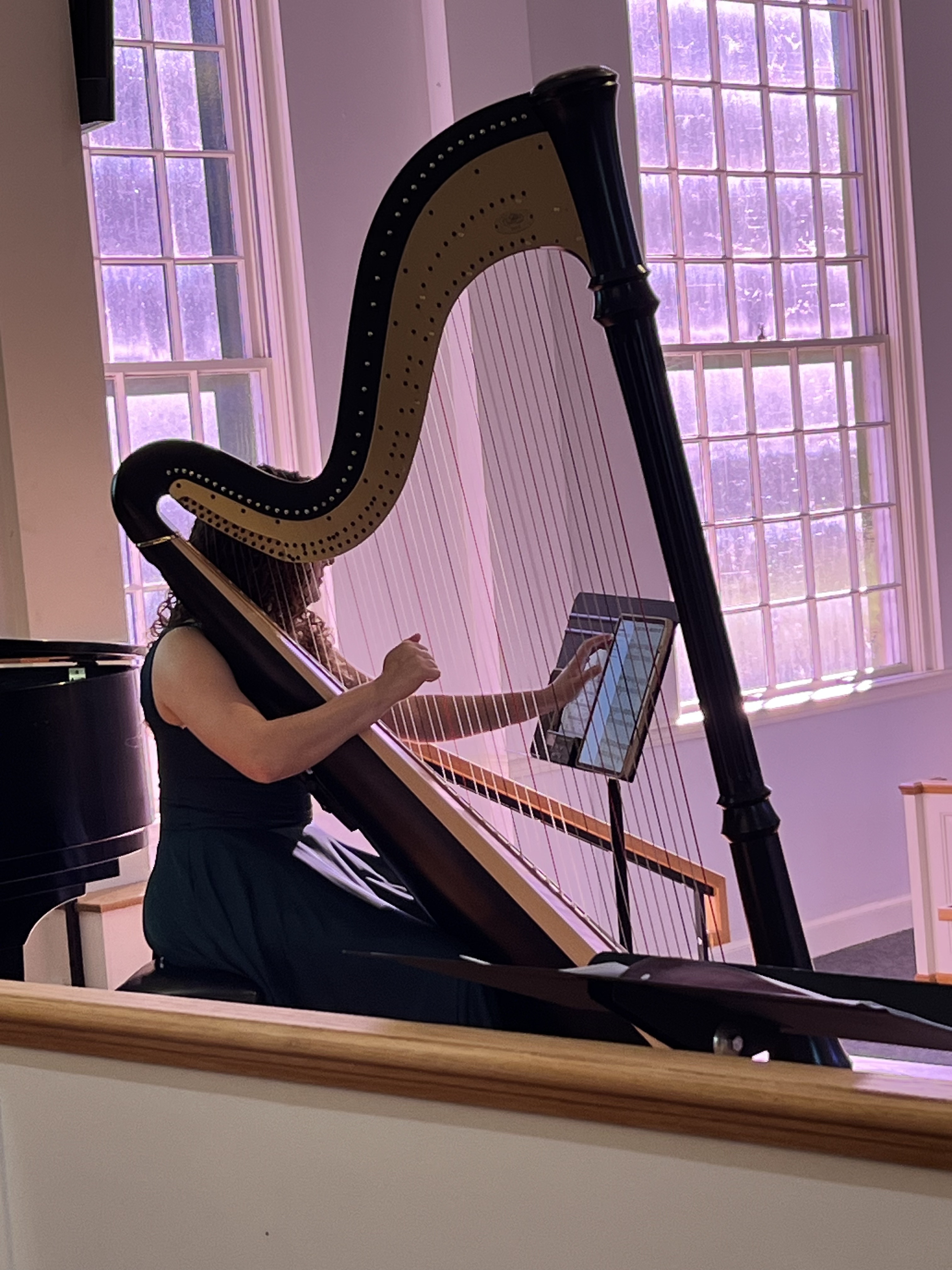
Korenna Hodge sat at her harp
and played “Breathe on Me, Breath of God,”
and “In the Garden,”
and at the end we sang
“All Are Welcome,”
and every note was distinct,
every word of the hymn
something I could carry home.
1 Corinthians 14 has a harp in it.
It has a bugle too,
and a stranger at the door.
Pursue love
and strive for the spiritual gifts,
and especially that you may prophesy.
For those who speak in a tongue
do not speak to other people but to God;
for nobody understands them,
since they are speaking mysteries in the Spirit.
On the other hand, those who prophesy
speak to other people
for their upbuilding and encouragement and consolation.
Pursue love.
The chapter begins
where the last one ended.
Love first.
Then the gifts.
Every gift measured
by whether it builds up the other.
Upbuilding, encouragement, consolation.
Three things a sermon is for.
I wish I had written them
on a card taped to the pulpit,
these forty years.
Not to impress.
Not to win the argument.
To build up.
To encourage.
To console.
Those who speak in a tongue build up themselves,
but those who prophesy build up the church.
Now I would like all of you to speak in tongues,
but even more to prophesy.
Here it must be said plainly:
Paul does not despise the gift of tongues.
He speaks in tongues himself.
I have Pentecostal friends,
and brothers and sisters from the holiness churches,
whose prayer rises in sounds I do not understand,
and I have felt the Spirit
in the room when they prayed.
Paul’s concern is not the gift.
It is the gathering.
Who is built up
when the church comes together?
Now, brothers and sisters,
if I come to you speaking in tongues,
how will I benefit you
unless I speak to you in some revelation or knowledge
or prophecy or teaching?
It is the same way with lifeless instruments
that produce sound, such as the flute or the harp.
If they do not give distinct notes,
how will anyone know what is being played?
And if the bugle gives an indistinct sound,
who will get ready for battle?
So with yourselves;
if in a tongue you utter speech that is not intelligible,
how will anyone know what is being said?
For you will be speaking into the air.
The flute or the harp.
A harp with every string loose,
plucked and plucked,
a blur of sound,
no melody anyone could sing.
And a bugle in the dawn camp,
blowing something no soldier recognizes,
so no one rises.
Speaking into the air.
I remember, by way of reflection,
the sermons I preached into the air,
long words from seminary,
Barth and Tillich and Moltmann,
to farmers and nurses and schoolteachers
who had come on a Sunday morning
needing bread.
I gave them a bugle
with no clear call.
They were patient with me.
They were kinder than my sermons.
There are doubtless many different kinds of sounds in the world,
and nothing is without sound.
If then I do not know the meaning of a sound,
I will be a foreigner to the speaker
and the speaker a foreigner to me.
A foreigner to the speaker.
These are the words I take from 1 Corinthians 14.
I know what it is
to be the foreigner.
I crossed the sea long ago
and stood in rooms
where the words went past me
like birds I could not name.
And I know what it is
to be the speaker who is foreign,
preaching in a second language,
my accent in every vowel,
watching faces strain
to follow me.
Every Sunday for years
I prayed,
Lord, let them understand me.
Let the gospel get through
the strangeness of my tongue.
On Saturday the seventeenth,
in Rome, Georgia,
Deaf Christians gathered at a Baptist church
for a day of worship and training,
and a woman named Tarter,
who is Deafblind,
said,
access is key,
if you don’t have access to the information,
it doesn’t matter what information you’re trying to share,
you’re missing it.
And a young Deaf worship leader
taught how to interpret songs
not only with the hands
but with the face,
the body,
the rhythm,
for those who cannot hear the music
and know it by lyrics, beats, and vibration.
Access is key.
Paul would have said it the same way.
If they cannot receive it,
it is speaking into the air.
And far away, this year,
twenty-eight complete Bibles were launched,
the whole Scripture now
in more than eight hundred languages,
among them the Marakwet people of Kenya.
I think of an old woman in a Kenyan village
hearing the psalms for the first time
in the language her mother sang to her,
no longer a foreigner
to the Word.
So with yourselves;
since you are eager for spiritual gifts,
strive to excel in them
for building up the church.
Therefore, one who speaks in a tongue
should pray for the power to interpret.
For if I pray in a tongue,
my spirit prays but my mind is unproductive.
What should I do then?
I will pray with the spirit,
but I will pray with the mind also;
I will sing praise with the spirit,
but I will sing praise with the mind also.
Otherwise, if you say a blessing with the spirit,
how can anyone in the position of an outsider
add their yes to your thanksgiving,
since the outsider does not know what you are saying?
With the spirit and with the mind also.
I remember, by way of reflection,
the Methodist way I was taught,
the warmed heart and the trained mind,
John Wesley at Aldersgate,
his heart strangely warmed,
and the same Wesley
reading Greek on horseback.
Not one or the other.
Both.
The spirit that sings
and the mind that understands what it sings.
The outsider.
Paul keeps the stranger in view,
the one at the back,
the one who wandered in,
who does not know when to stand,
who cannot find the hymn number.
Can they say yes to our thanksgiving?
Can they follow the prayer?
Worship is not a private room
for those who already know the words.
I thank God that I speak in tongues
more than all of you;
nevertheless, in church
I would rather speak five words with my mind,
in order to instruct others also,
than ten thousand words in a tongue.
Five words with my mind.
This is the verse I keep turning over.
Five words.
God is with you.
You are not alone.
Your sins are forgiven.
Come, eat, there is room.
I could have preached forty years
on five words,
and perhaps I did,
under the ten thousand.
At seventy-seven
my sentences grow longer,
I lose the long word
somewhere on its way to my mouth.
And I find I do not mind.
Five words, understood,
are worth more
than a library of brilliance.
These poems I write now,
short lines,
plain words,
are my five words
offered at the end.
Brothers and sisters,
do not be children in your thinking;
rather, be infants in evil,
but in thinking be adults.
In the law it is written,
By people of strange tongues
and by the lips of foreigners
I will speak to this people;
yet even then they will not listen to me,
says the Lord.
In the law it is written.
Paul turns again
to Israel’s Scripture,
to Isaiah,
the prophet who knew
that God speaks even through foreign lips.
Here it must be said plainly:
Paul does not turn this word against his people.
He turns it toward the Corinthians,
toward the church,
toward me.
The danger of not listening
belongs to all of us.
Tongues, then, are a sign
not for believers but for unbelievers,
while prophecy is not for unbelievers but for believers.
If, therefore, the whole church comes together
and all speak in tongues,
and outsiders or unbelievers enter,
will they not say that you are out of your mind?
But if all prophesy,
an unbeliever or outsider who enters
is reproved by all and called to account by all.
After the secrets of the unbeliever’s heart are disclosed,
that person will bow down before God and worship him,
declaring, God is really among you.
God is really among you.
I remember, by way of reflection,
the prophet’s vision
of nations coming to Israel,
saying,
God is with you alone.
And the stranger in Corinth
saying the same
about a little house church of slaves and merchants.
The highest praise a church can receive
is not, what fine music,
or, what a fine building,
but,
God is really among you.
The secrets of the heart disclosed.
Not exposed for shame.
Disclosed for healing.
I have seen it,
a visitor weeping in the back pew
because a plain word
touched the place no one had touched,
and afterward saying at the door,
how did you know?
I did not know.
The Spirit knew.
What should be done then, my friends?
When you come together,
each one has a hymn, a lesson, a revelation,
a tongue, or an interpretation.
Let all things be done for building up.
If anyone speaks in a tongue,
let there be only two or at most three,
and each in turn;
and let one interpret.
But if there is no one to interpret,
let them be silent in church
and speak to themselves and to God.
Let two or three prophets speak,
and let the others weigh what is said.
If a revelation is made to someone else sitting nearby,
let the first person be silent.
For you can all prophesy one by one,
so that all may learn and all be encouraged.
And the spirits of prophets are subject to the prophets,
for God is a God not of disorder but of peace.
Each one has a hymn.
Each one.
Not only the pastor.
Not only the choir.
A church where every person
brings something,
a hymn, a lesson, a word,
and the others weigh it,
and wait their turn,
and let another speak.
I think of all the Sunday mornings
when I did most of the talking.
Each one has a hymn.
I should have listened more.
Let the first person be silent.
A holy courtesy.
When someone else has a word,
sit down.
Even the prophet stops talking
when another rises.
I am learning this too,
at the church supper,
at the family table,
in old age.
Let the first person be silent.
God is a God not of disorder but of peace.
Shalom.
Not the peace of a quiet room
where no one dares to speak.
The peace of a harp in tune,
every string distinct,
every voice heard,
each in turn,
making one music.
As in all the churches of the saints,
women should be silent in the churches.
For they are not permitted to speak,
but should be subordinate, as the law also says.
If there is anything they desire to know,
let them ask their husbands at home.
For it is shameful for a woman to speak in church.
Or did the word of God originate with you?
Or are you the only ones it has reached?
Here it must be said plainly:
these lines have silenced women
for nearly two thousand years.
They have kept gifted women from pulpits,
kept their voices out of councils,
kept their wisdom at home.
And these lines sit uneasily
beside the same letter,
where Paul assumes
that women pray and prophesy aloud
in the gathered church.
Some ancient manuscripts
place these verses in a different spot,
and many faithful scholars
wonder whether they were added later,
or whether Paul was quoting
the Corinthians’ own words
in order to answer them.
I do not know.
I know only in part.
But I know this.
I have heard the word of God
from women in the pulpit,
clear as a harp,
building up,
encouraging,
consoling.
My own church, long ago,
opened its pulpits to women,
and the Spirit did not leave the room.
Did the word of God originate with you?
No.
It has reached the daughters too.
It always has.
Miriam with her tambourine.
Deborah under the palm.
Huldah reading the scroll for the king.
Mary Magdalene in the garden, saying,
I have seen the Lord.
Anyone who claims to be a prophet,
or to have spiritual powers,
must acknowledge that what I am writing to you
is a command of the Lord.
Anyone who does not recognize this
is not to be recognized.
So, my friends,
be eager to prophesy,
and do not forbid speaking in tongues;
but all things should be done decently and in order.
Decently and in order.
In my first years in this country
I thought those words meant
neat bulletins,
straight rows,
everyone seated by eleven o’clock.
Now I think they mean
something gentler.
Order for the sake of love.
Order so that the slow one can follow,
so that the stranger can say yes,
so that the Deaf worshiper can see the hands,
so that the shy voice gets its turn.
The order of a harp,
tuned so the music can be heard.
And God whispered: Begin.
Not once, but every morning.
Every time I choose five clear words
over ten thousand clever ones.
Every time I pray with the spirit
and with the mind also.
Every time I keep the stranger in view.
Every time I sit down
and let another speak.
Every time I hear the word of God
in a woman’s voice
and give thanks.
Every heart that rises after saying,
I cannot,
and then, after one long breath,
Perhaps I can.
This is Corinthians in the language of my soul:
love first,
then every gift for building up,
clear notes on a tuned harp,
each one with a hymn,
and a stranger at the door who says,
God is really among you.
To pursue love.
To speak five words with my mind.
To keep the stranger in view.
To let another speak.
To make peace, not disorder.
The window is filling with light.
In the next room
my wife is humming a hymn,
not loudly,
just enough to carry,
“Breathe on Me, Breath of God,”
the one the harp played last Sunday.
I know the tune
before I know the words,
and then I know the words,
and I hum along,
off-key, an old man’s voice,
and the two of us,
in separate rooms,
make one plain music
in the morning house.
God of peace and not disorder, thank You for every clear word that reached me, in my mother tongue and in the language I learned across the sea.
Teach me to speak five words that build up rather than ten thousand that only sound wise, and to keep the stranger and the Deaf and the slow always in view.
Forgive the church for silencing the daughters You have called, and let every voice You give be heard.
Tune us like a harp, each string distinct, so that whoever enters may say, God is really among you.


You must be logged in to post a comment.