We walk slowly down the hill
into the hush of Panther Creek.
Oliver, the barred owl,
keeps his feathered silence
somewhere in the oaks.
Again the sun rises
and sets at Buzzard’s Roost
without us.
Light leaves
the way old friends leave,
quietly,
before we turn to look.
*
So we listen.
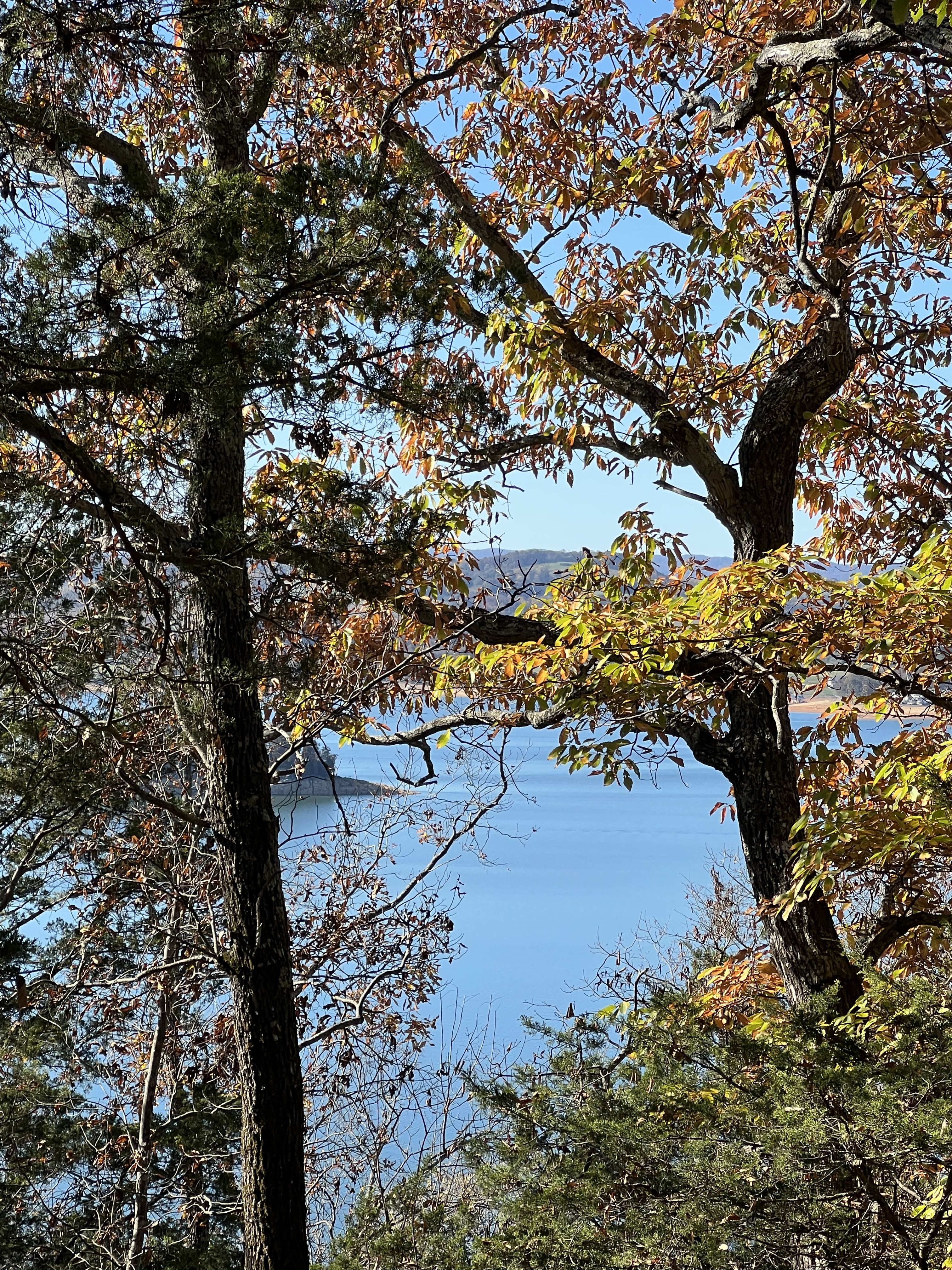
High above Cherokee Lake
two woodpeckers knock
on the door of the morning,
one answering the other,
a duet carved
into living wood.
Below them,
a dried line runs
all along the shore,
the mark of where
the water used to be.
Each season
it sinks lower,
the lake drawing down
into itself,
as if searching
for the floor of hope,
for the last
bare measure
of enough to live.
*
Then a message
crosses the sea to find me.
Half a century
since seminary.
A classmate,
now a retired bishop.
His words fall
like a stone into still water.
I watch the circles widen
across the shrinking lake
until they reach
the shore of my heart.
*
A small seed of worry
roots in the dark.
Leaders who love
power and gold.
A story of history
bent to fit a crown.
A king said to drink
until four in the morning.
Streets said to lie
in drunken quiet.
A people said
to welcome a stranger’s rule.
It is a lie.
The wound was real.
The grief was real.
Memory is not a coin
to be stamped
with someone else’s face.
*
How can shepherds
lead a flock
by such a crooked lamp?
The path bends
where the light bends.
And the sheep
cannot see
who has turned it.
*
Fifty years ago
I left my home.
Tonight
the ocean lies between us
like a dark field
no plow can cross.
I weep
for the land I lost,
the mountains that raised me,
the rivers that still
speak my mother’s tongue.
*
Yet one thin thread remains,
fine as the light
under a closing door,
fine as the dark line
the water left behind,
still marking
how high it once rose.
Lord, have mercy.
Lift a new sun
over a divided land.
Let North and South
remember they were once
one breath,
one table,
one name, for thousand years.
Let the small flame of peace
in Northeast Asia
lean but not go out,
sheltered by hands
on every shore.
*
Lord, have mercy on us.
The owl is still hidden.
The lake is low and dark.
The woodpeckers sleep
in their hollow trees.
Comfort my soul tonight.
Fill again
what has been drawn down,
the lake,
the land,
this aging heart.
Let the wound
lie down beside Your mercy,
as I lie down
in the quiet woods of my years,
and let me sleep
in peace.
——-
(I received the following statement from Korea from a seminary colleague. Reading it deeply wounded my heart, and I grieve over it because this statement is, in my conviction, a complete falsehood and pure distortion on currtain political purpose. Also the present government and the president are most honest and hardworking for people and the nation ever in the recent Korean history.)
—
The Day Joseon Fell, No One Wept
If that time were now, what would your choice be?
On August 29, 1910, the day of the so-called “National Humiliation of Gyeongsul,” Emperor Sunjong issued an imperial proclamation:
“Our weakness has accumulated, and our exhaustion has reached such an extreme that there is no prospect whatsoever of recovery. Therefore, I intend to entrust the great responsibility to Japan. I ask my subjects not to cause needless disturbances, but to comply.”
*
The country had fallen. Did people everywhere pour into the streets, weeping and wailing?
No.
Immediately after the announcement of the annexation of Korea by Japan, the streets of Jongno were strangely peaceful.
This is what foreign reports conveyed.
What was Emperor Sunjong saying?
“Was he not saying, ‘The country is weak and exhausted beyond recovery, so I will entrust it to Japan. Keep your mouths shut’?”
◇
Choe Rin, one of the 33 representatives involved in the March 1st Declaration of Independence, later recalled:
“That day on the streets of Jongno, Koreans went about as though nothing had happened, bustling about, doing business, eating, and drinking as usual.”
Chinese intellectual Liang Qichao wrote in an essay titled The Causes of Korea’s Ruin:
“When the annexation treaty was announced, people in neighboring countries grieved for Korea, yet Koreans drank, made merry, and appeared content. High-ranking officials lobbied the Japanese in pursuit of advancement, busily enjoying themselves as they sought positions under the new regime.”
According to Japan’s Annexation of Korea, Japan had originally decided to announce the annexation on the 25th. However, the Korean Empire’s government supposedly pleaded that the announcement be made on the day commemorating the fourth anniversary of Sunjong’s accession, and Japan agreed.
*
The royal family of this country, which we are taught was invaded and forcibly occupied by Japan through military force, supposedly went so far as to coordinate the date of annexation with a day carrying nearly the significance of a national holiday, holding parties to celebrate and enjoying toasts with those responsible for the takeover.
For those of us who learned about the sorrow of losing the country through terms such as “the National Humiliation of Gyeongsul” and “forced annexation,” this seems utterly unfamiliar.
◇
Liang Qichao’s Theory on the Causes of Korea’s National Ruin contains many painful criticisms.
His contention was:
“The cause of the country’s ruin was neither China, Russia, nor Japan. Korea destroyed itself.”
*
The problem, he argued, was not only the “incompetence and corruption of the ruling class,” including the Joseon royal family, but also the “national character” itself.
Koreans supposedly had a disposition toward relying on others rather than achieving independence, and the so-called reform factions competed to bring Japanese power, including Japanese troops, into the country. This was attributed to the bad habit of attaching oneself to a more capable nation.
The royal consorts did not have enough time to learn Japanese, while the ordinary people, already plunged into misery, supposedly attached no more significance to the country’s demise than they would have to a change of dynasty.
◇
Isabella Bird Bishop, a geographer associated with Britain’s Royal Geographical Society, traveled through and reported on Korea between 1894 and 1897. She left an account to this effect:
“Most commoners bore heavy taxes, while the yangban ruthlessly exploited them under the pretext of collecting rent.If word spread that a merchant or farmer had obtained money, a yangban would fabricate a debt and pressure him to repay it. One method favored by the yangban was falsely insisting that they had lent the person money.It was commonplace for yangban to buy commoners’ houses or farmland without paying for them.”
◇
At the time Korea was annexed by Japan, not one of the great powers sympathized with Korea. Rather, they supposedly regarded the development as long overdue.
As uprisings frequently broke out throughout the country during the final years of the Korean Empire, the Joseon royal court, unable to suppress them, brought in Japanese troops and entrusted them with putting down the disturbances.
At that time, the Korean military had completely lost its effectiveness.
—
Let us briefly look at records from the period.
“The political disorder of the old Korean state had already reached its extreme, and bands of brigands were extremely numerous. Among them, armed bandits carried firearms, formed groups, roamed throughout the country, and engaged in plunder, but the authorities were unable to eliminate them. The weapons of the army were hardly different from those possessed by the bandits, and local ruffians merely entered government service in order to obtain food and clothing. Instead, they used their weapons to seize property and mistreat women, becoming parasites who sucked the lifeblood of innocent people.Government troops largely became the hands and feet of powerful men and corrupt officials and openly engaged in slander and intrigue, while Confucian scholars distorted scholarship to flatter those in power and pursued only their own interests. During the final years of Joseon, the entire country was ravaged, and hardly a day passed without disputes and disturbances erupting somewhere.”
—
But what sort of person was Gojong?
Hwang Hyeon wrote in Maecheon Yarok:
“Gojong kept the lamps brightly lit and amused himself until dawn. Only around four to seven in the morning did he finally go to sleep, rising at around three or four in the afternoon. Gojong and Queen Min were obsessed with parties, spending day after day holding celebrations until dawn, eating and drinking. When the royal private treasury ran dry, they became frantic about replenishing it. Selling government offices was not enough; eventually even the rights connected with the minting of nickel coins were recklessly sold, causing the value of Korea’s currency to collapse.”
*
Let us look briefly at another account.
The National Institute of Korean History writes in Gojong’s Banquets and Amusements:
“Gojong enjoyed amusement, and after assuming power he held banquets every night and lived a dissolute life. Entertainers and shamans sang and strutted about.The palace was illuminated as brightly as daylight, and the festivities continued until dawn. Around four to seven in the morning, curtains were drawn and he lay down on the royal seat to sleep, rising at around three or four in the afternoon. Because this happened every day, the young crown prince became so accustomed to it that when sunlight shone through the window, he thought it meant it was time to sleep.”
—
“A country that deserved to fall!”
Discipline among government officials had collapsed.
Now then…
Would it not actually have been stranger if a country like this had not fallen?
Corrupt officials ran rampant. As the country reached this condition, Confucian scholars arose throughout the land, claiming that they would save the rotten institutions of the dynasty. Thus emerged the so-called righteous armies.
We were taught in history that these Confucian scholars engaged in righteous resistance.
*
But suppose their hopes had been fulfilled, the country had not collapsed, and Joseon had continued to exist. What would life have been like for the great majority of its people?
International affairs were dominated by imperialism, in an age in which the strong preyed upon the weak. Was it not perfectly natural for an antiquated country unable to adapt to those circumstances to collapse?
Are we perhaps outraged simply because the country responsible was Japan?
Yes.
Joseon was bound to fall.
No, it was a country that deserved to fall.
—
But what about our country today?
Some say that the present situation resembles Korea immediately before the Japanese invasions of 1592, and perhaps that is not such an unreasonable conjecture.
I feel that the confusion present at the fall of Joseon is being reproduced today.
—
Why?
The government is preoccupied with borrowing money and spending recklessly.
What about the military?
If war broke out, would it really be able to fight properly?
Developments in the surrounding region are by no means moving in our country’s favor, and our ally, the United States, distrusts us.
From the President to the members of the National Assembly, all those who wield political power are facing doubts about their legitimacy.
The ruling party arrogantly engages in factional politics among its own people.
Public sentiment has already turned away from such groups, and explosive resentment approaching the level of resistance is building like magma.
At a time when survival amid rapidly changing circumstances would be difficult even if we were united, the country is being torn into pieces, while businesses are following their own paths in an effort to survive.
—
We must change!
We must replace the corrupt and incompetent political establishment.
Recovery is impossible without major surgery to decisively remove the cancerous elements within society.
How hard-won was this country, and yet how did we come to this?
—
The people must awaken.
We cannot live by simply saying, “As long as everything seems fine, it is fine,” or believing that we should simply enjoy the present.
Why?
Because this is a precious country in which our descendants must live.
Should we not awaken to the present national situation, rise up, and set the country on the right path?
Is that not our calling in this age?
“Do you not think that the conditions of the state and society at the time the Joseon Dynasty collapsed are coming to resemble what we see in the Republic of Korea today? I hope you will take some time to reflect deeply on this.”


You must be logged in to post a comment.