The Church in a Multicultural Context, Developmental Pastoral Competency for Transforming Praxis, (Chapter 10) New York 1995

Chapter 10: Developmental Pastoral Competency for Transforming Praxis

Based on the theoretical analysis of the research questions examined thus far, the study group proposed a pastoral experiment focused on humanizing ministry through the Korean-American Women’s United Mission, as a way to practice transforming praxis for the purpose of church formation. Through this biblically grounded transforming praxis aimed at ecclesiogenesis, it is hoped that all forms of alienation caused by discrimination may be transformed into peace. It also aims to bring liberation to women in intercultural families who suffer the unbearable burden of racial and gender-based discrimination and dehumanization.

The initial subject of this experimental pastoral ministry was the Embury Korean congregation, and since October 1993. From the beginning until the present, the Korean-American Women’s United Mission, which was born as a result of this experimental ministry, has naturally become a central participant. Furthermore, the intercultural families living in and around New York City are also included in the scope of this study. Even before the proposal of this thesis was accepted in October 1991, the Korean-American Women’s United Mission had already been founded on August 23, 1991, through the author’s vision of generative ministry (saengseong sa-yeok, 생성사역). As mentioned in the introduction, a simplified but intentional process of conscientization, humanization, and generation was conducted to receive approval from the members of Embury Church.

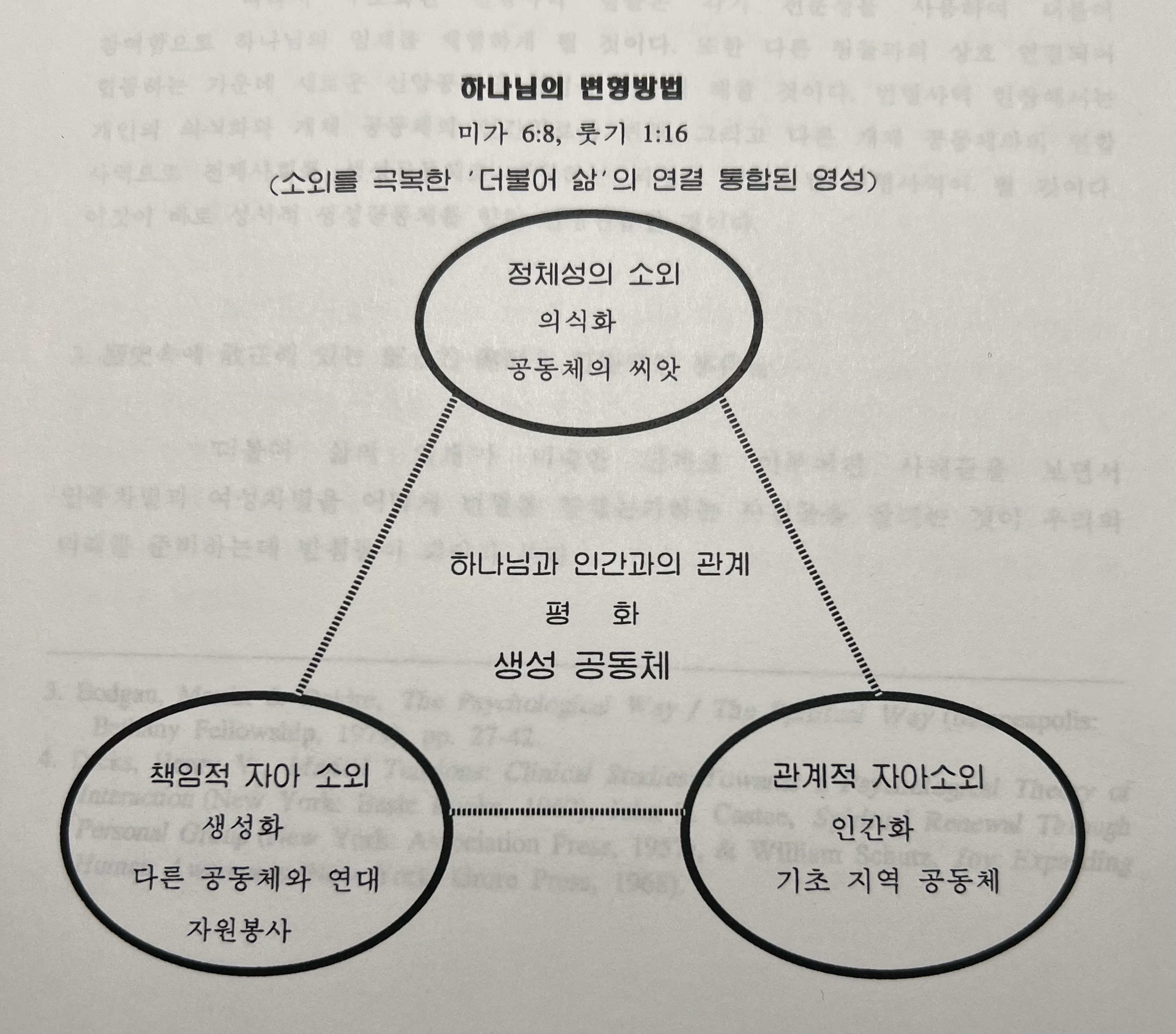
The first phase of this process is conscientization—a healing journey where individuals reclaim their identity. Once the conscientized individual rediscovers the possibility of dialogue, the restoration of a relational self within the framework of equality becomes the foundation for the church’s authentic identity to emerge—this is the generative process. When relationships are formed as a basic community, the church moves to the third phase, where it voluntarily engages in service to recover the responsible self. This is the priestly image of a chosen people sent into the world. At this point, the church truly becomes a missional church—a space where individuals can find the foundation for their identity and calling.

Summary of the Goals, Implementation Strategies, and Evaluations of This Experimental Ministry

1. Goal of Transformation

To implement these goals, an Integral Spirituality Workshop was established within the Korean-American Women’s United Mission (KAWUM), offering annual training sessions to fulfill each objective.


1) Transforming Practice for Identity Formation

Disintegration within families caused by alienation and inner division can begin to be healed by recovering the lost self. For this purpose, the Integral Spirituality Workshop offers a basic spiritual training course for personal healing once a year. The training is conducted in a three-day retreat format, including psychological assessments, counseling, lectures, Bible study, and worship. Tools and materials used—drawn from the author’s own training and described further in the section on pastoral competency development—include:

  • (1) MMPI-2 (Minnesota Multiphasic Personality Inventory)
  • (2) MBTI (Myers-Briggs Type Indicator)
  • (3) Lecture on Self-Discovery I (Homecoming)
  • (4) Focusing – for anger treatment
  • (5) Lecture on Self-Discovery II (Enneagram)
  • (6) Experiencing God – Rainbow Meditation
  • (7) Breathing and Fasting (brief sessions before gatherings)

2) Transforming Practice for Relational Self Formation

Family conflicts and high divorce rates are common issues in immigrant communities. Improving spousal relationships is essential for building healthy families and, by extension, a healthy church. The formation of the relational self within the family lays the groundwork for authentic ecclesial identity and readiness for mission.

Domestic violence was identified as one of the most serious relational issues in immigrant life. In response, the study group established a project for abused women as part of the second phase of training in the Integral Spirituality Workshop II-1. This training aims at humanization through relational improvement. Couples who complete this program can become effective missionaries against domestic violence. This training is also conducted annually in a retreat format, similar to Phase 1. Tools used include:

  • (1) Conflict Inventory & Self/Partner Knowledge Inventory
  • (2) FIRO-B & FIRO-F (interpersonal needs assessments)
  • (3) Relationship Therapy
  • (4) Getting to Yes (negotiation strategy)
  • (5) Six Thinking Hats (creative problem-solving)

After completing the Phase 2 couples’ training, couples may—after applying what they’ve learned for about three months (but within ten months)—participate in a family spirituality training session with their children. This session addresses issues between parents and children and is also offered once every two years in retreat format. Participation requires both parents and children to attend together. Tools include:

  • (1) Music therapy
  • (2) Healing through self-created skits
  • (3) Joint lectures for parents and children
  • (4) Separate lectures for parents and children
  • (5) Movement therapy

Graduates from this program can then join the team working in domestic violence prevention.


3) Transforming Practice for the Responsible Self

Once couples and families have completed the above training and have participated in domestic violence prevention efforts, they may move on to the third phase: life-practice training, which focuses on recovering the responsible self. This phase represents the ultimate stage of liberation from alienation and serves as an active, preventative strategy against social darkness.

This phase is lived out through voluntary suffering, in which participants form life-giving base communities within society. A key training context is the ministry to marginalized sex workers in immigrant communities. Practical training for transforming praxis is conducted through such outreach. Tools used include:

  • (1) Networking: organizing support circles among sex workers and volunteers
  • (2) Voluntary Suffering:
      - Prison visitation (Bible study, worship, counseling for those on probation)
      - Support for probationers (shelter, vocational/faith education, participation in renovation or construction projects, interpersonal healing, counseling, and spiritual formation)
      - Fundraising campaigns

2. Implementation Strategies for Achieving the Goals

1) Implementation Strategy Plan for Achieving Transformational Goals

(1) Transforming Practice for Identity Formation

Basic Course (Individual Workshop)
Integral Spirituality Workshop (I)

  • First Session Held: July 18–20, 1994 (conducted as a summer camp for intercultural families)
  • Target Participants:
     1. Anyone aged 18 and older may participate.
     2. After completing the basic training, participants are encouraged to choose the intermediate course after practicing for 3 months and within no more than 8 months.
  • Group Size: Designed for 20–40 participants (35 attended the first session).
  • Frequency: Begins each year in May and is offered once every 3 months.
  • Duration: Thursday to Saturday (3 days)
  • Location: Rotates regionally (e.g., Wisdom House in Connecticut)
  • Facility: Held at a retreat center or hotel (e.g., Catholic convent)

Celebrating Life

<Personal Training Schedule>

TimeDay 1Day 2Day 3
8:00 AMRegistration & BreakfastBreakfastBreakfast
8:30 AMRoom Assignment
9:00 AM(1) Mental Assessment(6) Self-Discovery I-3(9) Self-Discovery II-1
(2) Personality Test
10:15 AMBreakBreakBreak
10:30 AM(7) Focusing(10) Self-Discovery II-2
12:00 PMLunchLunchLunch
1:30 PM(3) Self-Discovery I-1(5) Personal Counseling
3:00 PMBreakBreakBreak
3:30 PM(4) Self-Discovery I-2(5) Personal Counseling
6:00 PMDinnerDinnerDinner
7:30 PM(5) Personal Counseling(8) Experience & Healing
10:00 PMSleepSleepSleep

(2) Transforming Practice for Relational Self

The church, when individuals find their true identity in God, naturally becomes a community of relational selves, as God is relational. Therefore, the church is not about events but about people. In other words, the church is the place of the cross, where relationships between God and humans are formed. The church can be understood as a collective identity.

Then, as an extended family, what can the church do today to counteract gender discrimination? Training in living together toward wholeness of life is essential. In response to dehumanizing alienation that disrupts communal living, this project aims to support women who suffer from domestic violence through the Korean-American Women’s Mission Fellowship. This project presents a policy alternative for healing and restoring the relational self.

<1> Problem Analysis

Wife battering most frequently begins within the first two years of marriage, and the rate decreases as the marriage continues. However, more women who were physically abused before marriage experience abuse than those who begin experiencing abuse ten years after marriage. This suggests that early tolerance or initiation of abuse is related to frequent, repeated violence.

From the perspective of the abused, initial tolerance of violence often leads to long-term, habitual victimization. For the abuser, failure to control the first act of violence often results in entrenched behavior that becomes increasingly difficult to heal or correct.

Commonly cited reasons for abuse—based on client reports—include violent temperament, alcohol dependence, extreme jealousy, and infidelity. While abusers may cite one of these as a justification, in reality, the underlying causes are often complex and interrelated: violent temperament combined with alcohol dependence, financial issues with inferiority complex, premarital sexual relations with jealousy, dissatisfaction with sexual life along with infidelity—all can lead to violence.

Such complex motives often lead to habitual wife abuse. While most violence is carried out by hand or foot, some cases involve weapons, burns from cigarettes, or stripping and beating—severe forms that often cause major injuries or trauma. Mental illness was reported in 62 cases, revealing the severity and brutality of domestic violence.

In many cases, even after severely harming their wives, abusers show no remorse—instead, they reoffend, confine, or expel their wives with shameless attitudes.

In such situations, abused wives often either endure silently, run away, or simply apologize to avoid further harm. Many feel helpless. Moreover, men who abuse their wives often also abuse their children. These consequences can severely damage not only individual families but also the growth and health of the Korean-American community.

<2> Policy Alternatives

• Public Awareness Campaigns (To be maintained throughout the initial 5-year plan)

Efforts must be made to eliminate gender-based discrimination. This must be a community-driven project, not the task of a single individual. It must be made clear that traditional gender role teachings have enabled the conditions for abuse.

  • Promote gender equality through books, newspapers, and broadcast media.
  • Ban media content that glorifies or encourages violence.
  • Create a cultural norm within the Korean-American community that violence is never acceptable under any circumstances.
  • Corporal punishment of children must not be justified.
  • Raise awareness about the ignorance surrounding wife abuse and correct these misunderstandings.
  • Widely educate the public about the seriousness of domestic and child abuse and provide clear guidance on protective measures:
     (First, call 911. After receiving a “complaint” number from the police, if personal safety remains at risk, go to the county family court where a judge can issue an Order of Protection. This legally prohibits the abuser from approaching the victim. If violated, police may arrest the abuser. This is grounds for divorce.)

• Community-Based Actions (To be implemented within the first year of the 5-year plan)

Phase 1 – What Local Community Institutions Must Do:

  1. Although general protective laws for abused women exist, legal safeguards tailored to Korean women’s unique circumstances must be developed. This includes Korean-language hotlines and legal follow-up, even under sexual harassment laws.
  2. Organizations advocating for women’s rights and human rights must be activated. Many such organizations must emerge within the Korean community to raise awareness, provide counseling, and push for institutional change.
  3. Early identification, prompt support from hospitals and counseling centers, connections with police, and swift legal aid from attorneys are all essential.
  4. Thorough education for staff in counseling centers and hospitals must be implemented. The community must not conceal these issues but bring them to light and raise public awareness.

Phase 2 – Early Detection and Early Intervention

Early Detection

  • Community members
  • Police stations
  • Hospital emergency rooms
  • Orthopedic clinics
  • Schools
  • Churches
  • Other public gathering places
  • Counseling centers (e.g., Women’s Helpline, Family Counseling Centers, Legal Counseling Centers, Child Counseling Centers, Youth Centers, Health Counseling Centers, Human Rights Counseling Centers, etc.)

Early Intervention

  1. Crisis Intervention and Protection:
    Upon discovery, the abuser must be reported to the police and arrested or restrained. The violence must be stopped immediately, and the victim should be evacuated from the scene. It would be helpful to establish emergency shelters in each county.
  2. Emergency Medical Treatment for Victims:
    Since abuse often leads to fractures, concussions, eye injuries, and miscarriages, emergency treatment is necessary. Psychiatric symptoms may also be present, so it is necessary to designate hospitals capable of treating abused wives with federal or New York State approval. Alternatively, victims should be referred to county psychiatrists, state mental hospitals, or community-based mental health clinics for outpatient treatment.
  3. Mental Health Facilities:
    Specialists with training in emotional and psychological recovery must be assigned to help victims regain self-esteem and overcome emotional and social isolation.
  4. Measures for the Abusive Husband:
    Psychiatric evaluations must be conducted for the abuser under legal authority. Treatment should aim to heal both the victim and the abuser to prevent further harm. If the entire family (children and parents) are victims, comprehensive family healing should occur in parallel.
  5. Cooperation with Related Organizations:
    • Religious Institutions:
      Spiritual healing methods should be explored through clergy members. Special ministries may be conducted through designated or specialized churches.
    • Emergency Shelters:
      Shelters with confidential phone numbers and addresses must be established for emergency evacuation. Victim locations must remain confidential for safety.

Phase 3 – Tertiary Prevention

Tertiary prevention involves ensuring that violence does not recur after early detection and treatment, and helping the victim establish an independent life apart from the abusive husband. In reality, first, second, and third-stage prevention must often proceed simultaneously for effectiveness.

To succeed in tertiary prevention, a strong and cooperative network is essential, including emergency shelters, counseling centers, job training centers, government offices, police stations, legal services, churches, addiction treatment centers, and medical institutions. Measures should be prepared both separately and jointly for the husband and for the wife and children.


<3> Healing Principles

Long-term treatment is required. Rebuilding independence takes time due to shattered self-esteem and chronic helplessness. Rushing treatment may lead to adverse effects such as suicide, homicide, or abandonment of treatment. If divorce is not an option, lifelong therapeutic support may be necessary.

The primary therapeutic goal is to rebuild the victim’s independence. Boosting self-esteem is key, and educational support on human rights, life’s meaning, and women’s rights should accompany it.

If the husband’s abuse results from a specific mental illness and that illness is successfully treated, divorce is not recommended. Instead, the wife should be educated about the nature of the illness, treatment, prevention, and home care.

If the abuse is due to a personality disorder without mental illness and continues, the wife should be helped to live independently, including divorce. In such cases, it is essential to arrange for legal protection in advance to restrain the husband’s violence.

Training should also be provided to help the woman recover or acquire economic and occupational functions. This is necessary before or after divorce, and even if she ends up living again with the abusive husband.

Before divorce, it is best if the wife can live separately from her husband. The longer this period, the more effective it is in rebuilding independence.

If the wife cannot divorce and must live with her husband, she must learn ways to avoid abuse. Even violent husbands have weaknesses. She should find methods to escape violence, such as threatening police reports, divorce, or hospitalization. However, these can sometimes provoke worse abuse. If the husband is drunk, verbal reasoning will not work—she must simply leave the scene carefully.

When abuse seems imminent, the wife might consider being hospitalized or escaping. Although avoidance is not always possible, it is important to seek the best methods to avoid violence.

Even after divorce, there is a risk of retaliation from the husband. The woman must maintain strong connections with legal and support agencies for protection.

Post-divorce, therapeutic help must continue. Emotional support is often needed to cope with despair, depression, and suicidal thoughts. Realistic support is also required for issues such as employment, child education, and social stigma toward divorced women.


Final Thoughts

Spousal abuse cannot be treated as merely a personal or family issue, nor can it be solved through isolated efforts. It must be addressed as a fundamental human rights issue at the community level. A united Korean-American community must actively and continuously work to prevent violence and protect the promise of a brighter future for the next generation.

< 4 > Conclusion

There must be continuous and fundamental healing efforts for abusive husbands, along with legal oversight functions to prevent the recurrence of violence. Women should not be subjected to unfair or one-sided rulings, so the monitoring role of women’s human rights organizations must be strengthened. The Korean-American Women’s United Mission is developing programs with the following focus areas to serve abused women and survivors of sexual violence.

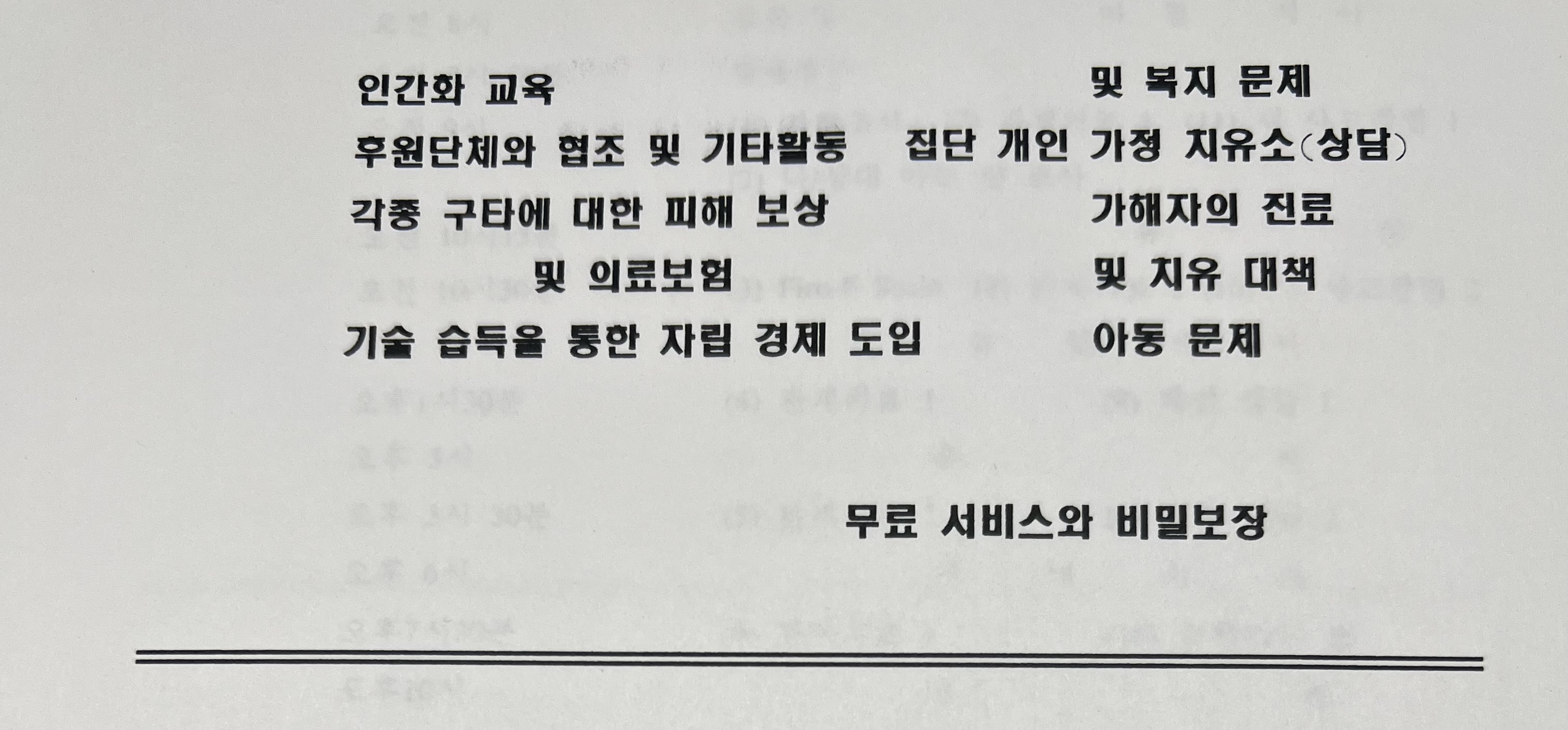
Service for Abused Women and Sexual Assault Survivors

  • Faith Education
  • Community Education & Early Detection
    (Family, School)
  • Early Intervention
  • Awareness Campaigns
    • Emergency Hotlines
    • Emergency Shelters
    • Advocacy and Companionship
  • Court Advocacy Design
  • Role of Research Departments and Hospitals
  • Legal Reform
  • Skills for Sustainable Living
  • Humanization Education and Welfare Issues
  • Collaboration with Support Organizations and Other Activities
  • Group, Individual, and Family Healing Centers (Counseling)
  • Compensation for Various Types of Abuse
    • Including Medical Insurance
    • Treatment and Healing Plans for Perpetrators
  • Economic Independence through Skill Acquisition
  • Children’s Issues
  • Free Services and Confidentiality Guarantee

Above all, the prevailing social norms must be transformed. It is our urgent task on earth to reform society so that all people may come to a proper understanding of true values and human rights, recover their authentic selves, and realize that genuine happiness lies in living together with true justice, mutual respect for one another’s dignity, and shared freedom.

< 5 > Relational Training

Beginner Course (Couples Workshop) – Integral Spirituality Workshop (II-1)

First Implementation Date:
Planned for the first time in June 1995.

Eligibility:

  1. Only those who have completed the basic training.
  2. After completing the basic training, participants are encouraged to practice for 3 months before selecting the intermediate course, preferably within 8 months.
  3. Married or engaged couples.

Group Size: Targeted for 10–20 couples.
Time: Begins every April, offered once every 3 months.
Duration: Thursday to Saturday (3 days)
Location: Rotates by region.
Facility: Held at a retreat center or hotel.


Corner Stone of Relationship (Relational Identity)

Couples Workshop Schedule

TimeDay 1Day 2Day 3
8:00 AMRegistration & BreakfastBreakfastBreakfast
8:30 AMRoom Assignment
9:00 AM(1) Conflict Survey(7) Relationship Therapy 4(11) New Way of Thinking 1
(2) Self/Partner Awareness
10:15 AMBreak
10:30 AM(3) Firo-F Scale(8) Relationship Therapy 5(12) New Way of Thinking 2
12:00 PMLunch
1:30 PM(4) Relationship Therapy 1(9) Individual Counseling 1
3:00 PMBreak
3:30 PM(5) Relationship Therapy 2(9) Individual Counseling 2
6:00 PMDinner
7:30 PM(6) Relationship Therapy 3(10) How to Receive Approval
10:00 PMSleep

Intermediate Course (Parent-Child, Family Workshop)
Integral Spirituality Workshop (II-2)

Eligibility:

  1. Only for couples and their children who have completed Intermediate Course II-1.
  2. After completing II-1, practice for 3 months and choose II-2 within 8 months.

Group Size: For up to 15 families.
First Implementation Date:
Planned for mid-August, following the June 1995 couples workshop.

Time: Begins every March, offered once every 3 months.
Duration: Thursday to Saturday (3 days)
Location: Rotates by region.
Facility: Held at a retreat center or hotel.


Corner Stone of Relationship (Relational Identity)

Parent-Child & Family Workshop Schedule

TimeDay 1Day 2Day 3
8:00 AMRegistration & BreakfastBreakfastBreakfast
8:30 AMRoom Assignment
9:00 AM(1) Orientation(7) Child Training(12) Child’s Self-Esteem
(2) Self-Assessment
10:15 AMBreak
10:30 AM(3) Stress Management(8) Child’s Social Behavior(13) Future Planning
12:00 PMLunch
1:30 PM(4) Parental Thoughts(9) Solving Relationship Problems
3:00 PMBreak
3:30 PM(5) Parental Work(10) Managing Anger
6:00 PMDinner
7:30 PM(6) Parental Supervision(11) Study Habits
10:00 PMSleep

(3) Responsible Self-Formation Praxis

The Church holds a responsible position in society. This reflects God’s choice of Israel to stand as a priest before the world. The relational self must now form a foundational community that reclaims the identity of a responsible self within society. When selves created in the image of God gather within the Church—the body of Christ—this assembly becomes a unified body through a likeness that reconnects with God. This body, in turn, must form life-giving relationships with various social groups. Unless it divides and shares itself like living cells, the foundational community hardens like spoiled milk and begins to resemble self-serving organizations, losing its function as an instrument of blessing to the world. It then forfeits its place among the chosen.

Thus, the Church’s identity as a responsible self is not merely a matter of choice but of blessing. Without such a formation process, the Church is no longer a priest to the world but degenerates into a secular interest group. Though its religious form may remain, the generation of life has ceased. The process of forming the Church as a responsible self is essentially the path of volunteer service. Volunteering itself is a form of integral spirituality, embodying the voluntary service Jesus Christ exemplified. This is how individuals, saved and freed through the Exodus, come together at the Cross for equal dialogue, form the body of Christ (communion), and carry out the Church’s active ministry in society, serving as life-giving yeast.

Yeast and seeds both symbolize self-giving for the resurrection of many lives. This is the fullness of God’s love and the fulfillment of God’s call to us.

As a Church moving toward eternity as a responsible self, this also entails a ministry of preventing community destruction. This is considered a crucial aspect of pastoral ministry. The following volunteer project is proposed to practice this type of generative community. One of the most marginalized communities in society is women involved in prostitution—perhaps the most difficult group to approach. This is not only a Korean issue but one increasingly visible in immigrant communities, including in areas like Manhattan. It represents the height of dehumanization. The commercialization of the sacred sexuality gifted by God is not only a tragedy but a manifestation of human sinfulness.

We must not scapegoat sex workers but rather, like Jesus, offer them living water, as He did to the woman at the well in Samaria. The dehumanization caused by prostitution is our collective problem and responsibility. It is precisely here that the Church’s life-generating mission becomes possible—bringing with it the blessing of integral spirituality, or eternal life.

Currently, there are no separate shelters, health clinics, or welfare centers specifically for sex workers in the Korean-American immigrant community. They rely on general homeless shelters and social welfare centers. The entire immigrant community must work toward deeper analysis, healing, and the formation of generative communities. A single sex worker is still our sister. Together, we must examine society’s unconscious biases and contradictions, diagnose the social pathologies, and jointly develop strategies of analysis and response. Healing must follow—treating root causes, providing medical care, and offering preventative education and faith-based restoration. Welfare systems should help rebuild lives and prevent recurrence through sustained research and intervention.

The goal is to raise individual awareness, humanize relationships, and train volunteers to engage in the healing of society. This is how we collectively move toward a future of healthy, generative communities.

Six reasons are identified for the past failures to address prostitution:

  1. No praxis of generative communities was attempted.
  2. Though missionary zeal and spiritual experiences existed, there was a lack of professional methods (in health, medical care, and education).
  3. Instead of comprehensive, long-term strategies, short-term programs were used.
  4. There was a lack of financial support and committed volunteers.
  5. Focus was on police arrests of women without addressing root causes.
  6. Most importantly, there was no theology of the Cross—no redemptive event that called for self-awareness and the transformation of alienation into communal life and volunteer service.

When over 300 Korean-American churches in New York and New Jersey unite in prayer, the immigrant community can reclaim the image of God in which it was created.


<1> The Problem

Among Asians already facing racial discrimination in the U.S., Korean women suffer dual discrimination. Those most burdened are women who came to America through interracial marriages and, after experiencing trauma and divorce, drift into massage parlors—estimated at over 60%. This reality demands the Church not fall into destruction like Sodom and Gomorrah, but rather become like Nineveh, repenting and being saved. A “Welfare Center for Sex Workers” should become a response to God’s call to overcome racial and gender discrimination.

Through this, the Church—constantly being renewed as the body of Christ—becomes the risen and eternal body of Christ in this world.


<2> A Comprehensive Welfare Center for Sex Workers

Existing mission centers offer:

  1. Psychological counseling
  2. Social welfare counseling
  3. Fellowship
  4. Worship and Bible study

Government-funded women’s centers provide benefits (including job and language training) when requested. However, sex workers often lack the self-awareness necessary to initiate change. Therefore, a Comprehensive Welfare Center for Korean-American Sex Workers is proposed:


Korean-American Women’s United Mission Comprehensive Welfare Center
(Departments and Services)

HealingSkills TrainingLife WelfarePrevention & AwarenessEducationResearch & Formation
Root Cause TreatmentBeautyEmploymentMaternal HealthBible StudySocial Pathology Research
Psychological CounselingSewingSelf-EmploymentSex EducationWorshipSeminars/Workshops
Mental TherapyBeautySide JobsHealth EducationGeneral EducationCollaborations, Adoptions
ComputerCommunity MarketplacePlanning & EvaluationLegislative Proposals
Disease TreatmentCredit UnionGeneral SchoolingLanguage, Community Bonding
OB-GYNDormitory(U.S./Korea)
Urology, DentalNetworking
Long/Short-Term TreatmentVolunteer Training

2) Strategy for Achieving Transformative Goals

Three workshops are designed to help individuals affirm their identity and prepare to live in community. Each workshop lasts 3 days. The first stage (individual identity) has already been conducted. The second stage (relational identity) will begin with a couples’ workshop in June 1995 and a family workshop in August 1995.

(1) Individual Identity Formation Workshop

  • Title: “Celebrating in Christ”
  • Scripture: Micah 6:8, Ruth 1:16
  • Methods: Psychological testing (MMPI-2), MBTI, Enneagram, Meditation, Focusing (anger), Fasting

(2) Relational Identity Formation Workshop

  • Title: “Corner Stone”
  • For couples and families
  • Scripture: Micah 6:8, Ruth 1:16
  • Methods: Conflict inventories, FIRO-B, relationship therapy, “Getting to Yes,” “Six Thinking Hats,” music and drama therapy

(3) Responsible Identity Formation Workshop

  • Title: “Team Spirit”
  • Start: October 1995
  • Scripture: Micah 6:8, Ruth 1:16
  • Areas: Prison ministry, parolee care, construction work, grace-centered counseling, spiritual education
  • Methods: Monthly gatherings, networking, caring and expanding systems, voluntary suffering, Creative activities(Education, training, performance, and exhibition).

3-Hour “Living Together” Workshop

A short, multipurpose program

Duration: 3 hours
Audience: Anyone
Location: Quiet setting

Contents:

  1. Alternating solitude and community practice
  2. Declaration of life together
  3. Worship and shared life with God
  4. Journey through 1 Corinthians 15:42–58
  5. Stages of personal grief and communal healing
  6. Rest and reflection
  7. Creating another shared life
  8. Living with God (prayer)
Posted in Doctor of Ministry | Tagged , , , , , , , | Leave a comment

다문화 속의 교회, 변형 연습을 위한 발전적 목회능력 (제 10 장) 뉴욕 1995

聖書的 敎會 生成을 향한 變形 演習

제 10 장 변형 연습을 위한 발전적 목회 능력

            지금까지 살펴본 연구 질문의 이론적 분석 연구에 근거하여 교회 생성을 위한 변형연습을 한미여성연합 선교회를 통한 인간화의 사역을 실험할 것을 연구반에서 제시했다. 성서적 교회 생성을 향한 변형연습을 통해서 차별로 인해서 생겨난 모든 소외가 평화 속으로 변형되어 들어가기를 바란다. 이중문화가정을 이루고 인종 차별과 여성차별의 이중고로 고난 받고있는 여성들의 견딜 수 없는 소외와 비인간화도 해방되기를 바란다.

            이 실험 목회 연구 대상은 첫 단계에서는 Embury한인 회중이였고, 1993년 10월 이후로는 로렌스 한인 교회가 대상이 되였다. 처음부터 현재까지 본 실험 목회의 결과로 탄생한 한미여성연합 선교회가 물론 대상이며, 뉴욕 시내와 인근에 살고 있는 이중문화가정이 되겠다. 1991년 10월 본 논문의 계획서가 수락되기 전 이미 필자가 주장하고 있는 생성사역을 통해서 이미 1991년 8월 23일 한미여성연합선교회가 탄생하고 있었다. 서론에서도 밝혔듯이 이를 위하여 Embury교회 교인의 수락을 위해서 이미 의식화와 인간화 및 생성화의 과정을 실험하는 과정을 간단한 모양이지만 거쳤음을 이자리를 빌려서 밝혀둔다.

            개인의 정체성을 확인하는 의식화의 치유과정이 일단계 이고, 의식화된 개인이 잃어버린 대화를 찾을 때의 평등한 모습 속에서 이루어지는 관게적 자아의 회복은 교회의 진정한 모습을 되찾는 생성과정이다. 기초 공동체로서의 관계가 형성이되면 교회는 다시 자원봉사를 통해서 제 3의 단게인 책임적 자아를 찾아나선다. 이것이 세상을 향하여 선택받은 제사장의 모습인 것이다. 이 때 비로서 교회는 선교하는 교회의 모습이며 교회는 교인이 자신의 정체를 찾을 수 있는 근거를 마련하고 있는 것이다.

            이러한 실험목회를 실행한 목표와 시행전략 및 그 결과에 대한 평가를 요약하면 다음과 같다.

1. 변화 목표 설정

            이를 위하여 다음과 같이 한미여성연합선교회내에 사업을 위한    영성훈련원 (Integral Spirituality Workshop)을 두어 각 목표를 1년에 1회씩을 실시했다.

            1) 자아 정체성 생성연습

            소외와 자기분열로 인한 가정의 분열은 먼저 잃어버린 자아를 찾는데서 해방과 자유의 실마리를 찾을 수가 있다. 이를 위하여 영성훈련원(Integral Spirituality Workshop) 매년 1회 개인치유를 위한 영성 훈련 기초반을 개최한다. 정신조사와 심리상담, 강의, 성경공부, 예배등의 내용으로 수양회 형식으로 3일동안 이루어진다. 사용되여질 자료 및 도구들은 목회능력 개발과 평가에서도 밝혀질 내용으로, 필자가 훈련받은 것들이다: (1) 정신검사 (MMPI-2), (2) 성격검사 (MBTI), (3) 자아발견 강의 I (Homecoming), (4) 촛점 (Focusing) – Anger Treatment, (5) 자아발견 강의 II (Enneagram), (6) 경험과 치유 (Experiencing God – Rainbow Meditation), (7) 호흡과 금식 (모일 때 마다 시작 전에 조금씩) 등이다.

            2) 관계적 자아 생성연습

            교회내의 가정들이 어려움을 갖고 부부들이 이혼의 사례를 맞는 경우가 이민사회에서 많이 있다. 먼저 부부의 관계개선이 가정을 건강하게 하며 교회를 건강하게 할 것이다. 관계적 자아가 가정내에서 형성이 되는 것이 교회를 교회답게 그리고 선교를 위한 준비가 되는 교회인 것이다

            이민 사회의 가장 심각한 관계파괴의 것 중에 하나로 가정내의 폭력을 심각한 문제로 보고, 학대받는 여성들을 위한 프로젝트로 연구반은 세웠다. 따라서 한미여성연합선교회의 영성훈련원(Intergral Spirituality Workshop II-1)의 제 2 단계 훈련인 인간관계 개선을 통한 인간화 작업으로 들어간다. 이것이 이루어진 부부는 가정폭력을 대항하는 좋은 선교사가 될 것이다. 이것도 매년 1회 주어진다. 사용되는 도구들로서는 (1) Conflict Inventory & Self/Partner knowledge Inventory, (2) Firo-B Scale & Firo-F Scale, (3) Relationship Therapy, (4) Getting to Yes, (5) Six Thinking Hats등이다. 물론 수양회 형식을 갖고하는데 그 형식은 제 1 단계와 비슷하다. 상담, 강의, 실습, 기도회, 예배들으로 이루어진다.

            제 2 단계 부부의 영성훈련이 끝나면 다시 3개월 동안 생활에 적용한 후 그러나 10개월이 넘지 않는 한도로 자녀들과 함께 제 2 단게의 후반부 가족훈련에 참여할 수가 있다. 이것은 자녀문제를 다루는 영성훈련이다. 물론 2년에 1회 주어지고 수양회 형식을 갖춘다. 부모는 자녀를 대동해야하며, 자녀도 부모를 대동해야 참석할 수 있다. 그 도구로는 (1) 음악 치유, (2) 스스로의 작은 연극 치유, (3) 부모와 자녀를 위한 합동강의, (4) 부모 자녀를 위한 분리 강의, (5) 운동치유등이다. 이 훈련을 끝낸 사람들은 가정폭력방지를 위한 프로젴트이 일원으로 실제의 훈련을 쌓는다.

            3) 책임적 자아 생성연습

            부부와 자녀와 더불어하는 훈련을 마치고 가정폭력 퇴치와 방지를 위한 사업에서 관계적 자아의 훈련을 쌓고 있는 사람들은 영성훈련의 제 3 단계인 생활편의 훈련에 임할 수가 잇다. 이것은 책임적 자아 회복을 위한 것으로 소외 해방의 궁극적인 단계가 되며 사회내의 어두움을 막는 적극적인 예방법인 것이다. 이것에는 훈련은 생활자체여서 자원봉사(VOLUNTERY SUFFERING)로 사회내에서 기초 공동체가 새 생명으로 생성되는 것이다. 이민 사회내에 소외당한 매춘부들을 위한 사역을 통해서 변형연습의 실제 훈련을 한다. 사용될 도구로는 (1) Networking으로서 매춘부 자신들의 모임이나 봉사자들은 후원회원이 된다. (2) Voluntary Suffering, – 감옥방문 (성경공부, 예배, 집행유예자들 상담), – 집행유예자들의 보호(숙소, 기술/신앙교육, 건물수리나 건축에 동원, 인간적 상대 즉 용서와 은혜 정신적 치료, 신앙교육), – 기금모금 등이다.

2. 목표 달성을 위한 시행 전략

            1) 변화 목표 달성을 위한 시행 전략 계획

            (1) 자아 정체성 생성 연습

            기초반 (개인 웍샆) – 영성훈련원 Integral Spirituality Workshop (I)

            첫실시일: 1994년 7월 18일 – 20일 (이중문화가정 여름캠프로 열었다.)

            대상:     1. 18세 이상이면 누구나 참석할 수있다.

                        2. 기초훈련을 마친 후 3개월 동안 연습한 후에 중급반 택하되 8개월 이내에 택할 것을 권한다.

            모임의 크기: 20-40 명을 대상으로 한다.(35명참석)

            때: 매년 5월부터 시작하되 3개월에 1회 제공된다.

            기간: 목-토 (3일간)

            장소: 지역을 순회한다. (CT Wisdom House에서)

            시설: 수양관이나 호텔로 한다. (Catholic 수녀원)

삶의 축제 Celebrating Life

<개인 훈련 일정표>

                                    1일                   2일                   3일

            오전 8시           등록 및  아 침 식 사

            오전 8시 30분    방배정

            오전 9시       (1) 정신검사      (6) 자아발견 I-3 (9) 자아발견 II-1

                                 (2) 성격검사

            오전 10시15분                     휴 식

            오전 10시30분   (7) 촛 점           (10) 자아발견 II-2

            정오                  점 심 식 사

            오후1시30분  (3) 자아발견 I-1

(5) 개인 상담

            오후 3시                        휴 식

            오후 3시 30분  (4) 자아발견 I-2

(5) 개인 상담

            오후 6시                        저 녁 식 사

            오후7시30분                  (5) 개인 상담    

(8) 경험과 치유

            오후10시                       취     침

            (2) 관계적 자아 생성연습

            교회는 개인이 자신의 정체성을 하나님 안에서 바로 찾은 모습일 때는 하나님이 관계적이니 자연 교회의 기초 공동체 속에서 함께 친교를 나누는 관계적 자아로 생성이된다. 따라서 교회는 사람이 중요하지 행사가 중요한 것이 아니다. 다시 말해서 교회는 관계를 하나님과 인간과 이루어지는 십자가의 자리이다. 교회는 집합된 정체성 (COLLECTIVE IDENTITY)이라 볼 수 있다.

            그러면 확장된 가정으로서의 교회가 오늘날 여성차별을 대항 해서 할 수 있는 일이 무엇일까? 삶의 온전함을 향하여 더불어 사는 훈련은 중요한 것이다 이 더불어 삶을 해하는 비인간화의 소외현상을 대항해서, 가정내의 폭력으로 학대받는 여성들을 위한 프로젝트를 한미여성연합선교회를 통해서 시도하고자 한다. 본 프로젝트는 관계적 자아회복을 위한 치유중 하나의 정책 대안제시를 임을 밝힌다.

            < 1 > 문제 분석

            아내 구타는 결혼 2년 미만에 시작되는 일이 가장 많고, 결혼기간이 쌓일수록 구타를 시작하는 비율은 차차 줄어들고 있는데, 결혼 전부터 손찌검을 당하면서 결혼으로 이르게 되는 여성이 결혼한지 10년 이후에 처음으로 구타당하는 여성의 비율보다 높게 나타나고 있다. 이와같은 결혼 전 혹은 결혼 초기와 같은 초장의 구타 시작 또는 구타 허용은 잦은 구타의 높은 빈도와 유관할 것으로 추측 된다.

            이로 미루어 피구타자의 쪽에서 볼 때 최초의 구타허용이 장기적 습관적인 피학대를 유발하게 된 것이며, 구타자로서는 최초의 만행을 자제하지 못했을 경우 폭력이 고질화되고 기질화되어 치유불가능한 경지에 이르는 사례가 많음을 알 수 있다.

            구타 이유로 제시되고 있는 항목은 내담자의 주장을 그대로 인용한 것인데, 이 가운데 성격난폭, 주벽, 의처증, 외도의 순으로 높은 비율을 나타낸다. 실제로 구타가 발생하는경우 구타자가 내세우는 표면적인 이유는 이 가운데 어느 하나일 수 있으나 구타자의 심리 저변에는 여러 요인이 복합적으로 깔려 있는 경우가 많다. 즉 성격난폭과 주벽, 의처증이 합병되어 표출도기도 하고, 돈 문제와 열등감 또는 불복종과 복합, 아내의 혼전 성관계와 의처증의 복합, 성생활불만과 외도가 겹쳐서 구타로 나타나기도 한다.

            이와같은 복합된 동기에서 발달된 아내 구타는 습관화하는 경향이 높고 손이나 발로 구타하는 경우가 가장 많으나, 흉기로 구타하거나 담배불로 지진다든지 옷을 벗기고 때리는 등 포악하게 구타하는 경우도 꽤 있어서, 피 구타자가 중상이나 골병이 드는 경우가 높게 나타나고 정신질환을 일으킨 경우도 62건이나 되어아내 구타의 횡포성과 그 심각성을 잘 나타내고 있다고 하겠다.

            이렇게 활동에 지장을 줄 정도로 심각하게 구타해 놓고도 반성하는 경우보다는 당연시하거나 재 공격, 감금 또는 아내축출 등 더욱 뻔뻔스러운 태도를 나타내는 경우가 훨씬 많아 지고 있다.

            이런 상황에서 피 구타자인 아내들은 참거나 못견디어서 가출 한다든지, 무조건 사과 한다든지 하는 경우가 많다. 피 구타자의 행동은 속수 무책인 경우가 상당히 많다. 더우기 아내를 구타하는 사람은 자녀를 구타하는 경우가 상당히 많음을 볼 수 있다. 이러한 결과는 결국 한 가정뿐만 아니라 한인 공동체의 발전적 요소에 치명타를 줄 수 있는 것이다.

            < 2 > 정책 대안           

            * 계몽운동 (1차 5개년 중 지속 시켜야 할 문제)

            남여의 차별의식을 없애는 일을 시작해야한다. 이것은 공동체적 사업이며한 개인이 할 수 없는 것이다. 남여 역할의 차이를 강조하는 이른 바 비 인간화교육이 아내의 구타의 소지를 마련해 주고 있음을 알려야한다.

            – 책, 신문 방송등의 대중 매체에서 남여 평등 운동을 고취시켜야 한다.

            – 또한 모든 방송 매체에서 폭력을 미화하거나 폭력을 조장하는 일은 금지 시켜야한다.      

            – 폭력은 여하한 이유에서 용납할 수 없다는 한인사회 기풍을 조성해 나가야 한다.

            – 어린이들 체벌을 정당화 해서는 안된다.

            – 아내 구타에 대한 무지를 깨우치고 잘못된 인식과 태도를 교정해야 한다.

            – 아내 구타 내지는 아동 구타에 대한 심각성과 이에 대한 대책방법으로 널리 알려서 보호 받도록 한다. (먼저 911 신고, 경찰에서 ‘Complain’ 번호를 받은 후, 진정으로 신변에 위험을 느끼게될 경우 카운티 가정법원에 가면, 판사가 그 자리에서 ‘Order of Protection’을 만들어 준다. 이로서 구타자는 피구타자의 주변에 접근할 수 없도록 법에의한 보호가 된다. 접근할 시에 관할 경찰에 전화 신고하면, 구타자는 불법인으로 구속 조치된다. 이것은 이혼 사유가 된다.)

            * 지역 사회 운동 (1차 5개년 중 1년 이내에 해결해야할 문제)

1 단계 – 정책 중 지역 사회 기관들이 해야할 일은 다음과 같다.

            첫째: 일반적으로 학대 여성보호법이 있으나 한인 여성의 특수 상황에 맞는 법적 보호 가 마련 되어야 한다. 심지어 성희롱 법의 적용과 신고를 위한 한인 여성을 위한 특별 전화 및 후속 조치의 강화

            둘째: 여권 신장을 위한 단체나 인권을 다를 단체가 활성화 되어야 한다. 이런 문제를 계몽하고 상담하고 그리고 제도적 뒷바침을 위해 투쟁하는 단체가 한인 공동체적인 차원에서 많이 나와야 한다.

            세째: 병원이나 상담소에서의 조기 발견 및 벅절한 도움, 경찰서와의 연계, 변호사 등의 신속하고도 적절한 도움이 필요하다.

            네째: 상담소나 병원 종사자들에게 철저한 교육 및 대책을 위한 교육이 이루어져야 한다. 지역 사회에서 이러한 문제를 덮어두는 것이 아니라 가시화시켜서 여론을 조성해 주어야 한다.

2 단계 – 2 단계에서는 조기 발견과 조기 대책을 강구하는 것이다.

            * 조기발견

                        – 지역인들이,

                        – 경찰서에서,

                        – 병원의 응급실,

                        – 정형 외과의원,

                        – 학교

                        – 교회

                        – 기타 집합 장소에서

                        – 상담소에서 (여성의 전화, 가정 문제상담소, 가정 법률상담소, 아동 상담소, 청소년 센터, 건간 상담소, 인권 상담소 등)

            * 조기 대책

            (1) 위기 차단과 보호; 발견 즉시 가해자를 구속 혹은 구속하도록 경찰에 신고해야한다. 그타를 즉각 중지시켜야 하고 그 현장으로 부터 피해자는 피신 시켜야 한다. 긴급 대피소를 각 카운티 마다 만드는 것이 도움이 될 것이다.

            (2) 피해자의 응급치료; 골절, 뇌진탕, 안구파열, 낙태 등으로 이어짐으로 응급 치료의 대상이 된다. 정신과적 증상도 동반하는 수가 있으니 어느 병원을 지정하여 쿠타 당한 아내들을 전문적으로 치유할 수 있는 병원을 연방정부나 뉴욕 주로 부터 지정받는 것이 필요하다. 아니면 현행데로 카운티 정신과 의사와 주립정신병원의 도움이나 왜래진료를 해주는 지역 공동체 정신 치료소로 가야할 것이다.

            (3) 정신적 치료소; 자존심의 회복, 정서적 및 사회적인 고립을 해소하기 위해서 특수 교육을 받은 전문가를 배치 하여야 한다.

            (4) 가해자인 남편에 대한 대책; 구타자의 정신 병리학적 검사를 법적인 차원에서 실시해야 한다. 구속력을 가지고 피해자 뿐 만 아니라 가해자도 똑같이 치유를 함으로 인해 더 이상의 피해가 나오지 않도록 최선을 다해야 할 것 이다. 만약 온 가족 (아동, 부모)이 다 피해자이면 가정적인 전인 치유가 병행되어야 한다.

            (5) 협조 기관과의 연계;

            종교기관 – 성직자를 통하여 종교적 심성을 가지고 치유의 방법을 찾아야 한다. 지정교회 혹은 특수교회를 통하여 특수사역을 할 수있다.

            긴급대피소 – 위기에 처해 있을 때 긴급히 대피할 수 있는 고유의 전화 번호 및 대피소를 설치해야 한다. 피해자의 안전보호를 위해서 절대 주소를 누설해서는 않된다.

3 단계

            3 차 예방은 조기 발견, 조기 치료를 한 후에 폭력이 재발하지 않도록 하거나 폭력 남편으로 부터 독립된 생활을 유지할 수 있도록 돕는 일이다. 물론 실제 상황에서는 1 차, 2 차, 3 차 예방이 동시에 진행되어야 효과적이다.

            성공적인 3 차 예방을 위해서는 김급 대피소, 상담소, 직업훈련원, 행정기관, 경찰서, 법조계, 교회, 약물 및 알콜중독 치료소, 의료원 등 지역 사회 전체가 우기적인 조직을 이루어 나가야 한다. 여기에는 남편에 대한 대책, 부인과 그 자녀들에 대한 대책이 별도로 혹은 공동으로 마련되어야 할 것이다.

            < 3 > 치유 원칙

            장기적인 치료대책이 요망된다. 뚝 떨어진 자존심과 오래 지속된 무기력 때문에 독립심을 재건 시키는 데는 많은 시간이 필요하다. 서두르면 자살, 타살, 치료 중단 등의 부작용이 생긴다. 이혼하지 못하는 경우에는 평생 치료적 도움이 필요하다.

            독립심을 재건하는 것을 치료 목표로 삼게 된다. 손상된 자존심을 올려 주는 것이 중요한 대책이 되는데, 그 밖에 인간의 권리, 삶의 의미, 여성의 권익 등에 관한 교육도 병행할 필요가 있다.

            남편의 구타가 종식될 가능성이 있는 경우 즉 특수한 정신 병일 때, 그것이 치료로 회복되었다면, 이혼은 종용하지 않는 것이 좋다. 그 대신 남편의 병의 본질과 치료, 예방 그리고 가정간호에 대한 지식을 가르쳐 줄 것이다.

            남편의 구타가 종식되지 않을 경우, 그러니까 특별한 정신병 없이 성격장애로 구타하는 경우는 이혼해서 독립해 사는 방법을 도와 주게 된다. 그럴 경우에는 가능하면 사전에 법의 명령으로 남편의 폭행을 제지하기 위한 대책을 주선함이 원칙이다.

            경제적 직업적 기능을 회복하기 위한 또는 그런 기능을 습득하기 위한 훈련을 주선한다. 그것은 이혼 전이나 이혼 후에나, 그리고 폭력 남편과 다시 함께 사는 경우에도 마찬가비로 필요하다.

            이혼하기 이전에는 가능한 한 남편과 떨어져 살 수 있도록 권하고 그런 기간이 길면 길수록 독립심 재건에 효과적이다.

            이혼하기 잊전이나 이혼을 못하고 남편과 함께 살 수 밖에 없는 경우에는 남편의 구타를 피하는 가능한 밥법을 모색할 것이다. 폭력 남편에게도 약한 점은 있다. 구타를 피할 수 있는 빈데를 발견하는 것이다. 가령 경찰 신고 혹은 신고의 위협, 이혼 위협, 입원 위협등이 효과적이다. 그러나 반대로 더 심한 구타를 자극할 수도 있다. 특히 술취하면 이론적인 설명이 필요치 않으므로 무조건 그자리를 피하여 조심하는 방법을 찾아야 한다.

            구타가 시작될 것 같으면 병원에 입원하거나 도망하는 방법도 있다. 그러나 피하는 것이 매양 가능한 것은 아니나, 최선을 다해 구타를 당하지 않는 방법을 신중하게 모색하는 것은 중요하다.

            이혼 전 뿐 아니라, 이혼 후에도 남편의 보복이 늘 예상되므로 법의 보호를 받도록 관계기관과의 유대를 굳게 할 것이다.

            이혼 후에도 치료적 도움은 계속 필요하다. 그 후에 오는 좌절, 우울, 자살 등 정서적 갈등을 도와 주어야 할 경우가 많고 현실적인 어려움들, 이르테면 직업, 자녀교육, 이혼녀에 대한 잘못된 인식 등에 대한 도움도 요망된다.

            아내 구타는 한 개인이나 가정의 문제로 만 다루어 질 수 없다. 또한 특정 분야의 노력으로만 해결될 것이 아니다. 한 지역 사회 나 공동체 전체의 차원에서 폭력 방이라는 인권의 중요한 문제를 그리고 자라나는 2세들에게 밝은 내일을 약속한다는 차원에서 지속적이고 적극적인 자세롤 실천해 나가야만 할 한인 인민 사회의 공동의 과제인 것이다.

            < 4 > 결론

            가해자인 남편에 대한 지속적이고 근본적인 치유 및 폭력 재발 방지에 대한 법적 감시 기능이 있어야 할 것이다. 불리한 판결이나 일방적으로 당하는 판결을 받아서는 않되므로 여성 인권단체의 감시 기능도 활성화 되어야 한다. 학대받는 여성들과 성폭행 생존자들을 위한 봉사를 한미여성 연합 선교회에서는 다음과 같은 내용으로 개발하고 있다.

학대받는 여성들과 성폭행 생존자들을 위한 봉사

             신앙 교육        

지역사회교육 조기 발견

             (가정, 학교)                              조기 대책

             계몽 운동

                                    긴급전화

                                    긴급피신처                   

                                    옹호와 동반

            법정옹호 설계               연구부서 및 병원 역활

            법률 개정,                     삶의 영위를 위한 기술

            인간화 교육                               및 복지 문제

            후원단체와 협조 및 기타활동     집단 개인 가정 치유소(상담)

            각종 구타에 대한 피해 보상                    가해자의 진료

                        및 의료보험                   및 치유 대책

            기술 습득을 통한 자립 경제 도입            아동 문제         

                                     무료 서비스와 비밀보장

            무엇보다도 사회 통념이 바뀌어지고 바른 가치관과 인간의 인권에 대한 모든 사람들의 바른 이해를 갖고 진정한 자신의 모습을 회복하여 진정한 정의로 더불어 모두가 자유로움으로 서로의 인격을 존중할 때, 진정한 행복임을 알도록 개혁해 나가는 과제가 우리에 남은 지상 숙제일 것이다.

            < 5 > 관계 훈련

            초급반 (부부 웤삽) – 영성훈련원 Integral Spirituality Workshop (II-1)

            첫실시일:          첫 시도를 1995년 6월에 실시 예정 이다.

            대상:     1. 기초훈련을 마친 사람에 한해서 주어진다.

                        2. 기초훈련을 마친 후 3개월 동안 연습한 후에 중급반을

                                    택하되 8개월 이내에 택할 것을 권한다.

                        3. 부부나, 약혼한 남여

            모임의 크기: 10-20 쌍을 대상으로 한다.

            때: 매년 4월 부터 시작하되 3개월에 1회 제공된다.

            기간: 목-토 (3일간)

            장소: 지역을 순회한다.

            시설: 수양관이나 호텔로 한다.

모퉁이의 머릿돌 Corner Stone (Relational Identity)

<부부 훈련 일정표>

                                    1일                   2일                   3일

            오전 8시                        등록 및             아 침 식 사

            오전 8시 30분    방배정

            오전 9시                        (1) 불화조사      (7) 관계치료 4 (11) 새 사고방법 1

                                    (2) 나/상대 아는 량 조사

            오전 10시15분                           휴 식

            오전 10시30분   (3) Firo-F Scale (8) 관계치료 5 (10) 새 사고방법 2

            정오                  점 심 식 사

            오후1시30분                  (4) 관계치료 1   (9) 개인 상담 1

            오후 3시                        휴 식

            오후 3시 30분    (5) 관계치료 2   (9) 개인 상담 2

            오후 6시                        저 녁 식 사

            오후7시30분                  (6) 관계치료 3   (10) 승락받는 법

            오후10시                                   취                    침

            중급반 (부모자녀, 가족 웤삽)/영성훈련원 Integral Spirituality Workshop (II-2)

            대상:     1. 중급 II-1을 마친 부부와 그 자녀에게 한해서 주어진다.

                        2. 중급 II-1를 마친 후 3개월 동안 연습한 후에 중급 II-2를           

                                    택하되 8개월 이내에 택할 것을 권한다.

            모임의 크기: 15가족의 식구들을 대상으로 한다.

            첫 실시일: 1995년 6월의 부부훈련이 끝난 후, 8월 중순에 시도 예정이다.

            때: 매년 3월 부터 시작하되 3개월에 1회 제공한다.

            기간: 목-토 (3일간)

            장소: 지역을 순회한다.

            시설: 수양관이나 호텔로 한다.

모퉁이의 머릿돌 Corner Stone (Relational Identity)

<부모자녀 및 가족 훈련 일정표>

                                    1일                   2일                   3일

            오전 8시                        등록 및 아 침 식 사

            오전 8시 30분    방배정

            오전 9시                        (1) 안내            (7) 자녀훈련      (12) 자녀의 자존심

                                    (2) 자체조사

            오전 10시15분               휴 식

            오전 10시30분 (3) Stress 관리 (8) 자녀의 사회행동 (13) 미래의 계획

            정오                  점 심 식 사

            오후1시30분                  (4) 부모의 생각 (9) 대인관계문제해결

            오후 3시                        휴 식

            오후 3시 30분    (5) 부모의 일     (10) 분노의 해결

            오후 6시                        저 녁 식 사

            오후7시30분                  (6) 부모의 상관 (11) 스스로 공부습관

            오후10시                                   취                    침

            (3) 책임적 자아 생성연습

            교회는 사회내에서 책임적인 위치에 있다. 그것이 하나님이 이스라엘을 세상 앞에 제사장으로 선택한 모습이다. 관계적 자아는 이제 기초 공동체를 이루어 사회내에서 책임적 자아의 정체성을 회복해야 하는 것이다. 하나님의 형상인 자아 정체가 다른 사람들과 함께 그리스도의 몸인 교회내에 모이면, 하나님과의 관계를 맺는 유사성으로 모두가 집합된 한 몸을 이룬다. 이 몸은 다시 모양이 다른 사회단체들과의 관계를 이루며 생명 세포가 되여 분활되여 나누어주지 않으면 기초 공동체는 우유가 굳듯이 굳어서 다른 이익 사회를 닮아버리고 세상을 향한 축복의 도구로서의 기능을 상실한다. 선택의 반열에 서기를 포기하는 것이다. 따라서 첵임적 자아로서의 교회의 정체성은 선택이아니고 축복이며, 이러한 생성과정이 없이는 교회는 세상의 제사장이 아니고 세속 이익 공동체로 전락하는 불행한 일을 맞게되는 것이다. 종교의 형태는 있으나 생명 생성은 이미 정지된 상태이다. 이러한 책임적 자아로서의 교회의 생성과정은 바로 자원 봉사인 것이다. 자원봉사는 그 자체가 복합영성(INTEGRAL SPIRITUALITY) 생활로서 예수 그리스도가 행하신 자원봉사의 모습을 따라가는 것이다. 이것이 출애급으로 구원받고 자유로운 개인이 십자가에서 더불어 만나 동등한 대화가 가능하여 그리스도의 몸된 교회를 이루고 (COMMUNION), 이제는 그리스도의 몸의 능동적인 사역을 감당하는 것으로 사회 내의 생명 세포 (누룩)의 역할을 당당하는 것이다. 누룩과 씨앗은 따라서 수 많은 생명의 부활을 위하여 자신을 내어 줌이다. 이것이 하나님의 사랑의 지극이며, 우리를 부르신 하나님 뜻의 완성이다.

            이러한 영원을 향한 책임적 자아로서의 교회는 이로 인해서 공동체의 파멸을 예방해주는 사역을 감당하게된다. 매우 주요한 목회의 영역이라 사려된다. 이러한 생성 공동체 연습을 위해서 자원봉사할 수 있는 다음과 같은 프로젝트를 제시한다. 소외된 사회의 한 공동체가 있다. 소외된 여성 중에서 가장 접근하기가 어려운 영역이 매춘부의 영역이다. 매춘부가 한국 뿐 만아니라 이민 사회에도 만하탄을 비로해서 많은 곳에서 독버섯일어나듯 일어나고 있는 실정이다. 이것은 비인간화의 극치이다. 하나님이 축복으로 주신 신성한 성이 상업화되는 것은 불행을 넘어 인간의 죄악상임에 틀림없다. 매춘부를 지목해서 희생양을 삼지말고 그리스도인 모두가 예수처럼 사마리아 땅의 야곱의 우물가에서 여인에게 생명의 물을 건네주며 이웃이 된 예수의 모습을 따라야 할 것이다. 매춘부로 인한 비인간화는 우리모두의 문제이고 또한 우리 모두의 해결해야할 문제이다. 여기서 교회의 생명 생성은 또한 가능한 것으로 결국 교회에 축복의 결과로 복합영성(영생)의 축복을 받는 것이다.

            현 미주 한인 이민사회의 매춘부를 위한 별도의 보호소나 건강진단소 혹은 복지시설이 전무한 상태이며 Homeless Shelter(무숙자 숙소)와 Social Welfare (사회 복지 센터)에 의존하고 있는 형편이다. 이의 심층깊은 원인분석과 치유 그리고 생성하는 공동체를 위해서 이민 사회가 모두 노력해야 할 것이다. 윤락 여성 한 사람이 우리 자신의 자매임을 확인하고 사회전반적인 무의식과 모순을 분석하고(원인) 사회병리현상을 진단하면서 그 모순에 대한 분석과 대응전략을 공동으로 마련해야하며 거기에 따른 적절한 치유(원인치료, 질병치료, 예방치료)와 영혼 소생의 신앙 교육 더나아가서 생활 재건을 위한 복지문제와 예방 및 지속정 연구를 통한 재발 방지를 노력해야 할 것이다. 이를 위한 개인의 의식 개발을 거처, 관계의 삶으로 인간화를 가져이제는 사회병리 치료로 미래 사회의 건강 즉 생성공동체를 위한 모두의 자원봉사에 나오도록 함께 연습하는 것이 목적이라하겠다.

            과거의 윤락문제에 대한 대책이 실패한 원인을 6 가지로 살펴보면, (1) 변형 공동체적 생성연습이 없었다. (2) 교회내에 선교적인 열정과 성령체험은 있으나 전문적인 방법을 도입하지를 않았다.(보건, 의료, 교육) (3) 종합적이고 장기적인 대책보다는 단순한 단기 프로그램으로 대처했었다. (4) 많은 재정적 후원과 자원 봉사자들이 없었다. (5) 원인은 놔두고 여성들에 대한 경찰에 의한 단순 검거에 의존했다. (6) 무엇보다도 개인의 영혼 속에 ‘자아의식’과 소외에서 벗어나오는 함께함의 훈련과 남을 위해 사는 자원봉사를 향한 생성역사인 십자가의 구속 사건이 없었다. 300여 교회가 넘는 뉴욕 뉴저지의 그리스도인들이 기도로 함께 할 때, 이민한인 공동체가 참 하나님이 창조하신 하나님의 형상을 회복하리라 확신한다.

            < 1 > 문제 제기

            인종차별을 이미받고 있는 아시안인중의 한 무리인 한인 가운데에서, 이중의 차별로 신음하고 있는 여성들은 가정내의 폭력에 의한 희생자들이라 하겠다. 그러나 삼중고를 받고 있는 여성들이 바로 이종결혼으로 미국으로 건너온 후, 차별과 충격의 결과로 이혼을 하거나 당한 후 60%이상이 스며 들어간 곳이 마사지 파러로 이들을 향한 인간화를 위한 자원봉사의 선교적 사명이 오늘의 교회가 조직과 건물과 함께 소돔과 고모라 속에서 멸망당하지 않고 오히려, 회개하고 구원받던 니느웨의 모습이 되라고 확신한다. “윤락 여성을 위한 복지센타”는 이와같은 인종차별과 여성차별의 문제를 극복하기 위한 하나님의 부름에 응하는 사건이 되어야한다. 이를 통해서 같은 교인과 조직 및 건물을 가지고 늘 새롭게 생성되는 그리스도의 몸, 즉 교회는 이 땅 위에서 그리스도 의 부활하신 몸으로, 영생하는 몸으로 서는 것이다. 그러면 제 3 단계의 변형연습은 어떻게 할 것인가?

            < 2 > 윤락 여성을 위한 종합 복지센타

            현재 진행되고 있는 복지시설은 선교센타에서는 (1) 심리상담, (2) 사회복지 상담, (3) 친교, (4) 예배와 성경공부의 내용으로 운영되고 있다. 정부보조 사설 여성센타에서는 여성들이 요청해 왔을 때, 그 수입에 따라 일반 정부기관이나 의탁된 사설기관에 의해서 복지혜택(직업교육과 언어교육도 포함)을 받는 것이다. 그러나 윤락여성들이 그 곳에서 나오려는 결단과 시행까지에는 자신들의 자아의식이 너무도 약한 상태에 있어서 문제는 단순하지를 않다고 본다. 따라서 다음과 같은 한인 윤락여성을 위한 종합 복지센타를 제시한다.

한미여성연합선교회 종합복지센타

치유부 기술교육부 생활복지부 예방 및 계몽부 교육부 기획 및 연구부 생성부

원인치료 – 미용 – 취업 – 모자보건 – 성경공부 – 사회병리현상연구 – 미혼모

– 심리상담 – 양재 – 자영 – 성교육 – 예배 – 세미나/웤삽    – 10대 매춘

– 정신치료 – 미용 – 부업 – 건강교육 – 교양교육 – 타기관과 교류입양

            – 컴퓨터 – 공동체 시장 형성 – 평가 및 기획 – 입법을       

질병치료

             – 신용협동조합 – 일반학교과정 이수위한

– 산부인과 – 기숙사 – 언어교육 친목결속

– 비뇨기과         (미주/한국)

– 치과   – Networking

                                                            – 자원봉사

종합치료                                                                                  

– 장기 치료

– 단기 치료

            2) 변화 목표 달성을 위한 시행 전략 계획에 대한 실시

            다음 3가지의 웍샆은 개인의 정체성을 확인하고 다른 사람과 함께할 수 있는 준비작업을 돕는 것이다. 각 웍샆은 3일간 이다. 제 1 단계인 자아 정체성 확인을 위한 의식화의 연습은 이미 실시가 되였으나, 관계적 자아 생성의 인간화 연습은 부부웤삽과 자녀와 함께하는 가족웤삽으로 각각 1995년 6월과 8월에 그 첫 시도를 할 예정으로 있다. 이 모든 교안은 논문의 분량의 이유로 각 단계 마다 한 권씩의 교안이 나올 것이다. 본 논문에서는 개략만을 소개하는 것으로 대신하려 한다.

            (1) 자아 정체성 생성 연습

            영성훈련원 Integral Spirituality Workshop (I)

            기간:     1994년 7월 18일 – 20일

            단계:     기초반 (Individual Identity)

            주제:     그리스도안에서 축제 Celebrating In Christ

                        (이중문화가정 여름수양회)

            성경본문:          미가 6:8, – “겸손히 네 하나님과 함께 행하는 것이 아니냐”

                        룻기 1:16 – “당신이 가는 곳에 나도 가고”

            치유영역:          개인치유 심리상담 (Self)

                        “자아” 발견의 여정을 위한 “고침”의 목회

            인도자: 윤태헌 목사

            사용했던 도구: (1) 정신검사 (MMPI-2), (2) 성격검사 (MBTI),                 (3) 자아발견

강의 I (Homecoming), (4) 촛점 (Focusing) – Anger Treatment, (5) 자아발견 강의 II

(Enneagram), (6) 경험과 치유 (Experiencing God – Rainbow Meditation), (7) 호흡과 금식

(모일 때 마다 시작 전에 조금씩).

            2) 관계적 자아 생성연습

            영성훈련원 Intergral Spirituality Workshop (II-1)

            기간:     4월 (첫 시도 1995년 6월 말)

            단계:     중급반 (부부 웤삽) (Relational Identity)

            주졔:     모퉁이의 머릿돌 Corner Stone

            성경본문:          미가 6:8 – “인자를 사랑하며”

                        룻기 1:16 – “어머니의 하나님이 나의 하나님이 되시리니”

            치유영역:          가정과 교회 치유 (Basic Community)

                        “하나님의 다스림” 발견의 여정을 위한 “만짐”의 목회

            치유내용:          (1) Conflict Inventory & Self/Partner knowledge Inventory

                        (2) Firo-B Scale & Firo-F Scale

                        (3) Relationship Theraphy

                        (4) Getting to Yes

                        (5) Six Thingking Hats

            영성훈련원 Intergral Spirituality Workshop (II-2)

            기간:     3월 (첫시도 1995년도 8월 말)

            단계:     중급반 (부모자녀, 가족 웤삽)

            주제:     모퉁이의 머릿돌 Corner Stone

            치유영역:          자녀문제, Relational Identity

            치유내용:          음악 치료

                        연극 치료

                        부모 자녀를 위한 함께 강의

                        부모 자녀를 위한 분리 강의

                        운동 치료

                        상담 치료

            3) 책임적 자아 생성연습

            본 3 단계 책임적 장아 생성의 변형연습은 제 2 단계 연습이 끝난 사람들로 1일 안내 교육을 받고, 안내되는 지역과 기관에서 혹은 한미여성연합 선교회가 제출하는 자원봉사중 하나를 선택하여 자원봉사를 체질화하여 생명의 생성화로의 진정한 성도의 삶을 살아간다. 사회는 공동체로 변화되고 옛 교회에서 진정한 교회는 생성이 되는 것이다

            영성훈련원 Intergral Spirituality Workshop (III)

            기간:     2월 (첫시도가 1995년 10월 부터 시작이 되면 자원봉사자는 월   

                                    1회 모여 더불어 삶의 나눔을 갖는다.)

            단계;     생활편

            주제:     Team Spirit

            치유영역:          대 사회 문제 (Collective Identity)

                        “영원성” 발견의 여정을 위한 “예방”의 목회

            성경본문:          미가 6:8 – “오직 공의를 행하며”

                        룻기 1:16 – “어머니의 백서이 나의 백성이되고”

            치유내용:          (1) Networking – Maintaining System

                                                – Caring System

                                                – Expanding System

                        (2) Voluntery Suffering

                        – 감옥방문 (성경공부, 예배, 집행유예자들 상담)

                        – 집행유에자들의 보호(숙소, 기술/신앙교육, 건물수리나 건축에

                        동원, 인간적 상대 즉 용서와 은혜 정신적 치료, 신앙교육)

                        – 기금모금

            한편으로 단기 훈련 프로그램을 사용하고 있다. 이것은 다목적으로 어떤 대회에 한 부분의 프로그램으로 넣을 수도 있고, 선교회가 하는 행사의 중간에 넣어서 갖을 수도 있고, 특별한 경우에 어떤 문제를 공통으로 지닌 사람들 끼리 모여서 갖을 수도 있는 다목적 훈련 웤삽이다. 이것은 필자가 흔히 필요에 따라 사용하고 있는 방법이다. 이 방법을 축소하면 30분짜리 모임을 위해서도 아무장소에서나 가능한 것이다.

3시간의 더불어 삶 (큰 나눔)

시간: 3 시간

대상: 누구나

장소: 조용한 곳

            1. 혼자 있기와 함께 있기의 교차 훈련

            2. 더불어 삶의 선언

            3. 더불어 계신 하나님과 더물어 삶 훈련 (예배)

            4. 고린도전서 15장 42-58절 속으로의 더불어 여행

            5. 홀로 있는 슬픔의 단계

                        (1) 흔들림과 무딤

                        (2) 경험과 표현

                        (3) 새로움으로 극복

                        (4) 잃은 자를 더불어 삶의 정황 속으로 밀어넣음

                        (5) 이웃들을 향해 부서진다.

            6. 휴식과 평가(나눔)

            7. 또 다른 더불어를 만들어

            8. 하나님과 더불어 (기도)

Posted in Doctor of Ministry | Tagged , , , , , , | Leave a comment

The Church in a Multicultural Context, The Pastoral Journey for Transforming Praxis, (Chapter 9) New York 1995

The Pastoral Journey for Transforming Praxis

Since the outbreak of the Korean War in June 1950, approximately 130,000 Korean women have married American soldiers and immigrated to the United States. Even today, around 3,000 to 4,000 continue to arrive annually. These women often sponsor their families of origin—parents, siblings, and their direct descendants—resulting in exponential growth that now constitutes nearly one-third of the Korean American community.

Due to limited class resources in the American social hierarchy, many of these women are relegated to manual labor. Consequently, the working-class population within the Korean American community has become increasingly larger. Among Korean women in intercultural marriages who immigrated to the U.S. through marriage to U.S. military personnel, approximately 10% are engaged in small businesses or professional occupations, 30% work in manual labor, and 60% are employed in various service industries. A majority of those in the service sector are women who have experienced marital failure, and half of them are working in massage parlors.

Understanding how these three groups—(1) self-employed or professional women, (2) manual laborers, and (3) those working in massage parlors—perceive the church will provide invaluable insights into their lives.

Korean immigrants are among the ethnic minorities who have suffered from racism, sexism, and classism in American society. The divide between lower-class Korean laborers and the more conservative, middle-to-upper-class Korean American population—combined with gender discrimination—reflects the hidden stories of sacrifice among Korean women in intercultural families. These stories are deeply embedded within the immigrant experience.

Therefore, the issues of division and alienation in the immigrant community—illustrated by the struggles of intercultural women—should not be viewed as marginal or special interest areas for the church. Rather, they must be recognized as central to the immigrant church’s mission: to raise awareness, promote human dignity, and build a just and inclusive community, both within the immigrant society and beyond. This is the true mission of the church.

1) Research Method and Procedure

In selecting the sample, the focus was placed on women from intercultural families who attend church. The study centered on Korean churches throughout the United States, categorized into three types:
(1) General churches,
(2) Intercultural family churches, and
(3) Specialized churches (such as Bible study or Christian fellowship groups for women working in service industries, including massage parlors).

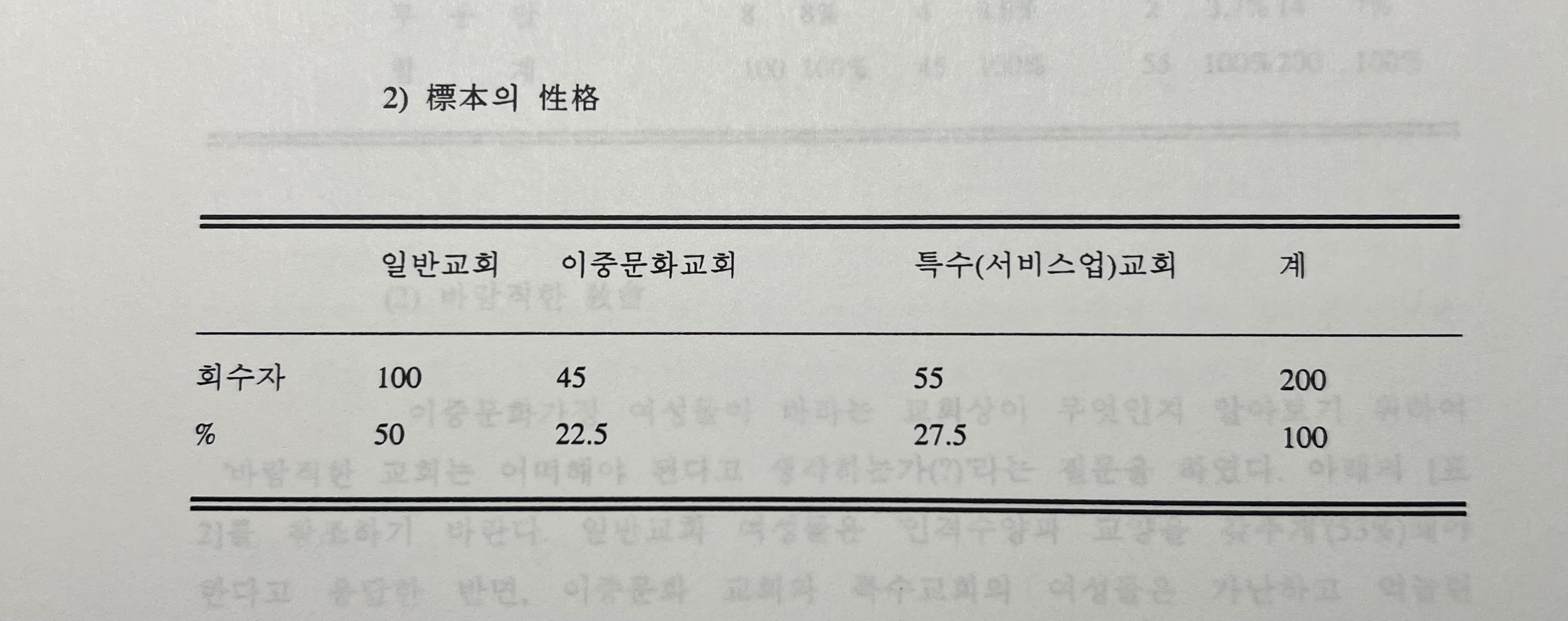
The research method involved having the mission or evangelism department representatives in each church distribute and collect the surveys during gatherings. Among the three types of church attendees, 1,000 questionnaires were distributed, with an expected response rate of about 150. The actual number of collected responses was:
(1) 100 from general churches,
(2) 45 from intercultural family churches, and
(3) 55 from specialized service-industry-related churches.


2) Sample Characteristics

Type of ChurchRespondentsPercentage (%)
General Churches10050.0%
Intercultural Churches4522.5%
Specialized Churches5527.5%
Total200100%

3) Perceptions of Intercultural Women by Church Type

(1) Perception of the Church

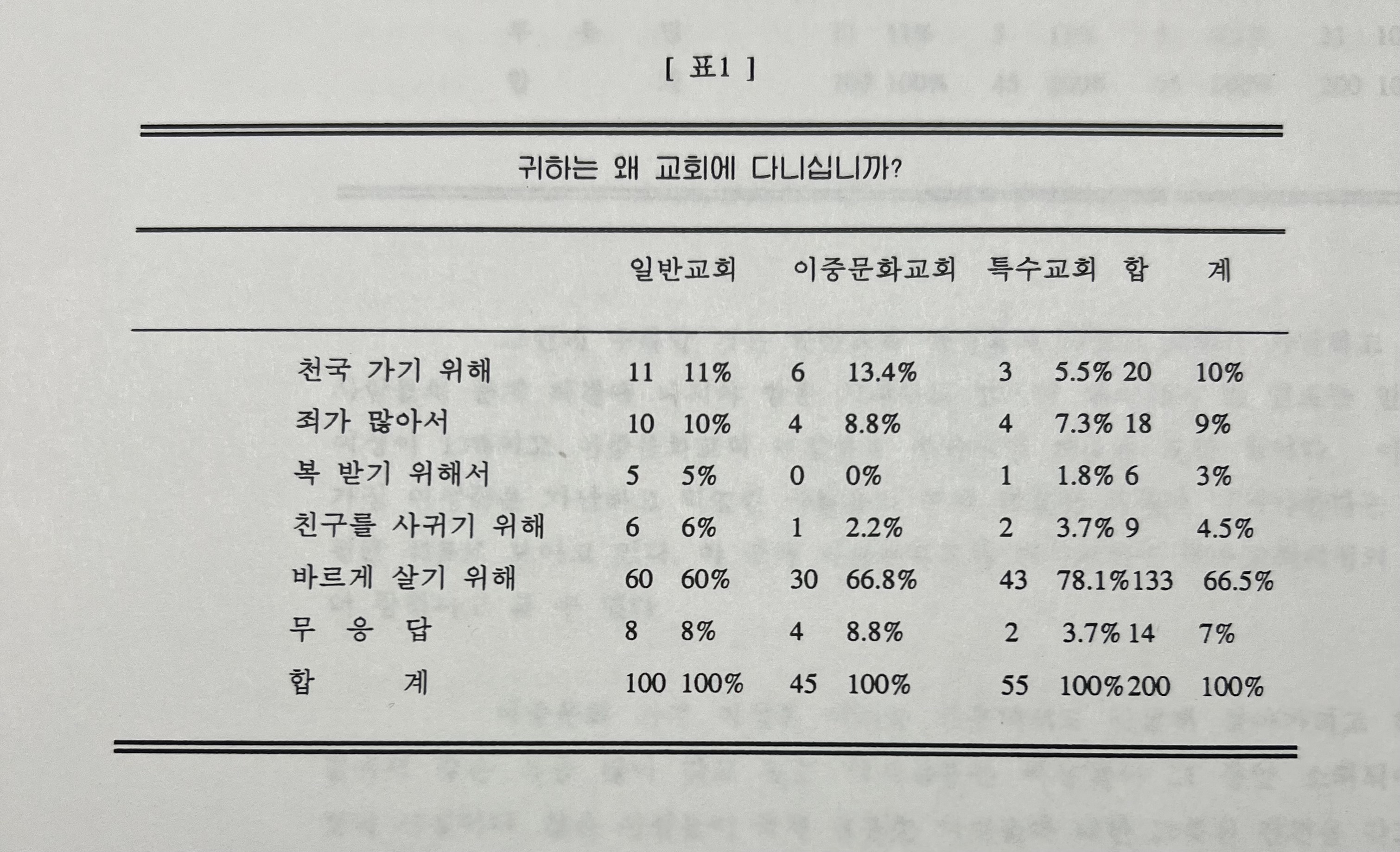
To understand how women in intercultural families perceive the church, they were first asked why they attend church. Please refer to Table 1 below.

The overwhelming majority of women in all three church types responded that they attend church “to live rightly.” The response rate was highest among women in specialized churches (78.1%), followed by intercultural family churches (66.8%) and general churches (60%).

A noteworthy point is that the percentage of women in specialized churches who chose “to go to heaven” or “because of sin” totaled only 12.8%, whereas those in general churches and intercultural churches showed higher rates at 21% and 22.2%, respectively—indicating a stronger tendency toward traditional religious beliefs in those groups.


[Table 1]
Why do you attend church?

ResponseGeneral ChurchesIntercultural ChurchesSpecialized ChurchesTotal
To go to heaven11%13.4%5.5%10%
Because of sin10%8.8%7.3%9%
To receive blessings5%0%1.8%3%
To make friends6%2%3.7%4.5%
To live rightly60%66.8%78.1%66.5%
No response8%8.8%3.7%7%
Total100%100%100%100%

(2) The Desirable Church

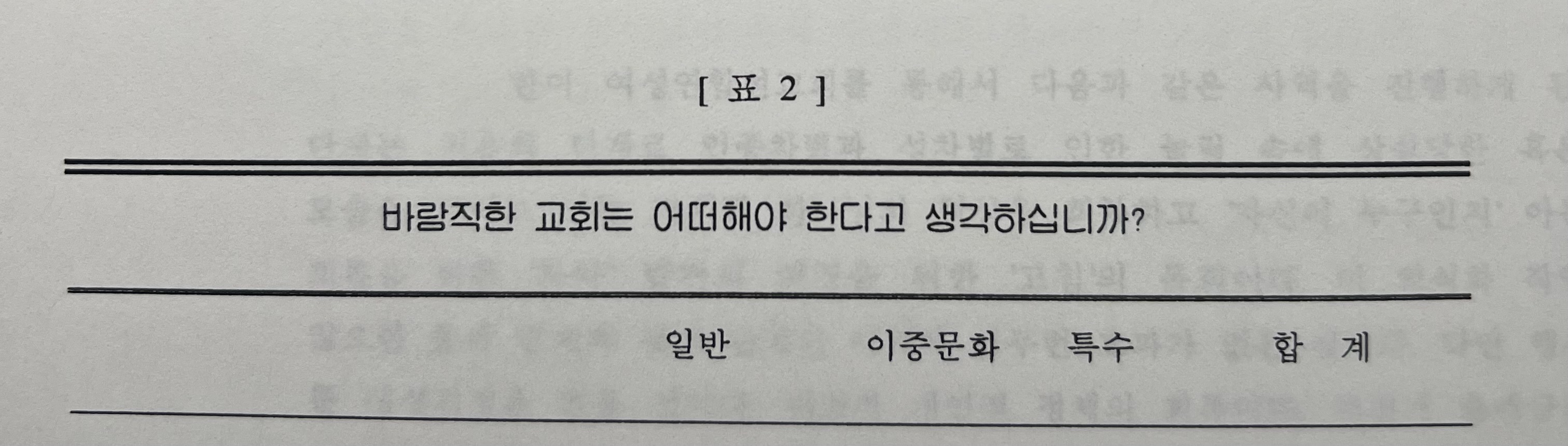
To understand what kind of church intercultural women desire, the question was asked:
“What do you think a desirable church should be like?”
Please refer to Table 2 below.

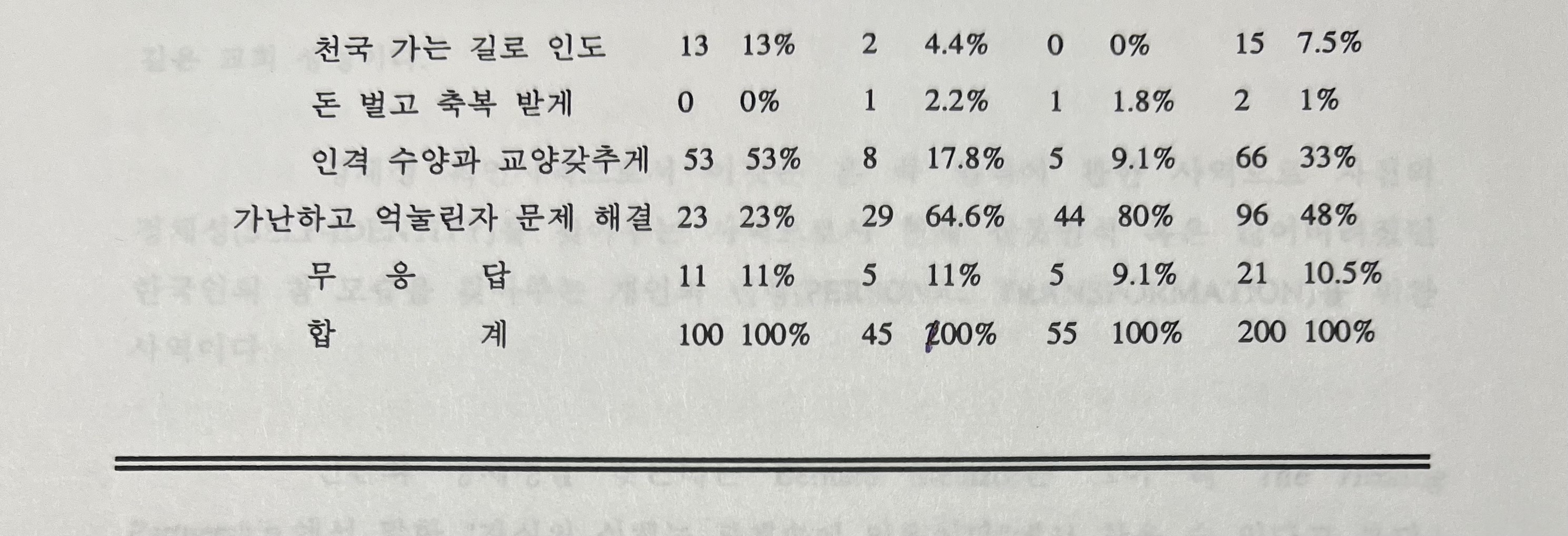
Among women in general churches, a majority (53%) responded that a desirable church should help individuals cultivate character and refinement.
In contrast, women in intercultural churches (64.6%) and specialized churches (80%) emphasized that the church should work to address the problems of the poor and the oppressed.


[Table 2]
What do you think a desirable church should be like?

ResponseGeneral ChurchesIntercultural ChurchesSpecialized ChurchesTotal
A place that leads people to heaven13%4.4%0%7.5%
A place to gain wealth and blessings0%2.2%1.8%1.0%
A place for character development and refinement53%17.8%9.1%33%
A place that addresses the problems of the poor and oppressed23%64.6%80%48%
No response11%11%9.1%10.5%
Total100%100%100%100%

What is noteworthy here is that even 23% of women in general churches expect the church to take action in solving the problems of the poor and the oppressed. In contrast, 13% of general church women view the church as a place to lead them to heaven, while women in intercultural churches showed little interest in this aspect. On average, 48% of women from intercultural families believe the church should actively address issues facing the poor and oppressed. Among them, women from specialized churches demonstrate a stronger awareness of these concerns than those from intercultural churches.

Women in intercultural families strive to live resiliently despite their hardships. In many ways, these “internationally married women” possess admirable strengths, yet they have long experienced marginalization. Many people hold misguided prejudices against women in international marriages. Sadly, such prejudices sometimes even appear within the church—a troubling reality.

It is in this context that church members, as carriers of the fragrance of Christ, must first cultivate a proper understanding of intercultural families. From this, three pastoral directions can be drawn.

2. The Pastoral Journey Toward Transforming Praxis

1) Personal Consciousness-Raising Ministry for Identity

Through the Korean-American Women’s United Mission, the following ministry unfolds.
The first stage is one of healing—a pastoral approach that helps recover the damaged image of God within individuals who have been oppressed or distorted due to racial and gender discrimination. This stage aims to rediscover the self and restore identity by asking “Who am I?” Without this initial consciousness-raising process, the second and third stages of ministry will be ineffective and remain mere events, lacking true transformative growth. This is the recovery of personal identity. It is equivalent to the Exodus story in the formation of the Church.

As a ministry of identity formation, it deals with the soul and the self. This is a personal transformation ministry that helps individuals rediscover their true Korean identity, often lost or misunderstood, and reclaim their self-identity.

Bernard Steinzor, in The Healing Partnership, suggests that a person’s true self exists in relationship. Martin Buber similarly states, “In the beginning was the relationship.” In the conclusion of chapter one of his book, Buber argues that:

“The world of ‘It’ (objects) exists within the framework of time and space, while the world of ‘You’ (persons) does not. A unique ‘You’ cut off from all relationship becomes just an ‘It.’ Conversely, a unique ‘It’ entering into a relational event may become a ‘You.’”
He insists that to be human is to exist in relationship. Though we cannot live without objects, if we live only with objects, we are no longer fully human.

Neither “It” nor “You” is inherently evil, but it is evil when:

  • “It” pretends to be “You,”
  • “You” disguises itself as “It,”
  • the relationship of “It-You” masquerades as “You-You,” or
  • “It-It” relationships replace genuine “You-You” relationships.

Thus, true human identity is found within relationships, and this requires the proper balance between “I-You” and “I-It” relationships. Only then can human beings become what God intended: truly free, unalienated, and in the image of God.

An ancient African proverb captures this relational self perfectly:

“A person is only a person through others, with others, and for others.”
Human beings exist within the complex webs of individual, familial, social, and historical contexts. Therefore, they must confirm their true essence both internally and externally. This becomes the basis for social transformation and the hope for an open, dialogical society of equality.

Even from a uniquely advantageous position—being bilingual and bicultural—some still experience identity confusion or self-devaluation, hiding away rather than contributing to society or the community. This pastoral model begins by embracing both languages and cultures. The Christian community must ensure that no one is excluded from worship, gratitude, fellowship, mission, or spiritual growth due to language limitations. Rather than settling for basic translation or interpretation, churches should develop ministries that recognize the value of bilingualism and biculturalism and foster mutual learning and communication.

Special focus is given to education and personal growth.

As women leaders share consciousness and pursue ministry, they must cultivate a strong self-awareness as professionals and practice their identity within concrete life situations. Criticisms arise such as:

  • “Some women are unwilling to give up the privileges they enjoyed by conforming to patriarchal roles,” or
  • “They replicate the methods of male-centered ministry and fall into self-contradiction.”

As Letty Russell once said, this may be the result of women’s uncritical assimilation into patriarchal clergy structures. Even if women succeed in “playing by the rules” of male-dominated leadership, they may be criticized for losing their femininity or paying an unbearable physical and psychological price. In this setting, women survive only peripherally—as symbols of token inclusion or assistants.

Despite these layers of gender discrimination, or perhaps because of them, women leaders must stake their claim boldly. They must become ardent advocates of women’s rights, help men become advocates as well, and ultimately strive for a world where such advocacy is no longer necessary—a world that reflects the Kingdom of God.

To support this journey, the following tools and programs are used in workshops to help individuals reclaim their identity:

  1. MMPI-2
  2. MBTI
  3. Homecoming
  4. Focusing
  5. Enneagram
  6. Breathing & Fasting

2. The Pastoral Journey for Transforming Praxis

1) Personal Consciousness Ministry for Identity Formation

Through the Korean-American Women United Mission (KAWUM), the following ministry is carried out. The first stage is a healing phase, aimed at restoring the distorted image of God caused by racial and gender discrimination. It is a journey to recover identity—knowing “who I am”—and to rediscover the self that has been lost or shattered. Without this process of consciousness-raising, the second and third stages of ministry will have no real effect—they will merely end as events without generating transformation. This is the restoration of personal identity and marks the church’s exodus-like journey toward ecclesiogenesis.

This identity-affirming ministry relates to the human soul or personality. It seeks to guide individuals in rediscovering their true Korean identity, which may have been misrecognized or lost. This is a ministry of personal transformation.

Bernard Steinzor, in The Healing Partnership, states, “The self is located in relationship.” Martin Buber famously said, “In the beginning is the relationship.” In the conclusion of Chapter 1 of the same book, Buber explains: “The world of ‘It’ (object) is situated in the realm of time and space, while the world of ‘You’ (human) is not. A ‘You’ that has lost all relationships becomes bound to ‘It,’ whereas an ‘It’ that enters into the event of relationship may perhaps become a ‘You.’” He argues that to be human is to be in relationship. Humans cannot live without things, but living only among things makes one less than human.

Neither ‘It’ nor ‘You’ is inherently evil; rather, it is evil when ‘It’ pretends to be ‘You,’ or when ‘You’ disguises itself as ‘It.’ Even worse is when the ‘It–You’ relationship imitates a ‘You–You’ relationship, or when the ‘You–You’ relationship is replaced by ‘It–You.’ At its worst, an ‘It–It’ relationship replaces a ‘You–You’ interaction.

Thus, true identity is found through relationships—both “I–You” and “I–It”—when they are rightly ordered. Only then can a person live as a truly undistorted human being, reflecting God’s original image: a free and un-alienated human.

A traditional African proverb captures this well: “A person exists only through others, with others, and for others.” Human beings exist within a web of personal, familial, societal, and historical relationships. By recognizing their reality both internally and externally, individuals become the foundation for social transformation and for the creation of an open, dialogical society.

Even when bicultural and bilingual individuals are in a uniquely advantageous position, they may suffer from confusion of values or self-deprecation. Rather than contributing their uniqueness to the community, they may withdraw or be seen as problematic. This ministry begins by embracing the strengths and weaknesses of both languages and cultures. Christian communities should not allow language barriers to hinder worship, fellowship, mission, or spiritual growth. Rather than simply relying on translation or interpretation, churches should build pastoral approaches that recognize and utilize the strengths of both cultures. This is especially important in education and personal development.

Women leaders, especially, must have a strong self-awareness as professional ministers and put their identities into practice in real-life contexts. Some critiques state that women refuse to give up former privileges tied to traditional gender roles, or uncritically imitate patriarchal styles of ministry. As Letty Russell noted, this often results in “the uncritical adoption of patriarchal clergy structures.” In this case, even if a woman excels in a male-dominated ministry environment, she may be criticized for losing her femininity or suffer physically and psychologically as a result. Thus, even when women are included in ministry, it may only be symbolically (tokenism) or peripherally (as assistants). Trapped in multiple layers of gender discrimination, women leaders must first become assertive feminists themselves, helping men also become advocates of gender equality. The ultimate goal is a world where feminism is no longer needed, and men and women work together for God’s Kingdom.

To support this, workshops are conducted to help individuals recover their identity using tools such as:
(1) MMPI-2
(2) MBTI
(3) Homecoming
(4) Focusing
(5) Enneagram
(6) Breathing & Fasting
(See Appendix B for details.)


2) Humanization Ministry for Relational Identity Recovery

The second stage focuses on those whose identity has been affirmed. These individuals are now capable of dialogue and understand that oppressing or violating others ultimately destroys their own peace. At this stage, the individual undergoes a transformation toward living together with others, and human relationships—long lost in a society of self-interest—begin to form. Here begins the basic ecclesial community (COMMUNION), initiated by communication. On the personal level, the problem of discrimination is resolved. This is the restoration of Christian relational identity—the essential foundation for an authentic church. It is the cross-bearing journey of ecclesiogenesis.

Our cultural situation tempts us with two extreme mindsets:

  1. Extreme Subjectivism – “Only I matter.”
  2. Extreme Objectivism – “Only God matters.”

Extreme subjectivism believes the world revolves around the self. Extreme objectivism believes the self only exists as an offering to the lofty God. The former leads to alienation and rage, denying any relation between the self and justice. The latter believes that since God is always right, we must always be wrong—even if we know better. This contradiction generates internal rage when others reject our reason or values.

Both extremes are rooted in a lack of dialogue. These polarized lives lead to silence. The Christian role is to bring these isolated individuals into dialogue—those trapped in narcissistic silence, or in blind obedience to God, must be invited into covenantal dialogue. Without dialogue, communion is impossible. A society without dialogue becomes a closed society.

As H. Richard Niebuhr said in The Responsible Self, the unsaved are closed-off beings, unresponsive to God and neighbor. The saved are open beings—living lives of open dialogue with God and humanity.

This healing ministry is spiritual in nature. After recovering their Korean identity, individuals confirm the value of having formed a family with an American spouse. This awareness affirms that their family represents the image of the Kingdom of God on earth—God’s original design for humanity. The church, too, is such a space of mutual belonging and empathy. Just as God gave Eve to Adam so he would not be alone, God created the family and the church as nests of “being with” others. This is true healing and ecclesiological transformation.

This pastoral form emphasizes the spiritual gift of healing han (한) and emotional wounds. It comforts women, especially international women, who have endured deep suffering. They experience the love of Christ and spiritual rebirth, and go on to share that love with others. Through words, expressions, gratitude, praise, and prayer, they embody a life of faith. This ministry challenges hypocrisy and illusion in human society, and leads individuals to genuine renewal of personhood in Christ.

When women come to accept themselves as they are—without self-deprecation—they can also accept others as equals. Shared womanhood fosters solidarity. Recognizing the past of gender discrimination and choosing to overcome it allows women to take action. Because of their history of suffering, women are deeply attuned to others’ pain, able to embody and speak on behalf of it. This enables not just women but all marginalized people to act for change. This is the hidden strength of women in the church.

For the recovery of relational identity, the following are used:
(1) Conflict Inventory & Self/Partner Knowledge Inventory
(2) Firo-B & Firo-F Scales
(3) Relationship Therapy
(4) Getting to Yes
(5) Six Thinking Hats

These tools are used in the spiritual training of the Korean-American Women United Mission but are omitted here due to space. They are available during actual training sessions.

3) Generative Ministry for the Restoration of Responsible Identity

The third stage focuses on the church as a model of an egalitarian community capable of dialogue. As such a model, the church begins volunteering toward individuals and groups throughout the world, engaging in relationships based on egalitarian communication. This ongoing, multifaceted dialogue of the church is called mission.

As a living cell capable of generating human relationships within a society driven by self-interest, the church must actively form such relationships within the social sphere. If the church fails to do this, it will either remain as a shell of its original form—no different from other self-serving organizations—or eventually vanish into the past. The church, as a life-giving cell that requires relationship, must live with society and teach the world—especially the profit-driven society—how to live together. This ministry of accompaniment, or voluntary suffering, expresses God’s love for humanity through the lens of relationship.

God is not only individual identity but also relational identity. Therefore, unless the church voluntarily seeks out relationships and embraces the suffering they may entail, it cannot be in relationship with God. To refuse this is to lose the source of its existence as a basic community. Moreover, it results in the loss of connection to the foundation of individual identity. For God voluntarily became flesh to liberate alienated and fragmented humanity from their isolated selves and led them to a land of relationship—the Promised Land. A body is healthy only when every part breathes and moves together. This is what we call a responsible identity.

Thus, within the society of profit, community must be generated—and these generative communities must continuously undergo transformation to maintain their vitality through ongoing relationships. In dialogue with God, we rediscover the relational self. As these gathered selves live together and voluntarily fill in the empty places (Place) and times of pain (Time), they become living witnesses, participating in the Community of Communion that prevents decay and death in the world.

This preventive ministry addresses the physical and emotional realities of life. For instance, women in intercultural families and other members of the Korean immigrant community, upon gaining new awareness of their identity as Korean Americans, begin to reimagine how they structure home and church life. Once they understand the true mission of the church, they move into communal ministry toward society.

Such new awareness will prevent further suffering and, when suffering does occur, will not abandon those affected or relegate the work of support to only a few individuals or institutions. Rather, this becomes the voluntary ministry/suffering embodied by the Incarnation—the Kenosis of Christ, who emptied Himself. Ministry in the flesh is the source of community transformation.

This ministry transcends generational gaps, intercultural divides, racial and class barriers, and unites people as brothers and sisters before God. It creates a form of faith community that does not remain inward but actively reaches out to the wider society and history. In this way, the church becomes a unique missionary tool of God. Churches composed only of intercultural women will one day be integrated into broader communities and join in social service, becoming partners in transforming history.

If we do not build this vision through intercultural ministry, the Cross and Resurrection of Jesus Christ—who is the cornerstone of God’s kingdom on earth—will lose their meaning. We must abandon fixed ideas, ethnocentric cultural attitudes, personal stubbornness, and social prejudices to fulfill the greatest commandment: to love God and our neighbor as ourselves. This requires a missional strategy rooted in profound faith that grows deep, wide, and high—making churches vibrant and responsive to today’s world.

These three forms of ministry should contribute to the growth of the church and the globalization of the gospel by activating the potential and possibilities within intercultural families.

A generative community is:

  1. A community of mutual service, not domination,
  2. An open community that engages with the local society,
  3. A community of education and participation,
  4. A community that goes out rather than merely waits, and
  5. A basic community ideally organized in groups of twelve.

To support this transformation toward generative church formation, the Korean-American Women’s United Mission includes various ministries for intercultural families, such as:

  1. Prayer Line
  2. Homeless Shelter (Emergency)
  3. Agape House (Long-Term Shelter)
  4. Credit Union
  5. Newsletter (Village Newspaper)
  6. Nursery and Kindergarten
  7. Family Counseling Center
  8. Language School
  9. GED School
  10. Technology School
  11. Food Pantry
  12. Thrift Shop
  13. Visitation to Mental Institutions, Prisons, Hospitals
  14. Active Engagement in Local Community Issues
  15. Volunteering in local police, fire, emergency response teams, PTA, school boards, councils, hospitals, senior homes, prisons (e.g., Bible study)
  16. Community Center Management
  17. Support Groups (Networks)

[Notes]

  1. Archie Smith, Jr., The Relational Self: Ethics & Therapy from a Black Perspective (Nashville: Abingdon, 1982), p. 13.
  2. Martin Buber, trans. by Ronald Gregor Smith, I and Thou (Edinburgh: T & T Clark, 1937), p. 18.
  3. Ibid.
  4. Ibid., p. 62.
  5. Archie Smith, Jr., Ibid., p. 27.
  6. Walter Brueggemann, Finally Comes the Poet: Daring Speech for Proclamation (Minneapolis: Fortress Press, 1989), p. 48.
  7. H. Richard Niebuhr, The Responsible Self: An Essay in Christian Moral Philosophy (San Francisco: Harper & Row, 1963), pp. 35–41.
Posted in Doctor of Ministry | Tagged , , , , , , , , | Leave a comment

다문화 속의 교회, 변향연습을 위한 목회의 여정, 뉴욕 1995 (제 9 장)  

제 9 장 성서적 교회생성을 향한 변형 연습

변형연습을 위한 목회의 여정

            1950년 6.25를 기점으로 현재까지 약 13만명의 한국여성이 미군과 결혼하여 미국으로 건너왔다. 매년 3-4천명이 현재 오고있다. 또한 이들의 친정 가족을 초청하여 부모와 형제자매 및 그 직계가족까지 포함 기하급수로 한인 공동체의 1/3의 인구를 차지하게 된다. 이들은 계층자원(CLASS RESOURCES) [미국사회의 계층분화]이 빈약한 관계로 단순노동에 이봐게 되는데, 이로 인해서 한인사회의 노동자 층의 인구가 더욱 두터워졌다. 한편 미군과 결혼해서 미국의로 이민온 이중문화가정의 한인 여성 가운데 10%가 자영사업이나 전문직에 근무하고, 30%가 단순 노동을 하며, 60%가 다양의 서비스 업종에서 일을하고 있다. 서비스업에서 일하는 여성의 대부분이 이미 결혼에 실패를 한 여성들이고 그중 절반이 맛사지 팔러에서 일을 하고 있는 형편이다.

            이러한 이중문화 여성들의 (1) 자영, 사업과 전문직, (2) 단순노동 (3) 맛사지 팔러로 분류된 구릅이 교회에 대하여 어떻게 의식하고 있는지를 조사해보는 것이, 이들을 이해하는데 대단히 중요한 자료가 되리라본다.

            미국사회의 인종차별, 여성차별 및 계급주의의 희생자인 소수민족 중의 하나가 이민 한국인이다. 하물며 계층자원이 없는 단순노동 한인과 중산층 이상의 보수파 한인사회의 분열과 여성의 차별의식과 그 현상은 이민 사회 깊히 이중문화가정의 한인 여성들의 숨은 희생의 이야기와 그 맥락을 같이 한다. 따라서 이민사회의 문제의 분열화와 소외화를 빙산일각으로 알려주는 이중문화 여성의 문제는 교회의 특수 선교 분야라기 이민 사회와 세계를 향한 교회의 의식화, 인간화 및 평등 공동체 형성을 위한 선교 목적 자체에 부응한 이민교회의 참 선교가 되여야 한다고 본다.

1. 이중문화 가정 여성의 교회인식

            이러한 기독교 복음에 대한 이중문화 가정 여성들의 인식에 대한 이해는 결국 한인교회가 그들의 문제와의 관계에서 어느 위치에 있는지를 말해 주는 것으로서 대다수 일반교회들이 보편적으로 당면하고 있는 이중문화가정 여성 문제를 선교적 과제로서 어떻게 정립해 나갈 것인가를 생각해 보는 계기가 될 수 있을 것으로 기대하는 것이다.

            1) 조사 방법과 과정

            표본을 선정함에 있어 교회에 출석하는 이중문화가정 여성으로 하였으며 미 전역의 한인교회를 중심으로 (1) 일반교회, (2) 이중문화가정 교회, (3) 특수 교회(서비스업 즉 마사지 팔러등의 종업원을 위한 성경공부 혹은 기독교친교 모임) 등 세 유형의 교인들을 조사했다. 조사방법은 각 교회의 선교(전도)부 담당자들이 집회중에 각기 작성하도록 해서 회수 하도록 했다. 위 세 유형의 출석자중 1000매의 설문지 중 150명 정도의 응답자를 기대하였으나 (1) 100, (2) 45, (3) 55가 최종 회수되였다.

            2) 표본의 성격

            3) 교회별 이중문화 여성들의 인식

            (1) 교회에 대한 인식

            이중문화 여성들의 교회에 대한 인식을 알아보기 위하여 먼저 그들이 왜 교회에 다니는지 물어 보았다. 다음의 [표 1]을 참조하기 바란다.

            세 유형 교회 여성들 절대 다수가 ‘바르게 살기 위해서’ 교회에 다닌다고 응답하고 있는데 그 강도는 일반교회 여성(60%), 이중문화교회 여성 (66.8%), 특수교회 여성(78.1%) 순이다. 특기할 점은 특수 교회 여성이 ‘천국에 가기 위해’ ‘죄 때문에’, 두 합계비가 12.8%인데 비해 일반교회 여성 21%, 이중문화교회 여성 22.2%로서 전통적 신앙의 경향이 두드러져 보인다.

[ 표1 ]

            (2) 바람직한 교회

             이중문화가정 여성들이 바라는 교회상이 무엇인지 알아보기 위하여 ‘바람직한 교회는 어떠해야 된다고 생각하는가(?)’라는 질문을 하였다. 아래의 [표 2]를 참조하기 바란다. 일반교회 여성들은 ‘인격수양과 교양을 갖추게'(53%)해야 한다고 응답한 반면, 이중문화 교회와 특수교회의 여성들은 가난하고 억눌린 사람들의 문제를 해결하기 위해 노력해야 한다'(64.6%와 80%)고 응답하고 있다.

[ 표 2 ]

            그런데 주목할 것은 일반교회 여성들의 23%도 교회가 가난하고 억눌린 사람들의 문제 해결에 나서야 함을 기대하고 있으며 천국가는 길 인도는 일반교회 여성이 13%이고 이중문화교회 여성들은 무관심한 반응을 보인 점이다. 이중문화 가정 여성들은 가난하고 억눌린 사람들의 문제 해결에 교회가 나서야한다는 견해를 평균 48%로 보이고 있다. 이 중에 이중문화교회 여성보다는 특수교회여성의 의식이 더 강하다고 볼 수 있다. 

            이중문화 가정 여성은 어려운 가운데서도 굳굳히 살아가려고 하고 그 점에서 좋은 점을 많이 갖고 있는 ‘국제결혼한 여성’들이 그 동안 소외되어 왔던 것이 사실이다. 많은 사람들이 국제 결혼한 여성들에 대한 그릇된 편견을 갖고 있다. 이런 현상은 심지어 교회에서도 나타나곤 하는 불행한 현실이다. 바로 이런 점에서 그리스도의 향기를 전하는 교회의 교인이 먼저 이중문화 가정에 대한 올바른 이해를 필요로 함을 느낀다. 이에 여기서 3가지 목회 방향을 설정할 수 있겠다.

2. 변형연습을 위한 목회의 여정

            1) 정체성을 위한 개인 의식화 사역

            한미 여성연합선교회를 통해서 다음과 같은 사역을 진행하게 된다. 첫째 단계는 치유의 단계로 인종차별과 성차별로 인한 눌림 속에 상실당한 혹은 극단의 모습을 모이고 있는 파괴된 하나님의 형상을 회복하고 ‘자신이 누구인지’ 아는 정체성 회복을 위한 ‘자아’ 발견의 여정을 위한 ‘고침’의 목회이다. 이 의식화 작업이 되지 않으면 둘째 단계와 셋째 단계의 사역에 아무런 효과가 없을 것이다. 다만 행사로 끝날 뿐 생성과정은 없을 것이다. 이것이 개인적 정체의 회복이다. 이것이 출애급의 역사와 같은 교회 생성이다.

            정체성 획인사역으로서 이것은 혼 즉 인격에 관한 사역으로 자신의 정체성(SELF-IDENTITY)를 찾아주는 사역으로서 현재 잘못인식 혹은 잃어버려졌던 한국인의 참 모습을 찾아주는 개인의 변형(PERSONAL TRANSFORMATION)을 위한 사역이다.

            인간의 정체성을 찾는데는 Bernard Steinzor는 그이 책 The Healing Partnership 에서 말한 “자신의 실체는 관계속에 있음이다”에서 찾을 수 있다고 본다.1 Martin Buber는 말하기를 “태초에는 관계가 있었다”고 했다.2 Martin Buber는 그의 상기 책 1장 결론에서 말하기를 “‘그것(사물)’의 세계는 시간과 공간의 상황 속에 자리를 잡고 있고, 당신(인간)의 세계는 시간과 공간의 상황속에 자리를 잡고 있지 않다. 모든 관계가 다 끊난 특별한 ‘당신(인간)’은 개체의 그것(사물)으로 되려 묶여(제한)진다. 반면에 관계의 사건 속으로 들어가게된 특별한 ‘그것(사물)’은 ‘아마도’ 개체의 ‘당신(인간)’이 된다”고 말하면서3 인간은 관계속에 있어야 만이 인간일 수 있다고 주장하고 있다. 인간은 사물이 없이는 살아갈 수 없으나 사물 만으로 살아갈 때에는 더이상 인간일 수 없다는 주장이다.

            ‘그것’이나 ‘당신’ 자체는 악한 것일 수 없으나 ‘그것’이 ‘당신인 척하거나, ‘당신’이 ‘그것’으로 가장하는 것은 악한 것이며, 더욱이 ‘그것과 당신’의 관계가 ‘당신관 당신’의 관계를 가장해서 나타나면 악한 것이며, ‘당신과 당신’이 ‘그것과 당신’의 관계를 대신할 때 악한 것이다. 더욱이 ‘그것과 그것’이 ‘당신과 당신’의 위치를 서로 대신할 때, 악한 것이다.4

            따라서 인간은 관계 속에 있어야 참 인간이 되기위한 정체성 (IDENTITY)을 찾으나, 그 관계는 ‘나와 당신’과의 관계와 ‘나와 그것’과의 관계 정립이 바른 자리를 찾을 때 왜곡되지않은 바른 인간의 존재가 가능한 것이다. 다른 표현을 쓴다면, 하나님이 본래 형상대로 창조하신 모습의 인간 즉 소외되지 않은 참 자유한 인간이 존재할 수 있다는 것이다.

            이러한 ‘관계적 자아’를 두고 고대 아프리카의 격언은 정확하게 촛점을 맞추고 있다: “사람은 타인의, 타인과 함께, 타인을 위해서 만이 존재한다.”5 인간은 개인과 가정과 사회와 역사의 과정 속에 얽혀있는 거미줄같은 삶의 마당 속에 존재한다. 따라서 인간 내면과 외면의 차원에서 자신의 실체를 확인(確認)하고, 사회적 변형의 근거가 되여, 열린 사회 즉 함께하는 동등의 대화의 사회를 소망할 수 있다.

            이중언어 이중문화의 양문화 수용이 가능한 유리한 입장에서도 가치혼란과 자신에 대한 비하가 자신의 특유한 위를 내세워 공동체나 사회에 이바지 하기보다는 숨어 지내거나 문제의 사람으로 남는 경우가 생긴다. 이 형태의 목회는 먼저 이중언어의 사용과 양 문화의 장단점을 수용하는 것으로 부터 시작한다. 그리스도의 신앙 공동체가 어느 언어의 제한으로 예배, 감사, 친교, 선교, 신앙의 성장을 제한 시키지 않도록 노력 해야할 것이다. 단순한 번역이나 동시통역으로 대치하기보다 양문화가 소유한 장점을 인정하고 수용하는 것으로 서로 배우고 교통하는 과정에서 목회 형태가 개발될 수 있다. 특히 교육적인 면과 자기 성장면에 목회의 비중을 둔다.

            여성의식을 공유하면서 여성지도자들은 특별히 사역의 전문인으로서의 자의식에 투철해야 하며 구체적인 삶의 자리에서 자기 정체성을 실천해야한다. ‘여자였기 때문에 누려왔던 기존의 특권을 하나도 포기하지 않으려한다’, ‘목회현장에서 기존의 남성목회 방법을 그대로 답습하는 자기 모순에 빠져있다’는 비판의 소리가 있다. 이는 레티 러셀이 말했듯이 ‘가부장적 성직에의 여성의 무비판적 투여’의 결과일 수 있다. 즉 가부장적 성직에의 여성의 무비판적 투여는 여성성직자로 하여금 마치 남성다움을 겨루는 경기에서 뛰어나게 성공하여도 여성다움을 상실해 버렸다는 비난을 당하거나 육체적 심리적으로 엄청난 대가를 지불하면서 형식적(여성을 수용했다는 선전 정도) 주변적(보조자) 방식으로 살아남을 수 밖에 없다는 것이다. 이처럼 이중삼중의 성차별 벽에싸여 있다 할지라도, 아니 어쩌면 바로 그렇기 때문에 치열한 삶을 담보로 여성지도자 자신이 먼저 철저한 여권론자가 되고, 남성들이 여권론자가 되도록 도우며, 종국에는 더 이상 여권론자가 필요없는 세상 속에서, 하나님 나라를 위해 함께 일해야 한다.

            이를 위하여 다음과 같은 프로그램을 사용하여 웤샆을 통해서 개인의 정체성을 회복하도록 한다: (1) MMPI-2, (2) MBTI, (3) Homecoming, (4) Focusing, (5) Enneagram, (6) Breathing & Fasting. [부록 B] 부분의 자료를 참고 바란다.

            2) 관계적 정체성을 회복하기 위한 인간화 사역

            둘째단계는 정체성이 확인된 자아는 함께 대화가 가능하며 서로를 누르거 나 침해하는 것이 결국에는 자신의 평화를 파괴한다는 것을 아는 경지이다. 따라서 이 지경에 이르면 ‘더불어’ 사는 삶의 단계로 변형되는데 이익사회내에 사라졌던 인간관계가 생성이 되게 시작한다. 이제부터 기초 공동체인 교회(COMMUNION)가 비로소 대화연 (COMMUNICATION) 에서 시작된다. 차별의 문제가 개인적인 차원에서는 기본적으로 해답을 얻은 것이다. 이것이 그리스도인의 관계적 정체 회복으로 교회가 교회다울 수있는 기본인 것이다. 십자가 역사와 같은 교회 생성이다.

            우리 문화 상황은 두가지의 양극단의 의식이 유혹하고 있다.6 극단적 주관주의 의식이고, 둘째는 극단적 개관주의 의식이다. 주관주의적 기둥은 언제나 ‘오직 나 자신 만’이라는 생각에 젖어 있는 경향 때문에, 세계가 나를 중심으로 움직일 수 있다고 믿는다. 반면에 객관적인 기둥은 높고 선하게 살기위해서 ‘오직 하나님 만’이라는 생각에 젖어 있는 경향 때문에, 하늘에 있는 거대한 자신에게 자신을 드리는 것으로 나를 연장 했을 때에 만이 자신이 오직 존재한다고 믿는다.

            ‘오직 나 자신 만’의 극단적 주관주의는 불안한 소외(疎外)를 초래할 수 있고, 깊은 격노(激奴)를 낳을 수 있다. 지나친 주관주의자들은 모든 정의(正義) 문제는 자신과는 아무런 상관이 없다고 믿는다. 왜냐하면 자신과 정의는 아무런 관계가 없기 때문이다. 반면 ‘오직 하나님 만’의 극단적인 객관주의자는 정의를 위한 원칙이 있다고 믿는다. 왜냐하면 하나님은 언제나 옳기 때문이다. 하나님이 언제나 옳기 때문에 나는 언제나 잘못하고 있다고 믿는다. 그리고 내가 좀더 많이 그리고 잘 아는데도 자신의 판단에 반대되는 태도를 용납하도록 부추기는데는 격노(激奴)할 수 밖에 없다. 이러한 두가지 극단의 경우를 단순화 시킨 견해들이 서로를 더욱 심화시킨다. 한쪽은 나 자신이 판단을 신뢰하라고 부추기고 다른 한쪽은 나의 판단을 무시하라고 요구한다. 한편으로는 자신의 극대화는 하나님과의 관계 통로가 없고, 반면에 하나님의 극대화는 자신과의 통로가 사라지고 없다. 소외가운데 자신의 극대화된 감각을 가진 사람은 언제나 홀로 남아 있고, 자신을 부정하고 하나님 만을 극대화한 사람들은 맹종끝에 결국에 하나님은 나를 무시한다고 격노와 실망을 형성한다.

            이러한 소외와 침묵하고 있는 격노는 그 중심에 공통된 성격히 있는데, 그것은 대화의 부재라는 것이다. 양 극단적 삶은 침묵으로 인도해 들어 간다. 따라서 그리스도인의 역할은 자신을 극대화한 소외된 침묵으로 부터의 삶들을 대화에로 인도해내는 일이며, 또한 하나님 만을 극대화한 거절과 격노의 침묵의 사람들을 심각히 계약적 대화에로 인도할 고집을 전복시킬 ‘함께 함'(COMMUNION)의 근본 형태인 대화에로 인도해내는 사명이 있는 것이다. 이기주의와 복종에 의해서 대화가 파괴되면 ‘함께 함’은 불가능한 것이다. 결국 대화를 잃은 개인과 사회는 폐쇠된 개인과 사회인 것이다.

            따라서 H. Richard Niebuhr은 그의 The Responsible Self 에서 구원 받지 못한 인간은 폐쇠된 인간이며 하나님과 이웃을 향하여 무반응한 인간이라고 보며, 구원 받은 인간은 개방된 인간 즉 하나님과 인간을 향하여 열린 대화로 살아가는 삶을 뜻하고 있다.7

            치유사역으로서 이것은 영적인 문제로, 한국인으로서의 자신을 찾은 후, 자신이 한국인으로 미국인과 한가정을 이루었음을 확인하는 과정으로, 이것이 얼마나 중요하고 의미 있는 일인지를 확인시킨다. 이 교육 훈련 과정에서 이들은 자신이 하나님의 창조역사에 이루신 인간사회의 하나님 나라의 원형이 가정임을 깨닫고 이것이 교회의 기본 구성으로, 외롭고 소외된 이들과 함께 있어줌(EMPATHY MINISTRY)이 바로 치료사역임을 확인한다. 입장과 배경이 다른 서로가 서로를 위해서 있어주는 것이 하나님께서 아담이 독처하는 것을 원치 않으시고 이브를 창조하셔서 동행인으로 삼으시고 인간과 인간 사이에는 ‘함께 함의 둥우리’인 가정을 삼으셨고, 하나님과 인간 사이에는 ‘함께 함의 둥우리’인 교회를 삼으셨다. 이것이 치유요 교회변형(ECCLESIOLOGICAL TRANSFORMATION)의 참 모습이다.

            많은 대상자들이 안고 있는 한을 풀어주고 상처를 치유하는 치유목회의 은사에 치중하는 목회이다. 많은 국제 여성들이 경험한 인간의 깊은 고난의 길을 그리스도의 사랑으로 위로하고 구원의 확인 속에서 거듭남의 변화를 체험케 한다. 그리고 자신들과 같이 어려움을 당하고 있는 이웃들에게 그리스도의 사랑을 다시 베푸는 사역자들을 배출하는 목회 형태이다. 말 한 마디, 표정 하나로 이웃에게 따뜻함을 전달하고 깊은 감사와 찬양과 기도가 중심이 되는 신앙생활을 추구한다. 인간 사회의 가식과 허상에 도전하고 진정한 인성의 거듭남이 그리스도 안에서 가능하게 되는 체험을 가지도록 치중하는 목회의 형태이다.

            현실인식으로부터 자기를 비하하지 않고 그대로를 수용하는 자기수용 (자의식)이 가능해지면 동시에 동등한 무게로 타인을 수용할 수 있게 되는데 여기서 같은 여성이라는 사실 때문에 생기는 동료의식이 중요하다. 여성들이 오랜 성차별적 전통에 눌려 제대로 성장하지 못했던 과거를 이해하고 공유하면서 그러한 과거를 초극하는 일을 위해 일할 결단까지도 할 수 있게 한다. 여성은 고통의 경험으로 남의 아픔에 민감하게 반응한다. 그 아픔을 온 몸으로 느낄 수 있고 그래서 그 아픔을 대변할 수 있다. 때문에 여성만이 아니라 소외된 모든 이웃의 아픔을 극복하기 위해 구체적인 일을 앞에 두고 결단까지도 할 수있는 것이다. 여기에 교회여성의 잠재된 힘이 있다.

            관계적 정체성을 회복하기 위하여 (1) Conflict Inventory & Self/Partner Knowledge Inventory, (2) Firo-B Scale & Firo-F Scale, (3) Relationship Therapy, (4) Getting to Yes, (5) Six Thinking Hats. 한미여성연합선교회의 영성훈련원에서 사용하는 본 자료는 본 논문의 지면 관계상 생략한다. 훈련에 참여시 받게된다.

            3) 책임적 정체성 회복을 위한 생성화 사역

            셋째단계는 대화가 가능한 평등 공동체의 한 모범으로서의 교회는 이제 그 관계 맺는 평등 대화법으로 세상의 모든 곳에 있는 개인이나 단체를 향해서 자원 봉사를 시작한다. 이러한 쉬임없는 교회의 복합적인 대화를 선교라 부른다. 교회 공동체가 다른 이익사회 속에서 인간관계를 생성할 수 있는 생명세포 임으로, 만일 교회가 관계 생성을 사회 속에서 하지 않으면 이익사회 뿐 만 아니라 사회 속의 관계를 필요로하는 교회도 관계의 부족으로 본래의 모양에서 파괴된 모습으로 다른 이익 사회와 같은 모습으로 잔존하던지 아니면 과거 속으로 침몰해서 사라져 버리고 만다. 관계를 필요로하는 생명세포인 교회는 사회와 더불어 살아야 하며, 더불어 사는 법을 모르는 이익사회를 가르치기 위하여 함께 살아 주어여한다. 그것이 자원봉사(VOLUNTARY SUFFERING)로서 인간을 향하신 하나님의 사랑을 관계의 측면에서 표현한 것이다. 따라서 하나님은 한 개인의 모습(INDIVIDUAL IDENTITY)도 있으나, 기초 공동체의 모습(RELATIONAL IDENTITY)도 있는 것이다. 따라서 교회가 자원해서 관계를 맺으려 찾아가서 고난을 자처하지 않으면 하나님과의 아무런 관계도 이룰 수가 없으며 이것은 교회 즉 기초 공동체가 실존할 수 있는 근원을 상실하는 것이며, 더욱이 개인이 실존할 수 있는 정체성의 근원과의 관계를 상실하는 결과를 가져오는 것이다. 왜냐하면 하나님은 자원해서 자신을 관계를 잃어버린 비 실체인 인간을 육신으로 오셔서 인간의 육신 속에 갇혀 있는 인간을 출애급시켜 관계의 땅, 가나안으로 인도 하셨다. 생명 세포가 모든 몸의 부분과 호흡을 같이 할 때 온 몸은 건강한 것이다. 이것이 책임적 정체 (RESPONSIBLE IDENTITY)이다. 이로서 이익사회내에 공동체는 생성이되고 생성공동체는 끊임 없는 관계 속에 활동력을 넣기 위해서 끊임없는 변형을 해야한다. 하나님과의 대화 속에 관계적 자아를 찾고, 모여진 자아들이 함께 살되 자원해서 빈 곳(Place), 아픈 때(Time)를 채워나가는 생명으로 생성될 때, 영원과의 관계(THE COMMUNITY OFCOMMUNION) 속에 그리스도인과 교회는 썩어감을 방지할 수 있는 예방사역을하고 있는 것이다.

            예방사역으로서 이것은 육적인 문제로, 이와같이 자신을 찾는 일에 이중문화가정 여성은 여성대로, 이민한인 사회의 일반인은 그들대로 새로운 한국인으로서의 이중문화가정에 대한 새로운 인식을 갖은 후, 가정과 교회를 어떻게 구성하고 운영해야되는지 더나아가서 교회 사역이 진정 무엇인지를 깨달은 후에는, 일반 사회를 향한 공동체적 사역을 하는 것을 말한다. 따라서 새로운 인식은 더 이상 불행한 일을 방지해주며, 있다하더라도 어렵고 불행한 경우에 처한 사람을 도외시하거나 특수한 몇몇 혹은 기관의 일로 버려두지를 않을 것이다. 이것이 바로 우리의 육신을 가지고 자원봉사(VOLUNTARY MINISTRY / SUFFERING)이며 하나님께서 ‘자신을 비우신(KENOSIS)’ 그리스도의 구원사건인 것이다. 육신을 가지고 바치는 자원봉사는 바로 사회변형(COMMUNITY TRANSFORMATION)의 근원인 것이다.

            세대간의 차이, 이중문화의 간격, 인종과 계급의 벽을 초월하여 하나님 앞에 한 형제 자매로 연결되고 교제할 수 있는 신앙 공동체의 형태이며 이는 내부적인 공동체로 끝나기보다는 밖으로 일반인들과 함께하는 공동체로 사회와 역사에 이바지 할 수 있는 하나님의 특수한 선교도구가 되는 것이다. 따라서 이중문화가정의 여인들만의 교회는 언제가는 사라지고 일반인들과 함께 하는 교회를 이루고 또한 대 사회적 봉사도 함께 함으로 역사변형에 동반자가 되어야할 것이다. 이중문화 사역의 차원에서 이를 만들어 나가지 않는다면 이 땅 위에 하나님 나라를 건설하도록 모퉁이 돌이 되신 예수 그리스도의 십자가와 부활이 그 의미를 잃고 말 것이다. 고정 관념이나 민족 중심적 문화성, 개인의 고집과 사회적 편견을 버리고 한 하나님과 내 이웃이 내 몸과 같이 되는 그 크신 계명을 이루는 선교 전략을 세운다, 깊은 신앙의 뿌리가 넓게 그리고 높게 펼쳐지는 교회가 되도록 그 역할을 다하는 목회가 오늘을 사는 이 시대 사람들에게는 필요하다.

            이와같은 사역의 세가지 형태가 이중문화 가정을 위한 목회와 그 가정의 잠재력과 가능성을 활성화 함으로써 교회 성장과 복음의 세계화에 이바지해야할 것이다.

            생성 공동체는 (1) 군림하는 교회가 아닌 서로 섬기는 공동체, (2) 지역사회와 함께 하는 개방된 공동체, (3) 교육하고 참여하는 공동체, (4) 기다리는 공동체가 아니고 찾아가는 공동체, (5) 12명을 단위로한 기초공동체로 가능한 한 구성한다. 또한 이와 같은 교회생성을 향한 변형연습을 위해서 한미여성 연합 선교회에는 이중문화가정 여성과 그 가정을 위한 사업으로 (1) Prayer Line, (2) (2) Homeless Shelter – for Emergency, (3) Agape House – for Long Term Shelter, (4) Credit Union (신용협동조합), (5) News Letter – 마을신문, (6) Nursery – 탁아소와 유치원 운영, (7) Family Counseling Center, (8) Language School, (9) GED School, (10) Technology School, (11) Food Pantry, (12) Thrift-Shop, (13) Visitation for Mental Institution/Prison/Hospital, (14) 지역사회문제에 주체적 참여, (15) 자원 경찰, 자원 소방원, 자원 응급원, 학부형회, 교육위원회, 의회, 병원자원봉사, 양로원 자원봉사, 감옥 방문 및 성경공부인도 등 참여 (15) 지역사회센터운영, (16) Support Group (Network).

[주]

1. Archie Smith, Jr., The Relational Self, Ethics & Therapy from a Black Perspective. (Nashville: Abingdon, 1982), p. 13.

2. Martin Buber, trans. by Ronald Gregor Smith, I And Thou, (Edinburgh: T & T Clark,  1937), p. 18.

3. Ibid.

4. Ibid., p. 62.

5. Archie Smith, Jr., Ibid., p. 27.

6. Walter Brueggemann, Finally Comes the Poet – Daring Speech for Proclamation. (Minneapolis: Fortress Press, 1989), p. 48.

7. H. Richard Niebuhr, The Responsible Self – An Essay in Christian Moral Philosophy. (San Francisco: Harper & Row, 1963) pp. 35-41.

Posted in Doctor of Ministry | Leave a comment

다문화 속의 교회, 변형연습의 역사적 실례, (제 8 장) 뉴욕 1995

聖書的 敎會 生成을 향한 變形 演習 (制 8 章)

1. 변형에의 접근

이중문화 가정의 기능마비를 회복시키기 위한 변형의 과정을 시작한다는 것이 쉽지 않은 일이다. 이에 따른 자아발견을 통한 개인회복은 또한 평등 공동체를 향한 첫 발걸음이 되는 것이다. 정신변형를 받아야 되는 경우에는 기능마비가 심화되였을 때 이다. 한인 이민 가정과 특히 이중문화가정 여성들을 지난 수년동안 대하면서 보고받는 기능마비 내용들 중에 극심한 혼란(장애) 즉 정신이상을 일으킨 사람의 보고가 의외로 많았다. 이것은 한인 가정에는 다른 인종보다 심한 정신병자들이 많이 있다는 것보다는 한인의 문화가 문제가 있을 때에는 할 수 있는 모든 경우를 집안에서 시도하다가, 극심화되여 집안에서 다룰 수가 없어서 포기할 때 보기 때문에, 언제나 극도화된 경우만 보게된다.

            이러한 한인 가정의 문제 해결의 방식이 형성되는데는 세가지의 중요한 이유가 있다고 본다:

            (1) 서양적 정신 건강의 개념에 익숙치를 않다.

            (2) 문제해결 방식이 내면적 시도로 훈련되여 있다.

            (3) 체면문화의 사회적 낙인을 두려워 하는 것1

             서양적 정신 건강의 개념에 익숙해가는 과정이 매우 느리다. 매우 다른 의식과 행동의 사회속에 익숙하지 못한 한인은 ‘약간의 굳어 있는 분열증세’를 보이는 경우에도 ‘미쳤다’고 믿어버리는 경향이 있다. 따라서 가정 밖으로 나가 도움을 요청할 때에는 전문인이 아닌 가족들이 볼 때, 진정 ‘미쳤다’고 판단이 될 때인 것이다. 보통 완전한 변형가 불가능한 지경에 이르는 악화 상태 이전에 변형가 되면, 흔히는 정상으로 돌아 올 수 있음에도 불구하고 그 시기를 놓치는 경우가 종종 있다.

            한인 가정은 문제해결을 기본적으로 가정이라는 상황 안에서 모든 것을 처리하려고 한다. 따라서 문제를 가정 밖으로 들고 나가는 것을 부끄러운 일로 여긴다. 이것은 부모가 가정관리에 실패한 것으로 부모의 얼굴이 없어짐을 뜻한다. 이와같은 철저한 비밀 봉쇄는 가정이 정해 놓은 기대선을 성취하지 못했다고 하는 생각을 조금도 누구러 뜨리지를 못한다.

            이러한 점은 문제의 해결을 전문인에게 의탁하지 못하는 세번째의 이유로 인도해가는데, 그것은 사회적인 낙인이다. 한인 사회 속에서는 공동체의 눈에 비치는 가정의 위치가 매우 중요한 것이다. 이것이 이민 생활을 어렵게 만드는 원인 중에 하나가 되는 것이다. 미국사회에는 계층을 염려해서 공동체 속의 자기 체면을 지키기 위해서 자신과 가정을 희생 시키는 일이 거의 없다.

            이러한 ‘미치는 원인’의 가장 보편적인 세가지 이유들은 가정을 추적해 들어가게 마련이다. (1) 세습적 특성이 가문 안에 있는 것으로 보인다. (2) 운명으로 보는 사람들도 있다. (3) 가장에 의해서 익숙지 못한 인도와 훈육의 반영으로 나타난다고 보는 것이다. 흔히는 상기 중의 하나 이거나 혹은 복합된 이유들로 인해서 가족이 미친다고 본다. 어떠한 경우이던지 간에 가문 유지하는데 가장 중요한 좋은 결혼을 찾고 허락되기에는 어려운 가정이 되고 마는 것이다.

            이러한 이유들로 한인 공동체 내의 토속적인 간접적인 치료방법(점쟁이, 자연식이요법, 한방의, 지압법, 호흡법, 심지어 무당)과 환자가 속한 핵 가정 안에서의 자원(심지어 신유방법)을 찾는 치료 가족들이 지치지 않는 한에는 한인가정은 절대 밖으로 전문인을 더욱 찾지 않으려는 경향이 있다. 그래서 한인들은 전문인을 찾을 때에는 미치거나, 폭력적이고, 자살미수이고, 혹은 가족이 더 이상 어쩌지 못하도록 되는 지경에 이르면, 창피하고 절망한 모습으로 찾는다. 학교에서 학생이 정신이상이 있음을 확인했을 경우는 가족의 반대에도 불구하고 학교에서 전문 기관에 의뢰해서 치료하는 경우가 종종 있다. 심지어 변형를 받으러 왔던 경우에도 첫번 방문 후에 53%가 다음에는 오지 않고 변형의 과정을 중단한다. 두번 째 돌아온 48%가운데에서도 변형 횟수를 평균 잡으면 2.35회에 불과 하다.

            따라서 한인의 대화 과정을 살펴보는 것이 매우 중요하다. 다음의 세 요소가 대화를 성공적으로 끌어가는 중요한 방법이다: (1) 문제 핵심의 확인, (2) 감정표현, (3) 반대의 과정.

            (1) 문제 핵심 확인

            전문인에게 가정의 갈등과 비밀들을 밝히기 전에 가족들은 먼저 편안한 관계와 신용할 만한 관계를 먼저 형성하려고 노력한다. 내편이 되어 믿을 만 해야 속을 보인다. 그래서 처음에는 모든 사건과 현상들을 모두 숨기고 빙산일각 만을 내어 놓거나, 전혀 다른 일을 보고 하기 마련이다. 그래서 말과 행동 속에 숨어 있는 언어를 찾아 내야하고 이에 반응을 보여야 안심을 하고 숨은 내용이 서서히 풀려 나간다. 따라서 많고 깊은 인내가 필요하고 정확한 욧점을 부족한 징조와 가족의 태도에서 잡아 갈 때, 가족들은 서서히 안심을 한다.

            (2) 감정 표현

            감정을 개방적으로 교통하는데 서양인과 전혀 다른 태도를 전통적인 한인들은 가지고 있다. 다른 사람들 앞에서 감정을 공개적으로 나누는 방법은 대화를 더욱 곤경으로 이끌어 간다. 사랑의 표현도 사람들 앞에서 공개적으로 하는 것이 아니다. 그러나 아기나 어린이들을 사랑하는 표현은 서양인들 보다 그 심도가 더욱 싶다고 본다. 어린나이에 받는 부모의 사랑의 표현은 기본적인 신뢰감을 깊고 강하게 쌓아 나가도록 돕는다. 성인이 되면 “나는 당신을 사랑합니다’라는 직설적인 표현보다는 간접적이면서도 구체적인 행동으로 사랑하고 있음을 표현한다. 즉 아버지가 열심히 일해서 수입으로 의식주를 가족을 위해서 제공하고, 또한 좋은 안내와 지도를 통해서 가족을 잘 이해하고 있음을 나타내면. 그것이 아버지가 가족을 사랑하고 있음을 구체적으로 표현하는 것으로 보는 것이다.

            감정표현의 어려움으로 인해 미주에서 태어나 자녀를 갖고 있는 한인 가정에 어려움이 일어나고 있다. 방송 매체와 자녀들의 친구가정들을 대하면서, 한인 부모들은 다른 서양인 부모가 자녀를 향한 표현적이고 애정적인 태도에 대하여 지나치다는 생각과 함께 혼돈을 하게된다. 서양 부모들이 자녀들을 덜 사랑한다고 보는 이유는 자녀들의 버릇을 잘못들인다고 생각하기 때문이다.

            (3) 반대 과정

            전문가나 자신보다 높은 지위나 연장자 그리고 은혜를 입고 빚진 사람에게 향한 분노와 비평의 감정을 표현을 하는 것은 불공스럽다고 본다. 따라서 어린 사람이나 지위가 아래 격인 사람들은 분노와 부정적인 감정 표현을 연장자나 높은 사람에게 잘하지를 않는 것이 상례이다. 어떤 경우에라도 그것은 불공스럽다고 취급된다. 이러한 이유로 자신의 감정을 참든지 아니면 주저하면서 조금 공개하게 된다. 결국에는 거의가 내면화하면서 자기반소(自己反訴)나 자기비판(自己批判)으로 나타고 만다.

2. 변형 근거

            변형는 대화가 상실돼여 소외된 상태의 결함, 침해, 왜곡, 결심등 즉 정체성의 소외(ALIENATION FROM SELF-IDENTITY), 관계적 자아의 소외(ALIENATION FROM RELATIONAL SELF) 그리고 책임적 자아의 소외(ALIENAION FROM RESPONSIBLE SELF)로 고통 당하는 사람들로 하여금 의식화를 통해서 자신을 찾고, 자신을 찾은 참다운 이웃들이 모여 공동체의 인간화를 이룬 후에, 사회가 생성 공동체로의 변형을 위하여 사회의 생성공동체로 변형을 스스로 자원해서 노력할 때, 이모든 과정을 변형연습이라 하며, 병을 앓기 이전 보다 한 단계 발전한 상태로 회복시키는 것을 목적으로하는 사역의 한 기능이라 보겠다. 그러므로 변형 사역은 결함 침해 왜곡 결심 이전의 상태를 회복하는 것으로 만족할 수 없다. 즉 사역 기능으로서의 변형의 사역은 육체와 심리 그리고 관계의 회복에 관심을 두는 것이다.

            그러므로 P. Tillich는 변형에 대하여, “구원은 근본적이고도 원칙적인 변형이다”라고 말했다.2 그는 인간 구조를 ‘복합차원의 결합체'(MULTIDIMENTIONAL UNITY)로 보면서 인간의 건강 질병 구원 등의 개념도 이러한 복합차원을 소유한 인간의 각 차원에 이미 비 인간화가 침투하였기 때문에 어느 한 차원의 변형 만으로는 전체적인 변형가 불가능하다고 주장한다. P. Tillich는 인간의 비인간화의 원인이나 비인간화 자체에 촛점을 맞추지 않고, 비인간화로 인하여 일어나는 인간의 내적 체험과 이에 관련된 타인들과의 관계에서 일어나는 사회적인 문제, 그리고 비인간화로 인하여 발생되는 영적인 필요(의식화)에 대하여 촛점을 맞추고 있다.

            그러므로 P. Tillich는 육체적 정신적 질병에서의 변형와 영적인 죄악에서의 구원, 그리고 공동체 속에 유발되는 문제점들을 구별하여 보지않고 있다. 즉 우리의 전인적인 존재의 구성요소 중에서 어느 한 부분이 상해를 입게 될 때, 상해가 일어난 그 부분 뿐 만 아니라 전인적인 와해의 위기를 맞게 되며, 이는 진실한 의미에서의 변형는 고통을 당하는 개인의 부분을 변형하여 원상 회복을 하는 것 보다는 전인적인 인간회복을 변형라고 보고 있다고 하겠다.

            따라서 변형사역은 한 개인의 자신의 정체성 확인을 위한 의식화로 정체성의 소외를 해결(대화 평등 공동체)한 후에, 살고 있는 사회가 관계자아의 소외로 고통받는 것을 위하여 처해있는 작은 공동체 내의 인간화 즉 관계적 자아 환원(대화 평등 공동체)으로, 전체의 사회 구조 변형을 위한 책임적자아의 소외를 자원봉사로 극복해서 전체 사회를 점차적으로 생성공동체(대화 평등 공동체)를 이루어 나갈 때 진정한 의미의 전인적인 변형가 일어 날 수가 있을 것이다. 예수는 사람을 육체 정신 영혼으로 따로 나누어 사역하시지 않고 인간을 전체적으로 보되 개인과 공동체로 보았기 때문에 사람이 어떠한 문제로 고통을 당하든지 그 고통에서 인간을 해방시킨다는 것은 한 개인의 해방 뿐만 아니라 공동체의 해방을 의미하는 것이다.3

            하나님의 변형방법을 도형화한 전면(前面)의 도표에서 보는 바와 같이 인간은 전체의 구조가 짜여져야 비로소 건강한 개인과 전체의 인간이 된다. 어느한 부분에 결함이 생기면 전인적인 파급효과를 가져오게된다. 심지어 자연환경의 한 부분에 파손이 생겨도 인간에게 고통과 병을 유할하게 되는 ‘더불어 삶’의 ‘얼개’를 알게 된다. 바울은 고린도전서 12장에서 몸에는 여러 지체들이 있어 각기 자기의 기능을 수행함과 동시에 한 지체의 고통과 영광은 다른 모든 지체의 고통과 영광이 된다고 지적했다. 사회학자들도 한 공동체의 한 지체의 모든 것은 다른 지체와 상호 연계되어 있다는 사실을 증명해 내고 있다.4 따라서 변형라는 개념이 변화되여야 하는데 그것은 한 부분의 변형가 아니고 전체의 변형이고 한 부분을 변형하고 있을 때에 우리는 전체와 연결되여 있음으로 온전(WHOLENESS)을 향하여, 소외를 극복한 더불어 삶의 연결 통합된 생성 공동체로의 변형를 말하는 것이다.

            따라서 구조화된 변형사역 팀들은 각기 전문성을 사용하여 더불어 참여함으로 하나님의 임재를 체험하게 될 것이다. 또한 다른 팀들과의 상호 연결되어 협동하는 가운데 새로운 신앙공동체 형성을 가능케 해줄 것이다. 변형사역 현장에서는 개인의 의식화와 개체 공동체의 인간화로의 변형, 그리고 다른 개체 공동체와의 연합 사역으로 전체사회를 생성공동체로 변형하는 과정이 구조화된 변형사역이 될 것이다. 이것이 바로 성서적 생성공동체를 향한 변형연습인 것이다.

3. 역사속에 산재해 있는 부분적 치유를 가능케한 사례들 

            ‘더불어 삶의 얼개’가 미숙한 단계로 이루어진 사례들을 보면서 인종차별과 여성차별을 어떻게 변형를 향했는가하는 사건들을 살피는 것이 우리의 미래를 준비하는데 받침돌이 되리라 본다.

            AMNESIA라는 말은 과거를 잊는다 혹은 과거의 기억을 방해한다는 뜻이다. 그러나 AN-AMNESIS는 반대의 뜻을 가지고 있다. 그 뜻은 잊어버렸던 과거의 기억을 다시 수집해서, 공통의 기억과 희망으로 삼고 노력한다는 뜻이 있다. 즉 과거의 사건을 다시 재삼 재사 마음에 둔다는 말이다.

            신명기 26장 5-9절에는 하나님이 고대 이스라엘인에게 어떻게 구원의 역사를 베푸셨는지에 대한 회상을 기록하고 있다. 잃어버린 과거의 사건을 다시 기억하는 가운데 그 공동체 속에 영속성의 감각을 갖게된다. 즉 공동체의 연대성이 형성되는 것이다. Archie Smith는 현재 속에 희망을 소유할 수있는 근거가 바로 ANAMNESTIC SOLIDARITY로 보고있다.5

            1) 여성을 내조자로 보는 차별개념에 대항한 사례들

            1637년 이전, Ann Hutchonson은 처음으로 바울의 가르침을 그녀의 삶에 적요하기 시작했다. “새 피조물의 법은 … 예수 그리스도 안에는 남자도 여자도 없고 여러분은 모두 하나입니다.” 이에 대한 확신으로 그녀의 집에서 집회를 시작했다. 마치도 광야의 소리처럼 보스톤의 여성들에게 외쳐댔다. 사회적인 남여 평등을 이야기 하기전에 하나님 앞에선 남여의 영적평등을 주장함으로 남성들에게도 인정을 받기 시작했다.6

            퀘이커 여성인 George Fox와 Margaret Fell이 있다. 이 들은 the Religious Society of Friends (Quakers)의 창시자로서, 거룩한 빛(the Divine Light)에 의한 영적인 중생은 평신도 사역이 여성들 에게도 적용할 수 있음을 주장했다. 최초로 미국으로 건너온 55명의 퀘이커 전도자들 중에 여성 전도자들이 26명이 되였다. 또한 Ann Hutchinson에 의해서 영향을 받았던 Mary Dyer는 공공 장소에서 설교하며 가르치다가 the Massachusetts Bay Colony에서 잡혔었고, 세번째 잡혔을 때에는 목을 다는 형에 처해짐을 당했다.7

            제2의 대각성(The second Great Awakening)은 여성들이 성경을 재 해석할 수 있는 좋은 기회로 주어졌다. 따라서 순수한 평등의 역할이 창조됐다. 부흥회의 참석인의 2/3가 여성들이였다. 그들은 성령의 역사가 자신들의 삶에 어떻게 역사했는지를 증거했다. 여성들이 공공 기도회도 인도하게 되였는데 1850년에 Phoebe Palmer는 성령의 은사를 강조하는 부흥사로 활약했다. 또한 Frances Willard는 Dwight Moody와 더불어 전도자로 활약했고 Women’s Christian Temperance Union의 회장을 역임했다. 또 구세군의 창시자 William Booth의 부인 Catherine Booth는 대단한 설교자였다고 한다. 대각성의 신학은 해방신학으로 변모했고 여성을 내조자로 만 보던 것을 바꾸기 시작했다.8

            19세기에 와서는, Elizabeth Cady Stanton의 The Women’s Bible이 1895년에 출간되면서 성경말씀을 재 조명하게 되였다. 가부장적 문화속에서 가부장들인 남자들 만을 위한 용어와 사상으로 쓰여졌고 해석되고 있다. 이것이 Elisabeth Schussler Fiorenza의 In Memory of Her에서 말씀이 재해석되고 있다. 여성은 교회의 참여자가 되였다.9

            한국의 사례를 들어보면, 경상도 고성(固城) 지방에서는 시장의 주도권을 여자가 쥐고 있었다고 오주연문장전산고(五州衍文長箋散稿)는 기록하고 있다. 곡가(穀價)를 이 여자들이 좌우하고 남자들은 자칫 언사에 실언을 하면 중녀(衆女)가 그 사나이를 둘러싸고 마구 치고 받는 바람에 사나이는 감히 대어들지 못하고 목만 늘어뜨리고 감수해야 한다는 것이었다.10 이 자료에서 우리는 이같은 풍습이 고성이라는 곳에만 점적으로 있는 특수한 풍속으로만 보기에는 무리가 간다할 것이다.

            한국여성은 양반사회에서는 나약했을 뿐 상민 사회에서는 나약하지 않았음을 통진 수령 임상현의 부인 금운의 경우에서 볼 수 있다.

            대원군이 집권하기 이전의 안동 김씨는 그 세도가 임금 위에 있었고, 김좌근은 세도 위에 올라 앉아 있었다. 모든 세도는 철종의 외삼촌인 그의 집이 있는 교동으로 집산되였다. 이 김좌근 위에 또한 사람이 있었는데 기생첩인 나합(羅閤)이였다. 나합은 본래 전라도 나주 기생이였다. 통진 수령 임상현의 첩 금운과 같은 기번출신이였다. … 나합의 생일 금운은 예물을 갖고 찾아갔다. 나합의 문전에서 모두가 고개를 들지 못하는데 금운이 마루에 올라, “사람은 태어날 때부터 귀천이 없는 것이다. 하물며 너와 나는 같은 청루의 천한 기생으로 어쩌다 우연히 손을 잘 받아 너는 영상대감을 섬기게 되고 나는 일개 수령영감을 섬기게 된 것 뿐이니 너와 내가 그 섬기는 이를 바꿔 섬긴다해도 그다지 망발이 될 바 아니라, 하물며 네년의 유모까지 이다지 교만하게가르쳤느냐.”하고 일갈한 것이다.11        

            금운의 이같은 용기는 수난만 받아오고, 목석처럼 인간성을 박탈당해 온 한국 여성사에서 대견한 반동이요 저항임을 알 수 있다. 곧 개화기의 인권의식에서 선구자적인 모습이라할 수 있다. 금운은 집으로 돌아와 남편에게 이 사실을 알렸고, 남편은 김좌근을 찾아가 사과를 했고, 금운은 남편을 벼슬로부터 보호하기 위해서 또한 그러한 사람을 남편으로 섬길 수 없다고 임상현의 집을 나왔다. 그 후 한말 일본의 침략으로 왕실의 관기들이 대폭 추방되여 거리로 방황하는 것을 모두어 잠자리와 밥을 주는 후생사업을 벌리는 한편, 관변의 아는 얼굴을 통해서 곡식을 얻어다가 주는 등 능동적인 활동을 대단히 펼쳐갔다는 것이다. 그녀는 ‘청루의 어머니’로 숭앙을 받다 죽었다고 한다.

            여학생들의 민족의식은 광복을 위한 결사로 발전했다. 그 중 숭의여학교에서 있었던 송죽결사대의 단발헌금은 잊을 수 없는 것이다. 이화전문학교를 갓 나온 황애덕이 숭의학교 선생으로 온 후의 일이다. 그는 김경희, 이효덕 선생과 뜻을 통하고 상해 임시정부 요원에게 군자금을 모금해서 보내는 비밀 결사대를 학생들로 하여금 조직하기로 뜻을 모두었다. 그들은 매달 15일에 회비 30전씩을 갖고 기숙사 지하실에 모여서 먼저 하나님 앞에 기도하는 것으로 시작했다. “우리들은 기왕에 이 나라의 여성으로 태어났습니다. 지금 우리는 여성의 힘으로 할 수 있는 일을 발견하였습니다. 그것은 나라의 독립이 속히 실현되도록 힘써 보려는 것입니다. 주님이시여! 이 일에 축복을 아끼지 마옵시고 저희들이 마음과 지혜를 더욱 부(富)하게 하옵소서” 송형제회에 뒤이어 ‘죽형제회’가 어린 학생들을 중심으로 예비 결사대로 조직되었다. 그들은 생일놀이, 엿장수행새등의 행새로 군자금을 모으는가 하면, 어린이 머리에 띠는 굴레(일종의 방한모)와 돌 띠(허리띠)에 아름답게 수를 놓아 놓아서 군자금을 모으기도 했다고 한다. 끝내는 회원들 자신들이 아끼고 다듬던 댕기머리를 자르기로 결의 했다. 대담하게 자신의 육신의 일부까지 잘라 팔았던 것이다. 이것은 자신의 신분이 여성으로만이 자리를 벗어나 영원한 인간의 가치의 자유를 천명한 것이리라.12

            이상은 여성을 남성의 내조자로 보는 차별개념을 넘어서 여성의 특유성을 보여준 작은 예들이다. 이 세상에는 더욱 많은 여성다운 이야기들이 산재해 있다고 믿는다. 여성 스스로가 남자의 심부름꾼으로 생각하는 것을 의식화하는 것이 여성의로서 인간화되는 것이라 믿는다. 한편 남성들이 여성에 대한 잘못된 의식도 변형이되여 여성이 남성의 동반자 임을 깨달을 때 여성의 진정한 해방과 남성 자신의 진정한 인간회복이 가능할 것이라고 사려된다.

            2) 여성의 낮은 지위라는 차별개념에 대항한 사례

            다음의 사례는 한 여성이 낮은 신분으로 온 나라의 존경받는 인간의 변형 모습을 보여준다. 개인의 의식변화가 주는 영향은 너무도 크다 할 것이다. 개인의 의식화가 공동체를 향한 변형 연습으로 연결되여 졌을 때, 이익사회가 더불어 삶의 얼개로 엮어진 생성공동체로 변화되가는 누룩이 되는 과정을 잘 보여주는 실례가 된다.

                        자신의 천한 신분에의 저항이 자선사업이라는 아름다운 열매로 승화한 한국 여성의 저항패턴을 살펴보자. 제주도의 만덕이라는 기생은 자신이 어떻게 해서 기생이 되었는지 몰랐으나, 본래 양반 출신이었는데 어머니가 일찍 죽어 의탁할 곳이 없어 기적(妓籍)에 올렸음을 알았다. 20세 때에 제주 목사에게 자신의 이름을 기적에서 빼어줄 것을 간청 했다. 기생의 일에 충실하면서도 몸가짐이 조금도 흐트러짐 없이 자신의 신분을 지켰다. 결국 제주 목사는 감동되여 기적에서 빼어 양민(良民)으로 복귀시켜 주었다. 꽃다운 나이로 양민으로 돌아오자 구혼자가 잇따랐다. 그런데 만덕은 여자에게 얹혀 무기력하게 사는 제주의 남자들에게 환멸을 느끼고 결혼을 하지 않았다. 끝내 만덕은 10년만에 제주에서 유수한 처녀 부자가 됐다. 정조 19년(1795년)에 제주도에 큰 흉년이 왔다. 한 마을에 온 식구가 굶어 죽어가는 집이 10여채씩 생기는 대단한 기근이였다. 조정에서도 구호양곡을 대느라 남해연안의 배들을 징발 연일 제주 나룻터를 붐비지만 기근을 매우기에는 역부족이 였다. 처녀부자 만덕은 자신의 재산으로 육지에 가서 식량을 구입해서 나룻터에 대놓고 먼저 친척을 그리고는 관의 협조를 구해 부황난 사람들을 관덕정(觀德亭) 넓은 뜰에 모이도록 하고 골고루 나누어 주었다. 이로 인해 새곡식이 날 때 까지 아사자가 나지 않았던 것이다. 제주 목사는 이를 조정에 알렸고, 임금은 만덕의 원은 무었이든지 들어 주라고 회유했다. 만덕은 서울 구경하고 그 길로 금강산을 구경하고 싶다고 했다. 그 당시 탐라 여인의 월해금법 (越海禁法)에서 만덕을 제외해주고, 모든 역마와 경비를 관비로 담당시켰다. 제주 만경나루에는 제주 여인들이 환송했고 한양에서는 당시 영의정이던 채제공이 마중했으니 당시 제주 여인으로 이러한 영광이 없었다. 임금은 선혜청(宣惠廳)으로 충분한 급량을 하라고 시달했고, 내의원 의녀들을 동숙 시켰고, 의녀장이라는 반수(班首) 명예벼슬을 주고, 그 자격으로 대궐에 들어가 임금을 알현하는 영광까지 누렸다. 임금은 여시(女侍)를 통한 전교에서 다음과 같이 말했다. “한 여자의 의기로 기근에 죽어가는 1천 1백여 백성을 구했음은 가상하기 그지없다.” 그 후 만덕은 금강산에서 그의 나이 58세로 불도에 접했다. 만덕이 제주로 떠날 때에 관아에서는 앞을 다투어 선물을 주었고, 장안의 공경대부 (公卿大夫)들은 만덕을 보려고 내원 앞 가마길을 메웠다고 한다. 만독의 하직인사를 받은 정승 채제공은 눈물을 흘리며 말하기를, “이 삶을 돌이킬 수 없으니 한탄스럽다”고 했으니, 이는 곧 다시 태어날 수 있으면 재상이나 정승반열에 오르는 것 보다 만덕이 같은 선행을 하고 싶어하는 간절한 욕구의 표현이었다. 그 후 정승은 그의 문집에 만덕전(萬德傳)을 쓰고 그 끝에 천하수비(天下隋非)에 만자가 많지만 미미한 여자만도 못하니 이 또한 어찌된 일인가고 개탄하고 있다. 제주에 돌아온 만덕은 절을 세우고 불법을 펴 제주 불교의 중흥자되 되기도 했다.13

            3) 여성이 공상가라는 차별개념에 대항한 사례

                        고려사의 “박유전”에 의하면 박유라는 정승이 다음과 같은 이색적인 상소를 하고 있다. ‘본래 우리 나라는 여자가 많고 남자가 적은데다 처 하나만을 얻어 사는 것을 존대하여 아들이 없는 자도 감히 첩 얻기를 주저하거늘 외국인(원나라)은 우리 나라에 와서 한정없이 첩을 거느리니 이러다가는 모든 인물이 북으로 흘러갈까 염려되옵니다. 대소 신료(臣僚)에게 허락하여 서처(庶妻)를 보게 하되 그 서처 소생의 아들 딸도 적자(嫡子)처럼 종사(從仕)하면 지금과 같은 원망은 없어질 뿐더러 호구도 늘어 국력도 커질 것이옵니다.”14

                        이 상소는 사실상 일부일처제를 일부이처제로 하자는 한국 여성 사상 가장 위기였다. 이 위기를 당한 고려 여성들의 반응은 우리의 선입감처럼 수동적이고 굴욕적이진 않았다. ‘부녀자들이 이를 듣고 원통하고 분함을 못 참아 하더니 때 마침 이를 부르짖은 박유가 가마타고 지나가자 한 늙은 할미가 손가락질하며 서처를 두자고 청한 자가 바로 저 늙은 거지라고 욕하자 이를 들은 여인들이 서로 손가락질하고 침을 뱉곤 하였다. 또한 당시의 재상들은 이 서처제를 욕하는 부인들의 등살에 잠을 자러 집에 가지도 못했다고 했다.

            정종조에 천주교가 들어왔을때 그 혹독한 박해에도 불구하고 많은 한국 여인들이 이에 귀의하였고 놀라운 용기와 영웅적으로 순교한 여인들이 남자들보다 많았다는 사실은 성리학의 사회 모랄에 짓눌려 그늘 속에 움추려 있던 인간에의 복귀의지가 남성보다 강렬했기 때문이다. 또한 초기 천주교도 가운데 결혼을 거부하는 처녀의 순결관이 유행하였고, 또 결혼을 하더라도 성교를 않는 동정처의 풍습이 유행하였음은 이미 그 이전부터 있어 왔던 한국 여성들의 인간적 집념과 자유를 향한 집념없이는 상상할 수 없는 일들이였다.15

4. 한인 이민사회 내에서의 교회를 중심한 여권회복을 위한 움직임

            1) 하와이의 한국여성 (1903-1945)

            Alice Chai에 의하면, 하와이의 한국여성들은 생존하기 위하여 노력하는 것 뿐아니라 조국의 해방운동에도 연합하는 운동체로 발전했다. 여성으로서의 정체성을 찾았던 좋은 예가 된다. 경제적인 조정과 연대구뤂과 삶의 어려움을 견디어 나가는 서로 연결된 조직과 더나아가서는 자신들의 목표를 달성하기 위한 정치적 힘을 형성해나가는 단체로 발전 해갔다. 이 모든 것이 사회에서 보이지 않는 교회를 중심으로 이루어졌다.16

            2) 이중문화 가정목회 전국협의회

            1989년 콜로라도 스프링스에서 이중문화가정 전국협의회가 미연합감리회 내의 이중문화가정 한인들이 중심이되여 구성한 후에 매 2 년에 한번씩 이중문화 가정을 위한 종합 수련회가 열리고 있다. 서로의 친교와 이중문화가정선교를 위한 관심사를 서로 나누고 대책을 의논하는 자리로 굳혀가고 있다. 지난 94년에는 유타주에 거주하는 옥금번 자매의 구제 연대서명운동을 벌이기도 했다.

            옥금번 여인은 1994년 6월 18일 남편으로 부터 심한 학대와 천대를 받아오던 중 이혼을 당하게 되여 자살을 기도하고 그의 아들 조슈아를 살해하고 자신도 자살을 시도했으나 살아나게 되였으며 이로 인하여 일급 살인범으로 기소되여 1994년 11월 중순에 판결을 받게 되였는데, 1개월 앞두고 94년 10월에 이를 알게된 지역 이중문화가정 여성들이 “옥금번 구제위원회”를 결성하고 담당판사에게 부록 [D-2]과 같은 Petition을 내고 전국의 그리스도인들에게 연대 서명운동에 참여해줄 것을 이중문화가정 목회 전국연합회를 통해서 벌렸다.

            3) 뉴욕아시안여성센터17

            뉴욕 아시안 여성센타는 미동부 지역에서 최초로 동양계 공동체에서 빈번히 발생하는 여성학대 및 성 폭행 등 여성의 삶 자체를 위협하는 문제들에 관심을 가지고 1982년에 독자적으로 설립되었다. 이 단체는 과거 직접 그러한 피해를 당했거나 그 문제성을 깊이 인식하는 여성들로 구성되어 있다.

            그 활동으로는 직접적인 봉사와 교육을 통한 구조개선의 두가지 분야로 크게 나누어져있다. 직접적인 봉사로는 24시간 여러 언어 핫 라인, 폭행 피해여성 상담, 법적 옹호, 안전한 피신처 제공등이다. 지역사회 교육활동으로는 각 민족 특유의 경제 및 문화 상황 등을 고려하여 시행하고 있다. 또한 문제의 근절을 위해서 상기의 두가지 방법을 동시에 실천하고 있다.

            이들은 절실한 도움만을 제공하는 것을 넘어서 현 동양계 공동체 내의 여성의 지위를 향상시키고 그 지위를 공고히 해서 여성의 삶의 질을 높이려고 노력하고 있다.

            4) 무지개 가정집

            무지개의 집은 (혹은 무지개 친정집, Rainbow Center)은 뉴욕시에 자리잡고 있는 이중문화가정을 위한 상담센터이다. 본 세터의 모체인 무지개교회가 1991년 9월 29일 이중문화가정의 한인 여성들을 위해서 여금현 여성목사에 의해서 창립되었다. 본 여성 교회는 여성의 시각으로 성서가 해석되고, 하나님의 여성성을 인정하고, 여성의 삶의 경험을 통한 예배의식을 개발하고, 여성들의 역사를 발굴하고 문화를 형성하는데 집중하는 것에 집중하면서, 여성의 삶을 억압하는 일체의 것에 대항하는 여성 해방운동에 교회의 사명을 두고 있다.

            교회 대내적인 프로그램으로는 예배, 친교, 성서연구, 속회, 심방, 지도자 육성, 수련회, 금식기도회, 강연회등이 있다. 그동안 9명의 성인 세례와 5명의 유아세례, 그리고 2년제 성서학과에 1명을 의탁교육해서 졸업했고, 또 1명이 재학 중이며, 찬양신학교에 1명이 재학 중에 있다.

            무지개 친정집(상담소)는 1993년 5월15일에 문을 연 후, 무지개집 소식을 간간히 출판하고, 한국의 가족을 찾아가도록 도움을 받은 사람이 2명, 방을 얻어 살림을 내고 직장을 다니는 사람이 4명, 정기적인 상담을 비밀리에 받는 사람이 2명, 재판중에 있는 사람이 2명, 자식에게, 맞고 쫓겨난 노부부와 할머니의 새 살림차림, 자녀를 보고싶어서 켄터키와 필라델피아로 무작정 떠난 여인이 2명, 테네시와 버팔로에서 오고 있는 사람이 2명, 기다리고 있는 사람이 6명, 상주하고 있는 사람이 2명.

            무지개 교회와 친정집이 그동안 법과 싸워서 불우한 이중문화가정의 한인 여성을 위해서 승리한 경우가 노스 캐롤라이나 감옥에 아들을 죽인 혐으로 20년 언도를 받고 5년간 수감되어 있는 송종순(Ms. Chong France)의 집행유예를 위해서 결성했던 송종순 석방위원회(Free France Campaign, 문혜림, 민경숙, 박혜정 여금현)는 이민사회와 세계에 흩어진 한국인에게 이중문화가정의 여인을 위해서 서명운동을 벌인 최초의 범세계적 운동(국내와 한인교회, 한인상가, 외국신문, 각종여성단체, 미국교회 및 개인) 이였다. 주지사에게 편지보내기 운동은 미국전역과 한국, 일본, 독일등으로부터 약 10개월간 이루어 졌고, 그 결과 1992년 12월 30일 송종순은 가석방되였다. 그동안 2년동안을 서승혜 변호사가 자원봉사했다. 지역주민 중 김인묵과 김소희씨가 석방을 위해서 모금운동을 했다. 인권회복의 최초의 일례가 되였다.

            5) 미 동부 한국 정신대 문제 대책 협의회 18

            1994년 총회에서 UN이 1995년을 여성의 해로 선포한 이 후 1995년 2월 세계 교회협의회는 정신대문제에 언급, ‘민간기금으로가 아니라 일본 정부가 올 해 이 문제를 해결해야 한다’고 역설하였고, 국제변호사협회는 ‘일본정부가 범죄자를 국제법에 의해 엄중처벌하고, 즉시 개인보상을 실시하라’고 촉구하였고, UN 인권 위원회는 5월에 특별조사관을 한국에 보내게 됨에 따라, 미동부 한국 정신대 문제 대책 협의회는 다음과 같은 일들을 94과 95년 동안 해왔으며 또 계획을 진행 중에 있다.

            94년의 행사: (1) 일본 정부 유엔 상임 이사국 가입 저지 활동: 이키히토 일왕 UN방문에 맞춘 ‘피해국 연합궐기대회’, (2) 피해 7개국 국제 연합 공청회 개최, (3) 일본 국내외 가해자 발국 작업, (4) 가해자 처벌을 위한 법적 투쟁, (5) 국제 여론 조성을 위한 홍보, – 갈리 UN 사무총장과 클린톤 미 대통령에게 탄원편지 보내기, – 영어증언집발간, – 1.5세 작가들에 의한 정신대 관련 작품전시회, – NY Times 전면에 일본 정부의 비인도적 죄상폭로, – 일본과 UN에 보내는 12,000명 탄원서명서 전달            .

            95년도 행사: (1) 국제 여론화와 전문인들에게 자료 제공 위한 ‘정신대문제 자료 연구소’ 개설, (2) ‘정신대문제 자료 및 작품 전시회’ 개최 (뉴욕, 북경, 세계여성대회, Smithsonian 박물관), (3) 각종 영문 자료집 및 News Letter 발간, (4) 국제법 강제 노동법과 UN인권 선언 행동, 지침에 근거한 정신대 가해자 처벌위한 법적투쟁, (5) 북미주내 생존자, 일본인 가해자 및 정신대 관련자료 발굴, 연구 및 홍보, (6) UN 위시한 각종 국내외 인권 여성회의에 대표 파송, (7) 정신대 관련한 영화 연극 조각 음악 및 예술 활동 후원, (8) 9월 북경에서 열리는 세계여성대회 에서도 참가자 5천여명을 상대로 홍보활동, (9) 5천만불 활동 기금모금 켐페인

            6) 만하탄 선교센터19    

            주로 만하탄의 한인 맛사지 팔러 여성들을 상대로 한 선교를 담당하고 있으며, 심리상담, 생활 상담, 성경공부 및 예배등을 주로 프로그램으로 하고 있다. 본 기관은 지난 1995년 3월 3-4일에 뉴욕신학교 주최로 열렸던 ‘가정폭력에 대한 교회의 대책’이라는 웤샆에서, 뉴욕신학교가 주는 공로패를 수여받았다. 필자도 ‘가정폭력의 신학과 성서적 연구’의 웤샆을 담당한 바 있다.17 [부록 D-4]

            7) 한미 여성 연합 선교회 21

            1991년 8월 24일 필자에 의해서 선교회가 창립을 보았다. 목적은 이중문화가정을 배경으로한 불우한 여성들을 돕는 것이다. 그 역사를 간단히 살펴보면 다음과 같다: (1) Embury United Methodist Church 담임자로 필자가 부임, (2) 필자에 의해서 1990년 12월 9일 같은 장소에 할렐루야 연감감리교회를 창립, (교인 절반이상이 이중문화가정 한인 여성), (3) 1991년 6월 30일 할렐루야 연합감리교회 교인 총회에서 한미여성연합선교회를 창립할 것을 결정, (4) 1991년 8월 12일 창립만찬 준비 모임, (5) 1991년 8월 23일 한미여성연합선교회 창립 (창립자: 최윤경, 박조이, 김영자, 김영, 김관수, 주일, 임덕순, 이기선, 신양순, 고순희, 민혜경, 김정애, 전인자, 최완자, 김분옥, 황보규연, 최귀례, 윤완희, 윤태헌, 이상 19명)22, (6) 1992년 2월 13일 NY주로 부터 기술(영어, 기술) 학교 인가 받음23, * 선교회원들의 개인 성경공부 및 상담 시작, * 자녀와 부모, 부부 사이의 갈등에 관한 상담 및 신앙지도24, (7) 1992년 12월 1일 제 1 회 사랑의 바구니 보내기 운동을 시도하여 15가구에게 전함, 2명의 선교회원들에게 생성의 삶을 보내기 시작, (8) 1992년 12월 25일 미국인 무숙자를 위한 크리스마스 파티 (장소: 할렐루야 연합감리교회)25, (9) 1993년 3월 22일 이중문화가정에서 AIDS 환자 발견, AIDS환자를 위한 사역시작, (10) 1993년 4월 17일 이필수 여인을 105경찰로부터 보고받고 퀸즈병원과 주립정신병원에 입원시킨 후, 가료중 가족 찾기 시작, (11) 1993년 5월 1일 이필수 여인의 가족을 한국에서 찾음, 생성의 삶을 추가 15명 더 보냄, (12) 1993년 8월 30일 이필수여인 한국에 있는 가족들에게 돌아감, (여권 갱신, 비행기표 마련, 한국의사에게 보내는 편지 지참, 6개월분의 약 지참케 함, (13) 1993년 9월 19일 AIDS를 앓던 환자 사망, (예수 영접) (14) 1993년 11월 21일 Florida로 이사 후 Timmer 정자(38세) 폐병 및 합병증으로 사망, (예수영접), (15) 1993년 12월 21일 제 2 회 사랑의 바구니를 24 가정에 전달 Coxsackie 감옥방문 (9명) 8명의 한인 청소년들에게 사랑의 바구니 전달, (16) 1994년 1월 4일 매달 첫 수요일에 임원 기도회 시작, (17) 1994년 3월 4일 한인 여성 AIDS환자인 Mrs. Dexter를 만하탄 Foundation 쉘터로 방문 위로26, (18) 1994년 5월 6일 한인 AIDS, HIV환자들을 위한 기도회에 뉴욕봉사 센터의 공중보건을 담당하는 안경현씨를 모시고, 한인들의 AIDS 예방교육에 관한 설명 및 필요서에 관한 대담, (19) 1994년 7월 18일-20일 제 1 회 이중문화 가정 썸머 캠프를 Wisdom House에서 열었음, “그리스도 안에서의 축제”란 주제로 회원과 자녀들이 함께 참석하여 이중문화가정의 장점과 자신의 뿌리를 찾는 일과 사명에 관한 신앙 수련회, 강사에는 필자였다.27 (20) 1994년 8월 15일 필자의 인도 아래 개인적 “전문 심리변형” 시작, (21) 1994년 12월 4일 사랑의 바구니를 위한 자선 음악회28, (22) 자녀 위한 장학금신청 추천 신청 및 수령(受領) 전달,29 (23) 1994년 12월 13일 감옥방문, (24) 1995년 2월 – 제 2 회 이중문화 가정을 위한 겨울 수양회 계획, (25) 1995년 6월 말 영성훈련원 중급반 (부부웤샾)30, (26) 1995년 8월 말 영성훈련원 중급반 II, (부모와 자녀의 웤샾)31, (27) 1995년 10월에 여성훈련원 생활편으로 자원 봉사훈련을 구체적으로 적용한다32.

[주]

1. McGoldrick, Monica, John K. Pearce, Joseph Giordano, Ethnicity and Family Therapy, (New York: The Guilford Press, 1982), p. 221.

2. Paul Tillich, Systematic Theology (The University of Chicago Press, 1967), Vol. III, pp. 11-29; pp. 275-281.

3. Bogdan, Martin & Deidre, The Psychological Way/ The Spiritual Way (Minneapolis: Bethany Fellowship, 1979), pp. 27-42.

4. Dicks, Henry V., Marital Tensions: Clinical Studies Towards a Psychological Theory of Interaction (New York: Basic Books, 1967), John L. Castee, Spiritual Renewal Through Personal Group (New York: Association Press, 1957), & William Schutz, Joy: Expanding Human Awareness (New York: Grove Press, 1968).

5. Archie Smith Jr., The Relational Self, Ethics & Therapy from a Black Perspective. (Nashville: Abingdon, 1982), p. 21.

6. Roger G. Betsworth, Social Ethics – An Examination of American Moral Traditions. (Louisville, Kentucky: Westminster/John Knox Press, 1990), p. 161.

7. Ibid., p. 162.

8. Ibid., pp. 162-163.

9. Ibid., p. 163.

10. 이규태, 한국여성의 의식구조, 제 1 권 생구인가 사람인가 (서울: 신원문화사, 1993) p. 23.

11. Ibid., pp. 30-34.

12. 숭의 60년사

13. 이규태, 한국여성의 의식구조, 제 1 권 생구인가 사람인가 (서울: 신원문화사, 1993) pp. 25-29.

14. Ibid., p. 17.

15. Ibid., p. 24.

16. Chai, Alice, “Korean Women in Hawaii (1903-1945) in Women in New Worlds by Thomas and Keller, Editors, (Nashville: Abingdon, 1981), pp. 328-344.

17. New York Asian Women’s Center, 39 Bowery, Box 375 New York, NY 10002, (Tel.) 212-732-5230. & 부록 [D-2]

18. 부록 [D-3]

19. Manhattan Mission Center Presbyterian Church for Korean Women, 110 W. 34th Street Rm 1100 New York, NY 10001, (Tel.) 212-268-4910

20. 윤태헌, 빛속에 걸어감 – 가정 안에서의 폭력사용에 대한 교회의 대응책, (뉴욕: 뉴욕신학교, 1995년 3월 3일) 발간되지 않은 웤샆 자료. & 부록 [D-4]

21. 부록 [D-5]

22. 부록 [D-5-3~5]

23. 부록 [D-5-7]

24. 부록 [D-5-11~16]

25. 부록 [D-5-26]

26. 부록 [D-5-25]

27. p. 201 참조

28. 부록 [D-5-17~18]

29. 부록 [D-5-8]

30. p. 208-209 참조

31. p. 209-210 참조

32. p. 214-215 참조

Posted in Doctor of Ministry | Tagged , , , , , | Leave a comment

The Church in a Multicultural Context, A Historical Example of Transforming Praxis, (Chapter 8) New York 1995

1. Approaching Transformation

Beginning the process of transformation to restore dysfunction in intercultural families is no easy task. Personal recovery through self-discovery becomes the first step toward an egalitarian community. Mental transformation becomes necessary when dysfunction has reached a critical level. Among Korean immigrant families—particularly women in intercultural marriages—numerous reports over the years have revealed severe dysfunction, including surprising cases of individuals exhibiting mental disorders. This does not necessarily indicate that there are more mentally ill individuals among Koreans compared to other ethnic groups. Rather, due to Korean cultural tendencies, families try every possible solution within the household. It is only when the problem becomes too severe to handle internally that they finally give up and seek external help—by which time, the condition is often extreme.

There are three key reasons for this pattern of problem-solving in Korean families:

  1. Lack of familiarity with Western concepts of mental health.
  2. A problem-solving style rooted in internal (introspective) effort.
  3. Fear of social stigma in a face-saving culture.

The process of becoming accustomed to Western ideas about mental health is very slow. In an unfamiliar society with different norms and behaviors, Koreans tend to label someone as “crazy” even when only minor symptoms of rigidity or dissociation are present. As a result, seeking help outside the family occurs only when family members are convinced that someone is truly “mad.” Many times, transformation could restore them to normal if intervention happened earlier—but families often miss this window.

Korean families fundamentally try to handle all problems within the family structure, seeing the act of exposing internal issues as shameful. This implies that the parents have failed to manage the household, leading to loss of face. Such strict secrecy prevents any softening of the belief that one has failed to meet the family’s expectations.

This leads to a third reason why Koreans do not seek help from professionals—fear of social stigma. In Korean immigrant communities, how a family is perceived by others is of great importance. This contributes to the challenges of immigrant life. In contrast, in American society, it is rare for people to sacrifice themselves or their families just to maintain their social standing.

There are three commonly cited causes for “mental illness” in Korean families:

  1. Hereditary traits within the family line.
  2. Perceived fate or destiny.
  3. The result of poor guidance or discipline by the family head.

Mental illness is often attributed to one or a combination of these factors. In any case, families seen this way often find it difficult to arrange good marriages, which are seen as vital to maintaining the family’s standing.

Because of these cultural factors, Korean families tend to rely on traditional or indirect healing methods—such as shamans, herbal medicine, natural diets, acupressure, breathing techniques, and even spiritual healing—within the household. As long as the family is not exhausted, they are reluctant to seek help from mental health professionals. When Koreans do turn to professionals, it is often in a state of shame and despair—after mental breakdowns, violence, suicide attempts, or total family burnout. In schools, when a student is found to have a mental disorder, schools may refer them to professionals despite family opposition. Still, even when individuals begin therapy, 53% drop out after the first session. Among the 48% who return, the average number of sessions attended is only 2.35.

Therefore, understanding Korean dialogue patterns is critical. Three components are key to conducting successful therapeutic conversations:

  1. Identifying the core issue
  2. Expressing emotions
  3. Navigating opposition

(1) Identifying the Core Issue

Before disclosing family conflicts or secrets to a professional, Korean families first attempt to build a sense of comfort and trust. They will not open up unless they feel the professional is on their side and trustworthy. At first, they may hide the true issue, showing only the tip of the iceberg or reporting something unrelated. Thus, it’s important to identify the hidden language in their words and behaviors and respond accordingly. When professionals detect subtle cues and patterns, families gradually feel safe enough to disclose more. This requires deep patience and the ability to read indirect signals and family dynamics accurately.


(2) Emotional Expression

Traditional Koreans exhibit emotional expression in a way that is completely different from Westerners. Sharing feelings openly in front of others may intensify tension rather than ease it. Expressions of love are not made publicly either. However, in showing affection toward infants or children, Koreans are often even more expressive than Westerners. Such early emotional experiences help children form deep and secure bonds. Once they become adults, love is not expressed through direct phrases like “I love you” but through indirect and concrete actions. For instance, a father working hard to provide for the family, offering guidance, and showing understanding is considered an expression of love.

This difficulty in expressing emotions causes challenges for Korean immigrant families raising children in the West. As children are exposed to media and Western peers, Korean parents may find Western parents’ affectionate and expressive attitudes toward their children both excessive and confusing. Koreans may even think Western children are misbehaved because their parents are “too soft” or permissive.


(3) Navigating Opposition

Expressing anger or criticism toward professionals, elders, or those to whom one is indebted is considered disrespectful. Therefore, younger or lower-status individuals refrain from expressing negative feelings to those of higher status. Even when they feel anger, they suppress or cautiously reveal it. Most of the time, these emotions are internalized, resulting in self-accusation or self-criticism.

2. The Basis of Transformation

Transformation refers to a process that helps those who suffer from the loss of dialogue and experience alienation—defect, violation, distortion, or broken resolve—such as alienation from self-identity, alienation from the relational self, and alienation from the responsible self. Through a process of conscientization (awareness-raising), individuals rediscover themselves. When these individuals, having found their true selves, come together as authentic neighbors to form a humanized community, and when this community voluntarily works toward transforming society into a generative community, the entire process is called Transforming Praxis. Its goal is to restore people not just to their former state before illness or suffering, but to a more advanced, life-giving level. In this sense, transformation is one function of ministry.

Therefore, transformation ministry cannot be satisfied with merely returning a person to their pre-defect or pre-trauma condition. As a ministerial function, it is concerned with healing the body, psyche, and relationships—that is, the whole person.

Paul Tillich described transformation this way:

“Salvation is the fundamental and radical transformation.”²

He regarded human beings as a multidimensional unity, and emphasized that since dehumanization has already infiltrated every dimension of the human structure, transformation must be holistic. Transformation in only one dimension cannot bring about true healing or salvation.

Rather than focusing on the causes or mechanics of dehumanization, Tillich directed his attention to:

  • the inner experiences resulting from dehumanization,
  • the social problems that emerge in relationships with others, and
  • the spiritual needs (conscientization) that arise because of it.

Thus, Tillich did not separate transformation from physical or mental illness, salvation from spiritual sin, or the challenges that occur in community life. In his view, when any single dimension of a person is damaged, it does not remain isolated—the entire person is placed in crisis. Therefore, true transformation is not merely the restoration of the broken part, but the recovery of the whole person.

In this light, the ministry of transformation begins with the conscientization of individuals suffering from alienation from self-identity, moving toward the formation of dialogical and egalitarian community. It then proceeds to the relational self, seeking humanization in the smaller communities where individuals live and suffer from alienation. Lastly, transformation expands to address alienation from the responsible self, encouraging voluntary service for the transformation of the entire society. Only when this layered and collective process unfolds can true and holistic transformation occur.

Jesus did not separate the body, mind, and soul in his ministry. He saw human beings as integrated wholes and ministered to individuals within their communities. Therefore, when Jesus liberated people from suffering, it was not just personal liberation—it was also communal liberation.³

Transformation Flowchart

             +──────────────────────────────+
             |   ALIENATION FROM SELF‑IDENTITY   |
             +──────────────────────────────+
                            ↓
               Consciousness & self‑rediscovery
                            ↓
             +──────────────────────────────+
             | ALIENATION FROM RELATIONAL SELF |
             +──────────────────────────────+
                            ↓
           Humanization within small communities
                            ↓
             +──────────────────────────────+
             | ALIENATION FROM RESPONSIBLE SELF|
             +──────────────────────────────+
                            ↓
           Voluntary service for whole society's transformation
                            ↓
           → Holistic transformation beyond pre‑illness state

As illustrated in the diagram on the front that depicts God’s method of transformation, human beings become truly whole individuals only when the structure of the whole is properly integrated. A defect in any single part inevitably leads to consequences that affect the entire person holistically. Even damage to a part of the natural environment results in suffering and illness for humanity, revealing the interconnected framework of “life together.”

In 1 Corinthians 12, Paul emphasizes that just as the body is composed of many members, each fulfilling its function, the suffering or honor of one member becomes the suffering or honor of all. Similarly, sociologists have demonstrated that everything about one member of a community is intrinsically connected with the others.

Therefore, the concept of transformation must be redefined—not as the change of a part, but as the transformation of the whole. When one part undergoes transformation, it remains interconnected with the whole, moving toward wholeness, and ultimately leading to a transformed, integrated, and generative community that overcomes alienation and lives in mutuality.

Accordingly, structured transformation ministry teams, each contributing their unique expertise, will experience the presence of God through mutual participation. Furthermore, through interconnection and collaboration with other teams, the formation of new faith communities will become possible.

In the field of transformation ministry, the structured process includes the transformation of personal consciousness, the humanization of individual communities, and collaborative ministry with other communities. All of these lead to the transformation of society as a whole into a generative community.

This is, indeed, the transforming praxis toward a biblical generative community.

3. Examples of Partial Healing in History

Examining cases in which early, incomplete structures of the “framework of life together” emerged—such as events that began to transform racial and gender discrimination—provides foundational lessons for preparing us for the future.

The Greek term amnesia means “forgetting the past” or “hindering memory.” In contrast, an-amnesis refers to restoring forgotten memories, collecting them once more, and embracing them as shared memory and hope. In other words, it’s a deliberate remembrance of past events.

In Deuteronomy 26:5–9, the Israelites are called to recall how God delivered them—a collective remembrance that gave them a sense of continuity and unity. Archie Smith calls this sense of shared hope in the present rooted in “anamnestic solidarity.”¹


1) Resistance to Viewing Women Only as Supporters

  • Ann Hutchinson (before 1637) began to apply Paul’s teaching—“There is neither male nor female in Christ; you are all one”—in her life, hosting meetings in her home. She proclaimed spiritual equality publicly, gaining recognition even from men.
  • Quaker women George Fox and Margaret Fell, founders of the Religious Society of Friends, argued that spiritual rebirth through the Divine Light applied equally to laywomen. Of the 55 early Quaker missionaries to America, 26 were women. Mary Dyer, influenced by Hutchinson, preached publicly in the Massachusetts Bay Colony and was eventually executed by hanging.
  • During the Second Great Awakening, women were given new spiritual agency. Two-thirds of revival attendees were women, who testified to the Spirit’s work in their lives. Phoebe Palmer led revival meetings emphasizing spiritual gifts; Frances Willard, alongside Dwight Moody, served as an evangelist and led the Women’s Christian Temperance Union; Catherine Booth, wife of Salvation Army founder William Booth, became a powerful preacher. The theology of revival evolved into a form of liberation theology that challenged the idea of women as mere supporters.
  • In 1895, Elizabeth Cady Stanton published The Woman’s Bible, prompting a reevaluation of scripture from a feminist perspective. Elisabeth Schüssler Fiorenza’s In Memory of Her further reinterpreted biblical texts, asserting women as active participants in the church.


2) Challenging the Concept of Women’s Inferior Status

One powerful example is Man-deok, a former gisaeng (courtesan) from Jeju Island:

  • Born to noble lineage but sold into gisaeng status due to her mother’s early death, Man-deok later had her status restored and became a wealthy landowner.
  • In 1795, Jeju Island suffered a devastating famine. Man-deok used her resources to buy and distribute grain, preventing a widespread humanitarian disaster.
  • In recognition, the royal court exempted her from usual travel restrictions, arranged her reception in Seoul and at Mt. Geumgang, honored her publicly, and granted her a prestigious title.
  • Afterwards, she returned to Jeju, built a temple, and became known as a Buddhist pioneer—her personal transformation inspired wider social renewal.

3) Confronting the Notion of Women as Idealists or Dreamers

In the Goryeo period, official Park Yu proposed allowing men to have secondary wives, arguing it would strengthen the state. When this suggestion provoked outrage, women openly protested—even spitting and hissing at his procession—forcing him into retreat.

During the introduction of Catholicism in the Joseon dynasty, many women embraced the faith despite harsh persecution. Notably, women outnumbered men among early martyrs, demonstrating fierce resistance to Confucian morality. They also practiced vows of virginity or celibacy, rejecting traditional marriages—an assertion of human dignity and theological liberty.


4. Church-Led Movements for Women’s Empowerment in Korean Diaspora

  1. Korean Women in Hawai‘i (1903–1945):
    According to Alice Chai, these women not only fought to survive economically but also fostered solidarity in Korea’s independence movement. Central to their efforts was the church, which nurtured their identity, social networks, and political engagement.
  2. National Council for Korean-American Multicultural Families (est. 1989, Colorado Springs):
    Korean-American bicultural families within the United Methodist Church organized biennial retreats to foster community support. In 1994 they rallied nationwide to sign petitions for Ok Geum‑beon, a battered wife facing legal charges—mobilizing Christian women to advocate for her.
  3. New York Asian Women’s Center (est. 1982):
    Founded to address domestic and sexual violence in East Asian immigrant communities, operated by survivors and advocates. Services include multilingual hotlines, counseling, legal advocacy, and safe housing—with cultural sensitivity in education and prevention efforts.
  4. Rainbow Center (New York):
    A counseling center established in 1991 by pastor Yeo Geum‑hyun’s church. The church focuses on feminist biblical interpretation, recognizing the female divine and elevating women’s experiences in worship and culture. Since 1993, the center has assisted Korean immigrant women with housing, legal aid, counseling, and advocacy—culminating in major campaigns like “Free France” for Chong France’s release.
  5. United Council for Korean ‘Comfort Women’ in Eastern U.S. (1994–95):
    Following the UN’s 1995 Women’s Year declaration, this council organized protests, petitions, legal actions, documentary exhibitions, and lobbying—pressuring Japan to formally apologize and compensate former military sex slaves.
  6. Manhattan Mission Center (mid-1990s):
    Focused on outreach to Korean massage parlor workers in Manhattan, offering counseling, support, Bible study, and counseling services. The center received a church award for addressing domestic violence.
  7. Korean‑American Women’s United Missionary Society (est. Aug 24, 1991):
    Founded by the user, this society provides comprehensive support—spiritual, educational, emotional—to Korean-American bicultural women and their families. Programs have included AIDS support, prison visits, scholarships, and summer camps. By 1995, they had conducted multiple workshops, retreats, counseling sessions, and relief programs.

Before the reign of Daewongun, the powerful Andong Kim clan held sway even above the king, and Kim Jwageun stood at the pinnacle of that power. All authority converged on Gyodong, the residence of Kim Jwageun, who was the maternal uncle of King Cheoljong. Yet, even above Kim Jwageun stood another figure—his concubine, a courtesan named Nahap. Nahap was originally a kisaeng (female entertainer) from Naju in Jeolla Province, and she came from the same background as Geumun, the concubine of Lim Sang-hyeon, magistrate of Tongjin.

On Nahap’s birthday, Geumun visited her with a gift. At Nahap’s doorstep, no one dared raise their head, but Geumun boldly stepped up onto the wooden porch and declared,
“Human beings are born without distinction of high or low. You and I were both lowly kisaengs from the same house of pleasure, and by sheer chance, you came to serve the Prime Minister while I served a mere local magistrate. Even if we were to switch the men we serve, it would not be a disgraceful act. How then, can you teach even your nanny to behave with such arrogance?”

Geumun’s courage in this episode stands out as a rare and admirable instance of resistance in the long-suffering history of Korean women, where they have been stripped of their humanity like unfeeling stones. Her defiance can be seen as a pioneering gesture in the emergence of human rights consciousness during the Enlightenment period. Upon returning home, Geumun told her husband what had happened. He went to Kim Jwageun and apologized. But to protect her husband from political consequences and to assert her dignity, Geumun left his household, saying she could no longer serve such a man.

Later, during the Japanese invasion in the final years of the Joseon dynasty, many royal courtesans were expelled and left to wander the streets. Geumun gathered them together, offering them shelter and food, and actively pursued welfare work. Through personal connections in officialdom, she also secured grain to distribute to the women. She led an active and compassionate life and was revered as the “Mother of the Courtesans” until her death.

The nationalist consciousness of female students developed into a strong resistance movement for independence. One unforgettable event was the Short-Hair Donation by the Songjuk Secret Society at Sookmyung Girls’ School. This happened after Hwang Ae-deok, a recent graduate of Ewha Women’s College, became a teacher at Sookmyung. Along with fellow teachers Kim Gyeong-hui and Lee Hyo-deok, she agreed to secretly raise funds for the Korean Provisional Government in Shanghai by organizing a student resistance group. Every month on the 15th, the students gathered in the dormitory basement, each bringing 30 jeon as dues, and began with a prayer:

“We were born as women of this nation. Now we have discovered a task we can fulfill with our strength as women: to hasten the realization of our country’s independence. Lord, please do not withhold Your blessings from this mission. Enrich our hearts and our wisdom.”

Following the Song Society, the Bamboo Society was formed as a junior group by younger students. They raised funds by performing street acts such as birthday plays or singing vendor songs. Others embroidered traditional children’s headgear or waistbands, selling them to support the cause. Eventually, the members resolved to cut off their cherished long hair—the very symbol of feminine beauty—and sell it. This was a bold act of sacrificing part of their own bodies for the sake of the nation. It was a declaration of the timeless human value of freedom, beyond mere womanhood.

These stories are small but powerful examples of women who transcended the traditional concept of women merely serving men. I believe many more such “truly feminine” stories are scattered throughout history. For women, becoming conscious of the fact that they are not mere helpers to men is the path to reclaiming their humanity. At the same time, only when men transform their own misconceptions about women and come to recognize them as true companions can we hope for genuine female liberation—and for men’s own recovery of authentic humanity.

2) Cases of Resistance Against the Discriminatory Notion of Women’s Low Status

The following case illustrates how a woman, born into a low social class, came to embody a profoundly transformed and widely respected human figure. The impact of personal consciousness is immense. When the awakening of an individual’s consciousness becomes connected to the transforming praxis for the sake of community, it can act as leaven, changing a profit-driven society into a generative community woven through shared life. This story serves as a vivid example of such transformation.

Let us examine the resistance pattern of a Korean woman whose opposition to her lowly status blossomed into charitable service. A courtesan named Mandeok from Jeju Island did not know how she had become a kisaeng (courtesan), but later discovered that she had originally been born into a yangban (aristocratic) family. After her mother died early and with no one to depend on, she was registered in the gijeok (official register of courtesans). At the age of 20, she earnestly pleaded with the local magistrate to have her name removed from that register. Despite faithfully fulfilling her duties as a courtesan, she preserved her dignity and conduct with utmost discipline. Deeply moved, the magistrate ultimately removed her from the register and reinstated her as a commoner.

Once she returned to society as a free woman in the prime of her youth, she received many marriage proposals. However, Mandeok, disillusioned by the lethargy of Jeju’s men who lived off women, chose not to marry. Over the next ten years, she became one of the wealthiest single women on the island. In the 19th year of King Jeongjo’s reign (1795), Jeju was hit by a severe famine. Whole families in multiple homes were starving to death in villages across the island. The central government, in an effort to provide relief, requisitioned ships from the southern coast, crowding Jeju’s ports—but it was not enough to meet the need.

Mandeok used her wealth to purchase grain on the mainland and brought it to the port. With help from the local authorities, she organized a fair distribution system. First, she aided her relatives, then invited those suffering from starvation to gather in the large courtyard of Gwandeokjeong Pavilion, where she gave out food equally to all. Thanks to her intervention, there were no deaths by starvation until the next harvest.

The magistrate reported this to the royal court. The king was so impressed that he ordered all her wishes be granted. Mandeok requested a visit to Seoul and to Mount Geumgang. The government waived the Wolhaegeumbeop (the ban on Jeju women leaving the island) specifically for her, covered all travel expenses, and provided an official escort. Crowds of Jeju women came to the harbor to bid her farewell, while in Seoul, the Chief State Councillor Chae Je-gong personally welcomed her—an unprecedented honor for a woman from Jeju.

The king ordered the Seonhyecheong (a royal granary) to supply her generously, allowed her to be housed with female physicians from the royal clinic, and granted her the honorary position of Uinyeojang (chief of women physicians), which allowed her to enter the royal palace and have an audience with the king. In a royal decree conveyed through a lady-in-waiting, the king declared:

“It is deeply admirable that one woman’s righteous will saved 1,100 starving people during the famine.”

At age 58, while visiting Mount Geumgang, Mandeok encountered Buddhism and embraced it. Upon her return to Jeju, she established a temple and helped revive Buddhism on the island. As she departed from Seoul, government officials competed to offer her gifts, and noblemen of the capital gathered in front of the royal clinic just to catch a glimpse of her. Moved to tears, Chief State Councillor Chae Je-gong said:

“This life cannot be relived—how lamentable it is.”

This statement was a heartfelt expression of his desire to perform virtuous acts like Mandeok’s, rather than attain high political office. He later wrote The Tale of Mandeok (Mandeokjeon) in his collected works, and lamented:

“Though there are many ‘Man’ characters (meaning ‘ten thousand’ or ‘great’ in Chinese) in the world, not one is greater than this seemingly insignificant woman—how can this be?”

3) Cases of Resistance Against the Discriminatory Notion That Women Are Merely Dreamers

According to The History of Goryeo, a high official named Park Yu submitted a most controversial memorial:

“Our country already has more women than men, and we honor monogamy such that even men without sons hesitate to take concubines. But foreigners (from the Yuan dynasty) come here and take concubines without limit. At this rate, our talented men will all be absorbed into the north. I propose allowing government officials, high and low, to have concubines. If the sons and daughters born to these concubines could serve in office as legitimate heirs do, it would reduce public resentment, increase the population, and strengthen the nation.”

This petition represented one of the most severe crises for Korean women, essentially proposing a shift from monogamy to institutionalized polygamy. Yet, contrary to modern stereotypes, the women of Goryeo did not react passively or submissively. Historical accounts say:

“Upon hearing this, the women were enraged and could not contain their grief and fury. When Park Yu passed by in a palanquin, an old woman pointed at him and cursed, calling him a beggar who advocated for concubines. Other women spat and pointed at him. The backlash was so intense that some ministers, fearing the anger of their wives, did not dare return home.”

During King Jeongjo’s reign, despite the severe persecution of early Catholicism, many Korean women converted and embraced martyrdom with extraordinary bravery. In fact, more women than men were martyred, revealing that their desire to reclaim their humanity—repressed under the moral constraints of Neo-Confucian society—was even stronger than that of men. Among early Catholic women, a trend of choosing lifelong virginity emerged, even within marriage. Some women practiced “virgin marriage,” abstaining from physical relations with their husbands. These practices cannot be understood apart from the longstanding yearning of Korean women for freedom and personal integrity.

4. Movements for the Restoration of Women’s Rights Centered Around the Church in the Korean Immigrant Community

1) Korean Women in Hawaii (1903–1945)
According to Alice Chai, Korean women in Hawaii not only struggled for survival but also evolved into a united movement participating in Korea’s liberation cause. This serves as a powerful example of reclaiming their identity as women. These women developed economic networks, solidarity groups, and support systems to endure life’s hardships. Eventually, they grew into politically organized bodies striving to achieve their collective goals. All of this was centered around the often-invisible yet pivotal institution—the church.

2) National Association of Intercultural Family Ministries
In 1989, the National Association of Intercultural Families was formed by Korean Americans within the United Methodist Church during a gathering in Colorado Springs. Since then, a biennial retreat has been held for these intercultural families. It serves as a space for fellowship, mutual support, and strategic planning for ministry within intercultural family contexts.

In 1994, the association launched a petition campaign for Ok Geum-beon, a woman from Utah who was severely abused by her husband and, following a divorce, attempted suicide and took the life of her son, Joshua. Although she survived, she was charged with first-degree murder. Upon hearing of her case in October 1994, local women formed the “Committee to Save Ok Geum-beon,” submitting a petition (see Appendix D-2) to the presiding judge and initiating a nationwide Christian solidarity signature campaign via the national association.

3) New York Asian Women’s Center
Founded independently in 1982, this was the first center on the East Coast of the U.S. to address issues such as domestic violence and sexual assault among Asian communities. Staffed largely by women who had either suffered abuse or were deeply aware of such issues, the center operates in two major areas: direct service and structural change through education.

Direct services include a 24-hour multilingual hotline, counseling, legal advocacy, and safe shelters. Community education programs are tailored to the specific economic and cultural contexts of various ethnic groups. The center not only provides immediate aid but also works to improve the status of women in Asian communities, enhancing their quality of life.

4) Rainbow House (also known as Rainbow Women’s Center)
Located in New York City, this counseling center for intercultural families is affiliated with Rainbow Church, founded on September 29, 1991, by Pastor Yeogum-hyun. The church is rooted in a feminist theology that interprets the Bible from a woman’s perspective, affirms the femininity of God, and centers worship on women’s life experiences. The church’s mission includes resisting all forms of oppression against women.

Church programs include worship, fellowship, Bible study, small groups, home visits, leadership training, retreats, fasting prayer meetings, and lectures. To date, it has baptized 9 adults and 5 infants and supported seminary education for several members.

Rainbow Women’s Center, opened on May 15, 1993, has helped Korean women reconnect with families in Korea, find housing and jobs, receive confidential counseling, and support elderly parents expelled by children. It has also provided shelter to women traveling as far as Kentucky and Philadelphia in search of their children.

A notable achievement was the formation of the “Free France Campaign,” which fought for the parole of Ms. Chong France, imprisoned in North Carolina for the death of her son. This global campaign—mobilizing Korean churches, businesses, foreign newspapers, women’s groups, and U.S. churches—culminated in her parole on December 30, 1992, after two years of advocacy and letter-writing, including legal support from attorney Suh Seung-hye and local fundraising efforts.

5) Korean Council for the Women Drafted for Military Sexual Slavery (Eastern U.S.)
Following the UN’s declaration of 1995 as the Year of the Woman, the World Council of Churches in February 1995 urged the Japanese government—not private entities—to resolve the “comfort women” issue that year. The International Bar Association and UN Human Rights Commission also joined in pressing for justice.

Activities in 1994 included:

  • Efforts to block Japan’s admission to the UN Security Council
  • International hearings involving seven victim nations
  • Legal campaigns to identify and prosecute perpetrators
  • Public awareness campaigns, including testimony collections, exhibitions by 1.5 generation Korean-American artists, and a full-page exposé in the New York Times
  • A petition with 12,000 signatures submitted to Japan and the UN

Plans and actions in 1995 included:

  • Launching a Comfort Women Research Center
  • Exhibitions in New York, Beijing (World Conference on Women), and the Smithsonian
  • Publication of English resources and newsletters
  • Legal actions under international forced labor and human rights law
  • Research and public outreach concerning survivors and perpetrators
  • Representation in international human rights and women’s conferences
  • Support for artistic productions related to the issue
  • Outreach to 5,000 participants at the Beijing conference
  • A $50 million fundraising campaign

6) Manhattan Mission Center
This center primarily serves Korean women working in Manhattan massage parlors, offering psychological and life counseling, Bible studies, and worship services. In March 1995, it was honored by New York Theological Seminary at a workshop titled “Church Responses to Domestic Violence.” The author of this text also led a workshop on the theology and biblical study of domestic violence.

7) Korean-American Women’s United Missionary Association
Founded by the author on August 24, 1991, the association aims to support underprivileged women from intercultural families. A brief history includes:

  1. Appointment to Embury UMC
  2. Founding of Hallelujah UMC (mostly Korean women from intercultural families) on Dec. 9, 1990
  3. Decision to form the association at the church general meeting on June 30, 1991
  4. Founding banquet held on August 12
  5. Official founding on August 23 with 19 charter members
  6. State accreditation for a technical school in February 1992
  7. Launch of personal Bible studies and counseling services
  8. First “Love Basket” campaign in December 1992, supporting 15 families
  9. Christmas party for homeless Americans on Dec. 25, 1992
  10. Ministry for a newly discovered AIDS patient in March 1993
  11. Reuniting a psychiatric patient, Ms. Lee Pil-soo, with her family in Korea in May 1993
  12. Sending 15 more women to live new lives of renewal
  13. AIDS patient passed away after accepting Christ
  14. Death of Timmer Jeong-ja in November 1993 due to tuberculosis
  15. Second “Love Basket” campaign to 24 families in Dec. 1993
  16. Monthly executive prayer meetings from January 1994
  17. Visit to Korean AIDS patient Mrs. Dexter in March 1994
  18. Prayer and education event on AIDS prevention in May 1994
  19. First Summer Camp for Intercultural Families in July 1994
  20. Launch of individual “professional psycho-spiritual transformation” sessions in August
  21. Charity concert in December 1994
  22. Scholarship recommendations and awards for children
  23. Prison visits in December 1994
  24. Planning of second winter retreat in Feb. 1995
  25. Mid-level spiritual formation workshops in June and August 1995
  26. October 1995: Introduction of volunteer training as part of women’s leadership training.

[Notes]

  1. McGoldrick, Monica, John K. Pearce, and Joseph Giordano, Ethnicity and Family Therapy (New York: The Guilford Press, 1982), p. 221.
  2. Paul Tillich, Systematic Theology, Vol. III (Chicago: The University of Chicago Press, 1967), pp. 11–29; 275–281.
  3. Bogdan, Martin & Deidre, The Psychological Way / The Spiritual Way (Minneapolis: Bethany Fellowship, 1979), pp. 27–42.
  4. Henry V. Dicks, Marital Tensions: Clinical Studies Towards a Psychological Theory of Interaction (New York: Basic Books, 1967); John L. Casteel, Spiritual Renewal Through Personal Group (New York: Association Press, 1957); and William Schutz, Joy: Expanding Human Awareness (New York: Grove Press, 1968).
  5. Archie Smith Jr., The Relational Self: Ethics & Therapy from a Black Perspective (Nashville: Abingdon, 1982), p. 21.
  6. Roger G. Betsworth, Social Ethics: An Examination of American Moral Traditions (Louisville, KY: Westminster/John Knox Press, 1990), p. 161.
  7. Ibid., p. 162.
  8. Ibid., pp. 162–163.
  9. Ibid., p. 163.
  10. Lee, Kyu-Tae, The Consciousness Structure of Korean Women, Vol. 1: Are They Livestock or Human? (Seoul: Shinwon Publishing, 1993), p. 23.
  11. Ibid., pp. 30–34.
  12. Sixty-Year History of Soongui Women’s University.
  13. Lee, Kyu-Tae, The Consciousness Structure of Korean Women, Vol. 1: Are They Livestock or Human? (Seoul: Shinwon Publishing, 1993), pp. 25–29.
  14. Ibid., p. 17.
  15. Ibid., p. 24.
  16. Alice Chai, “Korean Women in Hawaii (1903–1945),” in Women in New Worlds, edited by Thomas and Keller (Nashville: Abingdon, 1981), pp. 328–344.
  17. New York Asian Women’s Center, 39 Bowery, Box 375, New York, NY 10002, Tel: 212-732-5230. & Appendix [D-2].
  18. Appendix [D-3].
  19. Manhattan Mission Center, Presbyterian Church for Korean Women, 110 W. 34th Street, Room 1100, New York, NY 10001, Tel: 212-268-4910.
  20. Yoon, Tae-Heon, Walking in the Light – Church Response to Domestic Violence (New York: New York Theological Seminary, March 3, 1995), unpublished workshop material. & Appendix [D-4].
  21. Appendix [D-5].
  22. Appendix [D-5-3~5].
  23. Appendix [D-5-7].
  24. Appendix [D-5-11~16].
  25. Appendix [D-5-26].
  26. Appendix [D-5-25].
  27. See p. 201.
  28. Appendix [D-5-17~18].
  29. Appendix [D-5-8].
  30. See pp. 208–209.
  31. See pp. 209–210.
  32. See pp. 214–215.

Posted in Doctor of Ministry | Tagged , , , , | Leave a comment

The Church in a Multicultural Context, Sexual Discrimination in the Church and the Restoration of Community, (Chapter 7) New York, 1995

“Gender Discrimination in the Church and the Restoration of Community”:


1. The Role of the Church in Gender Discrimination

Christianity played a significant role in offering Korean women a pathway to liberation from the oppressive Confucian patriarchal system that dominated the Joseon Dynasty. As historian Moon Il-pyeong has noted, the introduction of Christianity made substantial contributions to dismantling gender discrimination. However, alongside its liberative potential, Christianity also absorbed and internalized the patriarchal power structures entrenched in Korean society, reinforcing them within the Korean church. The failure of Korean Christianity to become a fully liberating force for women can largely be attributed to the conservative theological orientation of early missionaries, who adhered strictly to fundamentalist doctrines such as biblical literalism and inerrancy.

Although these missionaries advocated for gender equality and women’s right to education, their perceptions of women remained rooted in traditional Western Christian gender biases. For instance, the principal of Ewha School, Mary F. Scranton, defined the purpose of women’s education as cultivating the virtues of the “wise mother and good wife,” thereby confining women’s roles primarily to the domestic sphere. Moreover, Mrs. Scranton imposed strict behavioral codes on women under the guise of providing “thoroughly Korean” education.

While women’s liberation was being promoted in certain aspects, it was simultaneously hindered by the convergence of Western Christian gender bias and Korean Confucian patriarchy. In this climate, gender discrimination within the Korean church intensified. In fact, the church has often functioned as a powerful ideological apparatus that has helped internalize and reinforce women’s subordination to men—despite women comprising 70–80% of the church membership.


2. Gender Discrimination Within the Church

From its inception, the Korean church has had a disproportionately large number of female congregants. Given the limited number of male pastors in the early period, many women evangelists (yeojeondosa) played a vital role in church revival and evangelism. Despite their contributions, gender-based wage disparities persisted; in 1922, for example, a female evangelist earned around 20 won compared to 100 won earned by her male counterparts. Additionally, missionaries often expressed dissatisfaction when women evangelists were married, encouraging the appointment of single women instead.

Such patterns of inequality continue even today. In the Methodist Church, although the ordination of women pastors was approved without discriminatory provisions in 1930, a clause was added in 1972 revoking the right of married women pastors to serve as lead ministers—a clause that was only repealed in 1990. In the Presbyterian Church (Tonghap), women demanded the right to be ordained as elders and pastors as early as the 1933 General Assembly, but these proposals were rejected. In contrast, the Presbyterian Church in the Republic of Korea (PROK) began ordaining women elders in 1956 and approved female pastoral ordination in 1974.

Currently, only 7 out of 58 denominations in Korea officially ordain women pastors. Even within these, female pastors often play supportive roles due to the male-preferential attitudes of congregants and the patriarchal church structure, making full pastoral ministry difficult for women. In many instances, churches established and nurtured by women pastors or evangelists are later handed over to male ministers. Furthermore, female evangelists who have served for many years often receive salaries comparable to newly graduated male ministers. In fact, their pay may be just a quarter or a fifth of that given to ordained male pastors. The introduction of specialized roles such as “visitation evangelist” has further devalued the status of female clergy, making such positions synonymous with low wages and limited authority.

The Korean church has thus perpetuated patriarchal domination—long a mechanism for female oppression in Korean society—under the guise of gospel truth. Women are excluded from policy-making bodies, and their roles are limited to servitude. Sacrifice and service are presented as spiritual virtues, relegating women to behind-the-scenes support roles in church events.

In this environment, the emergence of feminist theology aimed at empowering women has been met with severe resistance. It has even been labeled as “a theology more dangerous than communism.” A statement distributed at a 1990 denominational General Assembly opposing the ordination of women read: “To support women’s ordination is tantamount to participating in the Shinto shrine worship. Therefore, the church must expel those who promote women’s ordination just as it condemned neo-orthodox theologians.” Such declarations clearly demonstrate the extent of oppression women continue to face within the Korean church.

The deeper reason behind this is the alliance between the gender-discriminatory ideologies of Western Christianity introduced by missionaries and traditional Confucianism. While Christianity was initially seen as a symbol of women’s liberation, it ended up legitimizing patriarchal domination under the banner of Christian truth.

A unique feature of gender discrimination in Korean history is that it became entrenched alongside the influence of foreign powers. Thus, the issue of women’s liberation in Korea is intimately tied to questions of national identity and self-determination. Christianity is not exempt from this history. The ongoing gender discrimination within the church results from the hybridization of Confucian patriarchy and American fundamentalist theology. In other words, syncretism within the Korean church has contributed to the oppression of women.

Consequently, the pursuit of gender equality within the church must be seen as integral to the restoration of the church’s authentic identity. If the church continues to discriminate against women under the pretense of doctrinal purity, the gospel ceases to be good news for women. The gospel must be a gospel of liberation. Any doctrine that fails to liberate but instead oppresses women is fundamentally anti-gospel. Doctrine must be situated within the historical movement toward liberation.

To achieve this, the church must expose and resist patriarchal structures of domination that align with power. It must identify and challenge the systems that suppress human dignity. Recognizing the patriarchal conditions embedded within the church is a necessary step toward forming a gender-equal community—one that can become a transformative witness for the broader liberation from gender inequality in Korean society.

3. The Church as a Community of Creation: Its Anticipated Role

Has the Korean immigrant church truly offered a vision and model of communal life in the immigrant society? Has it provided a moral foundation? The failure to do so has led to the loss of communal identity within the church. When the church loses this communal nature and instead mirrors the competitive society focused on individual gain, it ceases to be the church in its true sense. Therefore, the recovery of the church’s communal character is not optional—it is an essential mission. Such a recovery is only possible when the church restores its moral and spiritual integrity. Unfortunately, we must honestly confess that the Korean church has not adequately fulfilled this role. Several reasons contribute to this failure.


1) The Church’s Irresponsible Egoism

Firstly, despite facing social disintegration and moral crises, the Korean church has persistently focused on individual salvation and church growth. While both are necessary, an exclusive obsession with these concerns has turned the immigrant church into a self-centered community, concerned only with its own members. A church that is indifferent to the problems of society eventually becomes apathetic toward its own internal injustices and moral failings.

Escaping a world filled with contradictions, injustice, and corruption, many believers have come to understand Christianity as a personal guarantee of salvation and blessing—a safe haven. This interpretation of Scripture and faith is deeply problematic. It resembles primitive religion or shamanism, where ethical responsibilities and community concepts are absent. The focus lies only on personal healing, divine blessings, and accident prevention, with no concern for eliminating the selfish factors that prevent communal life.

In such a church, the image of Christ is obscured, and the church becomes alienated from the world. This “mode of muteness” results in excessive subjectivism, leading to intensified selfishness (“Only Me, Only Us”). Eventually, believers become trapped in an exaggerated self-image and fall into deep alienation. Thus, today’s church must emerge into a space of honest dialogue before God. Otherwise, like the people of Babel, we will continue to pursue material greatness in the name of God.

Secondly, the immigrant church has clung too tightly to a “heavenly faith” disconnected from this world. Faith has been emphasized solely in terms of personal belief, and one’s relationship with God has been considered the only valid measure of faith. However, while turning attention to lofty, sacred ideals, the world has become increasingly violent and corrupt.

Faith without the practice of love, spirituality that bears no fruit in daily life, and vertical faith that lacks responsibility toward neighbors—this is what has led the Korean immigrant church to its moral collapse and crisis of community. The dangerous result is that one may joyfully sacrifice family, work, or business for God, divide the church, or even harm others—all under the name of faith.

Churches have emphasized how to pray, read the Bible, meditate, worship, and tithe, and why attendance is important. Yet, they have failed to train believers in practical love and trust for life in families, schools, workplaces, and communities. This disconnect has left the immigrant church like salt that has lost its flavor. The bitterness of this becomes evident when churches or members suffer due to social issues. Rather than addressing systemic problems, they internalize the anger and resolve it through prayer—returning to God the very responsibility He gave them. This is not piety, but spiritual irresponsibility.

Such compensation psychology—giving anger back to God in prayer—reflects another “mode of muteness”: an extreme objectivism that surrenders everything to God without question. It leads to exaggerated images of God (Exaggerated God) and blind submission (Submissiveness), which can cause self-alienation and, eventually, deep spiritual rage when one feels ignored or abandoned.

The common thread across all these issues—alienation, anger, or egoism—is the loss of dialogue. Life is led into silence. Where dialogue with God and others breaks down due to egoism or blind submission, life withers and dies. True communion and reconciliation only emerge through genuine conversation.

To overcome these misunderstandings, we can turn to St. Bernard of Clairvaux’s four stages of love:

  1. Love of self for one’s own sake
  2. Love of God for one’s own sake
  3. Love of God for God’s sake
  4. Love of self for God’s sake

Only through radical self-denial can one reach the fourth stage, where love is no longer self-centered but expands to embrace all humanity and nature. True love for God must lead to concern and action toward neighbors. When Jesus told Nicodemus that one more thing was needed for eternal life, He pointed to giving away his possessions to the poor—not to make him poor, but to realize that the poor are his brothers and an extension of himself. This is a true vision of community.


2) The Contradiction of Secular Materialism and Megachurch Ideology in Immigrant Churches

In reality, even churches that emphasize holiness, purity, and female modesty are under the strong influence of secular values—particularly materialism. Success and status are measured by wealth; faith is evaluated by financial status; blessings are equated with material prosperity. Such values are widespread within immigrant churches.

The obsession with worldly success, conspicuous consumption, and luxury is undeniably present. Many churches resemble corporate kingdoms, and internal religious factionalism rivals political infighting. Independent churches are increasing. How often do churches truly collaborate in unified ministry? How often do they contribute to broader social initiatives? Most churches focus only on projects tailored to their congregation’s preferences or numerical growth. Is any training for communal living being conducted within churches?

Furthermore, how often do churches unite to model communal life in society? Despite proclaiming spiritual and moral values, churches are often fixated on material, individualistic, or institutional gains. In this contradiction, we see within churches the same collapse of community that is happening throughout society.


3) The Church as the Last Fortress for Communal Restoration

What can the church do to recover community and demonstrate the wisdom of life together? It must now act. It must train its members. Genuine faith must be both socially engaged and spiritually grounded. The church must lead in transforming the deep-seated patriarchal assumptions of society through both male awareness and female empowerment.

The practice of living together in harmony is at the heart of Christian love. It is not an abstract, idealized life detached from the world. It is a life that can be lived in everyday interactions, among neighbors, and through our daily work. Living in community restores moral and ethical life in Christ.

4. Generative Communities Resisting Gender Discrimination

For many modern feminist activists, women’s response to domestic violence by men cannot simply rest upon advocating traditionally female values such as love and nurturing. They argue that emphasizing such traits is itself a product of internalized miseducation stemming from the socialization process that portrays women as timid and weak. In the current societal order, where women are oppressed and positioned as passive beings in need of protection, it is impossible to establish truly equal and peaceful relationships. A social structure that “protects” women legitimizes and tolerates male violence within the household. Therefore, the first step for women must be to cast off the shackles of fear and the self-deprecating consciousness instilled in them. Feminist activists have asserted that even though most women may be physically smaller than men, that does not justify their becoming victims of unchecked aggression.

Discrimination does not occur among men in workplaces simply based on physical differences—so why should women’s physical condition become a criterion for discriminatory treatment? Women, too, can prepare themselves for self-defense through military training. In combat situations, when male soldiers tremble in fear, female soldiers may courageously advance with a uniquely self-sacrificial spirit, boosting the morale of others. Joan of Arc is a notable example. Today, women serving in the national defense forces of Switzerland and Israel further demonstrate this reality. The highest reward gained by such trained women is a deep sense of self-respect. They no longer feel powerless in the face of potential assault. They send a clear message to the male-dominated world that they can no longer be easily overpowered.

Even though feminists may seek a new consciousness of self-respect to resist male violence, few aspire to match violent aggression with aggression. Rather, they pursue a new model of human identity—one that transcends both dehumanizing invasions of others and the silent consent or support of individual or collective violence stemming from fear. For some feminists, this vision presents a new pathway to realizing the ideal of nonviolence—not as passive submission, but as courageous resistance to injustice that affirms, rather than denies, the humanity of others.

True nonviolence must be grounded in a solid realization of one’s own worth. Acts of violence can never be an expression of one’s true self-worth; instead, they are rooted in the anxiety of weakness, which is easily converted into hostility toward others. The most aggressive men are often those who harbor the deepest fears about their own inadequacies. Nonviolent training must be based on inner development and self-empowerment. A person empowered with true capability will neither tolerate their own moral decline nor that of others.

All oppressors, inevitably, become anti-Christ figures, because Christ, in whom we believe, came to liberate the oppressed from all forms of oppression (Luke 4:18). The logic of gender discrimination—even when unconscious—ensnares not only men but also women. Therefore, Christian faith today bears the mission of urgently healing those infected by gendered cultures, both in society and in the church. The oppressive father, husband, colleague, or pastor must be reborn. Only then can we become Christians who truly work for peace, for national reunification, and for global harmony.

In this light, the fight against gender discrimination is intrinsically linked to the pursuit of peace and facilitates the formation of new relationships. Feminism, at its core, is a movement that rejects the power dynamic of domination and submission. It refuses the logic of victory and defeat, where one side’s triumph must mean the other’s loss—thus perpetuating endless warfare. Feminism challenges all social structures based on power dynamics, from interpersonal gender relations to international competition. Instead, it seeks another kind of power: the power of equality and shared dignity within community. This vision of community is founded on the mutual relationality of life—between male and female, superiority and inferiority, races, humanity and nature, water and air. The guiding principle is this: unless everyone wins, no one wins. Feminist thought has come to recognize that provoking war leads to collective ruin—the destruction of the planet itself. Modern feminism thus realizes that human survival is inseparable from the survival of Earth. A shift in self-consciousness toward desiring the well-being of others in community life will surely bring transformation not only to traditional men but also to traditional women.

The transforming praxis toward a generative community is, therefore, at its core both a feminist and peace movement. When we create spaces for dialogue and begin that dialogue from a place of equality, even if the community looks the same outwardly as before, a new kind of life—a new relationship—is born within it. This is the transforming praxis. It is not a new concept. Radical Christianity has long offered this alternative. It means rooting oneself in a new hope for authentic selfhood and community. This hope affirms that we are one humanity under one God, descendants of one shared ancestry, and participants in one interdependent life community.

On this foundation, we must oppose all social institutions that generate wealth and privilege for a few by impoverishing, corrupting, or excluding others. Whether such institutions oppress and dominate women or pursue false security through nuclear destruction driven by competitiveness—the opposition is the same. Only upon this new hope can men and women together co-create this Earth.


5. A Living Example of a Life-Giving Community

One such example is the Taizé Community, which practices reconciliation and sharing. The Taizé Community began in 1940 when a young man named Brother Roger, the son of a Protestant pastor, came from Switzerland to a small hill in the poor and abandoned village of Taizé, 110 kilometers from Lyon in eastern France. Today, about 90 members from 25 countries form the core of this community, including Roman Catholics, Anglicans, Presbyterians, Lutherans, Methodists, and Baptists. Though their religious backgrounds differ, they have all committed to live together in a community of unity, taking a vow of celibacy. They share everything—material possessions, talents, and love—in the spirit of brotherhood. They strive to live like the early Christian church.

“They devoted themselves to the apostles’ teaching and to fellowship, to the breaking of bread and to prayer. Everyone was filled with awe, and many wonders and signs were performed by the apostles. All the believers were together and had everything in common. They sold property and possessions to give to anyone who had need. Every day they continued to meet together in the temple courts. They broke bread in their homes and ate together with glad and sincere hearts, praising God and enjoying the favor of all the people. And the Lord added to their number daily those who were being saved.” (Acts 2:42–47)

They pray together three times a day—morning, noon, and evening—while working for their livelihoods in various roles such as researchers, writers, teachers, and spiritual counselors. Unlike Israeli kibbutzim or Korea’s Community of Love, a key difference is that Taizé members are celibate men.

While most brothers live in Taizé, some reside in small communities around the world for months or years. Still, they remain part of the same community, sharing in the struggles of the poor and suffering in diverse locations. This also serves as a form of encouragement to churches worldwide. Those seeking God and desiring to follow Christ are always welcome. Taizé has become a meeting place for people from many nations. Its church is now often called the “Church of Reconciliation.” Young Christians are sent to live there for a few weeks and then return to their home churches in Europe with renewed spiritual vigor.

The poor and suffering are always especially welcomed in Taizé. During WWII, Brother Roger received Jews and refugees fleeing the Nazis. Later, he also welcomed war-orphaned children. Unemployed laborers from various European nations and immigrant families from Spain and Portugal found refuge in Taizé. Some of the Vietnamese “boat people” who fled their country a decade ago settled there. Once a year, Brother Roger himself spends time in the most destitute areas of Haiti, Calcutta, Ethiopia, or Mauritania.

The key characteristics of the Taizé Community are:

  1. Community is only possible through trust, and forgiveness born from trust sustains community life.
  2. They seek to live a Christ-centered life, desiring to understand God’s love with open hearts—not through emotionalism or denominationalism, but through a transformative faith that changes lives. They follow the Christ who lived as one among humans.
  3. Each member eventually returns to their home. During their stay in Taizé, they learn about prayer, forgiveness, Scripture, and God through humble sharing. They engage in personal reflection, revisit their past, and share experiences of pain, struggle, and hope. They pray and sing together, and upon returning home, they engage in church life and serve their communities. In this continuity of life, true hope opens up. The transformation found in Christ manifests as change in their local communities.

They refuse to label themselves with the name “Taizé.” Their focus is on the gospel, Christ, the church, love, service, prayer, and faith. In everyday life—at work, in school, among neighbors—they aim to live out these values, building communities of reconciliation rooted in the life of Christ.

Though not a formal school, Taizé received the UNESCO Prize for Peace Education in the fall of 1988. When people from around the world gather to pursue faith together in a divided world, Taizé becomes a living school of faith. If Christians do not serve as agents of trust in their society, workplace, and schools, then who will?

A church formed by people who have reclaimed their identity through this kind of awakened consciousness becomes a community of dialogue and equality. As such, it can transform society into a life-giving community through volunteerism. The church thus becomes continually renewed—not just in name or buildings, but in essence. This work is a lifelong practice for Christians until the day God’s reign of freedom, equality, and love is fully realized throughout the world.

[Notes]

  1. Woo-Jung Lee, A Hundred-Year Journey of Christian Women, (Seoul: Minjungsa, 1985), p. 35.
  2. Ibid., p. 35.
  3. See Chapter 6, p. 145, “The Struggles of Women Toward Equality.”
  4. Ibid., p. 67.
  5. Ibid., p. 69.
  6. Korean Association of Women Theologians, A Survey on the Status of Korean Female Ministers, 1989.
  7. Walter Brueggemann, Finally Comes the Poet, (Minneapolis: Fortress Press, 1989), pp. 44–49.
  8. Ibid.
  9. Quoted from the author’s unpublished research paper, The Mysticism of St. Bernard of Clairvaux (Madison: Drew University, 1982):
    Bernard of Clairvaux (1090–1153 A.D.), the son of the lord of Fontaines-les-Dijon in Burgundy, entered the New Monastery at Citeaux in 1112. He brought with him around thirty companions, more than doubling the monastic community. Just four years later, he was selected to lead a new foundation named Clairvaux (1115). Due largely to Bernard’s influence, the Cistercians had expanded to 343 houses throughout Europe by the time of his death in 1153. Although Bernard was not the initial leader of this new monastic reform movement, he became a leading figure in Europe during the first half of the twelfth century. His influence was so significant that historians often refer to this era as the “Age of Saint Bernard.”
    Cf.:
     1. Bernard of Clairvaux, Saint Bernard on the Love of God, trans. Terence L. Connolly (Westminster: The Newman Press, 1951);
     2. ———, The Steps of Humility, trans. George Bosworth Burch (Notre Dame: University of Notre Dame Press, 1963);
     3. Watkin W. Williams, Saint Bernard of Clairvaux (Manchester: Manchester University Press, 1952);
     4. Ailbe John Luddy, Life of Saint Bernard (Dublin: Browne & Nolan, 1963);
     5. Bruno Scott James, Saint Bernard of Clairvaux (New York: Harper & Brothers, 1957);
     6. Georges CAT taut, Saint Bernard of Clairvaux, trans. Ena Dargan (Dublin: Clonmore & Reynolds, 1966).
  10. Translated by Soon-Im Lee, “The Taizé Community – Prospects for a New Community Movement,” Christian Thought (Seoul: The Christian Literature Society of Korea, May 1989), pp. 47–53.
https://francedigitale.com/multimedia/201107092041423294DSC00406_big.jpg
https://crcc.usc.edu/wp-content/uploads/2022/02/Taize--600x400.jpeg
Posted in Ministry | Tagged , , , , , , , | Leave a comment

다문화 속의 교회, 교회 내에서의 성차별과 공동체 회복, (제 7 장) 뉴욕 1995

聖書的 敎會 生成을 향한 變形 演習 (制 7 章 ) 

교회내에서의 성 차별과 공동체 회복

1. 성차별에 대한 교회역할

            기독교는 조선조 이래 유교적 가부장제 질서 속에서 신음하던 한국 여성들에게 있어서 일정 부분 해방의 계기를 마련해 주었다. 앞에서 문일평이 지적했듯이 기독교의 전래는 여성에 대한 성차별을 타파하는 데 큰 기여를 하였다. 그러나 이러한 기독교는 해방적 측면 못지않게 사회전반에 흡수되어 있는 가부장작 지배질서를 한국교회에 굴속시킨 비판적 측면도 있다. 이렇게 한국 기독교가 여성을 위한 참해방의 종교가 되지 못한데는 근본주의 신학에 입각, 축자영감설과 성서 절대무오성을 철저하게 신봉하고 가르친 선교사들의 보수적인 성향 때문이다. 이들 선교사들은 남여 평등을 외치고 여성의 교육권을 주장했지만 여성을 보는 인식은 전통적인 서구 기독교가 가지고 있는 성차별적 인식구조 그대로였다. 이화학당의 동라이 학장은 여성교육의 목적을 ‘현모양처’에 둠으로서1 여성의 역할을 가정에만 머물게 하는 명분을 마련해 주었다. 또 스크랜튼 여사는 철저한 한국적 교육을 시킨다는 미명 아래 여성의 예의범절 등을 규제하였다.2 사실상 한쪽에서 여성의 해방이 진행되고 있었으나 반대편에서는 서구 기독교의 성차별적 요소3 와 한국의 유교적 가부장제 질서가 맞물리고 있었다. 이러한 풍토에서 한국교회에서는 성차별적 요소가 점점 강화되었다. 오히려 사회의 성차별 정책에 교회는 70-80%의 교인인 여성들의 남성에 대한 ‘예속의식’을 의식화하는데 큰목을 담당해오고 있는 실정이다.

2.교회내의 성 차별

            한국교회는 지금도 그렇지만 초기부터 여성들의 수가 월등히 많았다. 남자 목사들의 수는 극히 제한된 수 였기 때문에 많은 여전도사들이 교회 부흥과 전도에 큰 공헌을 세웠다. 그럼에도 불구하고 여전도사의 봉급은 1922년 당시 남자 목사의 100원에 비해 20원 내외였다.4 뿐만 아니라 선교사들은 여전도사들이 가사일과 전도사업을 같이 하는 것에 불만, 전도부인의 자격을 가능한 한 독신 미혼 여성으로 장려하였다.5 이와같은 불평등은 오늘날에도 여전히 시행되고 있는 양상이다.

            감리교의 경우 1930년에 차별근항없이 여목사제도가 허락되었으나 1972년에 와서는 결혼한 여목사의 담임권을 뺏는 성차별조항이 삽입되었다가 1990년에 이조항이 폐지되었다. 1933년 장로교 총회에서 여성들은 여장로와 여목사제도를 요구하였다. 그러나 교회는 이를 부결하여 오늘에 이르렀다. 기장의 경우는 1956년 여장로 안수, 1974년에 여목사제도가 허락되었다. 현재 58개 교단에서 7개 교단이 여목사제도를 실시하고 있으나 그나마 여목사의 역할이 보조적 차원에 머물고 있으며 교인들의 남자목사 선호 경향과 가부장적 교회구조 때문에 온전한 여목사의 목회가 힘든 실정이다. 또 많은 경우 여목사 내지 여전도사가 교회를 개척해서 키워놓으면 그 교회가 남자교역자에게 넘어가 버리는 일이 종종일어나고 있다. 또한 사례금도 오래 일한 여전도사와 신학교를 갓 졸업한 남전도사 사이에 별차이가 없고 목사와는 4분의 1에서 5분의 1까지 차이가6 나는 경우가 있으며 심방전도사라는 특수제도를 두어 여교역자의 수준을 떨어뜨리면서 저임금의 산실로 만들고 있다.

            한국교회는 한국사회에서 여성을 억압해 온 가부장적 지배구조를 복음의 진리라는 이름으로 존속시켜 여성들을 정책기구에서 배제해 나갈 뿐 아니라 여성의 역할을 봉사일변도로 구성하고 있다. 여성에게 부과되는 것은 희생과 봉사로서 교회행사의 뒤치닥거리를 맡는 것이 신앙의 미덕으로 강요되고 있다.

            이런 풍토 속에서 여성들의 온전한 삶을 위한 여성신학이 전개되자 ‘빨갱이보다 더 지독한 신학’이라고 몰아 부치고 있다. 1990년도 모교단 총회 배포된 여성안수에 반대하는 성명서에 보면 다음과 같은 글이 있다. ‘여성 안수를 찬성하는 것은 신사참배를 하는 것과 같다. 그러므로 교회는 여성 안수를 추진하는 자들을 신신학자들을 단죄했듯이 교회에서 추방해야 한다.’ 이 성명서는 단적으로 한국교회에서 여성이 얼마나 억압되어 있는가를 잘 지적해 주고 있다.

            특히 여성해방의 상징으로 받아들여진 기독교가 여성을 억압하고 가부장적 지배질서를 기독교 진리의 이름으로 정당화하여 조장한 배경에는 선교사들이 전한 서구 기독교의 성차별 사상과 한국 유교와의 결탁이 그 근거가 됨이 드러난다.

            한국역사에서 여성에 대한 성차별 현상의 원인론으로 특이한 것은 여성차별은 외세와 더불어 시작되고 고착되었다는 것이다. 그러므로 여성해방 문제는 한국인의 정체성을 찾는 주체성 문제와도 밀접한 관계가 있다. 기독교 역시 예외는 아니다. 오늘까지 이어온 교회 안에서의 여성 차별은 유교의 가부장적 전통과 미국의 근본주의 신학이 제휴한 데서 비롯한다. 즉 한국교회의 혼합주의가 여성억압의 한 원인으로 작용한 것이다. 따라서 한국교회 내에서 여성과 남성과의 평등화는 교회의 정체성 회복을 위한 하나의 길이 된다.

            교회 안에서 여성이 차별을 받고 있다며는, 교리수호라는 이름으로 여성이 억압받는다면 그것은 더 이상 여성에게 복음일 수 없다. 복음은 해방복음이어야 한다. 해방복음을 전하지 못하고 여성을 억압하는 교리는 반복음적이다. 교리는 해방의 복음을 전하는 역사에 서야 한다. 그러기 위해서는 지배구조와 결탁된 가부장적 사상, 인간을 억압하는 가부장적 지배구조의 정체를 파악하고, 그것이 빚어내는 일과 싸워야 한다. 또한 교회안에 자리잡고 있는 가부장적 상황을 인식하고 남녀가 평등한 공동체가 됨으로 그 교회를 통해서 이 땅의 남녀불평등의 질곡을 해방하는 산실이 되어야 할 것이다.

3. 생성공동체로서의 교회 역할 기대

            과연 한인교회는 이민 사회에 더불어 사는 공동체성의 의미와 모습을 마련해주었고, 도덕서의 기초를 제공해 주었는가? 기초를 제공해 주지 못함으로 인해 발생되는 결과는 바로 교회의 공동체성의 상실이다. 교회가 공동체성을 상실하고 이익사회의 모습을 닮아간다면 교회는 교회다운 모습을 상실하게 된다. 따라서 교회의 공동체성 회복은 선택의 일이 아니요 교회의 필수적인 사명이라 하겠다. 공동체성의 회복은 교회의 도덕성과 영성의 회복이 가능할 때 만이 이루어질 수 있다 하겠다. 불행하게도 한인교회는 지금까지 이러한 역할을 제대로 수행하지 못했는 것을 솔직히 고백할 수 밖에 없다고 하겠다. 여기에는 몇가지 이유가 있을 것이다.

            1) 교회의 무책임한 이기주의

            첫째 특히 한인교회는 사회의 해체와 도덕성의 위기에 직면해서도 구태의연하게 개인구원 문제와 교회 성장 문제에만 집착해 왔다. 개인 구원이나 교회성장이 꼭 필요한 것이기는 하지만 모든 관심과 노력을 그것들에만 쏟는다면 이미 이민 한인교회는 더불어 사는 공동체가 아니라 우리만 사는 우리만의 의 공동체가 되어 버리고 마는 것이다. 교회 밖의 사회 문제에는 무관심해져 버린 교회는 자체내의 부조리와 부도덕에도 무관심해져 버리는 위험한 지경에 이르고 만다. 모순과 부조리 , 부정과 불의로 차 있는 세상으로부터 도피하여 편안히 구원이 보장을 받고 축복을 누릴 수 있는 안전한 구원방주로 피신하는 것으로 자족하는 것을 이상적인 기독교 신앙으로 이해하고 가르치고 있음은 매우 위험한 성서해석이요 신학이요 신앙인 것이다.

            왜냐하면 하등종교(SHAMANISM)일수록 도덕과 윤리의 개념과 적용이 없기 때문이다. 공동체의 개념은 전혀없고 다만 개인의 병 나음과 서낭당 신의 축복으로 아들을 낳고, 신령님의 축복으로 사업이 일어나고 사고를 미연에 방지해주고 등등으로 이여진다. 세상의 비윤리의 문제 즉 이웃과 더불어 살 수 없게 만드는 이기적인 요소를 제거할 책임을 망각하고, 또한 그 능력을 상실해버린 교회의 모습 속에서는 그리스도의 모습을 찾을 수가 없다. 이것이 바로 세상으로부터의 교회의 소외된 모습인 것이다. 이러한 교회의 침묵 형태(MODE OF MUTENESS)는 지나친 주관주의(SUBJECTIVISM)에 빠지는 유혹에 걸려든다.7 따라서 나 만(ONLY ME, US)을 주장하는 이기주의(SELFISHNESS) 성향이 짙어지고, 끝내는 극대화된 자신(EXAGERATED SELF)속에 갇혀 종국에는 철저한 소외(疎外) 속으로 빠져들어 가는 것이다. 따라서 오늘의 교회는 철저히 하나님 앞의 진실한 대화의 장으로 나와야 할 것이다. 그렇지 않으면 계속해서 물량적으로 하나님 처럼 되여보려던 바벨탑의 백성이 될 것이다.

            둘째 이민교회는 너무도 고상한 하늘 신앙에만 집착하는 경향이 있다. 믿음 만이 강조되고 신앙인 되는 일에만 관심을 가졌다. 하나님과의 관계 만이 신앙의 척도로 여겨졌다. 너무 높은 곳에만 의지하고, 생각을 거룩한 것에만 두는 가운데 이 세상은 너무도 살벌해지고 너무도 썩어져 가고 있다. 사랑의 실천이 없는 믿음, 생활 속에서 구체적으로 결실을 맺지 못하는 신앙, 이웃에 대한 책임으로 이어지지 못하는 수직적 신앙, 이것이 오늘날 이민 한인교회의 도덕성 붕괴와 공동체성 위기에 대하여 방관하게 만들었던 것이다. 따라서 하나님을 위해서 가정을 희생하고, 직장과 사업을 희생하고, 하나님을 위해서 교회를 가르고, 하나님을 위해서 사람을 해하는 것을 기쁨으로 할 수 있게 되는 위험에 빠져 있는 것이 현실이다.

            교인들에게 기도하는 법, 성경읽는 법, 묵상하는 법, 예배하는 방법, 헌금하는 방법, 교회출석 해야하는 이유등을 신앙의 척도로 가르쳐 왔던 반면, 가정 학교 직장 지역사회에서 더불어 사는 삶을 위하여 사랑과 신뢰의 실천적 삶의 자세를 충분히 연습하지 못한 교회는 그 고상함과 거룩함이 결국 이민사회 속에서 맛을 잃은 소금과 같은 교회 현실의 단면을 잘 드러낸다고 하겠다. 이는 사회문제로 인해서 교인과 교회가 희생을 당할 때 나타나는 분노에서 알 수 있다. 분노를 하되 결국 자신의 죄로 돌리고 자기비판(SELF-CRITICISM)을 함으로 교회와 사회가 가지고 있는 분노의 감정을 보상감정 즉 하나님 앞에 기도 함으로 풀고 만다. 하나님이 인간에게 맡겨준 책임을 다시 하나님께 돌리는 무책임이요 권리 포기인 것이다. 분노를 다시 하나님께 맏기는 보상심리는 교회의 또 다른 침묵 형태(MODE OF MUTENESS)로서 철저히 하나님께 모든 것을 맡기는 극단의 객관주의(OBJECTIVISM)에 빠진 것을 말한다.8 이러한 교회는 오지 하나님 제일 주의(ONLY GOD)의 무조건 복종(SUBMISSIVENESS) 유혹에 빠져서 자신을 희생한 하나님 극대화(EXAGERTED GOD)로 인해서 자기 분열을 일으키고 끝내는 자신이 무시당한 것 때문에 종국에는 극도의 분노(忿怒)에 빠지게 된다.

            이 모든 경우의 공통점은 극심한 소외이든 근심한 분노든 그 중심에 모두 대화의 상실 즉 말을 잃은 모습이다. 삶이 침묵으로 인도된다. 삶이 마르고 죽음에 이른다. 하나님과 교제는 대화가 이기주의 나 무조건 복종으로 인해서 대화가 손상 당했을 때에는 이루어 질 수가 없다. 진실한 대화는 교통을 성립시키고 일치의 교제를 만들어 화해는 이루어지는 것이다.

            이러한 오해는 St. Bernard of Clairvax9 의 사랑의 4 단계를 이해하면 극단적인 하나님 중심에서 벗어나리라 본다. (1) 자신을 위한 자신의 사랑, (2) 자신을 위한 하나님의 사랑, (3) 하나님을 위한 하나님의 사랑, (4) 하나님을 위한 자신의 사랑. 사랑의 제 4 단계에 이르는 것은 철저한 자기부정을 거친 후여서 나의 사랑은 더 이상 개인 자신이 아니고 모든 인간과 자연을 통합한 나가되는 것이다. 진정한 하나님을 향한 사랑과 이기주의적 신앙을 떠날 수있는 길은 하나님 제일주의로되 그 하나님 영광을 위한 사랑은 내 이웃을 향한 관심과 행동으로 이어져야 한다는 것이다. 예수님이 니고데모에게 영생을 위해서 한가지가 더 필요하다고 했는데 그것은 그의 재산을 팔아서 없는자에게 나누어 주는 것이다. 예수의 제시는 부자 청년이 가난한자가 되는 것이 아니요 부자 청년이 간난한 자도 부자의 한 형제요 확대된 자신이라는 것을 깨달으라는 것이라고 본다. 진정한 공동체 형성을 제시한 것이다.

            2) 이민 교회의 세속적 물질주의와 거대주의 모순

            실제 현실로 나타나는 현상은 그토록 거룩성, 고상함, 여성을 강조하는 교회 역시 이 세상의 세속적 가치의 지배를 받고 있다는 사실이다. 즉 물질주의 가치관이 교회안에 들어와 있다는 것이다. 모든 성공과 출세의 척도를 물질로 삼고, 교인들의 신앙 정도를 물질(소유 상태와 현금 정도)로 평가하고, 신앙의 축복이 물질이란 용어로 환원되고 있는 교회 분위기가 얼마나 많이 확산되고 있는가? 또한 이 세상적인 성공 제일주의, 과소비와 사치 풍조가 교회 안에 만연하고 있는 것도 사실이 아닌가? 재벌왕국을 닮아 개 교회 왕국이 되어가고 있는 교회가 늘고 있으며, 정치적 파벌 싸움 못지 않게 종교적 파벌 싸움이 그치지 않는 것도 현실이 아닌가? 독립교회를 자처하는 교회가 늘지 않는가? 연합사업에 힘을 합하기가 얼마나 쉬운가? 대 사회를 향한 교회의 연합사업은 얼마나 되며, 이를 향한 교회의 태도는 어떠한가? 개체교회의 물량적인 혹은 개체교회의 교인의 기호에 맛는 사업 혹은 개체교회의 부흥을 위한 일 이외에 얼마나 더불어 사는 훈련을 교회 자체에서 훈련하고 있는가? 더나아가서 사회내에서 교회가 연합하여 더불어 사는 공동체 삶을 보여주고 있는가? 그토록 영적인 가치, 정신적인 가치를 말로는 외치면서도 실제로는 물질적 가치, 세속적 가치, 그리고 체제 혹은 개인의 가치에 만 집착하는 모순을 안고 있는 교회의 모습에서 마냥 악화되어 가고 있는 이 세상의 공동체성 붕괴를 교회내에서도 목격하고 있는 실정이다.

            3) 교회 만이 공동체 회복을 위한 보루

            공동체성 회복을 위하여 더불어 사는 삶의 지혜를 보여 주기 위하여 교회는 무엇을 할 수 있는가? 이제는 실천 해야한다. 훈련해야한다. 참된 신앙은 신앙적 사회인, 사회적 신앙인 이어야 함을 일깨워 주어야 한다. 특히 여성에 대한 차별에 남성의 의식하, 여성자신의 의식화로 사회가 갖고 있는 뿌리 깊은 통념을 바꾸는 일에 교회가 앞장서야 할 것이다. 그리고 주어진 일에 최선을 다하는 청지기가 될 수 있도록 계속 변형연습을 게을리해서는 않될 것이다.

            더불어 사는 삶 그것은 기독교의 사랑의 원리이다. 그것은 세속적 생활과 단절되어 있는 추상적이고 이상적인 삶이 아니다. 우리가 일상생활 속에서 쉽게 접하게 되는 사람들과의 관계 속에서, 일들 가운데서 실천될 수 있는 삶인 것이다. 더불어 사는 삶은 공동체를 살리는 일이고 도덕과 윤리를 그리스도 안에서 회복하는 일이다.

4. 성차별에 대항하는 생성동동체           

            많은 현대의 여성 운동가들에게는 가정내의 남성의 폭행에 대한 여성들의 대응이 사랑과 양육이라는 여성의 특유의 가치로 삼고 주장하는 것으로 만족하지 않는다. 이러한 여성들의 자질들을 주장하는 것 자체가 여성을 소심하고 허약하게 만드는 여성의 사회화 과정에서 나오는 잘못된 의식화의 결과라는 것이다. 여성들이 억압을 받아 수동적인 ‘보호를 받는 여성’이 되여 있는 현재 사회의 질서 속에서는 결코 평화를 위해서 일하는 평등의 관계를 이룰 수가 없는 것이다. 여성을 보호한다는 차별적인 사회구조는 가정에서 남성의 폭력을 묵인하고 용납한다. 그러므로 여성들을 위한 첫 단계는 이러한 공포의 족쇄와 자기비하의 의식을 던져버리는 일이다. 여성 운동가들은 설사 대부분의 여성들이 남성들 보다 체구가 빈약하다 하더라도 그것이 곧 남성들의 제멋대로된 공격의 희생물이 되어야 하는 것은 아니라고 지적해왔다.

            남성들 간에도 신체적인 조건이 다양함에도 불구하고 작업장에서의 차별이 없지 않은가? 여성의 신체적인 조건이 인간대우의 차별 조건이 되어서는 않되는 것이다. 여성도 군사훈련을 받는다면 그 자신을 수 많은 여러 상황들 속에서 방어하도록 준비할 수 있다. 공격전선에서 남성이 두려움으로 떨고 있을 때 여성병사가 여성 특유의 희생적 자세로 죽음을 각오하고 진격하여 다른 병사들에게 사기를 주는 경우가 있는 것이다, 그 좋은 예가 John of the Ark인 것이다. 오늘에 와서는 스위스나 이스라엘 여성들의 국가방어에 참여하는 모습에서 찾을 수가 있다. 그러한 훈련을 받은 여성들이 얻는 최고의 소들은 자기존중 의식이다. 그들은 공격의 가능성 앞에서 더 이상 무려감을 느끼지 않는다. 그들은 자신들을 현재 이끌어 가는 바로 이같은 방식안에서 자기들이 더 이상 쉽게 먹어 치울 수 있는 방법이 아니라는 것을 남성세계를 향해 알리게 된다.

            비록 여성운동가들이 남성의 폭행을 막아 볼수 있는 새로운 자기 존중의식을 얻고자 하더라도, 남성의 공격적 폭력과의 경쟁을 향해 온갖 방법을 동원하려는 사람은 사실상 거의 없다. 오히려 그들은 인간 자아의 새로운 모형을 찾고 있는데, 그것은 타인의 침략적인 비인간화와 공포로 인한 묵인 및 개인적 혹은 집단적 폭력의 지원 모두를 초월할 수도 있을 그런 것이다. 어떤 여성운동가들에게는 이러한 생각이 비폭력 그 자체의 이상을 채워주는 새로운 방법을 제시한다. 그것은 수동적 태도로서가 아니라 다른 사람의 인간성을 부정하기 보다는 오히려 긍정하기에 이르는 폭력과 불의에 대한 용감한 저항으로서이다.

            진정한 비폭력은 무엇보다도 먼저 그 자신의 가치에 대한 확실한 깨달음 위에 서지 않으면 안된다. 남을 향한 폭력행사는 결코 자기 존재가치의 표현일 수가 없으며, 타인을 향한 적개심으로 곧 변화되어 버리는 자기 허약성의 압박감 위에 기초해 있는 것이다. 가장 격렬한 남성들이 그들 자신의 무능력에 대하여 가장 깊은 두려움을 갖는 사람들이다. 비폭력 훈련은 정신적 혹은 인격적 발전과 자기에의 능력부여에 기초하지 않으면 안된다. 능력이 부여된 자기는 그 자신의 타락이나 다른 사람이 타락을 용납하지 않을 것이다.

            모든 누르는 자는 반 그리스도인(ANTI-CHTIST)이 될 수 밖에 없다. 왜냐하면 우리가 믿는 그리스도는 모든 누르는 자의 압제에서 눌린 자들을 자유롭게 하시려는 분(누가복음 4:18)이시기 때문이다. 의식적 무의식적으로 여성을 차별하는 논리 안에 갇혀 있는 이들은 남성 뿐 아니라 여성들도 포함이 된다. 그러므로 오늘의 기독교 신앙은 우리의 사회 속에서 그리고 교회 속에서 성차별의 문화에 감염된 이들을 하루 속히 치유해야 하는 사명을 가지고 있는 것이다. 억압하는 아버지, 남편, 동료, 성직자에서 거듭나야 한다. 그래야만이 우리가 평화를 위하여, 조국통일을 위하여 그리고 세계평화를 위하여 일하는 그리스도인이 될 수 있을 것이기 때문이다.

            이 점에서 여성차별을 대항해서 싸우는 일이 평화를 이루는 일과 새로운 결합을 촉진 가능케 한다. 여성운동은 근본적으로 지배와 복종이라는 힘의 원리를 거부하는 운동이다, 그것은 한편의 승리는 반드시 다른 평의 패배가 되어서 끊임없는 전쟁의 근거를 마련하는 승리와 패배의 개념을 거부한다. 여성운동은 남녀간의 개인관계 속에서의 경쟁으로부터, 국제간의 경쟁에 이르는 모든 힘의 원리를 바탕으로 하는 사회구조에 대하여 문제를 제기한다. 오히려 공동체 안에서 동등한 자격을 부여하는 또 다른 평등의 힘을 추구한다. 공동체 속의 동등자격을 주는 일은 근본적인 생명 상호 관계성 즉 남성과 여성, 우월감과 열등감, 모든 인종들, 인간과 자연, 물과 공기 등의 모든 관계에 대한 인식위에 기초하는 것이다. 모든 사람이 이기지 못하면 아무도 이기지 못한다는 것이 원칙으로 선다. 전쟁도발은 한편 이 지구 그 자체의 파멸인 모두의 패망을 가져오는 파괴성향을 의미한다는 것을 인식하기에 이르렀다. 오늘날의 여성운동은 인간 생존의 근거와 지구 자체의 생존이 연결되어 있다는 사실을 절감해야할 것이다. 공동체 생활 속에서 다른 사람들에게 이득을 주기를 바라는 자아의식에로의 전환은 전통적인 남성들 뿐 만 아니라 전통적인 여성들까지도 개혁시킬 것이 틀림없다.

            생성공동체를 향한 변형연습은 따라서 여성운동과 평화운동을 하는 것이라 본다. 대화의 장을 만들고 평등한 입장에서 대화를 시작할 때 신체적으로는 과거와 같은 공동체라도 그 내용에 있어서는 전혀 새로운 생명(관계)를 생성해내는 공동체가 이미 되였다는 말이다. 이것이 변형연습으로 이는 전혀 새로운 것이 될 수가 없다. 이미 급진적인 성격이 기독교라면 오래전 부터 이를 공급해왔던 것이다. 진정한 자아와 공동체의 또 다른 소망에 뿌리를 내림을 말한다. 이 소망은 우리가 한 하나님과 하나의 지구와 한 부모의 후손들이며, 하나의 상호 의존적인 생활 공동체의 부분임을 분명히 할 것을 촉구한다.

            이러한 기초 위에서 우리는 인간을 가난하게 하고, 타락시키거나, 좇아냄으로써, 몇몇의 소수의 사람만을 위한 부와 특권을 만들어 가는 모든 사회제도들을 반대하지 않으면 안된다. 그러한 제도들이 여성을 억압하거나 지배하는 것들이든 또는 경쟁력을 바탕으로 한 안보를 향한 헛된 추구로 핵에 의한 파멸을 추구하는 제도들이든 그것은 마찬 가지다. 이와같은 또 다른 소망 위에서 만 남성과 여성은 합하여 이 지구를 생성할 수 있다고 본다.

5. 생명 공동체의 실례 하나

            하나의 예로는 화해와 나눔의 도리를 실행하는 ‘떼제 공동체’이다.10 떼제 공동체는 1940년 스위스로 부터 동부 프랑스 리용에서 110 Km 떨어진 한 작은 언덕, 가난하고 버려진 마을의 언덕, ‘떼제’에 들어 온 한 젊은이, 개신교의 목사의 아들인 ‘로제’에 의해서 시작이 되였다. 이제는 25개국의 90여명에 달하는 사람들이 이 공동체의 기본을 이룬다. 이중에는 천주교, 성공회, 장로교, 루터교, 감리교, 침례교등의 교인들을 포함하고 있다. 이들은 하나같이 신앙배경은 다르나 떼제 형제와 뜻을 같이해서 ‘일치적인 공동체 안에서 함께 살것’을 서약하고 독신으로 살아가고 있다. 가지고 있는 모든 것 즉 물질적인 것이든 소질이든 모두 함께 나누며 형제애적인 사랑으로 하나가 되여있다. 초대교회의 모습 그대로 살아가는 것이다. “저희가 사도의 가르침을 받아 서로 교제하며 떡을 떼며 기도하기를 전혀 힘쓰니라 사람마다 두려워하는데 사도들로 인하여 기사와 표적이 많이 나타나니 믿는 사람이 다 함께 있어 모든 물건을 서로 통용하고 또 재산과 소유를 팔아 각 사람의 필요를 따라 나눠주고 날마다 마음을 같이 하여 성전에 모이기를 힘쓰고 집에서 떡을 떼며 기쁨과 순전한 마음으로 음식을 먹고 하나님을 찬미하며 또 온 백성에게 칭송을 받으니 주께서 구원받는 사람을 날마다 더하게 하시니라.”(사도행전 2:42-47)

            그들은 아침 정오와 저녁으로 하루 세번씩 함께 기도하며, 각자의 일터에서 생계를 위해 일한다. 연구하는 사람, 저술을 하는 사람, 가르치는 사람, 다양한 형태의 영성적 상담과 지도등을 수행하는 사람도 있다. 이스라엘의 ‘기브츠’ 공동체나 한국의 ‘사랑의 공동체’와 다른 것이 독신 남자로 살아 간다는 것이 큰 차이라고 보겠다.

            적은 차이들을 보면, 대부분의 떼제 형제들은 떼제에 살지만, 세계 각지의 작은 공동체에서 수개월 혹은 여러해 동안 머무는 형제들도 있다. 그러나 흩어져 있는 형제들도 결국은 하나의 공동체의 일원이다. 그들은 가난과 고통의 현장에 동참하기 위해서 세계 각지의 다른 곳에 머무르고 있는 것 뿐이다. 이는 또한 세계의 교회들을 격려하는 일로 연결이 되고 있다. 하나님을 찾는 사람들, 그리스도를 본 받으려는 사람들은 언제나 환영을 받는다. 떼제는 기도하기 위하여 찾는 곳이다. 떼제 마을은 오늘날 세계 각국의 사람들이 서로 만나는 장소가 되어가고 있다. 떼제의 교회는 이제 화해의 교회라고 불리워지고 있다. 떼제 공동체에 몇 주간 참여하도록 하기 위해 젊은 그리스도인들이 보내여지고 있고, 몇 주 후에는 유럽의 교회로 가서 그리스도인들과 함께 신앙생활을 마치고 본국으로 돌아가고 있다.

            가난한 자, 고통받는 자는 떼제에서 언제나 특별한 환영을 받는다. 떼제의 초창기였던 제 2 차 세계대전 중에 로제 수사는 나치에서 피해온 유대인과 도망자들을 기꺼이 받아들였다. 그 후에도 그는 전쟁 중에 가족과 헤어지게 된 아이들을 받아들여 떼제에서 성장시켰다. 프랑스로 온 유럽 국가들의 실직한 노동자들, 스페인이나 포르투칼에서 온 이주 노동자들의 가족도 역시 환영을 받았다. 10여년전 베트남에서 탈출한 ‘보트피플’ 중 명몇 사람들도 그 마을에 정착했다. 적어도 일년에 한 차례씩, 로제 수사 자신도 하이티나 캘커타의 극빈자 촌, 혹은 이티오피아나 몰리타나의 기아에 허덕이는 현장에 가서 산다고 한다.

            떼제 공동체의 특징을 간추려보면, (1) 공동체는 오직 신뢰 안에서 만 가능하며, 신뢰하는 마음에서 우러 나오는 용서가 공동체를 의미한다. (2) 그리스도적인 삶을 추구한다. 열린 마음으로 하나님의 사랑에 대한 비밀을 깨닫기 원한다. 감정주의나 교파주의에 관심이 있는 것이 아니라, 그들의 삶을 변화시킬 신앙에 모든 관심이 있는 것이다. 인간들 사이에서 인간으로 살았던 그리스도를 추구하며 살기를 원한다. (3) 각자가 자기 고향으로 돌아간다. 떼제에 머무는 동안에 각자는 공동체의 형제들로부터 그리스도인으로서의 삶과 신앙의 기초적인 면모에 대하여, 기도와 용서와 성경과 하나님에 대하여, 소박한 이야기를 듣게 된다. 또 혼자서 묵상에 잠기며 과거를 돌아보는 시간을 갖는다. 서로의 고통과 투쟁과 소망에 대한 각자의 구체적인 경험을 함께 나눈다. 그리고 함께 기도하고 함께 찬송한다. 그리고 그들은 각자의 고향으로 돌아가 그들의 지역 교회 공동체에 몸을 담고 신앙생활과 더불어 지역사회에 봉사한다. 이렇게 삶의 연속성 속에 참다운 소망이 열린다. 그리스도 속에 발견된 새로운 삶의 변화가 징역 공동체 속에 변화로 나타나기를 바란다.

            이들은 떼제라는 이름을 사용하기를 거부한다. 그들이 관심하는 것은 복음, 그리스도, 교회, 사랑, 봉사, 기도, 그리고 믿음일 뿐이다. 각자가 일상 생활 속에서, 더불어 갈고 있는 지역사회와 이웃 속에서, 일터에서, 학교에서, 가족들 사이에서, 이러한 덕목들을 구현 함으로 화해의 공동체를 이루려는 그리스도의 삶들을 말한다.

            1988년 가을 유네스코의 평화를 위한 교육 봉사상을 수상한 바 있는 떼제 공동체는 사실 학교가 아니다. 그러나 분열된 세상에서 믿음을 추구하고자 하는 사람들이 세계 각처에서 모여들어 믿음으로 교류할 때 떼제는 분명 학교가 되는 것이다. 만일 그리스도인이 그들의 사회와 일터 그리고 학교에서 신뢰의 효소 역할을 해내지 못하면 과연 누가 그 일을 이 시대 속에서 할 수 있을까?

            떼제 공동체와 같은 의식화로 자신의 정체성을 찾아 치유를 받은 인간이 서로 모여 대화하는 평등의 공동체를 이룬 것이 교회이며, 교회는 사회를 공동체로 변화 시키는 자원봉사로 생명 공동체가 되는 것이다. 이러므로 교회는 비로서 옛 교회 자리와 건물 그리고 옛 사람이라도 새로운 교회를 날마다 생성이 되는 것이다. 이 작업은 온 세상이 하나님의 다스림인 자유 평등 사랑으로 완성을 이루는 날까지 영원한 연습으로 그리스도인의 삶 속에 남아있다

[주]

1. 이우정, 기독교 여성 백년의 발자취, (서울: 민중사, 1985), p. 35.

2. Ibid., p.35.

3. 제 6 장 p. 145에서 살펴본 “평등을 향한 여성의 어려움” 참조

4. Ibid., p. 67.

5. Ibid., p. 69.

6. 한국여신학자협의회, 한국 여교역자 실태조사, 1989.

7. Brueggemann, Walter, Finally Comes the Poet, (Minneapolis: Fortress Press, 1989), pp. 44-49.

8. Ibid.

9. 필자의 출판되지 않은 연구 논문 “The Mysticism of St. Bernard of Clairvaux” (Madison: Drew University, 1982)으로 부터 인용 소개한다.: Bernard of Clairvaux (1090-1153 A.D.), who was a son of the lord of Fontaines-les-Dijon in Burgundy, entered the New Monastery at Citeaux in 1112. He brought with him some thirty companions, more than doubling the community. Only four years later, he was chosen to lead a new foundation which was called Clairvaux(1115). Largely because of Bernard’s influence, the Cistercians were to possess 343 houses all over Europe by his death in 1153. But Bernard was not the leader of this new wave of monastic reform, he became the leader of Europe in the first half of the twelfth century. Bernard’s influence on his own time was so great that we tend to identify him with the age in which he lived, as well as identify his age with him, so that many have spoken of the ‘Age of Saint Bernard’. Cf.

1). Bernard de Clairvaux, Saint Bernard on the Love of God, Tran. Terence L. Connolly, (Westminster: The Newman Press, 1951),

2). ________, The Steps of Humility, Trans. George Bosworth Burch, (Notre Dame: Univ. of Norte Dame Press, 1963)

3). William, Watkin W., Saint Bernard of Clairvaux, (Manchester: Manchester Univ. Press, 1952),

4). Luddy, Ailbe John, Life of Saint Bernard, (Dublin: Browne & Nolan, 1963),

5). James, Bruno Scott, Saint Bernard of Clairvaux, (New York: Harper & Brothers, 1957), 6. CAT taut, Georges, Saint Bernard of Clairvaux, Tr. Ena Dargan, (Dublin: Clonmore & Reynolds, 1966).

10. 이순임 역, “떼제 공동체” – 새로운 공동체 운동의 전망, 기독교 사상, (서울: 대한기독교서회, 1989년 5월호), pp. 47-53.

https://francedigitale.com/multimedia/201107092041423294DSC00406_big.jpg
https://crcc.usc.edu/wp-content/uploads/2022/02/Taize--600x400.jpeg
Posted in Doctor of Ministry | Tagged , , , , , , , | Leave a comment

The Church in a Multicultural Context, The Phenomenon of Gender Discrimination in History (Chapter 6), New York, 1995

Martin Luther believed that the image of God referred to the original righteousness of humanity. Accordingly, Adam, who bore this image, knew God and lived a fully devout and humanized sexual life. However, with the fall of humankind, this concept of humanized sexuality was distorted. That is, the concept of reproductive sex—rooted in the Creator’s intention for equal proliferation—was transformed into dehumanized secular sex or ungodly commercial sex.

Due to this shift in consciousness and the exploitation of it by certain individuals, a dynamic of subordination arose between the sexes. This consciousness of subordination eventually manifested as a contradiction—where relatively privileged but flawed humans began to oppress other, relatively weakened, human persons.

As a result, men, who had taken economic, cultural, and environmental initiative, developed their own exclusive culture and ideology. Women were enslaved or commodified, and were subordinated to an artificially constructed patriarchal society. Domestic violence and prostitution—products of this subordinating ideology—are clearly real, pressing issues of our time, and they are undoubtedly our own issues to confront.

In this context, the present reality calls Christians to break down the walls that separate faith from society. We are called to encounter the marginalized—the ὄχλος (ochlos), the ‘am-haaretz’—and establish religion in the actual lived experiences of the alienated. To fulfill this calling, we must ask: What should we do? What structural contradictions hinder us? How can we design a missional project amid these contradictions? And how can we engage in more effective ministry?

Therefore, our concern and mission is this: How can we restore true humanity and rehumanize society in a dehumanized world?


1. The Justice of the Patriarchal Concept

The concept of patriarchy is often the most opposed idea among feminist liberation thinkers. The term originates from Greek and literally means “the rule of the father.” However, this is not a concept invented by feminist thinkers—it existed before. Even Jesus’ prayer includes this idea: “Our Father who art in heaven…”

Adrienne Rich 1 gives a detailed explanation of patriarchy:

“Patriarchy is the power of men. It is an ideological-political system where men determine what women should and should not do—through power, coercion, tradition, law, etiquette, and education. Under patriarchy, women may live behind veils, drive trucks, serve coffee to husbands every morning, or attend university graduations. Regardless of age, status, or economic class, women live under male dominance. Only when women pay the necessary price to gain male approval do they receive privileges and influence within the narrow bounds patriarchy allows.”

Kate Millett 2 puts it more simply:

“In our society, all roads to power are entirely in male hands.”

From this perspective, any society in which men exercise control over women is patriarchal. 3

Socialist liberationists describe patriarchy with these key features 4:

  1. It encompasses the totality of social relations of male dominance and female subordination.
  2. It exists across all societies and modes of production.
  3. It is a hierarchical system in which men are empowered to dominate and reproduce male control.
  4. It transcends class, creating solidarity among men.
  5. Its relationship with modes of production (or class relations) is interpreted differently depending on the feminist theory (liberal, Marxist, radical).

Still, there’s a risk in over-conceptualizing. True feminism should move beyond humanism to a theocentric view, focused on restoring the humanity given equally in God’s original creation.

Thus, patriarchal ideology may be seen as ideological conservatism that seeks to preserve one sex’s superiority over another.

To overcome the dehumanization of human community through gender discrimination, we need collective consciousness between men and women. To begin, we must ask:

  1. How do we understand ourselves and the world in our daily lives?
  2. How have our identities been formed?
  3. Why do we see the world the way we do?

H. Richard Niebuhr’s words help guide us:

“The knowledge of self depends on recognizing that we are social, interdependent selves seeking our place in a multicultural world.”


2. The Will to Reform Gender Discrimination

Current gender discrimination continues to deny women justice, equality, and freedom. That is, women are not granted equal opportunities to participate in society and are treated as outsiders.

We must help oppressed women participate in the discourse that reveals the reality of this oppression. Many women internalize societal norms that oppress them and even reject other women as a result. They become “outsider-insiders”—alienated from the mainstream, yet carrying complex internal contradictions that make them complicit in the very oppression they suffer.

These outsider-insider dynamics can legitimize oppression. Outsiders see that societal norms support unjust structures. Yet, with their religious, historical, and cultural experiences, they can reinterpret norms and forge new understandings that bring about genuine freedom and equality.

This attempt to reinterpret culture is undoubtedly difficult. Peter Berger points out that religion has often served to support oppressive social structures.5 However, on the other hand, religion also challenges these very structures, affirming that before God, all social constructs are merely human inventions.

Berger describes this dual role of religion as both a world-maintaining force and a world-shaking force. Religion maintains stability because of God’s unchanging nature, yet it also challenges oppressive systems, driving reform and justice. Still, we must beware of self-deception—blindly following the idea of a “predetermined path” as if it were divinely ordained.

The humanization of women is the humanization of men, and both are essential for the liberation of all humanity. When balance is lost, reform must take the lead.

3. Difficulties for Women in Pursuit of Equality

Here, I would like to present three dominant narratives that society traditionally holds about women. The following is a summary of Roger G. Betsworth’s analysis 6: In American society, women are commonly perceived in three archetypal roles:

  1. Helpmeet (内助者)
  2. Inferior being (Women’s Sphere)
  3. Romancer

All three serve as representations of the “virtuous woman” and function to maintain male dominance by legitimizing female subordination. A “good woman” is expected to be a helpmeet, uphold her inferior status, and satisfy men’s romantic and sexual expectations.


1) Viewing women as helpmeets

During America’s colonial period under English rule and the influence of Puritan beliefs, a woman’s role was that of a “helpmeet”—God‑given partner to support her husband. The term “helpmeet” commonly referred to having been taken from Adam’s rib. At Puritan wedding sermons, ministers often stressed: 7

“Our ribs were not ordained to rule, not made as heads to declare superiority, but to be taken from his side so he may live as an equal partner.”

A good man regarded his wife as a companion and helper in sharing life’s burdens, and a virtuous woman revered her husband as her head.

However, note that this supposed “equality” implied equality in labor, not in status. Women were expected to milk cows, go to market, weave cloth, sew, store grain, and engage in barter. Their domain was the household, which served as the economic center. They typically bore eight children, trained them in morality, and led pious lives. Women also cared for the sick, orphans, and the poor sent to their homes for respectability, and maintained the household’s ties to the church. Despite fulfilling public and economic responsibilities, being companions in marriage, and caring for church and community, women lacked basic rights: they couldn’t vote, speak publicly, teach or preach in church, or own property.

Nevertheless, colonial women embraced some idea of equality, inspired by Paul’s letters to the Galatians. They noted Titus’s allowance for female teachers, and recognized the presence of female prophets in Corinth and women figures in the Hebrew Bible. This tension existed between Puritan beliefs about women and scriptural interpretations.

As H. Richard Niebuhr wrote in The Meaning of Revelation: 8

“Our past is our present, in our conscious and unconscious memories… Understanding that past‑present is understanding ourselves, upon which we build our lives.”

Uncovering historical examples and mindsets of gender discrimination in Korea contributes to this study by providing context and awareness.

In Korea, where Confucius’s dictum—“Do not educate women or petty people”—was accepted as moral truth, women were regarded as little more than domestic animals, valued only for two functions: bearing sons and managing household affairs. Women were not allowed to possess intellectual capacity, emotional depth, or moral discernment. In fact, an ideal woman was expected to be as sensorially numb as possible—unable to see, hear, or even feel.

In the past, during wedding ceremonies, brides would have honey smeared on their eyelids to glue them shut, preventing them from seeing. Their ears were plugged with cotton, and a jujube seed was placed in their mouth to be bitten down on—measures symbolizing that they were not to listen, speak, or smile. Such customs epitomized the cultural ideal of rendering women into inert, voiceless objects. In the early Goryeo period, women were even referred to by the term saenggu (生口), a word denoting beings that were living yet subhuman.

Yi Gyutae investigated this term and noted:

“The word ‘saenggu’ most appropriately describes a living creature traded like cattle or horses. It marks a transitional phase in humanism, bridging animal and human. In China, the term originally referred to livestock such as cows, horses, and sheep. Over time, it came to denote not just animals but also degraded humans who were sold purely for their labor, forming a category that included humans, cows, and horses. In the historical texts such as the Book of Wei’s section on Goguryeo, the term appears repeatedly, indicating that over time, its meaning shifted from ‘human, cow, and horse’ to simply ‘a degraded human subject to trade.’” 9

This implies a horrifying cultural assumption: that women, too, were regarded as nothing more than useful livestock. The perception of women in Korean history remained stagnant at this level for centuries. Just as it would have been considered absurd to teach cows or horses to read, so too was the idea of educating women considered ludicrous. Women were valued most highly when they were uneducated, unthinking, and docile—akin to a well-behaved ox.

Patriarchy, as both a social structure and moral ideology, externally reinforced the animalization of women, while simultaneously fostering internalized acceptance of that identity among women themselves. In other words, women were not only turned into household slaves but were also trained to embrace that role. In traditional Korea, girls were essentially students being groomed for servitude within the domestic sphere.

By the age of ten, girls were taught to read basic Korean script (eonmun) and memorize Confucian moral codes such as the Samgang haengsil do (Illustrated Guide to the Three Bonds). In autumn and winter, they spun thread; in spring and summer, they cultivated mulberry trees and raised silkworms to weave fabric. By age ten, they were confined to the inner quarters of the home, forbidden to be seen by guests. By age fourteen or fifteen, they were not to engage with merchants, nor even male relatives, unless accompanied by immediate family. During ancestral rites, women performed bows (sabae) behind screens or from half-open doors, hidden from the male participants.

These customs are documented in Sanrim Gyeongje, a book written by scholar Hong Man-seon (1664–1715) during the Joseon dynasty. Even among upper-class families, women’s education was focused primarily on moral discipline, modest literacy, and domestic skills—all reinforcing their subjugation. It was not education in the liberating sense, but a form of self-cultivation for enslavement. 10

In this context, the term saenggu referred to transitional beings—beyond animals, not yet fully human. The history of Korean girls is, in many ways, a history of saenggu, for they were often the most valuable commodities in familial exchanges.

There were five common ways girls were bought and sold:

  1. As ritual sacrifices (saengchip): like scapegoats in the West, girls were offered to deities to appease divine wrath or ensure safe travel at sea.
  2. As funerary offerings (sunjang): when noblemen died, young girls were purchased and buried alive with them. In Buyeo, it is recorded that 100 girls were entombed with a single aristocrat.
  3. As political currency: girls were sold through slave documents (nobi mun-gwon) to purchase governmental positions.
  4. As legal substitutes: daughters were handed over to the authorities in exchange for leniency on a father’s criminal sentence. A well-known case is Bae Jeong-ja, a girl sold to a state brothel to save her father from punishment.
  5. As tax: in some regions, girls were offered as human taxes.

In Northern provinces, daughters were even more prized than sons. Sons were entered into military registries and conscripted for labor or military service. Girls, on the other hand, could be sold to southern merchants at a good price, making them more economically valuable to struggling households.

One of the most widely accepted frameworks for women’s conduct in Joseon was the Chilgeojiak (Seven Grounds for Divorce), as cited in Sanrim Gyeongje: disobedience to in-laws, infertility, adultery, jealousy, chronic illness, theft, and excessive talkativeness. These were considered legitimate grounds for a husband to expel his wife. Of these, jealousy—though natural to human emotion—was particularly condemned. In Gyenyeoseo (Instructions for Women), the scholar Song Si-yeol taught that a woman must never show jealousy, even if her husband took a hundred concubines. She must treat his lovers with courtesy and never express anger.

Alongside Gyenyeoseo, other instructional texts such as Naehun (Domestic Teachings), Yeollyeojun (Biographies of Chaste Women), and Yogyomyeonggam (Mirror of Female Teachings) were commonly taught to girls. These books upheld the Three Obediences (to father, husband, and son), and the Five Moral Relations. In 1481, Samgang Haengsil and Yeollyeodo (Portraits of Chaste Women) were published in Korean and distributed to women across the country. In 1523, Sohak was also translated and disseminated. During the reign of King Injo, Oryun-ga (Songs of the Five Moral Duties) became popular among women, and in the 7th year of King Sukjong, Gyeongminpyeon was written to further regulate women’s behavior.11

The establishment of Soongui Girls’ School in Pyongyang—founded by Pastor Lee Gil-ham in a traditional tile-roofed house—marked a shift. The Methodist Church founded Bae Hwa School in 1898, initiated by Mrs. Dr. Reed with two female and three male students in a home-tutoring setting. Jung Hwa School began in 1908 in Gaeseong with seven students. On April 28 of the same year, Dongdeok School opened in a small room of a thatched-roof house in Seoul with six girls. The first female student of Ewha Haktang, Mrs. Kim, studied only English, while the second, Boksoon, studied only the Bible.

It wasn’t until 1889—three years after its founding—that Ewha offered basic literacy in Korean, writing, composition, and letter writing. By 1891, music and organ lessons were added, and in 1892, home economics became part of the curriculum. However, these early schools often perpetuated traditional gender ideologies, reproducing rather than challenging patriarchal norms.

Some schools even included books like Women’s Codes of Conduct by Kwon Soon-gu, which compiled lessons traditionally taught to girls in inner chambers. These included: 12

  1. Serving one’s in-laws
  2. Maintaining harmony with in-laws and siblings
  3. Avoiding jealousy
  4. Accepting poverty with grace
  5. Loving the son of a husband’s former wife
  6. Preserving chastity
  7. Avenging the deaths of one’s parents

Interestingly, the Gospel of Mark—the earliest written Gospel—portrays male disciples as failures while highlighting the faithfulness of female followers. All Synoptic Gospels affirm that women were the first witnesses of the resurrection, though the male disciples initially denied their testimony. Luke’s Gospel also emphasizes the active presence of female disciples during Jesus’s public ministry. Paul’s letters frequently acknowledge the contributions of female leaders in the early church’s missionary work.

Elisabeth Schüssler Fiorenza points out that the early Christian movement must have held significant appeal for women, in light of Jesus’ radical teachings in Mark 10:43–44: “Whoever wants to become great among you must be your servant, and whoever wants to be first must be the slave of all.” Likewise, Paul’s declaration in Galatians 3:28—“There is neither Jew nor Greek, slave nor free, male nor female, for you are all one in Christ Jesus”—represents a stark challenge to patriarchal norms.

It is therefore evident that the hierarchical, patriarchal structure of the early church—and its theological justification—constituted a form of self-deception, inconsistent with the teachings and example of Jesus Christ.


2) Seeing women as an inferior status makes equal partnership impossible

Take the example of “Borittei-gi”, 버리떼기 13 —names given to abandoned baby girls. In Korean, “son” (男) often generically denotes “child”; a boy was considered the default. Girls, in Nietzsche’s words, were seen as “superfluous,” and in Sartre’s terms, as “sacrificial.” The very language reflected female inferiority.

For example:

  • On Siheung’s Suam Mountain, tradition recorded that when families gave birth to girls, mothers would abandon the newborns at a hill called “Bleeding Pass” to appease a local spirit, hoping that the next child would be a boy.14
  • On the southern coast, newborn girls were left on the doorstep of a large family and then taken in by women promised to have many sons—this practice became normalized, and the girls were named “Borittei.”
  • At a Myeongdong orphanage established in 1881, a Catholic sister noted that nearly all the women’s orphans were girls, abandoned at night, sometimes four per night, averaging over 100 per year. 15
  • A family‑education textbook published in 1914 by Namgung‑eok, a Korean enlightenment figure, began with chapters titled “How to Serve Parents‑in‑Law” and “How to Serve One’s Husband,” reflecting overt gender bias. 16

Thus, a woman’s identity was often considered purely a support to the success of a man. As democratic ideals spread, they undermined Puritan patriarchal beliefs, but women were still valued primarily for purity, piety, love, and sacrifice—all traits celebrated within relationships to men. A woman was evaluated less as an individual and more as a mother and wife—the “image of bread-giver.” In essence, she was seen as a shadow, not a person.

At the 1856 women’s rights convention, Susan B. Anthony posed critical questions:

  1. How can theology justify a woman being treated as a victim of someone else’s decisions?
  2. How can society tolerate oppressive customs stripping women of dignity and modesty?

While marriage is a structure created by men and inherited unfairly by women, Anthony urged that marriages should be equal contractual partnerships. The phrase “separate but equal” was used to dominate women—while separated, they were never truly equal, as men defined their roles and identities.


3) Seeing women as romantic dreamers rather than equals

Sociologists today describe modern women as sophisticated, trustworthy, and capable. Yet this image of happiness still ties a woman’s identity to romance. A “complete woman” is pictured as participating in golf, PTA, or little league with her husband, and maintaining a comfortable marital bedroom. A wife is a companion and sexual partner.

Yet this comes at the cost of loneliness and isolation. When a woman’s identity is defined by others—husband or children—she can never truly grow. Her sense of self is biologically determined rather than rooted in God‑given human worth. Women must discover their own paths to identity.

On the topic of abortion, theologian Beverly Wildung Harrison asked in 1983:

“Who controls the power of reproducing the species?”

In patriarchal society, men have historically held that power. Today, women are awakening to the reality that the moral issue is not abortion itself, but childbirth and who has authority over it.

As H. Richard Niebuhr noted:

“I am social; the fundamental form of the social self is face‑to‑face in community, where unrestricted commitments shape rules, and the full range of my existence is determined by membership.”

In patriarchal society, the image of woman-as-person is overshadowed by the enduring position of woman-as-outsider.


4) The “four complaints” of women from the 1930s era – a case of discrimination 17

Up to the 1930s, educated women were not viewed as social assets—they were outsiders. The era’s “four complaints” about educated women explain this bias:

  1. They were useless.
  2. They were wasteful pleasure-seekers.
  3. They were arrogant.
  4. They didn’t want to bear children.

A common saying was: “They’re not like potatoes—you can’t pull them up easily.” In surveys of male high-school graduates, only 18% preferred wives educated in girls’ schools—the rest cited parental expectations and fears of family conflict, often attributing it to the women not wanting to bear children. This distrust and social pressure caused emotional suffering. Some women reacted via runaway escapes (akin to Nora in A Doll’s House), prostitution, or even suicide. In 1928, 23% of suicides among women were graduates of girls’ schools—a horrific ratio, highlighting the pain of conflicting identities among educated women.


5) Discovering love beyond biology and roles

Unicellular organisms reproduce asexually, without sex. Biologist Jean Rostand discovered an affectionate mating behavior in freshwater protozoa: two unicellular creatures fuse, exchange cellular contents, then separate. It isn’t sexual reproduction—but an act of bonding, purification, and mutual respect. Rostand argued for acknowledging love beyond reproduction.

Korean women historically lived under strict norms forbidding expressions of affection—not to husband, nor even to children. Apart from childbirth, all sexuality was taboo—and that taboo was praised as female virtue.

Human history is marked by oppression through domination. Yet sexuality between sexes has been twisted and used to oppress. Many women—especially from colonized nations or dual-culture families—have endured sexual violence and coercion. The time has come to address the plight of Korean women drawn into prostitution and sex tourism. It’s a severe social pathology born of deep-rooted gender discrimination.

4. The Comfort Women under Japanese Imperial Rule

The institutionalization of prostitution in Korea began in earnest under Japanese imperialism. In 1916, the Japanese colonial government issued the Regulations for the Control of Licensed Brothel Business and Prostitutes, leading to the establishment of licensed brothels (public brothel system, or 公娼制度) across the country and the legalization of prostitution. In Confucian Korea, where such acts were culturally taboo, fierce resistance movements emerged to abolish this system, which was viewed as a colonial policy to erode Korean national culture. However, these efforts were brutally suppressed by Japanese authorities. Thus, Japanese imperialism was deeply complicit in the prostitution of Korean women.

After the outbreak of the Second Sino-Japanese War in 1937 and until Japan’s defeat in the Pacific War, the tragedy of unmarried Korean women reached a peak. From early to late 1938, the Japanese mobilized government-approved matchmakers to lure Korean women with false promises, ultimately forcing them into sexual slavery for Japanese soldiers on the Chinese mainland. It is estimated that 30,000 to 40,000 Korean women were deceived and coerced in this manner.

By 1941, quotas were assigned to each village for the recruitment of comfort women. In that year alone, around 10,000 Korean women were forced into sexual slavery under threat and deception by the Japanese Governor-General’s office to serve troops stationed along the border with Manchuria. The total number of Korean women forcibly taken under the name of “voluntary service corps” (정신대/挺身隊) is estimated to be around 200,000, of whom approximately 50,000 to 70,000 were exploited as “comfort women.”

After launching the Pacific War on December 8, 1941, Japan initially saw a string of victories, advancing into the Malay Peninsula and Burma. However, from late 1942, they began retreating under Allied counterattacks. During this period, all Japanese military units deployed to the southern front maintained comfort stations. Beginning in 1942, women were publicly forced into service under the name of the “Women’s Volunteer Labor Corps,” and by August 1944, under the so-called “Women’s Volunteer Labor Act,” they were legally conscripted through state power. 18

The author of Military Comfort Women includes testimonies from Korean women who were dragged into military camps as laundry workers and later forced into sexual slavery. One survivor reported that even during air raids, sexual violence occurred in air-raid shelters. At the Gogo-po Comfort Station in Rabaul, on the western part of New Britain Island near New Guinea, a single comfort woman was reportedly made to serve up to 90 Japanese soldiers in a single day.

As the Japanese army retreated, they abandoned these women, who were left to die from disease and starvation. In some cases, even if captured, the women were massacred by Japanese troops to cover up the crimes. Most horrifying is the fact that the Japanese military systematically destroyed nearly all records related to the “comfort women” to conceal the atrocities. Both perpetrators and victims have often refused to publicly disclose the truth, making it extremely difficult to fully investigate what happened.

Because these crimes were never subjected to historical judgment, contemporary imperialists continue to exploit Korean women through various forms of sexual violence—such as so-called “kisaeng tourism” (기생관광)—thus perpetuating a modern, economic version of the “comfort women” system.


5. Self-Abuse Among Women

A representative example of women abusing other women is seen in the traditional conflict between mothers-in-law and daughters-in-law. It is commonly assumed across many societies that such conflict is universal, but not every household experiences it to the same degree. In some families, the situation becomes so severe that it results in either the daughter-in-law being forced to leave the household or the mother-in-law moving in with another son. This intra-familial abuse by women against other women is a shadow that remains in Korean modern history and reflects a deep-rooted psychological imprint that must be acknowledged and addressed through intentional reflection and training.

In the patriarchal Korean society, women were educated to accept male dominance, especially among upper-class families (yangban). It was often the mother-in-law who took sole responsibility for training the daughter-in-law, often through severe mistreatment. The resentment felt by daughters-in-law toward their mothers-in-law only intensified over time and, after the death of the mother-in-law, that resentment was often redirected to the next daughter-in-law, continuing the cycle. 19

There is even a traditional saying that the degree of a daughter-in-law’s hatred toward her mother-in-law could be measured by how quickly the fire poker (used in the kitchen hearth) wore down from use. The faster it wore down, the more intense the daughter-in-law’s hatred was thought to be. In elite households, daughters were taught before marriage never to burn the fire poker too quickly—a custom rooted in this very idea.

Thus, the deeply ingrained issue of abusive relations between mothers-in-law and daughters-in-law is a prime example of how women can perpetuate abuse against other women. The human rights of daughters-in-law were often sacrificed under Confucian traditions such as “once married, no longer part of her birth family” (출가외인) and “respect for elders” (장유유서). This issue must be addressed through women’s self-awareness and consciousness-raising.

However, such consciousness-raising among women cannot be achieved without the cooperation and basic understanding of men regarding women’s human rights. Therefore, the education and awareness of men must also precede or accompany efforts toward women’s liberation.

[Notes]

  1. Adrienne Rich, Of Woman Born: Motherhood as Experience and Institution (New York: W.W. Norton, 1976), pp. 57–58.
  2. Kate Millett, Sexual Politics (New York: Avon Books, 1971), p. 25.
  3. Hester Eisenstein, Contemporary Feminist Thought, trans. Han Jung-ja, Modern Feminist Thought (Seoul: Ewha Womans University Press, 1986), p. 42.
  4. Linda Burnham and Miriam Louie, A Marxist Critique of Socialist Feminism, trans. Kim Hye-kyung and Kim Ae-ryeong, in Issues in Feminist Liberation Theory (Seoul: Taeam Publishing, 1989), pp. 151–152.
  5. Peter L. Berger, The Sacred Canopy (Garden City, NY: Doubleday, Anchor Books, 1969), pp. 3–51.
  6. Roger G. Betsworth, Social Ethics: An Examination of American Moral Traditions (Louisville, KY: John Knox Press, 1990).
  7. Rosemary Skinner Keller, “New England Women: Ideology and Experience in First-Generation Puritanism (1630–1650),” in Ruether and Keller, eds., Women and Religion in America, vol. 2, pp. 132–192; Mary P. Ryan, Womanhood in America, p. 4.
  8. Archie Smith, Jr., The Relational Self: Ethics and Therapy from a Black Church Perspective (Nashville: Abingdon Press, 1982), p. 79.
  9. Lee Kyu-tae, The Structure of Korean Women’s Consciousness, vol. 2: Women’s Liberation and the Enlightenment Period (Seoul: Shinwon Munhwasa, 1993), p. 60.
     Note: The word saeng-gu (생구) originated in ancient China to refer to useful livestock such as cows, horses, and sheep. When adopted into Korean usage, it extended to include women, grouping them with beasts of burden.
  10. Ibid., vol. 1: Saeng-gu or Human Being?, pp. 69–70.
  11. Ibid., pp. 71–72.
  12. Ibid., pp. 85–88.
  13. Ibid., vol. 2: Women’s Liberation and the Enlightenment Period, pp. 30–31, 14–15.
  14. Ibid., pp. 14–18.
  15. Ibid., p. 17.
  16. Ibid., vol. 1: Saeng-gu or Human Being?, p. 116.
  17. Ibid., vol. 1: Saeng-gu or Human Being?, pp. 131–134.
  18. Women’s Volunteer Corps under Japanese Rule, EYC Women’s Resources, 1982.
  19. Lee Kyu-tae, Ibid., p. 152.

visual image of marginalized korean women. Image 4 of 4

Posted in Doctor of Ministry | Tagged , , , , , , , | Leave a comment

다문화 속의 교회, 역사내의 여성차별의 현상 (제 6 장), 뉴욕 1995

성서적 교회 생성을 향한 변형연습  (제 6 장)

역사내의 여성차별의 현상

            Martin Luther는 하나님의 형상이란 인간 본래의 의 또는 최초의 의(ORIGINAL RIGHTEOUSNESS)라고 생각하였다. 그래서 이러한 형상을 가진 아담은 하나님을 알았고, 완전히 경건되고 인간화된 성(性)의 삶을 살았다. 그러나 이러한 인간화된 성의 개념이 인간의 타락과 더불어 변하고 말았다. 즉 창조주 고유의 개념인 평등적 번성의 성(REPRODUCTION SEX)이 비 인간화된 세속적 성(SECULAR SEX) 혹은 비경건적인 성 즉 산업적 성(COMMERCIAL SEX)으로 바뀌어 버렸다. 이런 의식의 변화와 이런 의식을 잘못 사용하려는 사람으로 말미암아 두개의 성 가운데에는 소위 종속주의가 생기게 되었고, 이런 종속의식은 급기야 상대적으로 기득권을 잡은 불완전한 인간이 상대적으로 약화된 하나의 인격을 억압하는 모순으로 표출되고 말았다.

            결국 경제적, 문화적, 환경적 선두(INITIATIVE)를 잡은 남성은 그들 만의 문화와 그들 만의 사상을 창조해 내었고, 여성들을 노예화 혹은 상품화 시켰으며 또한 인위적으로 만든 가부장적 이념 사회에 예속시켜 버렸다. 따라서 이런 예속이념 사회에서 파생된 전형적인 피해 소산인 가정 폭력과 윤락은 분명 우리의 현실 문제이며 우리 자신의 문제 임에 틀림없다.

            결국 현실은 소외된 민중(οκλοζ, AMHAARETZ)을 향하여 우리들에게 기독교 신앙이 사회와의 막힌 장벽을 헐어 버리고 서로의 만남을 통하여 소외된 사람들의 삶의 현장 속에서 종교가 올바르게 세워질 수 있도록 최선을 다해야 한다는 사명을 부여하였다. 이런 사명을 완수하기 위해서 이제 우리들은 무엇을 어떻게 하여야 하며, 이에 대한 어떠한 구조적 모순이 우리들을 가로막고 있는가를 생각해야 하고 그리고 이러한 모순 속에서 선교적 프로젝트를 어떻게 세울 수 있으며, 어떻게 하면 보다 효과적인 목회를 할 수 있는가를 연구해야 한다. 그러므로 이러한 비인간화된 사회에서 바른 인간성의 회복과 인간화 작업은 어떻게 이룰 수 있는가 하는 것이 우리의 관심이며 과제이다.

1. 가부장적 개념의 정의

            가부장적(家父長的)이란 개념은 여성해방 운동가들에 있어서는 가장 적대시되는 개념이다. 이는 헬라어에 어원을 두고 있는데 직역하면, “아버지만의 지배”를 뜻한다. 그러나 이 개념이 여성해방론자들의 고유의 창조적 개념은 아니다. 그 전에도 이러한 개념은 이미 사용되고 있었다. 예수 그리스도께서 가르쳐 주신 기도문에도 이개념을 포함되어 있다. “하늘에 계신 우리 아버지…”

            Adrienne Rich 1 는 가부장제를 보다더 자세히 설명해 주고 있는데,

“가부장제란 남성의 권력을 의미한다. 다시말하면 가부장적이란 남성이 – 힘이나 직접적인 압력을 사용함으로써 혹은 의식이나 전통, 법률, 습관, 예절, 교육 등을 통해 – 여성의 할 일이 무엇이며, 해서는 안되는 것이 무엇인가를 결정하고 남성 아래에 흡수되어야 한다고 주장하는 사상적 정치체제이다. 가부장제하에서 여성은 휘장 안에서 살 수도 있고, 트럭을 몰 수도 있다. 아니면 원주민 마을의 진흙담집에 살면서 이른 아침마다 남편에게 커피를 대접 할 수도 있고, 대학 졸업식 행렬에 참가할 수도 있다. 여성은 나이나 지위나 상황이 어떻하든 또한 자신에게 허락된 경제적 계급이나 선호도가 어떠하든 여성은 남성의 지배에 살게된다. 가부장제하에서의 여성은 남성의 승인을 얻는데 필요한 댓가를 치룰 때 만, 가부장제가 여성에게 허락한 범위 내에서만 특권을 누리고 영향력을 행사할 뿐이다.”라고 정의 했다.

            Kate Millett 2 는 보다더 간략하게 표현하고 있는데, “우리 사회에서 권력으로 가는 모든 길이 전적으로 남성의 수중에 달려있다”는 것을 가부장적 사상이라고 정의 했다.

            이런 관점에서 보면 남성이 여성에 대한 통제권을 행사하고 있는 사회는 전부 가부장적 사회(Patriarchy Society)라고 볼 수 있다. 3

            사회주의 해방론자들이 동의하는 가부장제의 특징들을 보면,4 (1) 가부장제라는 범주는 남성지배, 여성종속의 사회관계의 총체성을 표현하는 것으로 이해된다. (2) 가부장제는 일반적으로 현존하는 모든 사회와 생산양식 속에서 존재해 온 것으로 인식된다. (3) 가부장제는 위계의 체계이며 그 속에서 여성에 대한 지배를 획득하고 재생산할 수 있도록 남성에게 권력과 통제력이 부여된다. (4) 가부장제는 계급을 초월하여 남성들간의 연대를 만들어 내고 동시에 그것에 의해 유지된다.    (5) 가부장제와 생산양식 간의 (또는 가부장적 관계와 계급 관계간의) 관계는 사회주의 여성해방론들마다 각기 약간씩 다르게 설정된다. 이 말에 대한 반대적 개념으로 자유주의적 여성주의, 마르크스적 여성주의, 급진적 여성주의등이 있으나 이것 역시 개념화할 염려가 있다. 진정한 여성주의자는 인본주의적 사고 보다는 인간성 회복을 위해서 신 중심적(THEOCENTRIC)의 사고를 할 필요가 있다. 왜냐하면 본래의 창조 섭리는 동등성이 부여된 인간화에 중점이 있었기 때문이다.

            결국 가부장적 이념이란 하나의 성(性)이 다른 하나의 성보다 상대적으로 우월성을 강조하기 위해 자신만의 문화를 고수 하려는 이념적 보수주의를 말한다고 볼 수 있다.

            여성차별로 비롯되는 인간 공동체의 비인간화를 극복하기 위해서는 남녀 공동 의식화가 필요로 한다. 이를 위하여 우리는 먼저 다음과 같은 질문을 던지며 우리의 여정을 시작해야 할 것이다: (1) 우리의 삶 속에서 자신과 세계를 어떻게 이해할 것인가? (2) 우리의 존재가 어떻게 형성되여 왔는가? (3) 우리가 세상을 보듯이 왜 우리가 세상을 보는가? 라는 기본적인 질문에 대한 추구에서 출발한다.

            다음과 같은 H. Richard Niebuhr의 말은 우리의 나아가야할 방향을 잘 설명해주고 있다하겠다. “자신을 아는 지식은 다문화적 요구속에 자신의 결속을 추구하는 우리가 사회적이고, 의존적 자신들이라는 것을 인식함에 의존한다.”

2. 성차별에 대한 개혁의지

            현재 사용되고 있는 성차별주의는 대부분의 사람들에 의해서, 여성을 향한 정의, 평등, 그리고 자유를 계속해서 거절하고 있다. 다시 말하면 여성들의 사회참여에 충분한 기회를 부여하지 아니하고 문외한(門外漢, THE OUTSIDER)으로 취급을 하고 있는 것이다.

            억압 받는 여성들로 하여금 이러한 억압의 실체에 대한 이야기에 참여토록 해야할 것이다. 왜냐하면 대부분의 여성들이 여성들을 억압하고 있는 일반 사회의 통념을 받아 같은 여성들을 배척하는 경우도 있는데 그들의 한 걸음 더 나아가, 문외한이면서도 내부인(內部人, THE INSIDER)라는 복합성을 띄우게 된다. 이러한 문외한-내부인 (THE OUTSIDER-INSIDER)의 특이한 복합적인 메세지가 여성들에게 억압을 정당화하도록 만들고 만다. 왜냐하면 문외한은 일반 사회통념이 억압과 정의롭지 못한 사회 질서를 유지하며 후원하고 있다는 사실을 볼 수가 있기 때문이다. 그리고 이러한 문외한은 그들이 가지고 있는 종교, 역사, 그리고 문화의 경험으로 이루어진 이야기로 새롭게 통념을 형성해서 진정한 자유와 평등이 모든 사람에게 이루어질 수 있게 하려는 의지가 있다.

            이렇듯 문화에 대한 새로운 설명시도는 대단히 어려운 일임에는 틀림이 없다. Peter Berger는 지적하기를 일반적으로 종교적인 전통은 억압하는 사회 구조를 후원하고 있는 것이 일반적이라는 것이다.5 그러나 한편으로는 하나님 앞에서의 사회 구조는 단지 인간의 조작에 불과함을 인정하고 억압의 구조임을 밝히며 정의와 평화의 세계의 탄생을 위한 새로운 도전에 임하기도 한다. 그래서 Berger는 말하기를 이는 세계유지의 힘(A WORLD-MAINTAINING FORCE)과 세계개혁의 힘(A WORLD- SHAKING FORCE)이라고 종교를 일컽고 있다. 종교가 세계유지의 힘이란 변함없으신 하나님이 세상을 변함없이 유지하시기 때문에 인간이 이에 적응하도록 노력해야함을 말한다. 그러나 이러한 종교는 자신을 속이는(SELF-DECEPTION) 구조가 세계개혁의 힘이 되는 것도 하나님이 이루시는 ‘정해진 길’이라는 맹종의 위험에 빠지는 길을 마련하고 있음을 주지해야한다. 여성의 인간화는 남성의 인간화가 되며, 인간자체의 해방이되는 것으로 개혁의 힘과 유지의 힘이 규형을 이루게 됨을 발한다. 그러나 균형이 깨진 상태를 모를 때에는 개혁의 힘이 그 역할 감당의 시작을 해야한다.

3. 평등을 향한 여성의 어려움

            여기서 사회가 통념적으로 가지고 있는 세가지 이야기를 나누고자 한다. 다음은 Roger G. Betsworth의 이야기를 요약한 것이다.6 미국사회에서 여성을 통념적으로 다음 세가지로 본다: (1) 내조자(內助者, HELPMEET), (2) 열등한 신분(WOMEN’S SPHERE), (3) 공상가 (ROMANCER). 이 세가지 모두가 “선량한 여성”을 대표하고 있다. 즉 남성지배 사회내에서 자신의 이득을 유지하기 위한 방법으로 사용된 이야기들이다. 모두 여성의 남성에 대한 종속(SUBJUGATION)을 정당화하고 있다. 착한 여성은 내조자라야 하며, 여성의 차별적 지위를 지켜야하고, 남성의 욕구에 따라 낭만적 성적 상대자가 되여 충족 시킬 때에 일컫는 용어가 된다.

            1) 내조자로서 여성을 보기 때문이다.

            미국이 영국의 식민지로 있을 때, 청교도적인 신앙 (THE PURITAN)이 지배할 때며 이 당시의 여성이란 “내조자”로 통하던 사회였다. 식민지 경제사회를 위하여 하나님이 주신 동역자라는 말이다. 내조자라는 말은 흔히 “아담의 갈비뼈”라는 말을 의미했다. 청교도들의 결혼식장에서 목사는 흔히 설교를 다음과 같이 한다. “우리의 갈비뼈는 지배자가 되도록 안수받은 것이 아닙니다. 우월을 선언하도록 머리로 만드시지 않으셨습니다. 다만 동등하게 살게하시려고 옆구리에서 꺼내셨습니다.” 선량한 남자는 아내를 그의 짐을 함께 나누는 동반자나 내조자로 여겼다. 그리고 선량한 여성은 그의 남편을 항상 모든 것에 그녀의 머리로서 거룩히 존경했다.7

            여기서 내조자에게 “평등”이란 일의 동등이지 지위의 동등이 아니다. 여인들은 젖을 짜고, 시장을 보고, 옷감을 만들고, 바느질과 재봉질을 하고, 곡물을 보관하고, 물물교환을 해야했다. 가정은 경제생산을 위해서 중심지였다. 보통 아이들을 평균 여덟을 낳고, 아이들에 대한 사람됨의 훈련과 교육 그리고 경건 생활에 대한 책임을 져야했다. 더우기 경찰들이 과부나 고아 그리고 가난한 사람들을 발견할 경우, 사회에서 존경 받는 가정으로 보내면 그들도 돌보아야 했다. 그리고 교회에서는 여성에 교회의 생명을 유지는 살림살이를 기대했다. 아픈 사람들 찾아주고, 가난한 이들을 돌보고, 초상집을 후원하는 등, 여성은 교회와 진정한 가족으로 묶여 있었다. 이렇듯이 공공의 선과 경제성장의 동반자요 더 나아가서 결혼의 친구로서의 책임을 다함에도 불구하고, 그들은 투표를 할 수 없었고 공공 장소에서 자신의 의견을 말할 수 없었고 교회에서 가르치거나 설교를 할 수 없었을 뿐 아니라, 재산을 소유할 수 있는 권리가 없었다.

            식민지 시대의 여성들은 자신들을 “종속자”(SUBORDINTION)로 보았음에도 불구하고 사도바울의 갈라디아인들에게 말한 평등에 대한 주제를 시도했다. 디도서에 나타난 여성의 가르칠 수 있는 권리를 말했고, 고린도인들 가운데서의 여성 예언자들처럼 구약의 여성들을 인식하기 시작했다.이것은 청교도적인 여성 이해와 성서의 진정한 해석 사이에 끼여 있는 사실들이다.

            H. Richard Niebuhr은 그의 저서, The Meaning of Revelation 에서 “우리의 과거는 우리의 의식과 무의식의 기억속에 있는 우리의 현재이다. 그리고 그러한 과거의 현재를 이해하는 것은 한 인간의 자신을 이해하는 것인데, 이러한 이해를 통해서 다시 삶을 건축해 나가는 것을 말한다.”8 한국의 과거 역사속에 숨겨진 여성차별의 사례들과 의식을 살펴보는 것이 본 연구에 이바지되리라 본다.

            ‘여자와 소인은 가르쳐서는 안된다’는 공자의 말씀을 철리로 받아들인 우리나라에서는 여자는 아들을 낳아 주고 살림을 한다는 두 개의 쓸모 이외에는 가축이나 다를 것이 없이 다루어 졌었다. 여자는 사고력이나 판단력이 있어도 안되고 감성이나 지성이 있어도 안 되었다. 심지어 보고 듣고 숨쉬는 감각마저도 마비된 상태의 여자를 훌륭한 여자로 알기까지 하였다. 옛날 시집갈 때 신부들은 눈에 꿀을 발랐다. 눈꺼풀이 맞붙어 앞을 볼 수 없게끔 하기 위해서였다. 그리고 목화솜으로 귀를 틀어 막고 입에는 대추씨 한 알을 넣어 어금니로 물고 있게 하였다. 듣지도 말고 또 말하지도 웃지도 말라는 무생물화의 습속인 것이다. 그리하여 고려 초기 때만 해도 여자는 생구(生口)라는 야릇한 말로 불리우기까지 하였다. 이규태는 생구에 대하여 다음과 같이 조사보고하고 있다.

            “생구란 말은 소나 말처럼 매매되는 생물로서의 인간을 표현하는 가장 적격의 명사랄 것이다. 동물→생구→인간으로 개화해 온 휴머니즘의 과도적 중간 상황인 것이다. 중국에서 생구란 말은 소, 말, 양 같은 가축을 뜻하였다. 그 후 차츰 가축 가운데도 쓸모가 많은 소와 말에 국한되었다가 노동력의 가치만으로 매매되는 천한 인간까지 포함되어 사람, 말, 소를 통칭하는 보통명사로 쓰였다. 그 후, <위서> 고구려전에 기록 된 생구, 같은 책 왜전에 기록된 생구, 고구려 광개토대왕 비문에 적혀 있는 생구, 그리고<삼국사기> 신라 진흥왕조의 화랑 사다함이 ‘그 생구를 받아 놓아 줌으로써 양인(良人)이 되게 했다’는 기록등은 생구란 뜻이 ‘사람, 소, 말’에서 소와 말이 탈락하고 ‘매매되는 천한 사람’이란 뜻으로 전해왔음을 알 수가 있다.” 9

즉 여자도 그같은 유용한 가축에 지나지 않는다는 기막힌 인식인 것이다. 사실 그 후의 우리나라 역사는 생구로서의 여자의 인식에서 조금도 발전되지 않았던 것이다. 아마 소나 말에게 글을 가르친다는 것이 우스웠듯이 여자에게 글을 가르친다는 것도 그만큼 우스웠을 것이다. 여자는 무식하고 감각이 없는, 그리하여 부리면 부리는 대로 움직이는 한 마리 양순한 소로서 만이 가장 큰 가치를 누렸었다. 가부장제도는 제도나 윤리나 도의 같은 바깥 작용으로 여자를 소로 만드는 한편 여자 자신이 가정의 우리 속에서 스스로가 소가 되게끔 안으로 부터의 작용도 병행시켰다. 바꿔말하면, 우리 옛날 여성들은 가정의 소나 노예가 되기 위한 학생이였다. 계집아이 열 살 안으로 언문을 익히게 하여 삼강행실을 가르치고 이로써 여자가 옳게 사는 길임을 알리며 가을과 겨울에는 물레를 돌리고 봄과 여름에는 뽕누에를 쳐 베를 짜 입도록 가르쳐야 한다. 계집아이 열 살에 이르면 안방에 두어 바깥 나들이를 못하게 하고 또 바깥 손님의 눈에 띄지 않도록 숨겨 두어야 한다. 그리고 나이 열네댓 살에 이르면 비녀 반지 패물 파는 노파와의 접촉을 금해야 한다. 부모 형제가 같이 앉은 자리가 아니면 가까운 친척일지라도 이성의 사나이와는 같은 방에 있지 못하게 하고 삼촌이나 조카일지라도 자리를 피하도록 해야 한다. 제사를 지낼 때 부인들은 병풍으로 남자들로 부터 가리고 신위를 향해 사배(四拜)를 하거나 그저 제청 쪽으로 난 안방문을 조금만 열어 놓고 사배를 해야 한다. 이상은 조선 숙종 때 학자인 홍만선(1664-1715)이 쓴 산림경제란 책 속에 씌어 있는 여자 교육론이다. 이것은 보편적인 초등교육이고 중류 이상 가문에서는 언문력을 기초로 하여 약간의 고등교육을 시킨다. 이것은 수신교육과 독서교육, 그리고 생활교육 세 부분으로 나눌 수 있으나 이 역시 여자를 가정에 묶어매며 남성의 노예화하는 수신교육일 뿐이다.10

            짐승 이후요 인간 이전의 과도적 인간을 생구라 불렀던 것이다. 한국의 소녀사는 어느 만큼은 생구사이다. 소녀는 여자의 일생에서 매매하는데 가장 값이 비싼 재물이었기 때문이다. 소녀가 사고 팔리는 경우가 많다. 첫째, 생칩이라 하여 서양의 속죄양처럼 신의 노여움을 가라앉히는 제물로서, 신단에서 죽음을 당하기 위하여 팔려간다. 뱃 사람들의 풍속으로 위태로운 여울목이나 심한 풍운에 생칩한다는 기록은 많다. 둘째, 순장(殉葬)이라 하여 옛 귀인들이 죽었을 때 산 소녀들을 사서 함께 묻는 풍속도 있었다. 부여에서는 한 귀인이 죽어 묻는데 1백명의 생사람의 소녀를 묻었다는 기록이 있다. 셋째, 소녀는 관직을 사는 좋은 돈이기도 했다. 노비문권(奴婢文券)으로 벼슬을 흥정하기도 했다. 넷째, 죄를 면하기 위해 딸을 바치기도 했다. 한말 풍운기에 유명했던 배정자도 아버지가 지은 죄를 면하기 위해 밀양의 관기안(官妓案)에 팔렸던 가엾은 소녀였다. 다섯째, 소녀를 세금으로 바치는 인신 조세 제도도 있었다.

            북관지방에서는 딸을 낳으면 사내아이 보다 좋아하였다. 사내아이는 어릴 때 부터 병역인 군적(軍籍)에 올라 군포(軍布)를 물어야 하고, 자란 뒤에는 변방의 군역이나 부역에 동원되어 집일을 돌볼 수 없는데 비해, 계집아이는 웬만큼 길러 놓으면 남쪽 상인들이 와서 몸값을 주고 사가기 때문이다. 그러기에 어느 집에 남쪽 손님이 들었다면 마을 사람들이 모여 이 인신 상인을 만난 것을 축복해 주었다.

            조선 숙종 때 학자인 홍만선이 쓴 산림경제란 책 가운데 여자교육론은 여성 수신론으로 그중 가장 보편적인 것이 ‘칠거지악’이다. 부모의 말을 거역하거나, 나쁜 병에 걸리거나, 도둑질을 하거나, 음탕한 짓을 하거나, 투정을 하거나, 말이 많거나, 아들이 없으면 시집간 여자는 시집에서 쫓겨날 충분한 이유가 된다는 부도(婦道)의 가르침이다. 요즈음 이혼 사유로는 이중 도둑질한 것과 음탕한 짓을 한 것 두가지 밖에 없다. 그 중 투정은 여자의 본능이요 특권인데 가장 영향력이 큰 가르침의 책이였던, 우암 송시열 선생이 쓴 여자 교과서, 계녀서 (戒女書)에는, “여자의 1백 년 앙망이 오직 지아비라 여자가 지아비 섬기는 중에 투기 아니함이 으뜸 행실이니 1백 명의 첩을 두어도 본 체 만체하고, 첩을 아무리 사랑하여도 성내지 말고 공경하여라”고 했다. 조선시대에 부녀자에게 읽기를 강요하고 또 어머니들이 가르친 교과서의 대부분은 이러한 것들이다. 그 중 대표적인 것에 계녀서 말고 내훈(內訓)이라는게 있었다. 이 책은 덕종의 비(妃) 소혜왕후가 이전부터

있었던 열녀전(烈女傳)과 여교명감(女敎明鑑), 소학(小學) 등에서 몇 대목을 따다 한글로 적은 것이다. 열녀전은 시부모나 남편이 앓으면 왼손 무명지를 짤라 그 피를 먹이고 나쁜 병이 걸리면 자신의 허벅지 살을 잘라 먹이고 또 남편이 죽으면 따라 죽는 열녀들 이야기고, 여교명감은 삼종지도(三從之道), 칠거지악, 삼강오륜 등을 적은 것이며, 소학은 여자란 10년 동안 밖에 나가서는 안된다. 옷홰에 남자 옷과 같이 걸어 놓아도 안 되고 삼촌되는 남자에게도 안부 말을 해서는 안 된다는 그런류의 남녀유별을 정해 놓은 책이다. 성종 12년에는 한글로 ‘삼강행실’, ‘열녀도’를 찍어 각도의 부녀자들에게 나누어 주어 읽게 하였다. 중종 18년에는 앞서 말한 소학을 한글로 번역해서 널리 폈다. 인조 때에는 오륜가를 지어 부녀자들 틈에 유행시켰고, 숙종 7년에는 경민편(警民編)이라 하여 부녀자들의 행실을 다잡는 책을 부녀자들로 하여금 강제로 익히도록 했다.11

            숭의여학교는 평양 신양리에 있는 이길함 목사의 사택인 ㄱ자형 기와집에서 처음으로 10명의 여학생으로 학교를 시작했다. 한국의 여학교가 생겼다. 남감리 교회가 한국에 들어와 처음 세운 학교가 배화학교였다. 1898년 5월 1일에, 이 학교는 선교사인 리드 박사 부인이 두명의 여학생과 세 명의 남학생을 데리고 가정교사식으로 학교를 시작하였다. 1908년 개성 해나무골, 김정혜 여사의 자택에서 시작된 정화학교는 일곱명의 학생으로 개교하였다. 역시 같은 해 4월 28일에 개교한 동덕학교도 서울 소안동에 있던 초가지붕의 사랑채에 방 한 칸을 빌어 여섯명의 여학생으로 학교를 시작했다. 한국 최초의 여학생인 이화학당(1886)의 김부인은 영어만 배웠고, 두번째의 복순이는 성경만 배웠다. 1924년 이화학당에 중등과가 생기기까지에 교과과정이란, 첫학생이 나타난지 3년 후인 1889년에야 언문의 읽기 쓰기 작문 편지쓰기를 가르쳤고 생리학을 가르쳤다. 그 후 2년 후에 성악과 오르간을 가르쳤고, 1890년에 최초로 가사를 가르쳤다고 한다. 여기에서 관심을 가질 수 있는 것은 개화기의 학교가 여성 인원에 대한 관심보다는 기성사회의 통념을 어린 여학생들에 세습시키는 교육에 그쳤음을 알 수 있다.

            일부 학교에서는 권순구씨가 지은 여자 행실록, 그리고 예날 내방에서 가르친 행실을 모아 교과의 하나로 삼기도 했다. 여자 행실록의 내용을 보면:

                        (1) 시아버지 시어머니 섬기는 일,

                        (2) 시동생 시누이와 화순할 일,

                        (3) 투기와 시기를 버릴 일,

                        (4) 가난함을 편안히 알 일,

                        (5) 전처의 아들을 사랑하는 일,

                        (6) 절개를 지키는 일,

                        (7) 부모의 원수를 갚는 일 등이다.12

            가장 먼저 기록됐던 마가복음은 남자 제자들의 실패를 기록하면서 여 제자들의 충성스러운 모습을 담고 있다.

            그리고 모든 공관 복음서가 모두 동의하는 것은 여성제자가 예수님의 부활의 첫 증이였고 남자 제자들은 이를 처음에 부정하였다. 누가복음은 예수님의 공생에에서 여성 제자들로 함께 하셨다. 바울의 서신들은 초대교회 전도운동에 여성 지도자에 대하여 자주 언급 했다.

            Fiorenza가 지적하기를 초대교회운동이 여성들에게 분명 매력이 있었던 것은 예수님이 마가복음 10:43-44에서 “너희중에는 그렇지 아니하니 너희 중에 누구든지 크고자 하는 자는 너희를 섬기는 자가 되고 너희 중에 누구든지 으뜸이 되고자 하는 자는 모든 사람의 종이 되어야 하리라.” 그리고 바울 사도가 갈라디아서 3:28에서 가르치고 있기 때문이다. “너희는 유대인이나 헬라인이나 종이나 자주자나 남자나 여자 없이 다 그리스도 예수 안에서 하나이니라.” 그러므로, 가부장적인 관점을 갖고 있는 초대교회의 구조와 예수 그리스도의 삶과 교훈을 해석함이 바로 자기속임(SELF-DECEPTION)이였음이 분명하다.

            2) 여성의 신분을 열등한 존재로 보기 때문에 동등할 수가 없다.

                        버리떼기 (여성의 이름) 13

                        우리나라 말에 ‘아들’은 자녀의 통칭으로 쓰인다. 통칭이면서 사내아이를 뜻한다. 이것은 불란서 말 ‘HOMME’가 인간의 통칭이면서 남자를 뜻하는 것과 같다. 즉 사람이면 남자요, 자녀면 사내이다. 여자나 계집아이는 니체가 말했듯이 군더더기요, 사르트르가 말했듯이 희생이다.

                        시흥 수암산 한 기슭에 ‘피흘니 고개’라는 한 마루턱이 있다. 1910년대에 채집된 한 관습 조사에 의하면 갓 낳은 아이가 딸이었을 때 산고의 아픔이 가시지 않은 산모를 업어다가 이 피흘니 고개의 성황 옆에 버려두는 버리떼기 풍습이 있었다 한다. 이 잔학한 풍습은 산모 자신이 자신을 버리는 자울적인 버리떼기 풍습으로 변해왔다 한다. 딸임을 알았을 때 산모는 산고를 무릎쓰고 야밤중에 비틀대며 이 피흘니 고개로 기어간다. 그리고 그 성황의 돌무더기에 지친 몸을 기대고 밤새도록 손을 비비며 치성을 드린다 했다. 그런 타울적인 버리떼기나 자율적인 처참한 심야의 탈주로써 다음에 낳을 아이를 아들로 보장받는 것으로 알았기 때문이다. 이 피흘니 고개는 임진왜란 때 격전지로 많은 젊은 사나이들이 피흘리고 죽어 그 넋들이 환생할 육체를 못 찾아 헤메고 있으며 이 심야의 성황 치성으로 그 한 사나이의 넋이 산문을 통해 기어들 것으로 안데서 나온 풍속이라 한다.14

            남해안 지방에서는 ‘버리떼기(捨姬)’라 하여 딸을 낳으면 아들 많은 집 앞에 그 갓난애를 버렸다가 미리 약속된 다남의 여인으로 하여금 주워오게 하는 풍습이 있었다. 그렇게 버려졌던 여성의 이름은 그저 버리떼기로, 아무렇지도 않게 통용되었던 것이다. 저주받고 태어난 한국의 여자가 받는 가장 최초의 비정적 시련을 이에서 엿볼 수가 있다.

            명동성당 오른편 숲속에 70여년전 고아원이 하나 있었다. 이 고아원은 임오군란이 일어나기 한 해 전인 1881년에 천주교 뮈텔 주교가 지은 것으로, 한국 최초의 고아원이다. 이 고아원은 갑신정변이 일어나던 그 이듬해에 카미르 수녀가 맡아 40여년 동안 4천명의 고아를 길러냈던 곳이다. ‘이곳에는 여자 아이 밖에 없습니다. 사내 아이들을 받아 들이지 않은 것이 아니라 한국에는 사내아이로서 고아는 희귀합니다. 버린 아이들을 맡아 기른다는 것을 알고 밤중에 어머니들이 와서 이 둔덕에 아이들을 버리고 가는데 모두가 계집아이들 뿐입니다. 많을 때는 하루에 넷도 버리며 1년 평균 1백명을 넘습니다.’ – 라고 카미르 수녀는 그이 회고기록중에서 고백하고 있다.15

            한국 개화기의 선구자 중에 한 인물로 남궁억 선생을 꼽을 수가 있다. 그의 의해서 본격적인 가정학 교과서가 1914년에 여학생들을 위하여 1백 페이지 한국식으로 제본되여 발간됐다. 그러나 그 목차를 보면 남녀차별식의 교육을 강조한 것을 분명히 알 수가 있다. 그 차례를 보면, 제 1 장 시부모 섬기는 법, 제 2 장 남편 섬기는 법, 으로 시작하고 있다.16

            여성의 신분은 단지 남자의 성공하는 이야기에 순응(ADAPTATION)에 불과하다. 개인의 동등한 가치를 강조하는 민주주의 신앙의 확산은 하나님이 주셨다고 믿는 가부장제도의 청교도적 개념을 침식시켜나가는데 이바지하고 있다. 여성도 여성의 성품으로 성공할 수 있다고 믿으면서, 순결, 경건, 사랑과 열정(고난)들이 있다. 이러한 덕목이 바로 여인에게는 자연스러운 것이다. 남자가 전쟁과 일과 정치의 어려움을 딛고 일어서서 성공하면 이러한 여성의 덕목이 빛을 보게된다. 그래서 여성은 자신 독립으로 평가되는 것이 아니라, 남편과 자녀들과의 관계의 성격으로 판단되여 진다. 이것을 “빵을 주는 자로서의 모습(IMAGE OF BREAD GIVER)”으로 보고 있다. 여성의 최고의 행복은 한 남자의 부인이요, 그 남편의 아이들의 어머니로서이다. 여성은 인격체가 결코 아니다. 여성은 “그림자”에 불과하다.

            1856년 여성 인권 집회에서 Susan B. Anthony는 다음고 같은 질문을 던졌다. (1) 다른 사람의 의지에 의해 결정됨에 따르는 양심의 피해자로 여성을 만드는 신학을 어떻게 설명할 것인가? (2) 진정한 덕목과 위신과 고상함이 모두 벗겨져 버린 여성의 관습에 대하여 어떻게 참을 수있을까?

            결혼이란 남성이 만든 기구라면 세습적으로 부인에게는 불공평한 것이다. 따라서 결혼이란 양쪽에 똑같이 혜택이 가도록 하고 동등한 삶으로 인도하도록 양쪽이 동등히 계약을 맺는 것이다. 그러나 “분리 그러나 동등”이라는 말로 여성을 지배한다. “분리 그러나 동등”이라는 여성의 지위는 분리되여 있으나 결코 동등할 수 없다. 왜냐면 여성지위에 대한 사상이 남성에 의해서 만들어졌고 또한 남성을 위해서 만들어 진 것이기 때문이다.

            3) 여성을 공상가 즉 낭만적인 성에 만족하며 행복해하는 존재로 보기 때문에 동등할 수가 없다.

            신 세대 여성을 사회학자들은 세련되고, 신뢰할 수 있고, 유능한 여성이라고 재형성하고 있다. 여성이 행복할 수 있는 길은 낭만적인 성의 이미지와 연결되여야 한다고 봤다. 완전한 여인은 남편과 더불어 골프와 게임과 PTA 그리고 동네 Little League에 열심히 참여하고, Master Bedroom의 안락한 부부만의 공간을 유지하면 된다. 아내로 동료로 성생활의 동반자로서의 완전한 여성의 모습이다. 그러나 다른 면에는 외로움과 고립이 있다. 그들의 정체를 스스로 정하거나 제한 했을 때 결코 성장할 수가 없다. 이러한 여성들의 정체성은 타인 즉 남편이나 자녀들에 의해서 정해지거나 제한 된 것이다. 여성의 정체성은 여기서 바로 여성의 생물학적인 조건에 의해서 결정된 것이지 결코 하나님이 창조해주신 인간의 가치에 의해서 결정된 것이 아니다. 개인은 각자의 정체성을 찾을 수 있는 길을 발견해야만 한다.

            낙태문제에 대하여 Beverly Wildung Harrison이 1983년 다음과 같은 질문을 던졌다. “종의 재생산하는 힘을 누가 다스릴 것 인가?” 가부장적인 사회에서는 남자가 이 권력을 행사했다. 오늘에 상황에서 여성이 깨닫고 남성이 깨닫지 못한 것은, 성숙한 도덕 행위가 바로 낙태문제(ABORTION PROBLEM)가 아니고 오히려 해산(CHILDBEARING)에 있는 것이다.

            H. Richard Niebuhr는 다음과 같이 제시하고 있다. 자신은 사회적이다; 사회적 자신의 근본적 형태는 얼굴과 얼굴을 맞댄 공동체로, 제한 없는 헌신결단들이 규칙이되고, 자신의 모든 모양이 상호연결된 구룹 속에 회원들에 의해서 형성이 되여야 한다.

            가부장적인 사회에서의 인격자로서의 여성(IMAGE OF WOMAN-AS- PERSON)은 아직도 문외한으로서의 여성(THE END OF WOMAN-AS-OUTSIDER)으로 이용하는 목적이 된다.    

            1930년대 까지만 해도 여학생은 가정이나 사회의 좋은 요소로써 받아들여지진 않았다. 결국 여학생은 문외한(THE OUTSIDER)였다. 그 당시 보편적으로 사람들의 입에 오르내리던 ‘학교출신의 불평 4개조’ 17 가 바로 여학생을 가정과 사회에서 따돌린 원인이었다. 첫째, 아무짝에도 쓸모없는 퇴물이라는 것이다. 둘째, 사치만 늘고 생활의 규모가 없어 소비성만이 늘어나는데에 대한 불평이다. 셋째, 건방지다는 불평이다. 넷째, 여학생 출신은 아이를 낳기 싫어한다는데 대한 불평이다. 이 당시의 여학생들 사이에는 곧잘 ‘잡아뽑아주면 주렁주렁 달려 나오는 감잣대는 아니다’란 말이 유행했었다. 이 말은 마치 감자캐기처럼 뿌리에 매어달려 나오는 그런 다산(多産)의 도구가 되기 삻다는 인간 선언이였다. 그 무렵 남자 고등보통학교 졸업반에게 설문을 하여 그 결과를 종합한 기사를 보면, 결혼관에 있어 여학교 출신 배우자를 원하는 건 전체의 18%밖에 안됐다. 나머지 82%는 원하지 않는 것은 아니나 부모가 원치 않고, 또 가정불화가 심할 것 같다는 등의 시련을 감당할 길 없어서 배우자 선택에서 여학교 출신은 배제한다고 하였다. 따지고 보면 ‘4개 불평’이 주원인이며, 그 중 아이를 낳기 싫어한다는 대목에서 가장 배우자로서 배제되는 원인이 컸다고 보겠다. 1920-30년대 의 여학생의 불행과 수난은 이같이 해서 싹텄다. 여학생 생활에서 익힌 신지식과 인간의식, 개화의식을 짓누르고 묵은 습관과 도덕에 인종(忍從)해 사는 것도 수난이요, 불행이며, 또 그 인종을 배제하고 가정에서나 사회에서 하나의 인간으로 신 생활을 기도했다가는 그 더욱 수난이 컸고 아울러 불행도 컸다. 그 탈출구를 찾는 ‘풍선속의 팽창된 공기’처럼 파열은 바로 인형의 집에서 뛰쳐나가는 Nora 같은 무턱댄 가출 (그렇지 않으면 당시에는 기생이나 창녀로 전락 뿐)과 가혹한 경우에는 자살로 나타났다. 1928년도 한국여성의 자살 통계의 학력별 비울을 보면 전 여성의 23%가 여학교 출신이었다. 그 무렵 여학교 출신의 전 여성 인구 비율은 1천명에 하나꼴도 않되는데 자살 기도자수는 거의 네 여자 가운데 하나가 여학교 출신이였다. 그것은 가정이나 사회의 통념과 여학교 출신자의 의식의 밀도가 아프게 부딪치는 여성사의 슬픈 과도기를 말해주고 있다.

            단세포 동물은 성(性)이 없다. 분열로써 생식한다. 즉 씨를 보존하기 위해서 자기 희생을 한다. 그런데 생물학자 잔 로스탕 교수는 짚신 벌레 같은 담수(淡水)에 사는 단세포 동물들간에 접합이라는 애정 행위를 발견했다. 두마리의 단세포 동물이 하나로 결합, 서로 세포의 조직을 교환하여 일종의 정화(淨化) 작용을 한 후에 옛 모습대로 다시 분리한다. 이 접합 현상은 번식의 필요에 의해 일어난 것이 아니며 원래 성이 없기 때문에 이를 성적인 행위로도 볼 수 없다 하였다. 이 단세포의 결합은 분명 성적 결합이 아닌 사랑의 결합으로, 성적 결합에 앞선 보다 크고 보편적인 힘으로써의 생물계에 있어 애욕의 존재를 인정하고 있는 과학적 근거로 내세우게 되는 것이다. 사랑은 번식 기능으로서의 성보다 선행되어야 하는 보편적인 실존인 것이다. 한국 여성은 남편에게 뿐아니라 자기 자식에게 마져도 사랑의 표정을 금기당하고 살아야 했던 사랑금기, 그리고 아들을 낳아준다는 생식 기능 이외의 성금기를 생의 바른 길로 삼아야 했고, 이 금기투성이의 생을 부덕(婦德)이니 미덕이니하여 칭찬했다.

            인류의 역사는 지배와 피지배의 관계에 의한 소외의 억압으로 점철되어왔고, 남녀 사이의 사랑의 표현인 성조차도 끊임없이 왜곡되어 왔으며, 많은 여성 특히 피점령국의 여성들이나 소수민으로 이중문화가족을 이룬 여성들이 성적 침탈과 폭력의 수난을 받아왔다. 그리고 사회에서 소외되고 버림당한 여성들을 상품화하는 매춘산업에 종사하는 한인 여성들에게와 그 근저를 이루고 있는 여성의 문제를 방관할 수 없는 때가 온 것이다. 이것은 여성차별의 극심한 심화의 사회적 병리현상이다.

4. 일제하의 정신대

            우리나라에 본격적으로 매춘행위가 이루어진 것은 일본제국주의의 지배하에서였다. 1916년 경무총감부령 ‘유곽업 창기 취체규정’을 공포하여 곳곳에 유곽을 설치한 후 합법적으로 매춘을 인정하는 공창제도가 들어서게 되었다. 유교사상이 뿌리깊은 한국에서는 식민정책의 일환으로 민족문화를 퇴색시키려 제도화시킨 공창제도의 폐지를 위하여 격렬한 운동이 전개되었으나 일제의 무자비한 탄압으로 좌절되었다. 이처럼 일본제국주의는 한국 여성의 매춘화에 깊숙히 관여해 왔다.

            1937년 중일전쟁을 도발한 후 태평양전쟁 패전까지 한국 미혼여성의 비극은 극에 달했다. 1938년 초부터 가을까지 조선내 어용뚜쟁이를 앞세워 조선 여성들을 온갖 감언이설로 속여 중국대륙의 일본군 육욕의 노예가 되게 하였는데, 그 숫자는 3만 내지 4만 명에 달했다. 그리고 1941년부터는 위안부 차출에 따른 수효가 각 마을 마다 배당되기에 이르렀다. 1941년 소만 국경에 배치된 관동군 예하에는 조선총독부의 위협과 속임에 의해 1만명의 조선여성이 위안부로 끌려왔다. 이후 일제가 정신대 이름으로 끌고간 조선여성은 약 20만명으로 추계되는데, 이중 5만 내지 7만 명의 여성이 위안부로 비참한 삶을 살아가야 했다. 일본은 1941년 12월8일 태평양전쟁을 일으킨 이후 약 6개월 간 계속되는 승리 속에 말레이 반도 및 버마에 까지 진격했으나, 1942년 후반부터 연합군의 반격을 받아 패퇴의 길로 빠져들게 되었다. 이 때 남방전선에 투입된 모든 일본군 부대에서는 위안부가 관리되고 있었다. 다만 1942년 경부터 정신대라는 이름으로 공공연하게 강제 지원시켰고, 1944년 8월에는 이른바 ‘여자정신근로령’ 발동 이후 법적 강권으로 징용되었다.18

            ‘종군위안부’의 저자는 전남 목포에서 군대 세탁부로 끌려와 일본군 위안부가 된 한국여성의 증언을 소개했는데, 공습 때에는 방공호에서까지 성치탈행위가 벌어졌으며, 뉴기니아섬 서쪽 뉴브리텐섬의 라바울에 설치된 고고뽀 위안소에서는 한 사람의 위안부가 하루에 90여명의 일본군을 상대했다고 보고하고 있다. 일본군의 패퇴(敗退)과정에서 이들을 버려 질병과 기아로 굶어죽게 했고, 포로가 되여도 오히려 일본군에 의해서 몰살되었다고 한다. 더욱 무서운 사실은 일본군은 사실을 은폐하기 위해서 정신대에 관한 거의 모든 자료를 말살해 버렸고 죄악의 당사자들과 더불어 피해자들 역시 사실 공개를 거부하여 정확한 실상조사 파악이 어렵다. 그리고 이러한 범죄에 대하여 역사적 심판이 없었으므로 오늘날도 제국주의자들에게 다양한 성침탈을 다시 경제적 정신대(挺身隊)인 ‘기생관광’을 한국에서 자행할 수 있는 기회를 마련해주고 있는 것이다.

5. 여성 스스로의 학대

            여성 스스로의 학대 경우의 대표적인 예가 시어머니가 며느리를 취급할 때 나타나는 고부간의 문제이다. 고부간의 문제는 세계 어디에서나 보편적인 문제라고 보는 것이 사회통념이다. 그러나 모두가 고부간의 문제를 안고 사는 것은 아니나, 어느 가정에는 그 정도가 극심하여 문제의 결과로 가정이 며느리가 좇겨나가거나 시어머니가 살림을 다른 아들의 집으로 옮겨 낸 경우가 비일 비재하였다. 고부간의 문제는 가정 내에서 여성이 여성을 학대했던 한국 근대 역사속의 남아있는 그림자이며 인간 심리 속에 영원히 남아 있을 그림자로서 인간관계 정체성에서 심각하게 다루어져 훈련되여야만 할 것이다.

            가부장적 사회안에서 남성에 종속된 사회 통념에 의해서 교육된 여성들 가운데 특히 양반사회의 여성들에게 있어서는 며느리 교육을 시어머니가 단독으로 하면서 학대는 극심했고, 시어머니를 향한 며느리의 증오는 언제나 증가해 시어머니가 돌아가신 후에는 그 증오를 더욱세게 다음 며느리를 향해서 보응하는 것으로 세습되여 왔다. “시어머니가 그에게 투사하는 며느리의 증오의 분량을 가늠하는 잣대로써 아궁이 불 때는 부지깽이를 본다. 부지깽이가 빨리 타서 닳을 수록 며느리가 시어머니에게 품은 증오의 분량이 크다는 것을 안다. 즉 부지깽이의 길이는 고부간의 불화에 반비례한다. 그러기에 양가집 처자들은 시집가기 전에 부지깽이를 태우지 않도록 엄하게 가르침 받는 것이 관습이 되어 왔었다.”19

            따라서 한인 여성의 의식속에 심기워져 있는 고부간의 학대 문제는 여성이 여성을 학대하는 좋은 예가 되고 있다. 이는 며느리라는 한 여성의 인권이 유교적 전통의 ‘출가외인’과 ‘장유유서’라는 개념과 맛물려 희생당해 왔던 것이다. 이는 여성 스스로의 의식화로 해결이 되여져야한다고 본다. 여성의 의식화는 가정마다의 남성이 여성 인권에 대한 기본 이해와 협조 없이는 불가하다는 전제가 있다. 따라서 남성의 의식화도 필수적으로 선행되여야한다고 본다.

[Notes]

1. Adrienne Rich, Woman Born: Motherhood as Experience and Institution (New York: W.W. Norton, 1976), pp. 57-58.

2. Kate Millett, Sexual Politics (New York: A Von Books, 1971), p. 25.

3. Hester Eisenstein, Contemporary Feminist Thought, 한정자역, 현대여성해방사상 (서울:이대출판사, 1986), p. 42.

4. Linda Burnham, Miriam Louie, A Marxist critique of Socialist Feminism, 김혜경, 김애령역, 여성해방 이론의 쟁점, (서울:태암사, 1989), pp. 151-152.

5. Peter L. Berger, The Sacred Canopy, Garden City, N.Y.: Doubleday & Co., Anchor Books, 1969. pp.3-51.

6. Roger G. Betsworth, Social Ethics – an Examination of American Moral Traditions, Louisville, Kentucky: John Knox Press, 1990.

7. Rosemary Skinner Keller, “New England Women: Ideology and Experience in First- Generation Puritanism (1630-1650),” in Ruether ans Keller, eds., Women and Religion in America, vol. 2, pp. 132-192; Mary P. Ryan, Womanhood in America, p. 4.

8. Archie Smith, Jr., The Relational Self, Ethics & Therapy from a Black Church Perspective. (Nashville: Abingdon, 1982), p. 79.

9. 이규태, 한국 여성의 의식구조, 제 2권 여성해방과 개화기 (서울: 신원문화사, 1993), p. 60.; 생구란 말은 그 옛날 중국에서 소, 말, 양 같은 사람에게 유용한 짐승을 통틀어 표현하는 말이었고, 이 말이 우리나라에 들어 왔을 때는 그같은 짐승과 여자까지를 통틀어 뜻하는 말로 쓰여진 것이다.

10. Ibid., 제1권 생구인가 사람인가, pp. 69-70.

11. Ibid., pp. 71-72.

12. Ibid., pp. 85-88.

13. Ibid., 제2권 여성해방과 개화기, pp. 30-31, 14-15.

14. Ibid., pp. 14-18.

15. Ibid., p. 17.

16. Ibid., 제 1 권 생구인가 사람인가, p. 116.

17. Ibid., 제 1 권 생구인가 사람인가, pp. 131-134.

18. 일제하의 여자정신대, EYC여성관계자료, 1982.

19. 이규태, Ibid., p. 152.

visual image of marginalized korean women. Image 4 of 4
Posted in Doctor of Ministry | Tagged , , , , | Leave a comment