Just for a moment— open your ears, lift your eyes.
For a full circle of days, autumn has been sleeping gently beneath the soil, fed by wind and rain, sun and moon, stars and the cool breath of midnight dew.
Now, ripened with kindness, it calls you— calls you to its quiet feast in the fields.
On the pale face of a wild chrysanthemum rests a smile untouched by time. Even in a fading blade of grass, the long quarrel between joy and sorrow has come to rest, and prepares to depart alone.
Those who feared to love, those who turned away from love, those whose hearts were torn by love, those who drowned in love’s sweetness— all must go now, empty-handed, their hearts a hollow shell.
Before the clouds drift from the sky, before the stars and dew dry up, before the sun grows cold—
there is a face you must meet alone, a cry of insects you must hear alone, a dry forest path you must walk alone.
In the field, where the last flame of life burns bright, hope scatters its small seeds, whispering: “This is not the end.”
Beloved, come into autumn.
Meet the season that dies to enter a greater love.
Come now— to the waiting arms of autumn, open wide, longing for your embrace.
The earth was his bride, silent and sure, Waiting for the touch of his step. Where he walked, flowers rose As if the ground remembered spring. When he looked upon a tree, The tree broke open in bloom.
Those who heard him speak Felt something stir inside— As if their hearts had grown wings.
Heaven leaned closer to earth; Stone and cloud were kin again. And I, no longer bound, Found myself saying, I am free.
[The soul was the beam beneath it all.]
The fire that burns you now Casts its net wide— Catching, drifting, Then sleeping in the calm of dusk. Each dawn becomes a year, Each year, a life passing From one world to another.
But if you wait too long, If fear keeps your hands from rising, You will lose him forever.
They said, “One day?” But the air grew tight— They could not breathe. Death was leaning close.
Do not turn around. If you are swallowed, let it be so.
The ball is already rolling. No hand can still it now.
So say farewell— To your shoes, your bread. You have already left the ground.
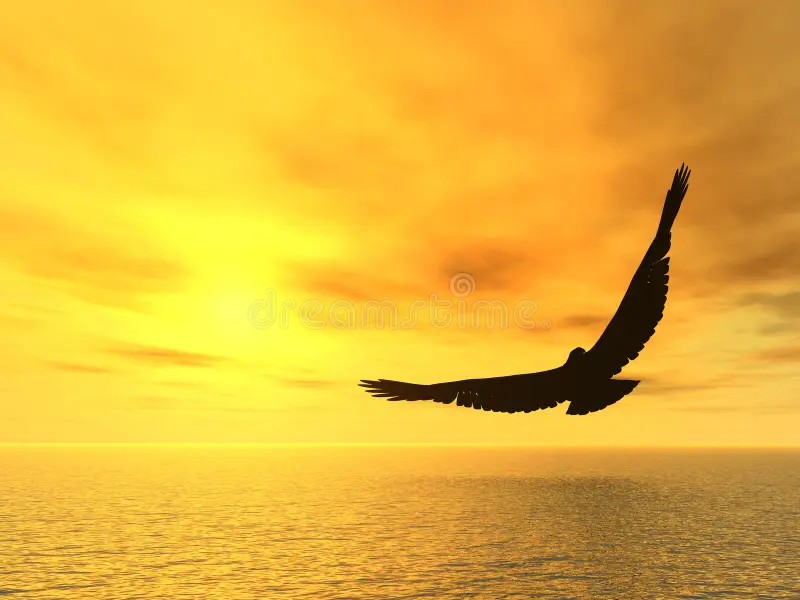
You are soaring now, Leaving sea and soil behind, Rising, light as breath, Into the waiting air.
Author’s Note
“Soaring” was born out of a meditation on freedom — not as escape, but as a movement of the soul that rises through surrender. The poem imagines transformation as both spiritual and earthly: where every step, every gaze, brings life into bloom. It carries echoes of resurrection, the breaking of boundaries between heaven and earth, the divine and the human.
In its rhythm, I wanted the language to feel both grounded and light — to rise naturally, as if the wind itself were carrying the voice. It is also a quiet farewell: to what binds, to what feeds, to what has been known. The act of letting go is not loss, but the beginning of flight.
May the reader feel, as I did while writing, that mysterious pull of grace — the invitation to rise, softly and without fear, into a larger breath of being.
At dawn—beneath the frozen moon suspended in the still air— I strike a match, and light a small flame before the Presence of the Lord who allows all things.
With trembling hands, I fasten my hunger, my frailty, to the belt of the Lord— and once again, I open the prayer box.
For the brother who sleeps with the dark in his arms, for the sister wading through the troubled tide, for the child whose growing stopped mid-summer, for all who have fallen among the thorns of sickness and sorrow—
Unless the sap still rises through the body, unless the knees touch both earth and sky, the meeting with the Lord is not yet complete.
So I pray— for the day you lift your face toward light, for the day I may become a stepping stone beneath your feet, for the day you walk alone yet unafraid.
And this small one— by the mercy of the Lord— opens the prayer box again before the closed gate of heaven.
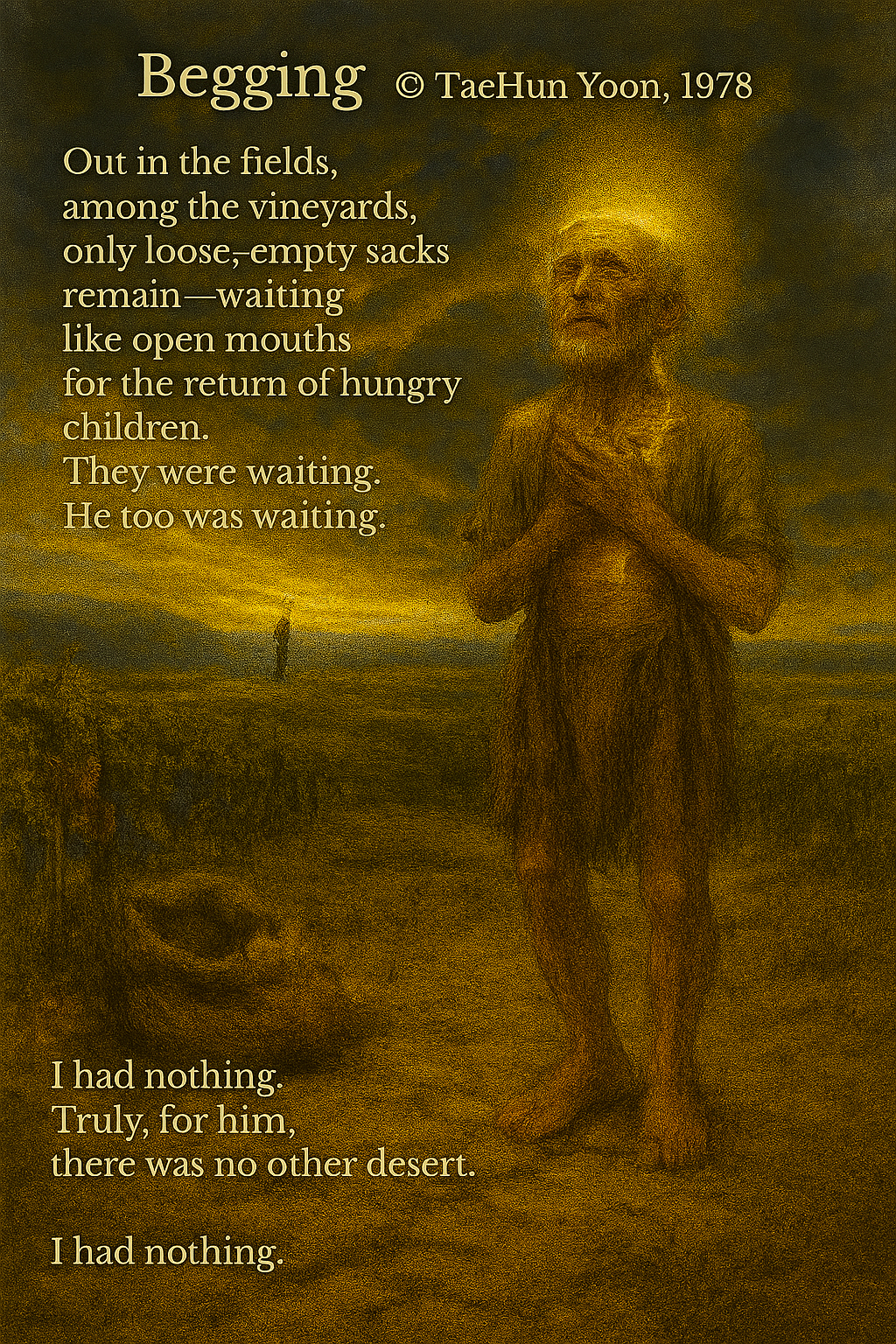
Beyond the stone wall, in fields that once held vines, only empty sacks remain— their mouths gaping, waiting for children who have not returned.
They waited. And he, too, waited.
I had nothing. Truly, for him, there was no other desert.
Freedom cried out— but hunger cried louder.
Now comes the most honest hour of day: on the hill’s crest, where a fisherman once cast his line into the throat of night, the ghosts begin to weep.
He watches light and shadow wrestle at the rim of the sky, and from that struggle, he tells his fable of the world— of those who sow, and those who take, and the earth that remembers both.
The seams of his skull split open, and through the cracks something thick and sweet as grass poured in— through brain and mouth and chest, to the trembling tips of his toes.
Now everyone has gone. Even the wind has learned silence.
I was truly hungry.
Author’s Note:
“Begging” was written in 1978, during a time when both body and spirit knew hunger. It arose from the sight of people waiting—waiting not only for bread, but for justice, mercy, and a word from God. In those fields of silence, I began to see that divine absence was not void, but a space where faith must learn to breathe. The poem is a cry, yet also a prayer—one that asks where God dwells when the world turns away from the poor. Through the language of emptiness and yearning, I sought to glimpse a sacred possibility: that every hunger, if lifted toward heaven, might become an altar of hope and transformation.
Author Bio:
Tae-Hun Yoon is a Korean-born poet and retired United Methodist pastor living in Knoxville, Tennessee. His poetry often explores the meeting ground between faith and social justice, memory and longing, silence and divine presence. Through his work, Yoon seeks a language of transformation—where hunger becomes hope, and the human cry becomes a prayer.
To welcome the Lord into my house is to begin with cleansing— to sweep the dust of long-forgotten corners, and lift each curtain that has hidden the truth.
In closets sealed by fear, I open the boxes— untie the cords of greed and pride, shake loose the dust of vanity, and feed them to the fire of repentance.
To welcome the Lord is to kneel at the threshold, where shoes once waited for forbidden roads. Now I set them aside, and slip on the sandals of purity and grace.
In the wardrobe of my heart, I fold away the garments of deceit and indulgence, the worn fabric of quarrel and lust, and dress myself instead in the bright linen of mercy and peace.
To welcome the Lord is to cleanse the kitchen— to pour away the overflowing cups of desire and excess, and fill the jars once more with the Word that satisfies.
Each mirror in each room must be polished clean, until the stains of envy and complaint are gone— and the naked face of life meets the gaze of grace.
The courtyard, too, must be weeded. Vanity and self-importance must be torn out by the roots, so that tender shoots of truth may grow in their place.
To welcome the Lord is to kindle light in every room, to pour the oil of patience into the weary lamp, and strike the match of prayer against the flint of faith.
At last, I open every door wide. The locks of honor, wealth, and power fall away— and only obedience remains to usher Him in.
Now the Lord dwells wholly within, and my house— once silent and dim— breathes again with His light.




 Daily Sauntering
You must be logged in to post a comment.