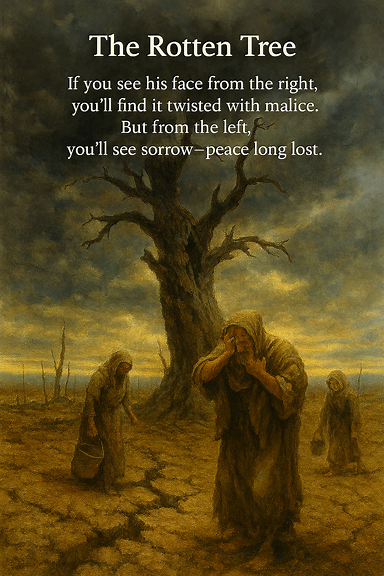
If you look from the right, his face is hard— twisted with something mean and small. But turn to the left, and sorrow shows, the kind that’s forgotten what peace is called.
The earth keeps what it knows best— hunger, thirst, and death beneath. And so we pray with trembling breath, “Let us walk this ground in peace.”
But the ground is never still for long; it splits beneath the surest feet. You are the quake, the breaking song, your grief the fault, your pulse the beat.
We, the hungry, gather grain from fields already stripped and dry. Men and women, children, rain— all wander where the furrows lie.
Don’t run too far; we’ll meet again, when dusk leans low across the plain. In sackcloth rough, with ashes spread, we’ll lift our eyes and bow our heads.
This world’s one tree, from root to crown, already hollowed through and down. And every thought we called our own— was crooked wood, from birth full-grown.
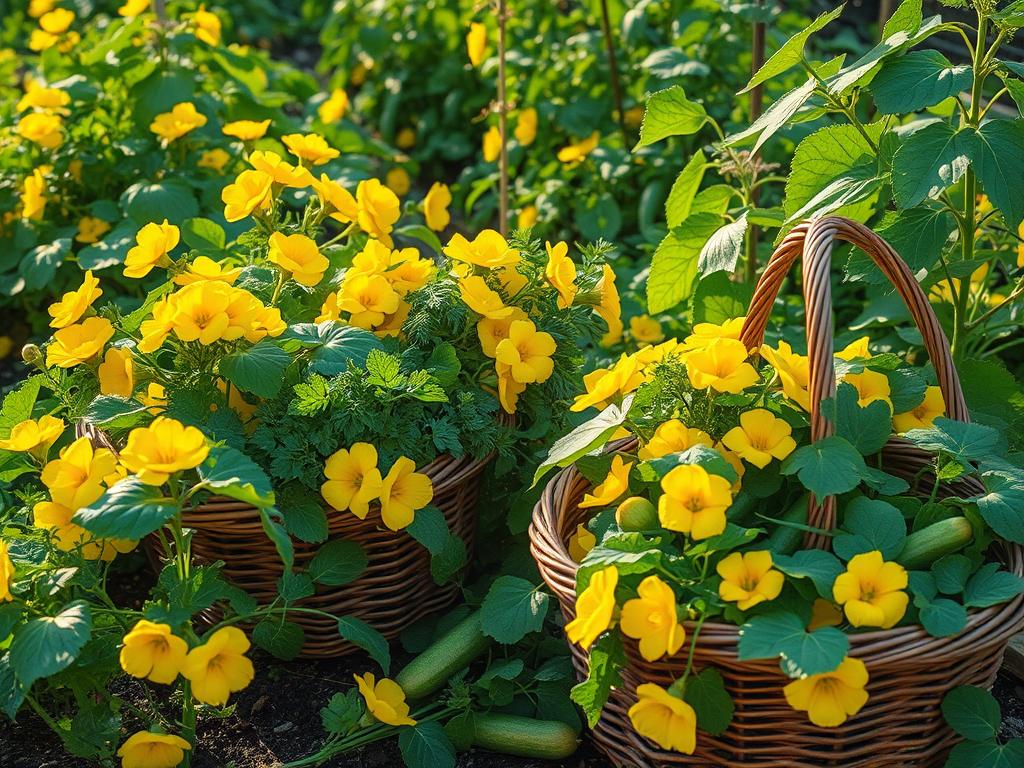
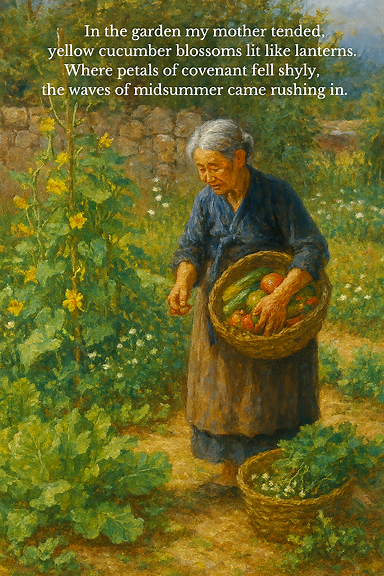
In the garden my mother tended, yellow cucumber blossoms glowed like lanterns. Where petals of covenant fell shyly, the waves of midsummer came rushing in.
She labored beneath the burning sun, her back bent to the Lord’s promise: “As you sow, so shall you reap.”
She unearthed stones, split the tangled roots of wild vines, pulled up weeds, thinned out stray thoughts.
Gathering fluttering lettuce leaves into her basket, I remember the long-haired girl with a ribbon, plucking stars into her chest as frogs sang through summer nights.
She crossed the barley-hunger hills, ran in straw shoes over the winding bends of Hwangdeung-ri, Jeolla— seventy years of paths behind her.
She never turned from the thirst of green sorrow, living a little slower, a little humbler than most.
When ants move their burdens in swarms, she knows the monsoon is near. When the moon wears a halo, she knows tomorrow will burn with heat.
Still, she heeds the Lord’s word: “As you sow, so shall you reap.” And with her hoe, she tills the soil of the heart without rest.
Life floods the garden like a river. Fragrance rises from it like a well.
And when I step into the garden my mother tended, her lifelong prayers bloom into fruit— overflowing the basket in my hands.
Forgive me, Lord, when I pray, “Give me!” yet share nothing of what I have with my neighbor in need.
Forgive me, Lord, when I plead, “Help me!” but never trust Your perfect will— wholly good, wholly kind.
Forgive me, when I gaze upon the Cross without the tearful yoke of love and sacrifice, yet say, “I am willing to bear it.”
Forgive me, when I long to be used by You, but refuse to be broken first into nothingness.
Forgive me, when I cry, “Make me obedient!” yet hold fast to my will, my desires unpierced.
Forgive me, Lord, when I say, “Let me serve You,” but do not receive the freedom Christ has already given.
Forgive me, when I cry, “Lead me!” yet boast in the sight of my own eyes, and not in Yours.
Forgive me, when I ask, “Forgive me!” but block the river of forgiveness that should flow through me.
Forgive me, when I pray, “Use me greatly!” without suffering, patience, or the quiet altar of the heart.
Forgive me, when I ask, “Bless me!” not to inherit heaven’s kingdom, but to gain a little more of the earth.
Forgive me, Lord, when I say, “I give all freely,” yet keep the best for myself, and offer You only what is left.
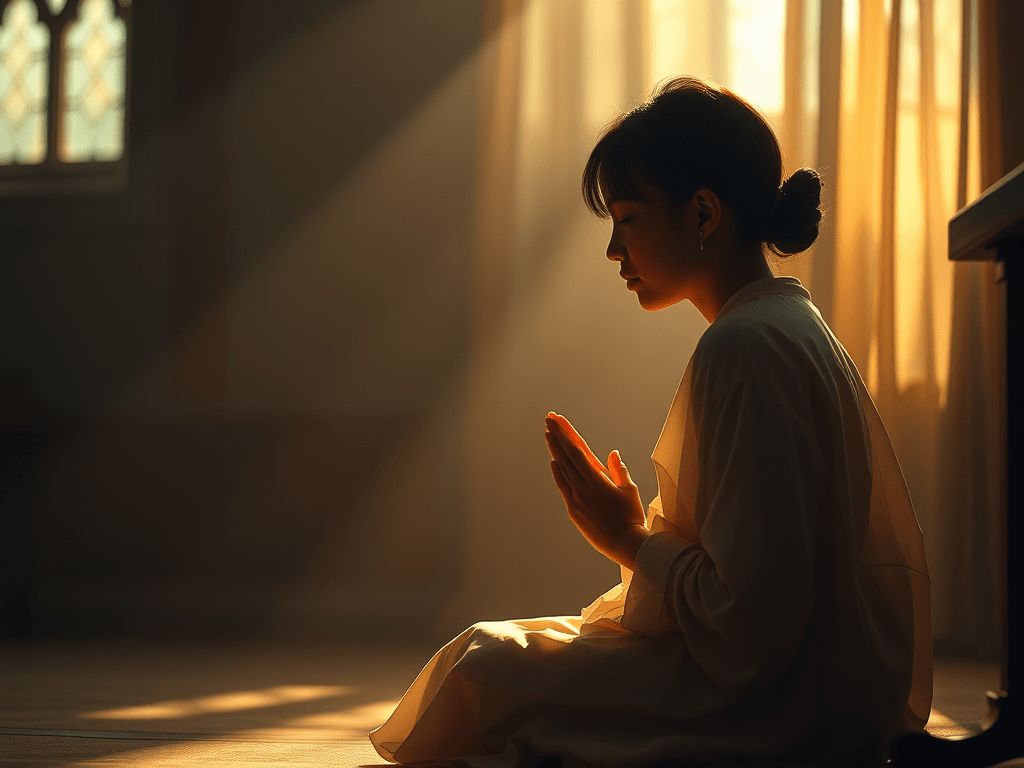
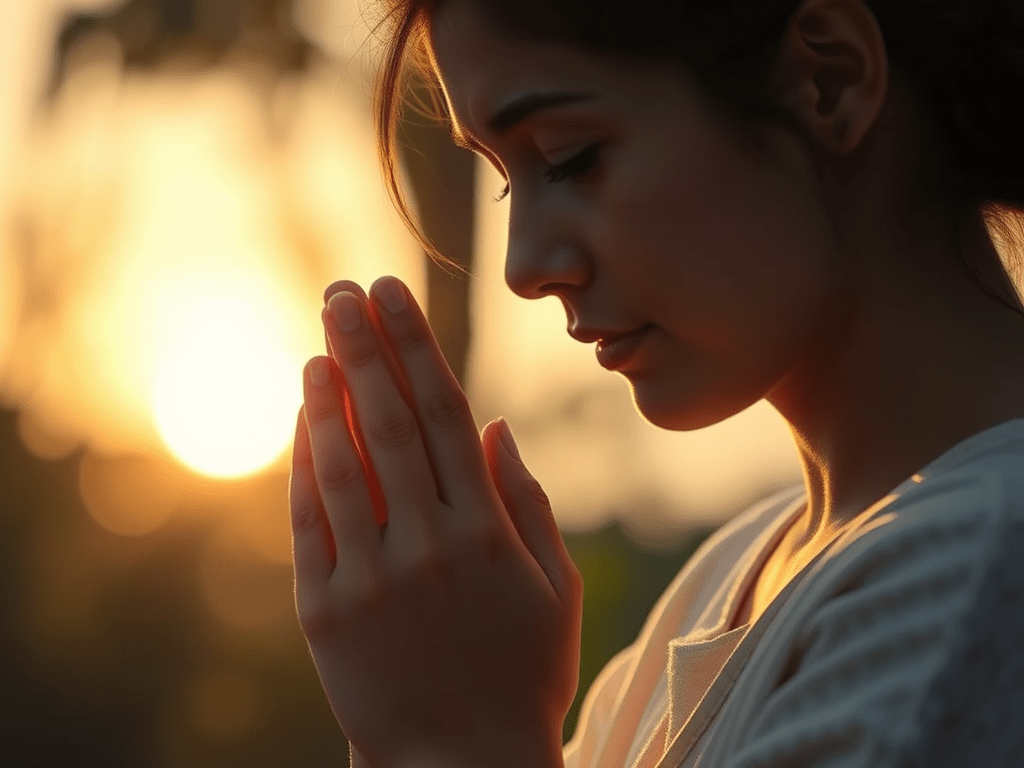
O Lord— let my prayer become true prayer. Teach me to say “Thank You” for what I have, for all You give. Clothe me in humility, and lift my eyes to heaven to say,
Among the young, there are some who already live as though they belong to the world of the old. Yet among the elderly, there are those who live with the freshness, vitality, and fulfillment of youth. When I speak with young people who have grown old in their minds, I often feel a heaviness in my chest. But whenever I meet elders who live youthfully in spirit, I find myself newly challenged and inspired.
In Long Island, New York, there lived an old man named Harry Lieberman. At the age of eighty, he began learning painting at a senior center. Four years later, he was acclaimed by critics and art lovers as “an unadorned Chagall.” He continued to hold exhibitions—his twenty-second solo show opened successfully under the title “Lieberman at 101.”
Lieberman often encouraged other elderly people, saying, “Don’t let your age control you. Think about what you can still do now—then act. That’s how you begin a new life and prove that you are still alive.” Through this conviction, he transformed himself into an artist no less creative than the young.
Not long ago, after more than ten years, I met an elderly church deaconess again. Now nearing eighty, she looked neither weak nor discouraged—on the contrary, she seemed brighter and healthier than before. When I asked her the secret, she smiled. Living alone in a senior apartment, she volunteers for other elderly people and records Chinese Bible readings for a Christian radio station. Though she might have complained that she spent her youth raising her grandchildren in America, instead she discovered a new calling. Her health improved, and her confidence in life returned.
There are others who sigh, saying, “Now that my children are settled and my grandchildren grown, I only want to go back to my homeland to die.” But if they would only find meaningful work where they are, I believe a new world would open before them. We cannot live as walking corpses, yearning only for the home of our memories while neglecting the life that is here and now.
Many people around us lose courage before they even begin. They think, “I’m too old now; it’s too late.” Or, “My children are still young,”“We’re not financially stable,”“I have no money,”“I have no time.” Even in faith, we excuse ourselves—“I don’t have enough belief,”“I don’t know how to pray,”“I’m too busy,”“I can’t understand the Bible.” In truth, these are often not excuses but declarations of surrender—like soldiers who give up a battle before stepping onto the field. Such defeat, born of fear rather than failure, makes any dream of victory impossible.
I am reminded of Dr. Kwon Young-jik, the first Korean to earn a doctorate while being fully paralyzed. In his testimony, he once shared how he struggled to confess his love to the woman who would later become his wife. Feeling hopeless in his condition, he decided to give up on her. But then a single, courageous thought rose within him: “Though I am paralyzed, what reason have I to love her less than any other man?”
That conviction became a banner of faith—one that led his beloved to thank God for giving her a man who could love her so purely. Today, Dr. Kwon not only lives as a devoted husband and father but also as a source of inspiration to those who, though physically healthy, live as if paralyzed in spirit.
If there is one blessing about life in America, it is this: through its welfare systems and opportunities, people can still build new dreams, even in later life. Some, unfortunately, fall into dependency and despair—but others, by using these same supports wisely, rise from poverty and reclaim a life of dignity.
Here, in this land we call home, the choice between defeat and renewal still lies within each heart.
As Scripture reminds us,
“Faith is the substance of things hoped for, the evidence of things not seen.” (Hebrews 11:1)
Regardless of age, it is a beautiful thing to keep one’s spiritual youth alive within faith. In a heart that never grows old, faith, hope, and love overflow—what more could one possibly desire?



 Daily Sauntering
You must be logged in to post a comment.