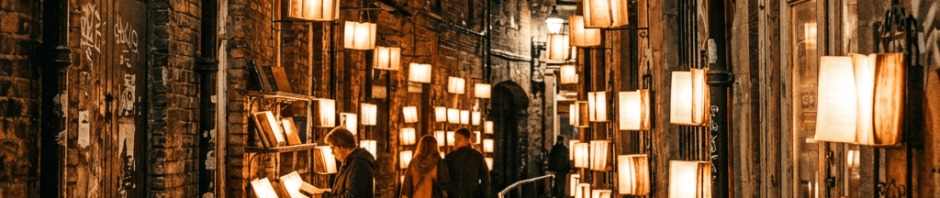
In the narrow alley of Manggmi‑dong*, where evening settled softly upon old books, a quiet voice refused to disappear. Long before I met him— long before June in Daegu brought his presence close enough to change the temperature of my heart— he had already become a lamp in the winter of a nation.
History says the 1970s in Busan were a crucible— a city where democracy was still learning how to breathe. Research tells us that Middle Church, under Rev. Choi Sung‑mook, was a spiritual headquarters, and the book alley nearby a cultural artery where students, pastors, and weary dreamers gathered beneath the watchful eyes of the state.
But I know this story not only from archives. I know it because I lived on the second floor of that alley— a young assistant pastor, sleeping beside stacks of books, listening to footsteps on the stairs that could be students or soldiers.
And in that narrow space, Kim Hyung‑Gi held books as a farmer holds seed— trusting that what is planted in faithful hearts will one day rise as a harvest of justice.
He often said, “Books are small lamps. When winter covers a nation, even one lamp keeps hope alive.”
But darkness heard him first.
Heavy boots climbed the stairway. Voices accustomed to command filled the room.
“You gather students. You read forbidden books. You plant rebellion. Is this not treason?”
Silence lingered— the kind that trembles before courage speaks.
“What is treason?” he answered. “Is truth an enemy of the nation? Or does a nation betray itself when it fears its own people?”
The answer was followed by blows. Fear always speaks with clenched fists when it cannot answer truth.
History records three days of interrogation— walls without mercy, windows without light, Emergency Measure No. 9 casting its long shadow over a nation taught to whisper and hide its own conscience.
But my memory adds another layer: the lamps above Busan that refused to go out. Students gathered. Books opened. Ideas crossed from heart to heart. No prison could arrest the freedom of thought.
I saw it myself— the 양서읽기 모임 growing from quiet reading into weekly journeys to Masan Prison, where we visited Kim Dae‑jung. I watched as courage became contagious, as buses were stopped, as students were dragged away, as the spark of 부마항쟁 rose from the dust of our book‑lined room.
Kim Hyung‑Gi returned— not carrying resentment, but responsibility.
“Let us build a house for books,” he said. “A place where conscience may grow freely, where knowledge becomes bread, where neighbors learn together how to become citizens.”
So shelves rose quietly within Bosu‑dong Book Alley— not as monuments, but as living trees whose branches offered shelter to every seeker of truth.
Students came. Teachers came. Workers came. Pastors came. Poets came. Each carrying questions. Each departing with greater hope.
History moved again. Buses stopped. Streets filled. Hands joined hands. The voices of ordinary people became the heartbeat of democracy.
Many suffered. Many were imprisoned. Some gave everything.
Yet conscience had already awakened. And conscience awakens another conscience.
A just society is never born all at once. It begins inside one honest heart. It grows through one faithful life. It passes from generation to generation like a lamp carried carefully through the darkness.
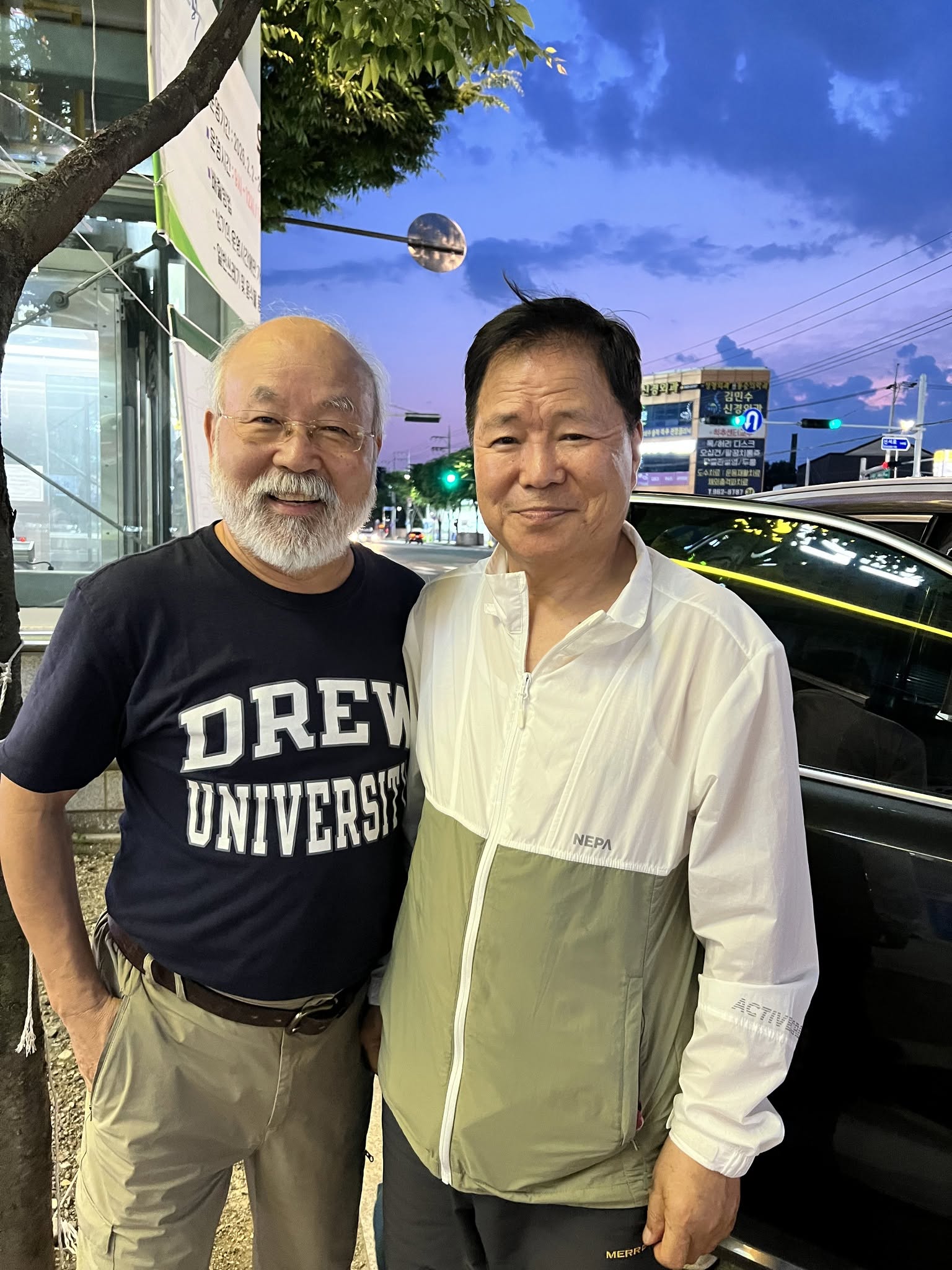
And now— across the Pacific, decades later, after meeting him only once in June in Daegu— I find myself missing him as one misses a brother of the spirit, a companion in the long walk toward justice.
Even now, if you walk the quiet alley of Bosu‑dong, listen carefully. You may still hear the gentle turning of old pages. You may still feel the warm breath of those who believed that truth need not shout to change history.
For every book opened with courage, every conversation held with integrity, every conscience that awakens another— becomes one more light guiding humanity toward the beloved community God has always dreamed for the world.
-TaeHun Yoon, August 5, 2026 (Edited on 8/6/2026)
*Manggmi-dong – The Martial Law Command (Defense Security Command) Busan Branch — commonly known as “Sam-il Gong-sa, Three One Cooperation.”
**Kim Hyung‑Gi (1952– )
Rev. Kim Hyung‑Gi, an alumnus of the 80th class of the Presbyterian University and Theological Seminary (PUTS), has been appointed as the 7th Chairperson of the Committee for Truth Investigation and Restoration of Honor for the Busan–Masan Democratic Uprising, serving a two‑year term.
Kim’s journey into democracy and human rights began in the early 1970s, when he was a student at Seoul National University of Education. During that period, he took part in the funeral organized by Christian students after the self‑immolation of Cheonggyecheon laborer Jeon Tae‑il. Soon after, he became active in the college ministry of Saemunan Presbyterian Church, and from that point forward, he has lived his entire life as a pastor committed to democracy, human rights, and Christian faith.
After graduating from university, Kim was arrested in 1974 for involvement in the Mincheonghakryeon (National Democratic Youth and Student Federation) incident and for violating Emergency Measure No. 4. The Supreme Court sentenced him to 12 years in prison and 12 years of disqualification, and he served time as a political prisoner. He was released on a stay of execution and was fully pardoned and reinstated in 1983. Only in 2009, through a retrial, was he finally declared innocent—officially recognized as a contributor to Korea’s democratization movement.
Busan, the political home of former President Kim Young‑sam, was at that time a gathering place for many democracy activists. Kim worked as a clerk in the law office of attorney Kim Kwang‑il, who later served as Chief Presidential Secretary, and through that role he became deeply involved in the Busan democratization movement.
Within the Busan church community, Kim worked alongside prominent leaders such as the late Rev. Choi Sung‑mook of the Presbyterian Church in the Republic of Korea (PROK) and Rev. Cha Seon‑gak. Together, they spearheaded the founding of the Busan Yangseo Cooperative, integrating cooperative activism with community engagement. Their efforts received strong support from the local society and became an influential model of faith‑based civic participation.


 Daily Sauntering
You must be logged in to post a comment.