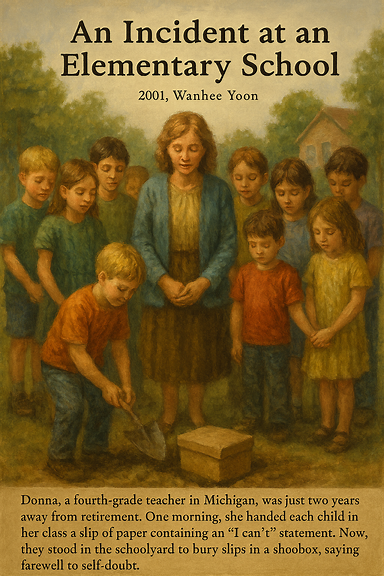
미시간 주의 어느 초등학교 4학년을 담임하고 있는 도나(Donna) 선생님은 2년 후면 은퇴하실 분이었습니다. 어느 날 아침, 선생님은 아이들에게 한 장의 하얀 종이를 나누어주셨습니다. 자, 여러분 이 종이 위에 그동안 나는 할 수 없다! 라고 생각했던 것들을 모두 적어 보세요. 예를 들면, 나는 몸이 약해서 풋볼 팀에 절대 들 수 없다, 나는 노래는 할 수 없다, 나는 절대 축구 팀의 골키퍼가 될 수 없다 등등을 적어보세요.”
아이들은 열심히 종이에 적기 시작하였습니다. “나는 볼을 학교 운동장 울타리 너머에까지 차진 못한다.” “나는 쿠키를 한 개 이상은 못 먹는다.” “나는 팔굽혀펴기를 10번 이상은 할 수 없다.” “나는 바이올 린은 할 수 없다.”
도나 선생님도 아이들과 함께 열심히 종이에 적기 시작했습니다. “나는 존의 엄마를 학부모 회의에 한 번도 참석시킬 수 없다.” “딸 아이는 차에 가스를 채울 수 없다.” 도나 선생님과 아이들의 빈 종이가 가득 채워져 갔습니다.
“다 쓴 사람들은 이 상자에 넣기 바랍니다. 선생님은 빈 구두 상자 를 보이셨습니다. “자! 우리는 지금부터 ‘나는 할 수 없다! 라는 자신의 생각을 오늘 장례하겠습니다. 모두 나를 따라오세요!” 도나 선생님은 어리둥절해하는 아이들을 데리고, 운동장 한켠의 잔디밭으로 인도 했습니다. 그리고 준비된 삽으로 작은 구덩이를 판 후에 나는 할 수 없다! 라는 종이가 든 상자를 구덩이에 넣었습니다. 그리고 선생님은 삽자루를 쥐고 흙을 한 삽 뿌렸습니다. 아이들에게 삽자루가 돌아왔습니다. 아이들도 흙을 한 삽씩 떠서 상자 위에 뿌렸습니다. 선생님은 상자가 묻혀 있는 구덩이를 중심으로 아이들에게 서로 손을 잡고 동그랗게 둘러서게 하였습니다
“다같이 머리 숙입시다. 오늘 우리는 그동안 우리 생활 속에서 가장 가까이 지냈던 ‘나는 할 수 없다’ 의 업적을 기억하며 여기에 모였습 니다. 그의 생애는 모든 공공기관과 학교, 시청, 백악관에까지 영향을 끼쳤으며 세계 곳곳마다 그의 이름이 닿지 않는 곳이 없었으며, 모든 사람들의 절친한 친구였으며, 누구나 그를 사랑했습니다. 그러나 오늘 우리는 그가 이곳에서 평안히 잠들 수 있도록 자리를 마련했습니다. 그동안 그로 인하여 ‘나는 할 수 있다! 나는 바로 시작한다! 의 형제들은 우리 생활에 아무런 영향을 끼칠 수 없었습니다. 그러나 오늘 ‘난 할 수 없다!’ 가 이 자리에 영원히 잠들므로, ‘난 할 수 있다!’가 우리 삶에 강력한 영향을 끼칠 것이며 새로운 세계가 열리게 되었습 니다. 이제 우리는 ‘나는 할 수 있다!’와 함께 내일을 향해 힘찬 발걸음을 내딛게 되었음을 감사드립니다. 아멘:
도나 선생님은 아이돌과 함께 교실에 돌아와, “나는 할 수 없다’의 죽음을 애도하는 뜻에서 쿠키와 과일 화채로 파티를 열었습니다. 그리고 선생님은 두꺼운 종이에 묘비명을 그린 후 “나는 할 수 없다, 여기 평안히 잠들다”라는 글귀를 쓴 후에 교실 한쪽에 붙이셨습니다.
그 후, 아이들이 어려운 시험이나 수학 문제로 “난 할 수 없어요.”라고 말할 때마다 교실에 붙어 있는 묘비명을 말없이 가리키며 아이들 에게 용기를 주었습니다. 도나 선생님의 교육을 받은 학생들은 어려운 일에 부딪칠 때마다 교실벽에 붙어 있던 묘비명을 늘 기억하곤 했습니다.
성경의 달란트의 비유(마 25 : 14~30)는 우리에게 큰 교훈을 줍니다. 어느 주인이 타국에 잠시 가기 위해, 자기 소유를 종들에게 맡깁니다. 주인은 종들의 능력대로 달란트를 주고 떠나갔다가 돌아와 계수를 시작합니다. 다섯 달란트를 맡은 이는 다섯 달란트를, 두 달란트를 맡은 사람은 두 달란트의 이문을 남겨, 주인 앞에 자랑스럽게 내어 놓습니다.
그러나 한 달란트를 받은 사람은 주인에게 와서 이르기를 “주인이시여! 저는 이 한 달란트를 잃어버릴까봐 두려워하여 땅에 묻었었나이다. 여기 당신 것을 다시 가져왔으니 받으소서!”라고 했습니다. 주인은 화를 내며 말하기를 “이 악하고 게으른 종아! 내가 심지 않은데서 거두고 헤치지 않은 데서 모으는 줄 네가 아느냐? 차라리 내 돈을 빌려주어 이자라도 받았어야 되지 않았느냐? 이 무익한 종을 바깥 어두운 데로 내어 쫓으라!”라고 명하십니다.
여기서 종들은 ‘나는 할 수 있다!’ 와 ‘나는 할 수 없다!’ 의 생의 자세를 배우게 됩니다. 실패를 두려워하지 않고 믿음 안에서의 결단과 시작에서만이 기적은 일어날 수 있으며, 두려움과 소극적인 삶의 태도는 우리에게 결국 실패라는 결재를 내리게 됩니다.
저 자신도 지나간 생애의 굽이굽이 길마다 ‘나는 할 수 없다!’ 의 영향을 누구보다도 많이 받으며 살았었습니다. 변명과 구실의 전문 대변인이라도 된 듯이, 무슨 일을 시작하기도 전에 ‘난 할 수 없어!’ 하고 자신에게 속삭이곤 하였습니다. 그런데 어느 날, 내 인생의 최고의 스승이신 주님께서 저를 가르치시기 시작하였습니다. 더 이상 ‘나는 할 수 없다!’ 에게 빼앗길 시간이 없음을 깨닫게 되었습니다. ‘내게 능력 주시는 자 안에서 능치 못할 일이 없음’을 알게 되었습니다. 주님이 함께하시는 나의 삶엔 두려움이 없어졌습니다.
도나 선생님의 훌륭한 믿음의 향기는 어린 학생들의 삶에 잊을 수 없는 감동을 불러일으켰습니다. 오늘도 우리의 삶이, 교회가, 사회가 ‘나는 할 수 없다!’ ‘우린 할 수 없다!’ 에 발목이 붙들려 발걸음을 옮기 지 못하고 있진 않습니까? 도나 선생님의 교실에 걸려 있는 묘비명을 기억하시며, 삶의 교실에도 묘비명을 걸어보십시오. 그리고 “내게 능 력 주시는 자 안에서 난 할 수 있다! 우린 할 수 있다!” 하고 믿음으로 나아가 보세요. 기적이 일어납니다. 당신은 어느덧 삶의 구경꾼이 아니라 삶의 주인공이 되실 것이며, 역사를 이끌어 가는 작은 그리스도가 되어 이 어두워지고 무력해져 가는 세대에, 소망의 빛을 전달하게 될 것입니다.
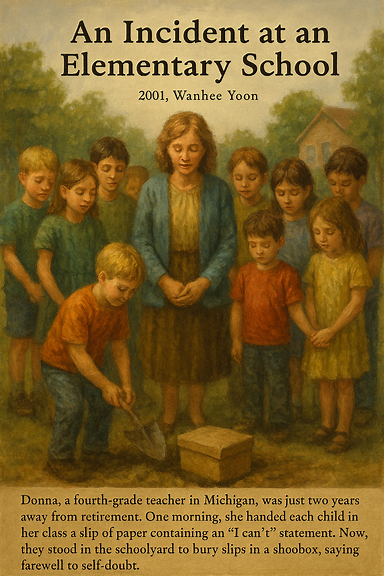
Donna, a fourth-grade teacher in Michigan, was just two years away from retirement. One morning, she handed each child in her class a blank sheet of white paper.
“Now, I want you to write down all the things you believe you cannot do,” she said. “For example: I can never make the football team because I’m too weak. Or, I can’t sing. Or, I could never be the goalkeeper on the soccer team. Go ahead—write down anything you’ve ever thought you couldn’t do.”
The children quickly filled their papers:
“I can’t kick the ball over the school fence.”
“I can’t eat more than one cookie.”
“I can’t do more than ten push-ups.”
“I can’t play the violin.”
Donna also joined in, writing her own “I can’ts”:
“I can’t get John’s mother to come to a parent meeting.”
“My daughter can’t put gas in the car.”
Before long, every sheet of paper was filled.
“Now,” Donna said, holding up an empty shoebox, “everyone put your papers in this box. Today we are going to bury our ‘I can’ts.’”
She led the puzzled children out to the schoolyard, where she had already prepared a small hole in the ground. The box full of “I can’ts” was placed in the hole. Donna dropped in the first shovelful of dirt, and then each child, one by one, did the same.
When the box was buried, the children stood hand in hand around the little grave. Donna spoke with a gentle, serious voice:
“Bow your heads. Today we gather to remember the life of ‘I can’t.’ He lived with us for many years. He influenced every public office, every school, even the White House. He was a close friend to everyone and was loved by all. But today, his life has ended. From now on, his stronger brothers, ‘I can’ and ‘I will,’ will influence our lives. A new world has opened for us, because today ‘I can’t’ has been laid to rest. Let us be grateful, for now we can move forward with confidence. Amen.”
Afterwards, the children returned to the classroom. Donna held a small “funeral party” with cookies and fruit punch. She then wrote an epitaph on heavy paper and posted it on the classroom wall:
“Here lies ‘I can’t.’ May he rest in peace.”
From that day on, whenever a student faced a difficult exam or problem and said, “I can’t do this,” Donna would quietly point to the epitaph. The children never forgot that day, and many carried its lesson into adulthood.
The Bible’s Parable of the Talents (Matthew 25:14–30) teaches us something similar. The master entrusted his servants with talents according to their ability. Two servants invested what they were given and doubled their talents. But one servant, out of fear, buried his one talent in the ground. The master called him a “wicked and lazy servant” and cast him out.
Here we see the contrast between “I can” and “I can’t.” Only those who act in faith, unafraid of failure, experience the miracle of growth. Fear and passivity, on the other hand, bring only loss.
I myself have often lived under the influence of “I can’t,” making excuses before I even began. But one day, my greatest Teacher—our Lord—showed me the truth: I no longer had time to waste with “I can’t.” In Christ who strengthens me, nothing is impossible. Fear disappeared when I realized He was with me.
The fragrance of Donna’s faith has left an unforgettable mark on her students’ lives. And what about us—our families, our churches, our society? Are we still trapped by “I can’t” or “We can’t”?
Remember the epitaph in Donna’s classroom. Write one for your own life. Then say with faith:
“I can do all things through Him who strengthens me.”
When you believe it, miracles will happen. You will no longer be a spectator of life—you will be a true participant, even a small Christ, bringing light and hope to this weary and broken generation.
A star did not hide its trembling light, and on the branches where dawn rested, before the ripe persimmon fell, on one autumn morning— a child was born.
It was autumn, a morning at ten, dew resting on the hill, birds winging fresh songs through sky and branches, apples falling one by one, while God dwelt in heaven— and the earth was at peace.
I long to see Semi, to hear her voice— to teach me joy, to show me peace, to bring me mercy in my fears, comfort in my pain. My heart is held captive by her.
I long to see Semi, to behold the overflow of God’s mercy and love, His power, His promised compassion that holds me fast.
In the beauty of mercy’s glow, in the peaceful breath of life, I long to see Semi’s face.
Look upon us! Look upon us! Look upon us! O incomparable One!
Semi—overflowing with light.
Please! Turn Your kind and gentle face toward me, show me my blessedness.
The One I once longed for in ages past— now Semi has returned.
Oh! Blessing beyond all measure, beyond every expectation!
I come to a quiet and safe place. Alone. Still. Present.
Yesterday lingers: my heart restless, my mind chasing news from Korea, my soul unsettled by heavy rains. My eyes blurred, my memory faltered, my spirit wandered.
Two movements stir within me: to recall the past, or to rest in God’s presence now. I choose the present— to seek God here, not cling to yesterday’s shadows.
I pray with Sundar Singh:
“The world is so vast, yet it cannot satisfy the tiny human heart. Only in the Infinite God is peace found. As water is restless until it reaches its level, so the soul finds rest only in God.”
I lift my heart with George Matheson:
“Make me a captive, Lord, and then I shall be free. Imprison me within Your arms, and strong shall be my hand.”
[LECTIO – Reading the Word]
I breathe deeply. I open the Word: Psalm 103.
The words fall gently upon my soul:
“Let my whole being bless the Lord! Let everything inside me bless His holy name!”
“He forgives your sins—every one. He heals your diseases—every one. He redeems your life from the pit. He crowns you with love and mercy.”
“As far as east is from west, so far has He removed our sins from us.”
“As tender as a father with his children, so the Lord has compassion for those who fear Him.”
“All God’s creatures, bless the Lord! Everywhere, throughout His kingdom, let my whole being bless the Lord!”
The words echo: “Bless the Lord, O my soul, and forget not a single blessing.”
[MEDITATIO – Reflecting on the Word]
I let the words sink deeper. David’s psalm is both praise and memory— a festival song, a hymn for all creation.
God’s love is not distant. It is active, tender, unending. He forgives. He heals. He redeems. He crowns. He renews.
How easily I dredge up the past— old wounds, old sins. But God wipes the record clean.
To follow Him, I must forgive as He forgives— fully, freely, forgetting the sin.
We are fragile like grass, but His mercy endures forever.
St. Augustine reminds me:
“If we do not recognize our sins, we cannot receive grace.”
Yet in God’s mercy, even weakness is gathered up, transformed by compassion.
[ORATIO – Praying the Word]
So I pray:
Lord, let Your Word not only enter my ears, but my soul.
Your anger is not vengeance— it is justice tempered by mercy. Only the Cross reveals Your eternal love.
You know my weakness, my hidden impatience, my restless heart. And still, You embrace me.
All creation sings with joy— the wind, the trees, the stars.
Jonathan Edwards once said:
“The whole world rejoices and sings, embracing one another in love.”
So may I, too, rejoice in You.
[CONTEMPLATIO – Resting in the Word]
I enter silence. No words. No images. Just being with God.
Two pictures arise within me:
(1) A frame hangs on the wall— inside it, a painting of nature. When I step back, the frame becomes part of the landscape.
(2) I sit quietly with my two dogs. Simple. Peaceful. Loved.
I do not force meaning. I simply rest.
There is work to do— lawns to trim, gutters to clean, choir to prepare for.
But in this moment, I have peace. I have a home. I have God.
[INCARNATIO – Living the Word]
I open my eyes. I breathe again—slowly, deeply.
I lift my heart with the hymn:
“Draw me nearer, blessed Lord, to the cross where You have died. Draw me nearer to Your bleeding side, where love flows without end.”
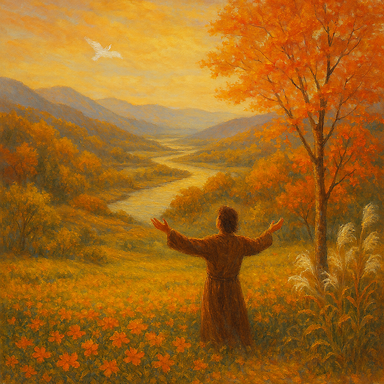
이 가을, 내 영혼 한 마리의 새가 되어 산야를 날아봅니다. 하나님의 솜씨 어찌 그리 아름다운지요! 산의 능선과 들녘, 강줄기따라 흘러 넘치는 오색 축복의 잔치, 기쁨의 빛으로, 평화의 물결로, 사랑의 폭죽으로 불타고 있나이다. 수려한 산등성이와 바닷가 갈대 숲을 걸으시는 주님의 옷자락 스치는 소리, 찬양하는 갈잎들과 갈대의 노래, 들국화 춤의 향연이 골짜기마다 물결을 이루며 거룩하다! 거룩하다! 주님의 솜씨 거룩하다!” 하며 기뻐하고 있나이다.
주여! 보시옵소서! 피조물들의 경배를 … …. 아침과 낮, 저녁과 밤을 통하여 주께서 일년 내내 베푸신 햇살의 풍성함과 단비의 촉촉함과 청명한 이슬과 천둥 번개로 무르익은 향기로운 단맛의 과실들이, 가지마다 휘청하게 매달리어 찬미의 합창을 부르고 있나이다. 한 입에 물씬 깨물리는 붉게 물든 단감과 탐스러운 포도송이의 단물 속에서 당신의 속삭이시는 사랑의 고백을 듣나이다. 인간이 무엇이기에, 사람이 무엇이기에 당신의 성실하시고 지극하신 사랑, 그토록 진하고 향기로우며 달콤하옵니까?
아름다우신 주여! 요즈음엔 어디를 가든지 당신의 모습뿐입니다. 찬서리 내린 이른 아침에 유유히 물위를 헤엄쳐 가는 백조의 모습 속에 당신의 우아함을 뵈오며, 코스모스 가는 허리 높이 펴고 방긋거리는 해말간 웃음, 속에 당신의 순결하심을 뵈옵나이다. 낙엽쌓인 숲속을 장난질치며 질주하는 다람쥐들의 빠른 걸음 속에 당신의 쾌활하심을 뵈오며, 저 높고 높은 하늘의 뭉게구름 떠오름 속에 당신의 인자를 뵈옵나이다. 들녘, 농부의 손길을 기다리고 있는 노오란 옥수수 단에서 당신의 풍요를 뵈오며, 우수수 흩어져 내리는 낙엽을 흔드는 바람 속에 당신의 손길을 뵈옵나이다.
전능하신 내 주여! 이젠 뉘엿뉘엿 서산에 넘어가는 붉은 노을을 바라보면서도 슬프지 않은 것은, 당신이 그 어느 때보다 가까이 와 계심 입니다. 주룩주룩 내리는 가을 빗속을 옷이 젖도록 걷고 걸어도 외롭지 않은 것은 당신의 관용이 온몸에 가득함입니다.
나의 왕, 나의 주님이시여! 떨어지는 낙엽을 밟으면 언제나 흐르는 뜨거운 눈물이 있사오니, 못다한 날들과의 이별과 회한의 눈물이 결코 아니옵니다. 그 눈물은 위대한 당신의 언약 앞에 이 연약한 인간이 두 팔을 벌리고 감격하는 환희의 눈물입니다.
주여! 지난날의 게으름과 용기없음과 덧없는 허무에 사로잡혀 귀한 세월 허송하였음을 용서 구하기도 전에, 당신은 어느덧 나를 용서하시고 받아 주시옵기에 염치없는 얼굴로, 눈물을 닦으며 다시금 당신께 향하곤 하옵니다.
나의 하나님, 나의 아버지시여! 이 산야에 오색으로 타오르는 불덩이 속에 호렙산 가시불 앞에 선 모세를 생각하며 떨리는 가슴으로 하늘을 우러러봅니다. 당신은 언제나 불이시며 빛이시옵니다.
소멸의 불이 아니요, 생명의 불로 오시는 이여! 말씀하소서. 이 가을엔 당신의 감추인 비밀을 내게 말씀하옵소서. 이 작고 무지한 생명이 감당하기엔 너무나 엄청난 주님의 뜨거운 가슴을 안고 무릎 꿇었사오 니 말씀하소서!
팔씀이 육신이 되어 생명의 빛으로 오신 이예! 영접하오니 나의 가장 깊고 깊은 곳으로 오시옵소서, 나의 냉기어린 빈 땅에 오시옵소서,
오늘도 사람을 위해 베풀어 주신 당신의 사랑은 창고마다 가득할진대, 정작 마땅히 베풀어야만 했을 나의 사랑은 변변치 못하였음을 어찌하오리까? 당신의 가슴은 지금도 자식과 남편을 잃은 르완다 여인과 함께 빨갛게 타들어가고 있으며, 굶주린 독수리 한 마리 광아에서 죽어가듯, 죽어가는 소말리아의 어린것들과 함께 노오랗게 굶주려 가고 있건만, 내 가슴은 아직도 설익어 퍼렇기만 함을 이 가을날 고백하 옵나이다.
앞뜰과 뒤뜰, 산골짜기마다 쌓여가는 낙엽조차도 그냥 내버려두시지 않으시고, 흩으시며 모으기도 하시며 흙으로 돌아가는 날까지 돌보시며 거두시는 주여! 높고 높은 빈 나뭇가지 꼭대기에 덩그러이 남게 될 새들의 둥지를 지키시고, 벌거벗은 산짐승들을 먹이시며, 상한 갈대를 꺾지 않으심같이, 내 수치와 자애 (자신 만을 사랑 함) 조차도 결코 꺾지 않으시고 무르익기를 기다리시옵니다.
주여! 한 해 동안의 시련과 고난을 넉넉히 이겨 나갈 수 있는 은총을 허락하시고, 생명의 처소에 쏟아지는 별빛으로 내 영혼의 어둠 밝히시며 열매마다 미래를 심으셨사오니 감사하옵나이다.
이 가을! 내려덮이는 낙옆 속에 내 영혼의 겹겹이 쌓인 껍질들을 미련없이 벗어놓습니다. 그리고 벗은 몸으로 또 하나의 거룩한 약속을 위하여 묵묵히 겨울로 떠나가는 나무를 닮고 싶습니다.
나의 주님이시여! 이 가을, 주님이 지으신 산야의 성소가 가슴 뭉클 하도록 참으로 곱고 아름답게 물들었습니다. 인간에게 당신의 가장 아름다운 것으로, 가장 풍성한 것으로, 가장 소중한 것으로 주시기를 즐겨 원하시는 주여! 이 생명의 찬양 받아주시옵소서! 아멘.



 Daily Sauntering
You must be logged in to post a comment.