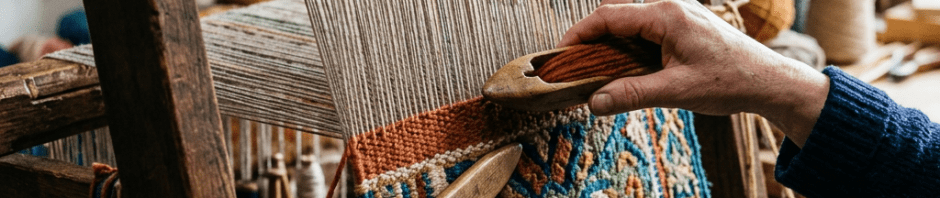
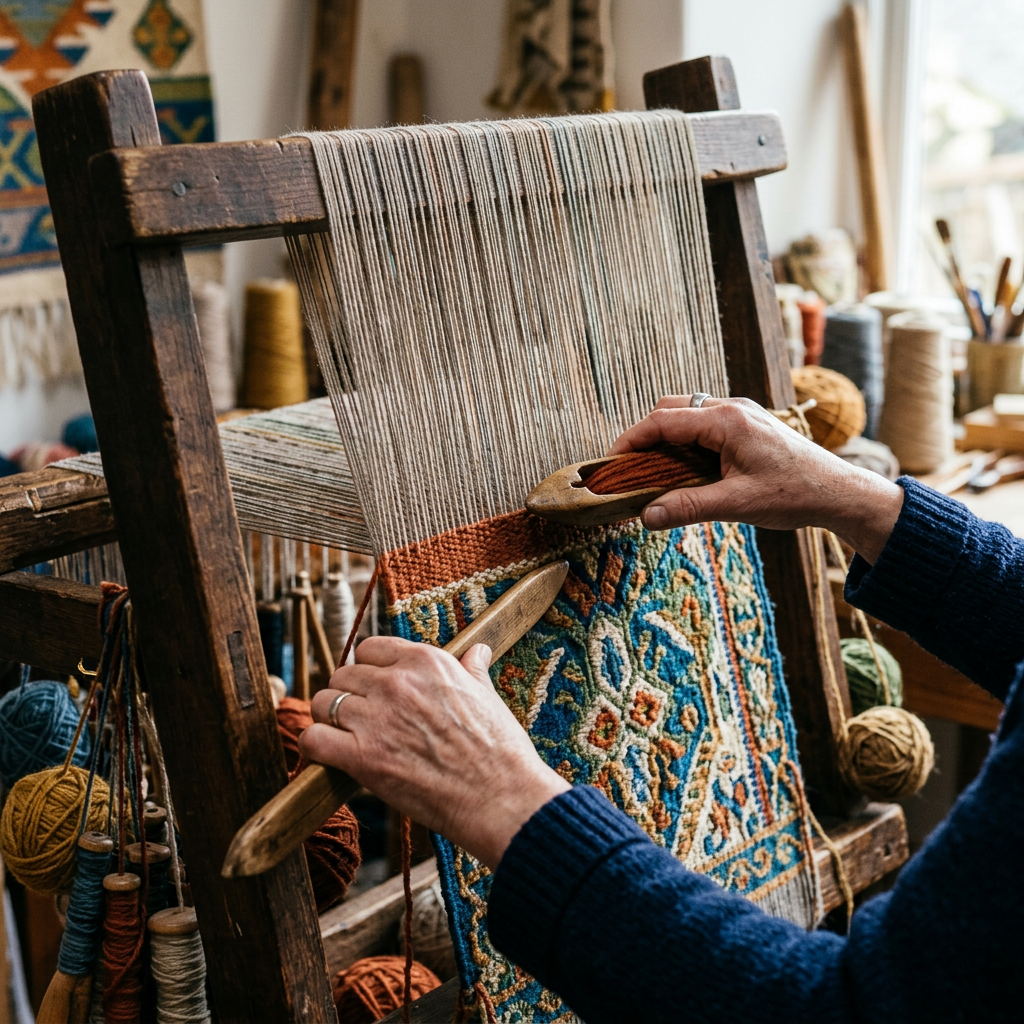
One day, while organizing the house, I came across several skeins of knitting yarn. Red, yellow, white, black—beautiful colors that had been waiting quietly in a dark corner for a long time, hoping to be used by their owner’s hands. Seeing them reminded me how long it had been since I last sat down calmly to knit a blanket or a sweater. I remembered those early years of marriage—pregnant, waiting for my husband to come home—when I spent many peaceful hours knitting. Some of those pieces still remain: a small baby blanket, a wall hanging of Millet’s Angelus, and another of a tiger roaring in a bamboo forest. Whenever I look at them, I marvel: “How did I ever finish something that took so much time?” And I realize that in every season, God allows us to create certain works within His providence.
As I looked at the leftover yarn, it struck me that no matter how beautiful the color, thread that is never used becomes something pitiful—full of potential but never fulfilling its purpose. That thought led me into a deeper meditation.
The raw materials for thread come from many places: cotton from the earth, silk from silkworm cocoons, fibers from plants, and synthetic fibers made by human hands. There is also wool from sheep and mohair from angora goats. All of these exist because God, in His wisdom, provides what humanity needs and gives us the creativity to use them well. Depending on how we use them, these threads can become works that last for generations—or they can be used briefly and discarded.
Ephesians 2:21–22 says:
“In Christ the whole building is joined together and rises to become a holy temple in the Lord. And in Him you too are being built together to become a dwelling in which God lives by His Spirit.”
Whenever I read this passage, I think: Are not God’s people the holy threads of His history? Where believers are present, there is possibility. Scattered pieces are woven together. Wounds are wrapped and mended. Where there is cold, believers become warmth and shelter. Even after enduring the harsh coldness and loneliness of the world, when we meet fellow believers, we find comfort and joy—because God uses His people as His instruments.
Dr. Martin Luther King Jr. once said, “A calling without sacrifice and passion is sin.” Those words pierce me. A true work of God is created only when threads of holy sacrifice and passion are woven together. Each of us has a calling—elders, deacons, leaders, and laypeople alike. These roles are God‑given threads meant to build up the church. Our backgrounds and personalities differ, just as natural fibers differ from synthetic ones. But when God uses us, each becomes part of a beautiful work—on earth and in heaven.
Recently, I reread a story by Mrs. Ahn Yi‑Sook titled “You Will Die, But You Will Not Die.” One chapter, “Building Fund,” deeply moved me.
After a painful church split, only a small group of struggling Korean students and a few members remained. The church did not grow for years. But eventually, God blessed them so much that their 200-seat sanctuary became too small, and they needed to build a new church. Everyone agreed a new building was necessary, but no one knew where the money would come from.
Then one student said, “I will save $20 a month for the building fund. Pastor, if you deposit it and co‑sign for me, I can borrow $2,000. I will give that $2,000 to the church.” Other students followed: “I will do the same.” They kept their promises faithfully, even in poverty.
Later, a well‑established immigrant pledged $3,000—but the burden overwhelmed him, and he stopped attending church. Then the women’s missionary group spoke up: “If these students—like our own sons and daughters—are giving $2,000 each from their scholarship money, shouldn’t we, the mothers of the church, give at least $50,000?”
They decided to try—selling kimchi, pancakes, soybean paste, chili paste, clothing—anything they could make. But the women’s group president, who proposed the idea, soon learned she had cancer. Her heart sank. “I am going to die. If the Lord asks, ‘What have you done?’ will I answer, ‘I raised five children and worked from dawn to night’? I am going to die.” She could not delay any longer.
Though she could barely eat or drink, she went to the market, bought radishes and cabbages, washed them, salted them, and made kimchi. On Sunday she placed it out with a sign: “Please buy for the building fund.” She made chili paste and soybean paste the same way. Others joined her. Some days she collapsed in the kitchen, unable to move her swollen hands and wrists.
Two years later, she walked toward the pulpit with trembling knees, carrying an envelope. The congregation fell silent, moved by the sight. When the pastor received the envelope, his voice shook with emotion. Inside was written: “We offer the $50,000 we promised to the Lord. — Women’s Missionary Society.”
That day, she ate a full meal for the first time in a long while—and believed her cancer had retreated. Mrs. Ahn wrote, “She was so beautiful. I felt as if I were looking at something radiant. I seemed to hear Jesus say, ‘Well done, good and faithful servant.’ Her cancer fell away before the power of her devotion.”
Their passion and sacrifice eventually built a $500,000, 500-seat church for God.
Commitment and passion—these are like the cement of a building, the needles of knitting. Even if all the materials are ready, without the willingness to weave them together, nothing is created; only time is wasted.
Looking back at the history of the Korean church and the global church, we see that many great works were accomplished by people who seemed insignificant in the world’s eyes.
Among them, Mary of Bethany shines like a diamond—her love and devotion to Jesus unchanged through the ages. She moved the heart of the Lord, bringing Him to tears. Jesus praised her for pouring out her perfume with all her strength. Her act was unexpected, extravagant love—love that touched Jesus Himself.
At the radio station where I prepare this program, I often handle the recording equipment. At first, everything felt unfamiliar, and I focused only on avoiding mistakes. But after a year, I began to notice how old the machines were—running nonstop for ten years, ready to break at any moment. The deacon who maintains them works tirelessly, repairing broken parts with sweat on his brow. His image often comes to mind, becoming a prayer request: that God would provide new equipment for our Christian broadcasting station.
This station is a beautiful tapestry woven from the prayers and love of believers. Through these broadcasts, many experience God’s comfort and power. It continues only because of the passion and sacrifice of countless unnamed saints. It is truly a masterpiece woven by God’s people. I applaud the dedication of our staff—they are remarkable servants of God.
Dear listeners, As we live our lives, let us remember with joy that we are the holy threads God uses in His story. Even if our beginnings were lowly like the silkworm, God desires to spin from us beautiful silk. Even if we were like dirty wool, He washes us with His blood and makes us whiter than snow. Even if we were like useless scraps, He transforms us into soft, warm fibers for His purpose.
God longs to use each of us to create His beautiful work. May you become precious threads in God’s hands this week, wherever you are.
— Yoon Wan‑Hee, October 27, 1998


You must be logged in to post a comment.