Live broadcast, September 3, 1998 — KCBN — Wanhee Yoon
Hello, everyone.
Through the ordinary rhythms of daily life, we each paint a picture of our existence. No one is born into this world having already decided how they will live, or making special demands upon it. We all grow up within the love our parents give us equally, and through the living of our lives we each arrive at our own particular place. Above all, when a person grows up and enters marriage, they are led into an entirely new chapter of life — which is why there is perhaps nothing more consequential for a human being than marriage.
Some people say “marriage is a grave.” Others say “marriage is the shortest path to becoming the most complete version of yourself.” Either way, through marriage, the full spectrum of human emotion — joy, anger, sorrow, delight — deepens, and a person truly grows up. This is why the elders of old, watching an immature child, would often say: “You won’t understand until you’ve been married!” And I have seen it myself — a young man who seemed entirely unremarkable before marriage becomes somehow dignified and responsible afterward, to the great comfort of those who love him. Marriage is part of God’s design from the very moment of creation — it is entirely natural for a grown man and woman to marry and build a life together. And yet in our modern age, the complexity of society, competing interests, marital unfaithfulness, or the untimely loss of a spouse to illness has made it undeniably true that married life does not run smoothly for everyone. Unwanted divorces lead to remarriages, and in that process, human relationships grow tangled and complicated. But those who manage to make something beautiful out of their portion of life — even in the midst of such difficulty — are the true victors of the human story.
A few weeks ago, while traveling, I had the opportunity to visit the home of the daughter of a church friend from an American congregation where we once served. Her name was Mrs. Alice Hawk, a woman now past sixty, living in a place called Windsor in upstate New York. She would occasionally visit our church, and she was extraordinarily cheerful by nature — she especially loved rolling up her sleeves and working in the church kitchen. Every time she came, she would talk without end about her farm and her four daughters, practically glowing with pride. She told us there were horses and cows on her land, and that a pond on the property was home to dozens of Canadian geese and ducks that had flown in wearing their little green caps and simply stayed. Every time she saw us, she made us promise to visit her farm, and I, who have always had a soft spot for farm life, promised that one day I would.
That day finally came — years later — and we arranged to spend a night at her home. Though our promise had been long delayed, I set out with a flutter of excitement, picturing in my mind wide green meadows stretching endlessly, horses running free across the fields, cattle grazing here and there, and the breathtaking sight of Canadian ducks lifting off the pond at dusk in a great sweep of wings. I thought it would be wonderfully romantic.
What we actually found when we arrived was something else entirely. My imagination collapsed the moment we pulled into the driveway. Her house sat on a wooded hillside, and the driveway was lined with broken-down cars. The pond, which I had imagined shimmering with clear water and white water lilies floating serenely, turned out to be a small, murky, sorry-looking puddle that could only be called a slop hole. Even that was nearly dried up from the drought, and in the muddy water, three or four ducks were quacking and rooting through the muck for food. In the stable were two horses — one of them so old it could barely eat and was nearly starving. Eight cows heaved and panted on the hillside in the heat. In a thoroughly dilapidated chicken coop, four or five chickens wandered about, and perched on top of the coop was a homeless black cat, crouching in wait for a bird to catch.
Inside the house, in the dim light, four cats and two dogs flinched and shifted in the shadows. A wave of animal smell hit me immediately. Flies swarmed at us as if in welcome, and a voice in my head muttered, “I shouldn’t have come.” What made me recoil further was a small mouse on the living room floor, freshly delivered by one of the cats, taking its last gasping breaths. All around us, family photographs covered every wall in cheerful chaos, and mounted among them — glaring down at us — was the head of an antlered deer that her husband had shot and stuffed, its glass eyes fixed in a wide, accusatory stare.
Alice was sweating and flushed with excitement, doing her very best to welcome us. My husband and I exchanged glances as we tried to find a place to sit in the living room, our bodies and minds needing a moment to collect themselves. And then Alice declared proudly: “Pastor! My husband said — these people are coming, you can’t have the house looking like this — so actually, we’ve been cleaning all week!”
She then led us on a tour of the family photographs covering the walls. There was her late mother’s portrait, and then the pictures of nine grandchildren, and then, one by one, the family portraits of her four daughters. She told us that her marriage to Donald was a second marriage. When she had first met him, her eldest was ten, the second was eight, the third was six, and the youngest had just turned three. After her first marriage had failed, she was struggling alone when a friend encouraged her to meet someone through a professional matchmaker. She and Donald corresponded by letter for a while, feeling each other out, and eventually agreed to meet — Alice traveling to visit Donald at his home. That day, a blizzard descended without mercy, and she arrived four hours late to their meeting place. Yet Donald had waited — four hours, in the bitter cold and driving snow. That act of faithfulness became the foundation of their trust in each other, and they married.
But once married, Alice found that raising Donald’s four children from his previous marriage was no easy thing. His former wife, who lived in the same town, came around constantly to interfere and stir up jealousy, threatening to take the children away and doing everything she could to sabotage the marriage. Then, as if that weren’t enough, Donald — worn down by the stress of raising the children alone through the divorce — suddenly collapsed. The little girls were running fevers with colds, her husband lay in the hospital between life and death, and bills came flying in from every direction, tightening around Alice’s throat. More than once she was overwhelmed with regret for having remarried. In those moments of unbearable pain, she would reach for the telephone and call her mother. Her mother, Maple, had herself survived the Great Depression and World War II as a single mother, raising many children on her own. “Child, it is hard now, but it will get better soon. Hold on just a little longer. God is with you.” That short word of encouragement from her mother was enough, time and again, to carry Alice through those long tunnel-dark moments of suffering.
The relationship with Donald’s former wife remained one of Alice’s greatest ongoing trials. Every Thanksgiving, every Christmas, every Mother’s Day, the ex-wife would arrive to compete for the children’s affections, and every holiday season brought a new wave of tension into the home. One year, Alice came home to find all four children with their bags packed, gone — the biological mother had taken them to another state. Alice’s love and fierce attachment to those four children — though she had not given birth to them — was as strong as any mother’s. Through an attorney, she fought to bring them back, and she did.
One day, Alice reached out to the former wife and asked for a long, honest conversation. Her proposal was simple: let us accept each other as we are. Eventually the two women became something more than adversaries — they became friends, confiding their struggles and difficulties to each other. When issues arose with the children, they talked them through together. When Alice and Donald traveled, they arranged for the biological mother to come and stay with the children. Peace settled over the household at last, and in time all four daughters found wonderful husbands and left to build lives of their own.
As I listened to Alice’s story, my eyes drifted to a picture frame on the wall, hanging among all the family photographs — old and slightly yellowed, it held a poem copied from a newspaper. The moment our eyes fell on it, Alice’s eyes filled with tears. “My eldest daughter sent it to me one Mother’s Day,” she said, her voice full of quiet pride. “It was the greatest gift I ever received.” As my husband and I read down through the poem, we could do nothing but turn to Alice and embrace her, weeping, with genuine love and applause. The poem was titled “A Stepmother’s Love.”
A Stepmother’s Love
Life was not easy for children from a broken home — and I was the oldest among them.
After our mother left, we saw her on weekends still, but we could never shake the feeling of being abandoned.
The day our father brought home a woman and married her, we were glad. She knew how to love us. She knew how to care for us. She had no children of her own, and yet she took on every responsibility. From the day she married, she began to fill our mother’s place.
As she stepped further into that place, my sisters and I sometimes pushed back, resisting her. A stepmother always seemed so strict to us.
But looking back now, she gave everything she had to be the best mother she could be.
The years passed and my wedding day drew near. My birth mother was hundreds of miles away — but my stepmother sat right beside me and guided every moment of that day.
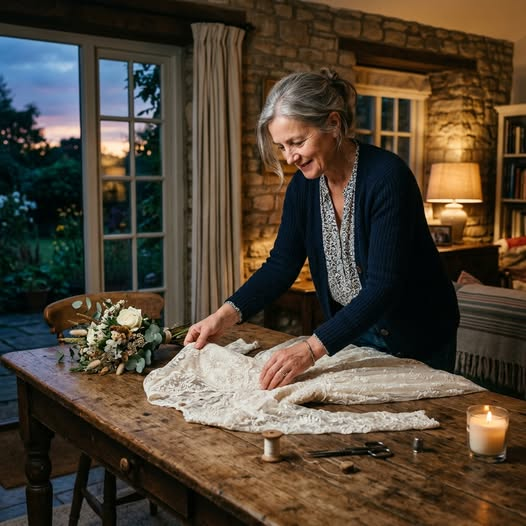
She took me to the bridal shop and helped me choose my wedding dress. She made the bouquet herself — flowers to match the dress, just right. She stayed up through the night sewing dresses for my sisters. She even made the veil — one I hoped would be worn only once, only on the most beautiful day of a life.
My birth mother could make nothing for my wedding, and could not come — and my heart ached for it. But my stepmother watched me that day with eyes full of a pride that belonged to no one else.
Only now does it break my heart to realize how much extraordinary love I received from this woman all those years, without ever truly knowing it.
I am a mother of three now, and I am grateful for everything she taught me, everything she gave me. Whatever goodness I have as a mother today is the fruit of her love and devotion across all those years.
Thank you, my dear mother.
— From your eldest daughter —
That single poem was, for Alice, a citation for her life — a public recognition of a life lived faithfully. I thought to myself: it could not have been easy — a city woman marrying a poor country farmer, stepping into the wreckage of his shattered life and piecing it back together, fragment by fragment. Like fitting together jagged shards of glass, navigating the dangers and wounds of human relationships at every turn, she had created something genuinely beautiful — a masterpiece of a life that only she could have made. Through the quiet strength and patience of her inner life, she had raised up and healed an entire family. No celebrated woman’s success story could match what lay hidden in that truth. Through one poem, I was reminded again of how rare and precious a thing it is — this human capacity for jeong, for love, rising up clear as a spring from the ground.
Without noticing when it happened, we had stopped being her guests. We had become family.
She set a beautiful dinner for us on the porch. Her youngest daughter, who lived nearby, came with the grandchildren to join us. The table held corn on the cob, potatoes, and steak, beautifully grilled over an open fire. We said grace, and then — as if they had been waiting for the invitation — the flies arrived, along with several homeless cats and the dogs, crowding around the table. But I no longer paid them any mind. At one point I noticed a hummingbird had appeared from nowhere and was circling just above our heads. Even Donald, whom Alice said rarely had much to say, joined in his wife’s happiness and laughed out loud again and again.
On the drive home, I finally understood why Alice had always described that modest, untidy, smell-soaked farm as a beautiful and happy place. It was because people who were truly human lived there — people who did not hold back their love for one another.
Dear listeners, even if we live in a palace, if there is no love between family members, no patience, no effort to understand one another — that place is the most wretched and impoverished spot on earth. But wherever we are — however humble, however lowly — if there is love between family members and a genuine desire to understand each other, that place is heaven. It is the wealthiest, most beautiful place on this earth.
This week, let us pick up the brush of love — thick and full — and continue painting our masterpiece of life.

 Daily Sauntering
You must be logged in to post a comment.