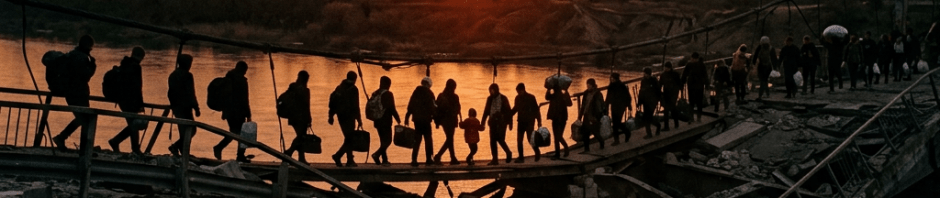
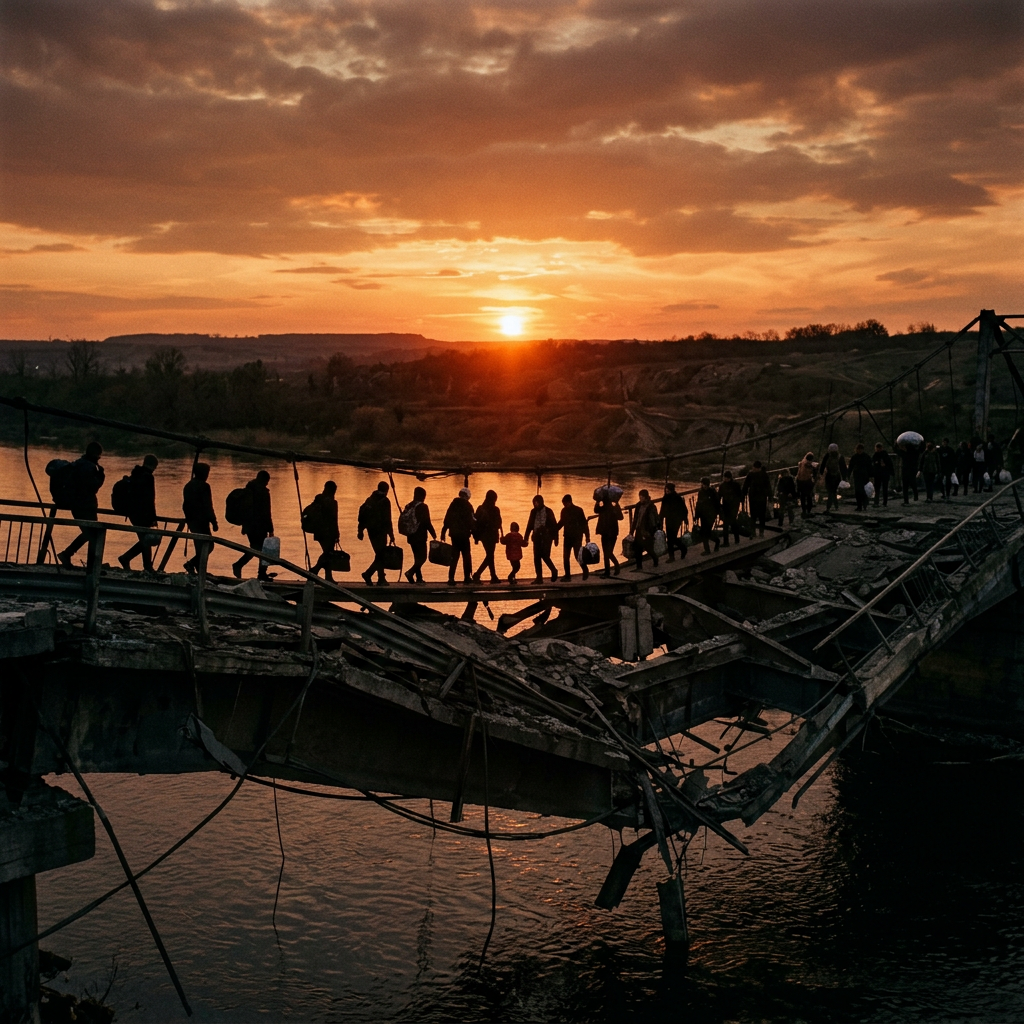
When June comes, our Korean people remember a tragedy of history we can never forget.
This year marks forty‑five years since the Korean War entered its armistice. I myself never lived through the war, so I do not claim the right to speak as one who personally experienced the suffering of our nation on June 25, 1950. Yet I hope we can take time together to search for God’s hidden purpose within the pain and disaster our ancestors endured, and to learn the lesson that such a tragedy must never again be repeated in our generation or in the generations to come.
In particular, I believe it is vitally important to teach our second‑generation children—who are growing up as American citizens—the historical meaning of the Korean War. Even though the first and second generations grew up in different environments, when we share a consciousness of history that connects our people and preserves our identity, the generational gap narrows. Our children will also discover their identity as Korean Americans living in this land.
And when people, having grown up with good education and comfortable surroundings, achieve a measure of success yet forget their roots and the suffering of their ancestors, they inevitably drift toward a life of indulgence. Teaching our second‑generation children—who have never shed tears over the preciousness of family, the dignity of human life, or even the value of a single grain of rice—the history of our people is to give them the ability to cherish their future happiness with greater care.
The scholar Beringheim once said, “Let us know history correctly. If we know history correctly, we need no separate education in ethics or morality.” Indeed, living with historical consciousness leads a person toward a deeper and more ultimate dimension of life.
“One, two, three, four—little captain marching out. One, two, three, four—matching steps together. Hey, Red, come on out! Kim Il‑sung, come on out! One, two, three, four—we are the national army!”
This was the song my eldest daughter—then only four years old—sang as her “introduction performance” before relatives when we first immigrated to America. My sister‑in‑law, who had already been in the U.S. for more than ten years, burst into laughter hearing her new little niece sing every word of this children’s marching song without a single mistake. “You really are a true daughter of Korea!” she said, stroking the child’s head.
That little girl has now grown into a twenty‑two‑year‑old young woman. She has nearly forgotten the words to “Little Captain.” Sometimes I sing it in front of her, hoping that somewhere inside her grown‑up heart, the fragrance of our people’s suffering will not be forgotten.
I sometimes talk to my children about Korean history and current events. When we discuss what we hear in the news, I often find myself sharing not stories that make us proud, but stories that are embarrassing or difficult to understand. The children ask, “Why does the president have to go to prison? How can regional hatred be so severe? Politicians live on the people’s taxes—how can they do such things? How can companies dump waste into rivers so carelessly?”
At such moments I sometimes regret bringing it up, but afterward I realize it was the right thing to do.
For although my children are being educated in America and growing up as citizens here, they may one day have an opportunity to understand their parents’ homeland more deeply or even serve the Korean people in some way. When that time comes, I do not want them to be shocked or disappointed. It is better to reveal our flaws early and begin from there.
General Douglas MacArthur entered the Korean War in July 1950 with the hope that American soldiers would be home by Christmas. But the Korean War left one million dead, two million wounded, 700,000 widows and orphans, and ten million separated family members. After all this pain, the war settled into a long armistice that has now lasted forty‑five years.
St. Augustine warned humanity’s repeating sins by saying, “Do not think of past events as things that happened only in the past—remember them in the present.”
We must express gratitude and respect to the generation of our fathers and mothers who climbed the most tragic heights of history. Young men of that time sometimes became North Korean soldiers aiming rifles at the South, and sometimes South Korean soldiers aiming rifles at the North. In mountain caves, in attic spaces, in pigsties—wherever they could cling to life—they endured hunger, cold, fear, and despair, barely surviving by sharpening every sense of their bodies.
Neighbors who once drew water from the same village well could be “Reds” by night and ordinary South Koreans by day. People lived suspended between life and death.
Millions of refugees who lost everything in an instant cried out countless times, “God, please just spare our lives!” and pushed through the roar of war to reach the present day.
Now the entire Korean people must work together for peace. I believe God scattered us across the world through immigration to give us and our descendants a vision for peace. It is similar to how, after the war of AD 70, the Jewish people were scattered across the world yet clung to God’s Word and eventually rose as leaders among the nations.
This dream of world peace cannot depend solely on certain politicians. Every field must participate—businesspeople, politicians, writers, musicians, artists, journalists, clergy, students, professors, homemakers, laborers, and medical workers.
I hope that Korean immigrant communities around the world, while recognizing their diversity, will unite in their longing for national reconciliation and reunification. May the eyes of grandfathers, fathers, sons, and grandsons all look together toward peace.
Professor Maeng Yong‑gil, quoting Karl von Clausewitz’s On War in his article “War on the Korean Peninsula and the Providence of God” (Ministry and Theology, June 1994, p. 94), wrote:
- War is aggressive.
- War aims at victory.
- War follows a teleological logic.
- War inevitably uses violence.
- War seeks to break the enemy’s spirit and drive them toward surrender.
Human history shows plainly how much fighting mankind has endured. Statistics say that over the past 5,600 years, an average of twenty‑six wars broke out every year. Dividing that period into 185 generations, only ten generations experienced sustained peace. Another statistic says that between 1945 and 1990, out of 2,340 weeks, only three weeks were free of war.
Historians say that Korea alone experienced about 930 wars during its 4,331‑year history (as of 1998)—a war every four to five years. And these were not wars we initiated, but invasions from outside powers. Even now we remain in an armistice, not true peace.
“My homeland, the Republic of Korea”—even speaking these words fills my heart with longing, and a mountain of yearning rises within me. The more difficult the homeland becomes, the more affection wells up, because it is the place where my life began. No one knows me better, and I know my homeland better than anyone else. It is a relationship that longs to embrace and weep together.
South Korea has endured the painful era of the IMF crisis. North Korea suffers famine so severe that children, reduced to skin and bone, lie motionless without even the strength to cry. In their faces, I see my own reflection more clearly.
About eight years ago, when visiting North Korea still raised suspicion of espionage, a pastor—now an American citizen—returned to his hometown of Pyongyang and met his older brother and relatives for the first time in forty years. He visited his father’s grave, weeping with a grief like a river.
He longed to know whether his father, an elder in the church, had remained faithful to Christ until the end. But under the oppressive ideology of the North, he could not ask his brother directly. So he asked instead about his father’s final years. His brother replied, “Whenever there was trouble or hardship in the family, Father would go out to the mountains or fields to meditate.”
The pastor understood what that meant. His father had clung to God without betraying Christ, surviving under communist oppression.
He also longed to know whether his brother’s family believed in Jesus, but the ever‑present government guide made it impossible to ask.
The next day, weakened by travel and food, the pastor lay down in a side room while the family ate. Suddenly the door opened quietly. His grand‑niece, a young woman with rough skin and a shy face, slipped in, knelt beside him, and whispered something into his ear.
It was a hymn—something he never imagined he would hear in that place:
“Jesus loves me, this I know, For the Bible tells me so. Little ones to Him belong, They are weak, but He is strong. Yes, Jesus loves me…”
Her hot tears fell onto his face as she sang. When she finished, she wiped her tears and fled the room.
The pastor rose, overwhelmed, and poured out a prayer of thanksgiving to God. The questions he had carried for decades were washed away like a stream after heavy rain.
When June comes, I remember the suffering of our people. The pain of separated families and the longing for peaceful reunification—our national hope—remain unresolved, left behind in the shadows of forty‑five years.
Dwight Moody once said, “Give your life to God. He can do more with it than you can.”
I am convinced that if all generations of believers dedicate their lives to this unfulfilled longing of our people and teach it to our descendants, the God who governs history will surely accomplish great things. Remembering the painful history of the past gives purpose to our present and guards our hearts from future complacency. It is, in a sense, a return to Eden.
— Yoon Wan‑Hee, June 24, 1998


You must be logged in to post a comment.