
| “THE TRANSFORMING PRAXIS TOWARD ECCLESIOGENESIS, Church Rebirth” (Chapter Three) |
A Theological Perspective on Transformative Praxis Toward Ecclesiogenesis
Today’s world is confronted with the problem of dehumanization within communities, stemming from prejudice, racism, and gender discrimination. Practicing transformation toward a humanized society is the vocation entrusted to baptized disciples of the Lord. Sanctification refers to the process by which those who have been justified (justification) move toward perfection. Thus, the transformative praxis of Christian sanctification implies that the church in society is always in the process of becoming a new and continually evolving community. Therefore, piety, the core of sanctification, is not merely a religious discipline. It is both the communal life of the “gathered church” and the embodied witness of the “scattered church” in society—living together and engaging in ongoing transformation. Within this, one may envision the expanded image of the heavenly household.
Racism is an intensified form of prejudice. Prejudice itself, a form of racism, literally means “pre-judgment.” Most prejudice does not stem from factual knowledge but is rooted in traditions, stereotypes, and myths far removed from truth. While a certain level of ethnic pride may foster positive development, it can also evolve into a sense of superiority over others. Opinions and assumptions—especially when based on superficial, second-hand, or inaccurate information—can give rise to prejudice. As such, most individuals harbor some degree of prejudice. The information we possess is often flawed or incomplete, and even when we receive accurate information, we tend to reinterpret it in ways that suit our preferences. Consequently, persistent racial prejudice may develop into racism, even if it contradicts factual reality.
Such racism cannot be eliminated through education or reason alone. Prejudice may be conscious or unconscious. However, racism is a deliberate attempt to justify one’s superiority by treating other races as inherently inferior. Racists often attribute superiority not to environmental factors but to inherited traits and genetics.
Ultimately, racism and sexism lead to human alienation and the dehumanization of community life. A society marked by alienation must recognize that interrelatedness offers the key to problem-solving. This raises several theological and ecclesial questions: What does it mean for a person to exist in interrelatedness? What form should an interrelated community such as the church take? How can consciously awakened individuals within the church practice transformation for the humanization of community? Finally, how can such ecclesial communities, as responsible and relational entities, engage in society?
This study pays particular attention to sexism and racism as two significant causes of dehumanization—issues that deeply affect the Korean immigrant community and intercultural families. Accordingly, this paper seeks to offer a theological understanding of ecclesial praxis in response to these two issues.
1. The Theology of the Correlated Self Toward God’s Community
The transformative praxis toward ecclesiogenesis refers to the church’s movement from being a societal entity to becoming a communal reality. By its nature, this process remains an eternal task. Theologizing such praxis is greatly aided by insights from process theology, which emphasizes relationality. In particular, this paper draws upon Marjorie Hewitt Suchocki’s God-Christ-Church 1 to explore relational theology.
In a correlated world, God is the power of love, trust, and hope. Dialogue is essential to community, and such dialogue depends on forms of thought that shape the “common sense” at any given moment. If theology is one way of articulating human existence in a world where God is present for us, then theology must emerge from this relational language.
Our inner being is understood through external realities: all relationships formed beyond oneself are necessarily connected through self-constructed meanings and understandings. External realities become internal through relationship. Just as environments shape persons, individuals also shape their environments. Ongoing history is shaped not only by the submissive events it records but also by the interpreters and agents who choose its direction. Identity, therefore, is more than what influences an individual—it is also that which flows outward and influences others. Thus, mutual relationality expresses our very being. Relationship pushes existence into being. Once existence emerges, it continually requires relationships to move forward. Relationships are both the beginning and the end of real entities. The power of God is found within the force that gathers many relationships into a single being and pushes them toward unified futures. The process of such synthesis brings forth new realities. These dynamic processes generate new relationships, new syntheses, and new entities. Relational reality is rarely exhausted by human existence. Process is not merely a human privilege—it is fundamental to all beings. Change permeates existence. Change is a function of relationship. If relationality is the key to transformation within human existence—and if humanity is not alien to the world or universe but part of its expanding dominion—then relationality must be the key to all transformation. Even the human body exemplifies this: all its cells change within seven years, revealing the continuous process of transformation embedded in the very fabric of our being.
Forms of Process
A new form of unity constitutes the present. Alfred North Whitehead described separate entities as “actual occasions.” 2 Here, “actual” refers to concrete, factual realities, and “occasions” refers to events or instances of becoming. The existing entity becomes an “actual occasion” both for itself and for the whole to which it belongs. This becoming process can be visualized through a series of complex patterns. [Diagram I] illustrates three simple “occasions.”
From the diagram, we can see that each “occasion of being” is a complex unity of multiple influences. Thus, the three occasions—A, B, and C—are formed through such integrative impacts.
Each “occasion of being” reflects some degree of coordinated influence within a final unified identity. Once each of these three active entities is completed, they each possess influence. That influence is integrally connected to the contents of the forming entity.

From Diagram II to Diagram IV: The Dynamics of Actual Occasions in Transformative Praxis
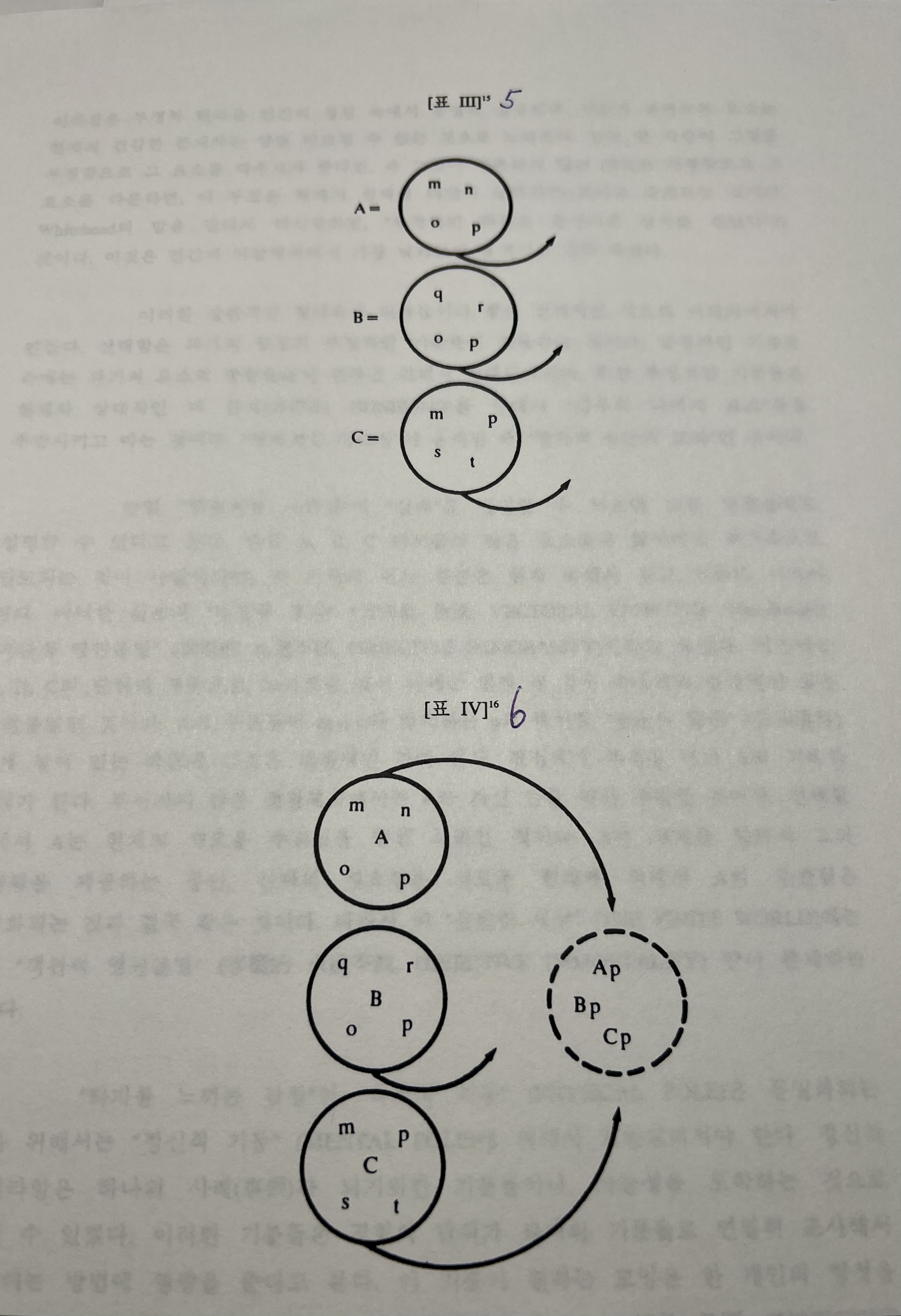
In Diagram II, unit A propels elements m, n, o, and p forward in a repeated movement toward unification for the fulfillment of its own actualization. Once A’s self-formation is completed, the creative activity transitions—illustrated in Diagram III—toward the formation of the Other, carrying a transformative effect.
Every unit of activity possesses a vectoral effect, an inherent directionality. This forward-pushing movement beyond itself is referred to as the superjective character of the subject of existence. As the arrow indicates in the diagrams, this effect is not merely attached to the unit but is embedded within its process of transmission. An actual occasion exists within itself but also simultaneously moves toward shaping the Other. Its subjectivity is offered outward toward the world.
What, then, are the dynamics that make up the becoming of such a unit?
Each preceding occasion is a unification of its own past. Thus, any forming actual occasion must integrate the totality of its own past. That is, it must unify prior occasions A, B, and C. As Diagram IV demonstrates, the convergence of A, B, and C marks the beginning of a new subject. The origin of a new actual occasion is grounded in the feeling of the totality of the past. The feeling of the Other constitutes each moment of formation. Alfred North Whitehead refers to this feeling of the Other as prehension—a concept he also calls the physical pole of experience. It is the incorporation of the Other into one’s own process of concrescence.
The new occasion thus begins with this physical pole—through the prehension of A, B, and C. In the end, unification refers to the harmony of many into one. Such harmony cannot occur apart from compatibility. Compatibility may be discerned through common elements shared among the individual occasions, or through the introduction of new elements that convey the harmony of the past. In any case, selection takes place. This selection is the innermost, creative process oriented toward the formation of the unit.
The interest of selection lies first in the simple form of the flux of the past. As depicted in Diagram III, the qualitative element p flows from the past and moves toward a higher dimension of compatibility. In this process, p is, in a sense, a reconciliation of past demands, and when the three units initiate repetition, p becomes an element of all three and is selected for reappearance in a new occasion. Thus, p serves as a means by which the demands of A, B, and C are harmonized.
Hence, the dynamism of relational existence always includes movement toward the new, which transcends the mere repetition of the past. The past cannot be simply reduplicated. This is evident not only in the situational limits placed upon repeated elements but also in the profound process of harmonization, which involves elimination of certain past parts. For instance, as unit A is repeated with qualitative p, what are the other qualities being negated?
This leads to Whitehead’s concept of negative prehensions, which are not without effect. As seen in Diagram IV, certain elements are absent from the final effect—these include losses in the surrounding environment and the death of prior units—thus allowing p to reappear independently of m, n, or o. In this sense, repetition involves both affirmation and negation, shaping each new occasion through a balance of inherited and excluded influences.
Negative Prehension, Subjective Aim, and the Rhythm of Relational Existence
Such negative prehensions are clearly illustrated within human experience. Elements from a person’s past are often felt as incompatible with one’s present, healthy state of being. When one chooses to negate such elements—by treating them as though they no longer exist—this negation can exert a powerful effect upon the individual’s current actuality. Borrowing Whitehead’s own words, we might say, “a negative prehension endures the wound of birth.” This becomes most vividly apparent in the human act of repression.
Prehensions, understood within this correlative framework, must be regarded as selective acts. The process of selection operates through both positive and negative feelings from the past. Within positive feelings, synthesized elements from past experiences are chosen for repetition. Meanwhile, negative feelings drive out the remaining elements of an occasion, pushing them toward a relative non-being. This process of exclusion is what Whitehead refers to as “perpetual disappearance,” which constitutes the tail end of relational existence’s ongoing motion.
If perpetual disappearance can explain actuality, it must also account for objective immortality. That is, if many elements of units A, B, and C are indeed drawn into a lost past, then it is also true that some portion of each unit continues to live in the present. Whitehead called this vectoral effect of existence—its inherent directional influence—objective immortality. What was once felt as part of unit A, B, or C is now transformed into a qualitatively new mode of real life, eternally enduring.
Because A’s subjectivity is placed within the shared presence of p, together with m-n-o, it becomes objectified. When the crystallization of experience is shattered, the sacred actuality of A is revealed. Prior to this dissolution, A remains subjective only to itself. However, in the act of selection, A becomes an object oriented toward the new subjectivity of the present. As A offers its subjectivity to the world, it is simultaneously being objectified by the new present’s necessity for selection. Therefore, within this finite world, only objective immortality truly exists.
The physical pole, as the feeling of the Other, must be complemented by the mental pole in order for unifying existence to occur. The mental pole can be understood as the feeling or apprehension of possibilities necessary for becoming an actual occasion. These feelings influence the process through which a unit of experience sifts and filters past emotions. The configuration of such feelings is aimed toward the formation of a particular individuality. Whitehead called this the subjective aim—a unifying, creative force oriented toward something specific. Through this aim toward self-becoming, each existential occasion moves toward its own actuality.
It is through the power of this subjective aim that the integrated past elements are gently retired to their respective places. Harmony is achieved through the fulfillment of this process. Whitehead referred to this culmination as satisfaction, the completion of a creative moment. At this stage, creative activity enters the universe once more as a propulsion of creativity. The many become one. But to become one, the many must have grown under the influence of that one. A new diversity emerges—an invitation to a creative unity toward a new one.
Thus, this cosmic dance continues, pulsating with a rhythm from many to one and from one to many again. Within this ongoing process, relational existence is continuously drawn into the act of becoming.
2. What Kind of Body of Christ Shall It Be?
J. Bernard defines community as:
“A social group comprised of individuals sharing homogeneity, residing in a natural, ecological, and geographically bounded and proximate area, sharing a historical heritage, possessing basic institutions of service, participating in a common way of life, and enjoying conditions that permit cooperative living and a consciousness of unity.”7
Crucial to this definition is the sense of communality—a collective identity or emotion. When members feel unity (“we”) and there exists mutual trust—both among individuals and between individuals and the community—it establishes harmony, stability, cooperation, and solidarity.8 Such communal solidarity was once taken for granted in traditional societies, where familiarity and mutual aid formed strong social bonds.
F. Tönnies explored how communities based on kinship and region (Gemeinschaft) depend on organic, interpersonal, informal relationships grounded in shared customs and beliefs. He contrasted this with modern societies (Gesellschaft), built on rational will and legal contracts, where relationships become impersonal and secondary, and institutions—rather than shared lineage or heritage—bond society.9 Émile Durkheim echoed this, contending that as societies transition from mechanical to organic solidarity, they lose cohesion, retaining only functional interdependence.10 R. Redfield and Howard Becker similarly argued that urbanization and modernization inevitably erode communal solidarity. In essence, these scholars understand the weakening or collapse of communal bonds as indicative of broader social transformation.
This shift—from communal solidarity to individualism and egoism in the absence of rational and institutional frameworks—produces anomie: a breakdown of social norms that destroys the practice of living-with others. It leads to political detachment, gender domination, racial injustice, religious animosity, and socioeconomic exploitation.
1) A Dialogical Community Is God’s Church
Humans cannot live apart from community; such communities sustain solidarity through shared experiences. This communication is vital for communal identity and humanization. In modern society, dialogue primarily occurs through educational and media systems, both closely tied to power structures.
Just as human essence is dialogical, so is religious faith. In Christianity, faith is viewed as God’s self-communication to humanity. In Exodus 3:7, God hears the suffering of the Hebrews under Egyptian oppression and speaks to them. This act of divine communication culminates in salvation—liberation from Egypt. Scripture is thus woven through as a dialogical relationship between God and the people.
This dialogical relationship establishes a covenant community in which God’s promises and the people’s faith are fully communicated and received. When communication breaks down or is distorted—i.e., when communion (koinonia) is violated—humanity becomes alienated from God. Restoration then requires sacrificial mediation, confession, and forgiveness.
2) God’s Dialogical Community
From Genesis onward, God’s rule is enacted through speech. He engages in personal dialogue with Adam and Eve, created in His image, thereby forming a dialogical community. In Eden, communion existed in abundance—between God and humans, among humans, and between humans and creation.
However, this harmony was fractured. The exile from Eden, conflict between Cain and Abel, and the generational ambition symbolized by Babel demonstrate how humanity’s rejection of communication led to estrangement and divine judgment. Yet, whether in judgment or redemption, God initiates dialogue—reaching out to Adam, Eve, Cain, and even the exiled community at Babel.
When the covenant community faltered, prophets were God’s communicative instruments to call the people back to justice. And when dialogue ceased entirely under oppressive structures, reconciliation was procured through sacrificial rituals. Through acts of judgment, forgiveness, and peace, God restored genuine “dialogue-community” between Himself and His people.
3) The Son’s Dialogical Community
The Incarnation of Jesus Christ is the most profound expression of God’s communication—His dialogue of love with humanity. “The Word became flesh and dwelt among us” (Jn 1:14). Jesus brings “good news to the poor, liberty to the captives…” (Lk 4:18–19). His life, cross, and resurrection embody divine justice shared with humanity and victory over death.
This message took shape in the early Christian community as koinonia, an experiential fellowship of solidarity and shared love. Conflicts, divisions, and alienation were overcome by perfected dialogue: even people from different languages and ethnicities were reconciled. This nascent community prefigured a multicultural reconciliation, distinctly countering the separatism of Babel. Under Roman oppression, this community proclaimed the Messiah’s coming kingdom—a message of hope born out of despair. Revelation 21:3–4 affirms this: God dwells with His people; pain, death, mourning, and suffering shall be no more.
Thus, Christianity is affirmed as a tradition grounded in dynamic, restorative dialogue: between God and human, human and human, reshaping society. Dialogue is not mere instrument, but identity.
4) The Spirit’s Dialogical Community
Experiencing the Holy Spirit empowers believers to perceive God’s love and will. The Spirit enacts communicative transformation within individuals and communities. At Pentecost, the Spirit enabled cross‑linguistic understanding (Acts 2). The Spirit continues to use believers to transmit God’s Word, ensuring the continuity of divine dialogue.
5) The Trinity as Dialogical Community
Christian theology affirms that the Triune God is inherently dialogical—Father, Son, and Spirit exist in mutual, eternal communion. God’s revelations to humanity generate the Church, which exists as a dialogical community. The Church is called to proclaim the Gospel—God’s liberating, reconciling, transformative message—and by doing so, participates in a divine dialogue that reshapes history, society, and individuals.
Early Christians enacted this through worship, Scripture, sacraments, and fellowship. They embodied communities without social distinction (rich or poor, slave or free, male or female, Jew or Gentile) as the tangible reality of God’s reconciling Word.
6) The Loss of Dialogue as Sin
When we discuss the loss of dialogue with God, we often focus primarily on the resulting immoral actions of human beings. Consequently, the suffering of victims tends to be overlooked. This suffering is deeply painful and, as expressed through the experiences of victims, often seems beyond the reach of any help. Professor Seung-Ho Park refers to this kind of suffering as Han (한, 恨). He defines Han 11 as a severe wound of the spirit caused by socio-political, economic, and cultural oppression, compounded by unjust psychological and physical depression. Han dwells within the wounded hearts of victims of sin and violence, hiding like a trench in their souls. It manifests in various emotional responses such as sorrow, helplessness, despair, resentment, hatred, and the desire for revenge. Victims of events like the Holocaust, the occupation of Palestine, racial discrimination, domestic abuse, divorce, child sexual abuse, job loss, and the exploitation of migrant laborers reflect the twisted and refracted presence of Han in their inner lives.
From a Hellenistic perspective, the loss of dialogue is approached more openly than in Latin doctrinal thought. The significant contribution of the Eastern Church Fathers prior to Augustine lies in their rejection of the doctrine of original sin. While they acknowledged the widespread corruption that leads to death, they did not equate this with sin. In their view, such corruption did not necessarily draw human nature into guilt. So long as humanity remained physically connected to Adam, they maintained belief in the freedom of the will and the voluntariness of human actions. In contrast, the Western Church adopted a different view. The concept of human fallenness and guilt continued through Tertullian and eventually culminated in Augustine’s doctrine of original sin. Augustine saw pride and worldly desire as the roots of original sin. Later, Scholasticism, along with Reformers such as Luther and Calvin, emphasized human autonomy and brought a counterbalance to Augustine’s rigid and pessimistic theology. Yet, the Stoics adopted a pessimistic stance toward human nature.
Sin as Alienation
From a modern perspective, Hegel’s absolute idealism understood sin as alienation. He interpreted alienation as a necessary stage in the unfolding of divine glory, thus linking sin, salvation, alienation, reconciliation, and unity in a more optimistic trajectory that challenged the pessimism of the Reformation. In contrast, Schleiermacher approached God and sin with intuitive rather than rational reasoning. His romantic concept of sin as world-consciousness attempted to transcend the rational contradictions of idealism. However, this weakened the concept of sin by interpreting it as a mere shortcoming on the path toward perfection. Kierkegaard harshly criticized this Hegelian approach, arguing that the dialectical process between God and sin should instead be characterized by existential discontinuity. For Kierkegaard, sin was a leap into existential absurdity—irrational, illogical, and foolish. Meanwhile, Rauschenbusch, a leader in the Social Gospel movement, moved beyond individualistic interpretations and viewed sin as social disorder rooted in collective selfishness.
Recent theological trends show a growing effort to overcome unilateral understandings of sin. Feminist and liberation theologians challenge traditional, male-dominated, and individualistic conceptions of sin.
Valerie Saiving, for example, critiqued Reinhold Niebuhr’s concept of sin 12 as male-centered. 13 According to her, pride is a male sin, whereas women struggle with other issues: triviality, passivity, distractibility, lack of central focus, and dependency on others for self-definition. While women may also commit sins, Saiving argues that they more often suffer from low self-esteem, lack of assertiveness, and a deficient sense of agency.
In a similar spirit, Latin American liberation theologian Gustavo Gutiérrez challenges the individualistic interpretations of sin prevalent in Western theology. 14 He identifies three dimensions of sin:
- Sin as socio-economic and political oppression, especially the exploitation of the poor.
- Sin as historical determinism, denying the oppressed any agency over their destinies.
- Sin as the destruction of communion with God and neighbor—a spiritual dimension of sin.
Because these aspects are interrelated, Gutiérrez argues that sin cannot be understood solely as an individual act before God. He calls for unmasking such theological reductionism.
In contrast, Professor Park rejects Saiving’s understanding of triviality and low self-esteem as sin. For Park, sin requires volition, and what Saiving attributes to women are not sins but expressions of Han.15 Sin, in his view, is the oppressive act of the sinner, while Han represents the suffering of the victim. Thus, labeling women’s traits such as distractibility or lack of central focus as sin is a misnomer. These are, rather, manifestations of Han. Such analysis demonstrates that a proper distinction between sin and Han is essential for the healing of the world.
Park also critiques Gutiérrez’s conflation of the victim’s Han with the oppressor’s sin.16 Although Gutiérrez rightly highlights socio-political oppression and historical determinism, Park argues these conditions are not sins but expressions of the victims’ Han. The lack of precise terminology leads Gutiérrez to blur the distinction between the oppressed suffering (Han) and the oppressor’s sin (the destruction of communion), resulting in theological confusion.
Park also emphasizes that Han cannot be fully understood using data merely collected from psychology, sociology, philosophy, economics, or physics. The suffering of humanity and creation is not merely psychological, sociological, political, or economic—it must be approached holistically. Healing the world’s wounds requires interdisciplinary collaboration. Without clear distinctions, we cannot foster personal awareness or transform dehumanized societies into generative communities. Misidentifying Han as sin places the burden of repentance on the victim rather than on the oppressor. 17
Historically, the Church has developed robust doctrines of sin, but has largely neglected the victims of sin. Park denounces this as un-Christian. To proclaim the good news to the poor and the oppressed, theology must develop frameworks that simultaneously engage both sinners and victims. The concept of Han is essential in developing such a dual perspective. This requires a theological reformation of our understanding of repentance, humanization, and salvation. Repentance must include forgiveness for the oppressed. Justification, traditionally applied to the oppressor, must be complemented by a doctrine of justice for the oppressed. Similarly, the doctrine of salvation for sinners must be completed with a doctrine of Han resolved for the victims of sin.
We must not forget that sin and Han are intertwined realities. While sin and guilt belong to the oppressor, Han and shame belong to the oppressed—but these states can overlap within a single individual. The oppressed can become oppressors, and vice versa. A person may at times commit sin and at other times experience Han. For instance, a victim of racism may also perpetuate sexism. This complexity, however, must not dilute the critical distinctions between sin and Han, nor between oppressors and the oppressed.
7) Jesus Christ as a New Form of Dialogue—and Dialogue Itself
Paul Knitter, in No Other Name?, argues that dialogue precedes human knowledge. 18 Based on this, we can affirm that Jesus Christ precedes knowledge itself—because he is the very substance of dialogue between God and humanity. He also embodies the true form and content of dialogue between humans. Thus, the generative community (saengseong gongdongche) becomes possible only in Christ. The faithful must continually practice transformation toward this Christ-centered community as a response to dehumanized societies.
A true community must include four essential elements:
- A shared value system;
- A common direction based on those values—namely, a collective goal;
- A shared way of life among its members;
- A common language—namely, a communal confession of faith.
Christianity places great emphasis on community because God is concerned with the salvation of all humanity, which is impossible without the salvation of the human community as a whole. Moreover, God works through small, chosen communities to achieve this salvation. The Church understands itself as such a chosen community.
The challenge is that the contemporary human community shows signs of disintegration. Charles Reich, in The Greening of America, described American society using seven characteristics: (1) confusion, corruption, hypocrisy, and war; (2) poverty, misplaced priorities, and elitist legislation; (3) uncontrollable technological civilization and environmental degradation; (4) the erosion of democracy and nature, and the disempowerment of the masses; (5) the meaninglessness of work and culture; (6) the absence of community; and (7) loss of self. This crisis is not limited to America; it resonates globally. Our age is marked by value conflicts, disoriented direction, broken communication, and cultural upheaval. Revolutions of the colonized, the masses, gender, students, education, and religion indicate a global crisis of community. Reich’s identification of the “absence of community” is therefore apt. Likewise, the Church—embedded within human society—may also have lost its communal essence, perhaps without even realizing it.
3. How Shall We Live Within the Body of Christ?
1) The New Community as a Becoming Community
Humanity can no longer avoid seeking a new kind of community. A completely different kind of community is needed—one with new values, new ways of orientation, new lifestyles, and even a new language. In this new community, the focus of value is not on material goods but on people. The goal is not possession but righteous living. Life is no longer about competition but about co-creation. Rather than simply breaking away from the old, could it be that hope for the new begins to sprout from within the old?
Today, almost all religions and ideologies are moving toward a humanistic direction. Christianity is being liberated from the concept of an absolute “Other,” and Marxism is moving away from dogmatic state communism. Women are fiercely challenging oppressive traditions in their struggle for full humanity. Around the globe, new experimental communities are springing up. From Israel’s kibbutzim to a wide variety of intentional communities, different models are being explored. Some are strongly religious in nature, while others are purely humanistic. Though their specific characteristics and lifestyles vary widely, what they all share in common is a negation of the industrial society that has reached a dead end. This rejection applies not only to capitalist societies but also to socialist ones, as both are overly fixated on industrialization.
When we examine various forms of communities, while their external appearances differ, they share a common spiritual foundation. This is because they all resist the current systems and cultures. The “becoming community” discussed in this paper is not a withdrawal from society or the church, but rather an attempt to form a new kind of community within them.
Moon Doo-Hwan compares the important characteristics of such communities as follows 19:
- The past community cherished tradition and looked to the past; the new community is future-oriented and hopeful.
- While the former focused on material ownership, the new community values spiritual aspects—people, life, and existence itself.
- The old community was bureaucratic, creating insurmountable gaps between rulers and the ruled; the new one stands on equality and freedom.
- The old life centered on the self; the new community values the collective “we.”
- The old community operated on competition; the new one is based on cooperation.
- The former was based on ethnic nations; the new community sees all humanity as its unit of concern.
- In the past, the driving force was profit; in the new community, it is creativity.
- Comfort was the goal of life in the old; the new seeks the joy of creation.
- In the old, people were expected to conform and accept; in the new, people are called to active engagement and the celebration of life.
These nine characteristics, according to Moon, must be the essential elements possessed by a becoming community. To develop this, four formative stages of transforming praxis are needed:
- One begins to notice and resist the wrongs within their existing community. This stage is a personal awakening or consciousness-raising.
- As one becomes more aware, they recognize broader societal injustices and gain the courage to confront them. At this stage, individuals no longer act alone—they form a small becoming community with other awakened individuals, together resisting dehumanizing structures.
- While resisting, one encounters like-minded individuals and begins to taste the experience of a new community. Here, through transforming practices, members experience dynamic growth in life, witness the emergence of new people, and begin planting seeds of transformation in old communities.
- Eventually, in the attempt to confront large institutional structures, one realizes the limits of change within them and begins to seek fundamentally new values and forms of community. This is not a stage of despair but the core of transforming praxis. One denies what must be denied in the old, seeks the new, and through experimentation and honest evaluation, begins to create the new. This whole process must be grounded in dialogue. True dialogue always presupposes equality.
2) The Life Community as a Community of Dialogue and Reconciliation
The realization of dialogue and new human community is only possible when vertical oppression—whether by the oppressors or the oppressed—is dismantled. Relationships of male and female, rich and poor, superiority and inferiority, clergy and laity, sexism, classism, racism, and clericalism—all of these structures are evil and sinful in essence, for they are deeply oppressive.
When the oppressed begin to develop power to overcome both their internalized oppression (identity and awareness) and horizontal oppression (trust issues), they will also begin to transform the vertical structures of both society and church (leadership issues) 20.
A new form of human life emerges when both oppressors and oppressed are liberated from the dehumanizing and prejudiced systems that entrap them.
Thus, a theology for the life community must concern itself not only with social, political, and economic barriers, but also with God’s ultimate purpose: the reconciliation of all people in mutual equality.
Our goals, then, are as follows:
- That women become advocates for their own liberation.
- That men assist women in becoming such advocates.
- That both men and women enter into spaces of genuine dialogue and continue the transforming praxis of building new communities through equal conversation.
Eventually, this process will lead to a world in which feminism—whether by men or women—is no longer necessary.
The church, as one of the last remaining institutions within society, is called to be a becoming community that hears and faithfully responds to the gospel mandate for the new age: “to bring good news to the poor… to proclaim release to the captives… to let the oppressed go free” (Luke 4:18).
But even now, we must confess: the transformation of the church for the sake of the world can only be realized through new communities composed of newly awakened individuals.
4. Generative Praxis
Our primary concern lies in overcoming the gender discrimination embedded in Korean American history, thereby cultivating an egalitarian society as a generative community in pursuit of authentic humanization. In doing so, we also aim to challenge the dehumanizing elements within Korean American society—specifically, the misperceptions toward intercultural families and the development of self-awareness among women in such households. Our goal is to foster a generative community through the process of humanization. This endeavor, we believe, represents God’s creative activity in the present Korean immigrant history.
Authentic Christian mission must address the dehumanized aspects of society and move toward the expansion of God’s reign—a society governed by God’s justice and love—by transforming individual consciousness and humanizing social structures. This creative praxis should become the core of the Church’s missional vocation today.
1) Gender Discrimination
All human beings are created by God and formed in God’s image and likeness. God has bestowed dignity and value upon every person—men, women, and children—and desires that we respect and care for one another with attentiveness and mutual reverence. Our bodies and sexuality are sacred gifts from God. Therefore, sexual relations—when practiced responsibly and faithfully—should be grounded in mutual consent and agreement, becoming a natural expression of intimate relationship. Conversely, sexual misconduct, harassment, or abuse not only degrades human worth but also disrupts well-being, communal order, interpersonal relationships, and the purity of the body of Christ.
The Church is called to be a single body composed of members whose lives hold purpose and meaning. When any part of the body is wounded—physically, emotionally, or spiritually—the entire body suffers. The dignity and honor of the whole community are tarnished. All persons, including both perpetrators and victims of sexual abuse, are profoundly impacted. Ministering to those who suffer from sexual violence bears witness to the healing power of the Christian community.
To those who have experienced sexual abuse, God in Christ proclaims the wholeness of life. When the Church pursues justice, God grants the power of healing and enables the powerless and oppressed to accuse their oppressors.
To those who have perpetrated sexual abuse—many of whom are themselves past victims—God offers forgiveness in Christ upon sincere repentance and contrition. Through repentance and a renewed covenantal relationship with God, true transformation becomes possible.
The restoration of broken trust and the journey toward forgiveness is not a matter of swift or superficial psychological repair. Even if forgiveness and reconciliation may not lead to full reinstatement in public ministry, we must hold firm to the goal that even the gravest sinners are capable of communion with God and restoration into fellowship with the Church.
As the body of Christ, the Church is entrusted with the sacred task of naming and challenging abuse and harm, advocating for the oppressed, and reconciling the broken body of Christ (cf. Matthew 18:15–18; 2 Corinthians 5:18–20).
From a biblical perspective, God’s design for human community is one of balanced power and interdependence. As Galatians 3:28 declares, “There is neither Jew nor Greek, slave nor free, male nor female, for you are all one in Christ Jesus.” No individual—regardless of gender—should wield oppressive power over another. Yet, throughout history, the rupture of human dignity has often privileged men over women and adults over children. Male misconduct has frequently been ignored or denied, dishonoring the Church’s holy calling. The generative community has been threatened, even fractured. We cannot turn a blind eye to powers that bring death to the community of life.
Violations of women’s human rights and systemic gender discrimination are calls to repentance in our time. All people—regardless of social status or power—must be able to experience justice and mercy. This is the blessed hope for the Church in covenant with the God who makes all things new, who is righteous and merciful.
Thus, biological differences between men and women must not be interpreted or treated as signs of male superiority. The order of creation makes this abundantly clear.
The Essence and Meaning of Sexuality 20:
- Sexuality is a good and purposeful creation of God.
- It enables the union between male and female.
- It forms human community through mutual respect and cooperation toward wholeness.
- It can only achieve harmony when practiced equitably.
- It must not be reduced to a tool of pleasure or mere expression.
- It must not be used as a power tool in hierarchical relationships of domination and subjugation.
- It must reflect the unity and reconciliation necessary for building God’s generative community.
The Bible sternly condemns discrimination that stems from disregard for human dignity and equality, rooted in biological or social differences between men and women.
2) Stages of Racial Reconciliation through Intercultural Families
The contemporary Church can progress toward racial reconciliation through five key stages. But who bears primary responsibility? Prejudice is not the exclusive domain of white churches. All churches today—regardless of race or cultural background—must recognize their own complicity in the sin of racial discrimination and narrow-mindedness.
(1) Repentance
Because racism is sin and deeply embedded in self-defensive rationalizations, repentance must be the first step. White Christians must repent of the historical sins rooted in slavery—beginning in 1619 when Dutch ships first brought 20 enslaved Africans to colonial Virginia, initiating the transatlantic slave trade. This occurred one year before the Mayflower arrived in Massachusetts. By the end of the 17th century, over 100 European ships had transported more than 50,000 Africans to America as property. Such historical atrocities demand repentance. Apathy and pride are as grievous as injustice itself. And the object of our repentance matters. Judas Iscariot (Matthew 27:3–4) is a cautionary example of misplaced repentance. True repentance requires not only confession before God but also restorative action toward those who have been oppressed and discriminated against.
(2) Reconciliation
The Church must determine how and to whom it will confess. Reconciliation, when effectively practiced, will transcend individual congregations and denominations. But the most impactful reconciliation begins within the local church.
The goals of reconciliation cannot be achieved through declarations or publicity alone; they must begin with dialogue. Participation must extend beyond clergy to all levels of church membership. Prayer gatherings focused on mutual repentance, forgiveness, and cultural understanding are vital to bringing previously divided groups together. Creating opportunities for mutual learning and exchange reflects the Great Commission.
According to Christianity Today, when asked, “What is the first step to improving racial relationships?” the most common response was, “Let’s get to know each other.” 21 While reconciliation may be easier in some regions than others, it always requires intentional steps: admitting sin, seeking forgiveness, and committing to a shared process.
(3) Recognition
Repentance and reconciliation must be accompanied by action. Charles H. King, founder of the Urban Crisis Center in Atlanta, stated that while many Christians advocate for love in their families, when it comes to racial injustice, love too often remains a mere philosophical idea or pious sentiment. 22
In multicultural and interracial ministries, two critical steps are necessary. First, mutual legitimacy must be recognized. If different facilities, leadership training methods, or worship styles are judged as inferior, then the foundation for racial harmony is undermined. Second, after acknowledging the legitimacy of others, churches must engage in learning from one another and celebrate their unique cultural contributions.
Recognition must be followed by reciprocity.
(4) Reciprocity
True racial harmony is built upon reciprocal relationships. Growth in effective relationships is rooted in mutual giving and receiving. As unity deepens, dominant cultural or racial groups must listen to and accommodate minority perspectives and concerns. For example, white individuals do not need leadership in order to remain white. Likewise, Korean Americans need not assert leadership to stand over other minorities. Racial reconciliation is not achieved through hierarchical dominance but through equal partnership and mutual respect.
Joint worship services, resource-sharing (such as food or clothing banks), workshops, and youth programs are all viable forms of reciprocal collaboration.
(5) Shared Resources
Before implementing any joint programs between churches, it is essential to critically assess the efforts each church has undertaken within their respective communities to resist racial discrimination and systemic injustice. Equally important is the formation and expansion of collaborative networks that bring together local churches and community organizations. Such coalitions are vital for fostering broader, sustainable impact.
One of the most pressing challenges faced by minority churches is the lack of adequate resources—both human and financial. There is a notable scarcity of scholarships to support children and youth participation in retreats and spiritual development programs. Moreover, funding for teacher training and theological education remains critically insufficient. Addressing these shortages is indispensable for empowering marginalized congregations.
However, we must not assume that these efforts alone will bring an end to racism. The eradication of racial injustice requires sustained mutual interdependence. Only through reciprocal partnerships can we move toward the formation of egalitarian communities. Within this vision, the distinct cultural heritage of minority communities emerges not as a barrier but as a valuable contribution. When these cultural resources are exchanged in creative collaboration, churches can cultivate a deeper sense of communion. This mutual enrichment not only enhances fellowship but also becomes a generative space for transformative praxis.
For instance, engaging in shared artistic endeavors—such as performing arts, traditional music, visual arts, and cultural storytelling—within the church context can serve as a vital platform for both education and expression. Through such creative exchanges, the church may embody the true essence of a generative community, one that is dynamic, inclusive, and transformational.
Dialogue with God naturally extends into dialogue with one’s neighbors. In such relationships of mutual respect and equality, new forms of community are born. This kind of training—of forming just and life-giving human relationships—is at the heart of Christian discipleship. Indeed, this represents the authentic, ongoing creative activity of God throughout history.
Notes
- Suchocki, Marjorie Hewitt. God Christ Church: A Practical Guide to Process Theology. New York: Crossroad, 1982.
- Whitehead, Alfred North. Process and Reality. New York: Free Press, 1978.
- Ibid., p. 13.
- Ibid., p. 14.
- Ibid., p. 15.
- Ibid., p. 17.
- Bernard, J. The Sociology of Community. Glenview: Scott, Foresman and Co., 1973.
- MacIver, R.M. Community. London: Routledge and Kegan Paul, 1951, p. 5.
- Tönnies, Ferdinand. Community and Society, translated by C.P. Loomis. New York: Harper & Row, 1957.
- Durkheim, Emile. The Division of Labor in Society, translated by G. Simpson. Chicago: Free Press, 1933.
- Park, Andrew Sung. The Wounded Heart of God: The Asian Concept of Han and the Christian Doctrine of Sin. Nashville: Abingdon Press, 1993, p. 10.
- According to Reinhold Niebuhr, human beings, in a state of fear, exhibit two possible reactions: first, denying their finiteness; and second, surrendering their freedom in an attempt to escape the uncertainty of fear. The former is seen as a fundamental sin—pride—because it pushes the self beyond its limits, denying human finitude. The latter is termed the sin of sensuality, as it relinquishes freedom in pursuit of physical pleasure. Both sins, Niebuhr argues, are inevitable for humanity and require no conscious intention to commit. Within the broader history of Christian thought, one clear point emerges: the doctrine of sin and salvation has been focused primarily on the moral function of the sinner and one’s standing before God. As a result, the roles and sufferings of the victims of sin have received little theological attention within the narrative of salvation history.
- Saiving, Valerie. “The Human Situation.” In Womanspirit Rising, edited by Carol Christ and Judith Plaskow. New York: Harper & Row, 1979, p. 37.
- Gutiérrez, Gustavo. A Theology of Liberation, translated and edited by Sister Caridad Inda and John Eagleson. New York: Orbis, 1973, pp. 25–37.
- Park, Andrew. Ibid., p. 13.
- Park, Andrew. Ibid., p. 13.
- Knitter, Paul F. No Other Name? A Critical Survey of Christian Attitudes Toward the World Religions. New York: Orbis Books, 1986, p. 205.
- Moon, Dong-hwan. “The Future of the Korean Community and the Church.” Christian Thought (Seoul: Korean Christian Literature Society), January 1984, pp. 74–75.
- Cone, James. “Black Theology and Reconciliation.” Christianity and Crisis, January 22, 1973, p. 307; see also William Jones, “Toward an Interim Assessment of Black Theology,” Reflection (Yale Divinity School), January 1972.
- Kim, I-Bong. Feminist Theology. Seoul: Yangseogak Publishing, 1985, p. 72.
- Frame. “Race and the Church: A Progress Report,” pp. 16–17.
- “White People Must Change – An Interview with Charles King.” Sojourners, May 1981, p. 21.

 Daily Sauntering
You must be logged in to post a comment.